
《DSP using MATLAB》Problem 5.24-5.25-5.26

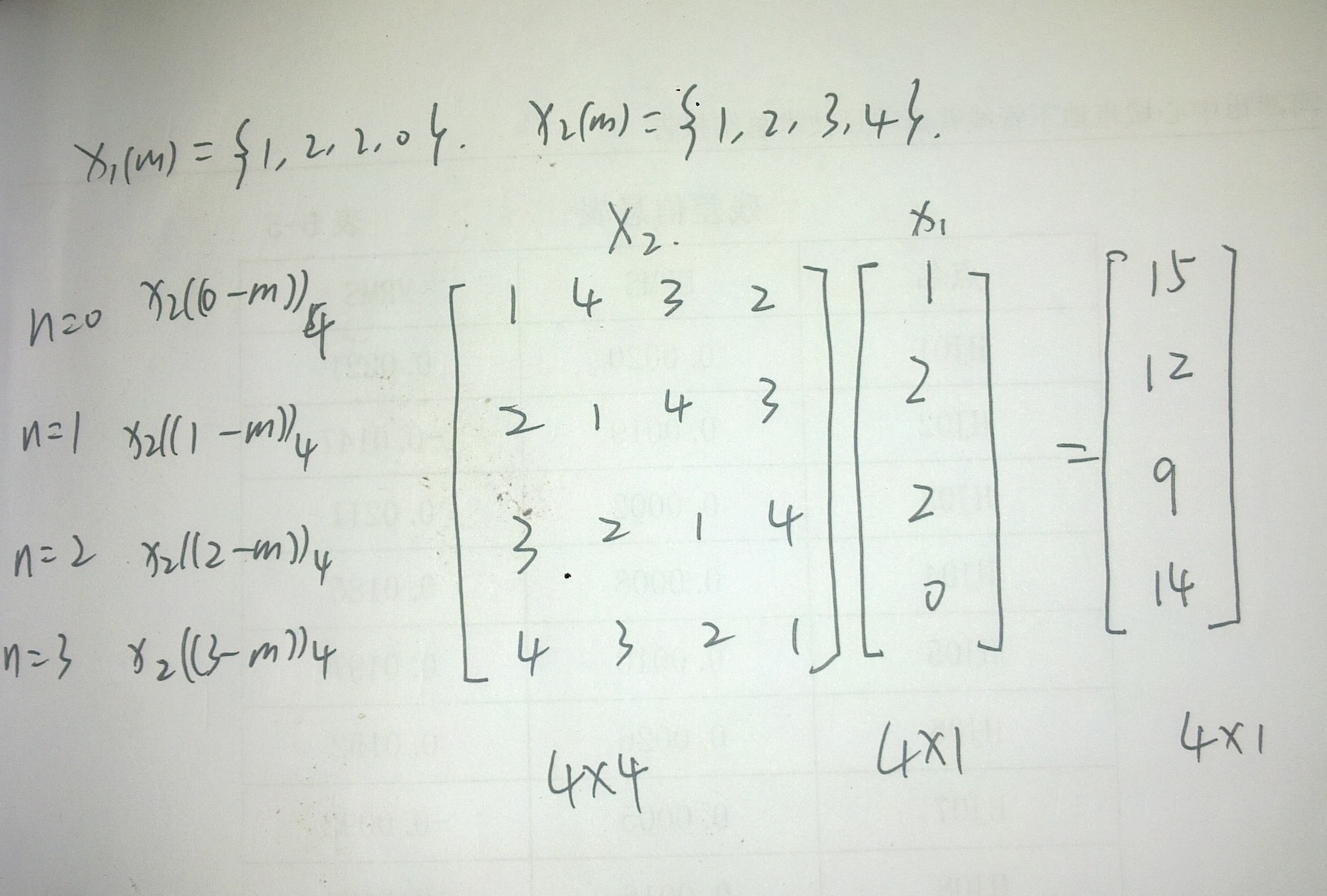
代码:
function y = circonvt(x1,x2,N)

	%% N-point Circular convolution between x1 and x2: (time domain)

	%% ------------------------------------------------------------------

	%% [y] = circonvt(x1,x2,N)

	%% y  = output sequence containning the circular convolution

	%% x1 = input sequence of length N1 <= N

	%% x2 = input sequence of length N2 <= N

	%%

	%% N = size of circular buffer

	%% Method: y(n) = sum( x1(m)*x2((n-m) mod N) )

	%% Check for length of x1

	if length(x1) > N

		error('N must be >= the length of x1 !')

	end

	%% Check for length of x2

	if length(x2) > N

		error('N must be >= the length of x2 !')

	end

	x1 = [x1 zeros(1,N-length(x1))];

	x2 = [x2 zeros(1,N-length(x2))];

	m = [0:1:N-1]; x2 = x2(mod_1(-m, N)+1); H = zeros(N,N);

	for n = 1:1:N

		H(n,:) = cirshftt(x2,n-1,N);

	end

	y = x1*conj(H');         % x1---row vector

%    H

%    y = H*x1';               % x1---column vector
主程序:
%% +++++++++++++++++++++++++++++++++++++++++++++++++++++++++++++++++++++++++++++++++++++

%%            Output Info about this m-file

fprintf('\n***********************************************************\n');

fprintf('        <DSP using MATLAB> Problem 5.24 \n\n');

banner();

%% +++++++++++++++++++++++++++++++++++++++++++++++++++++++++++++++++++++++++++++++++++++

% -------------------------------------------------------------------

%

% -------------------------------------------------------------------

N = 4;

n1 = [0:3];

x1 = [1, 2, 2];

x2 = [1, 2, 3, 4];

y1 = circonvt(x1, x2, N)
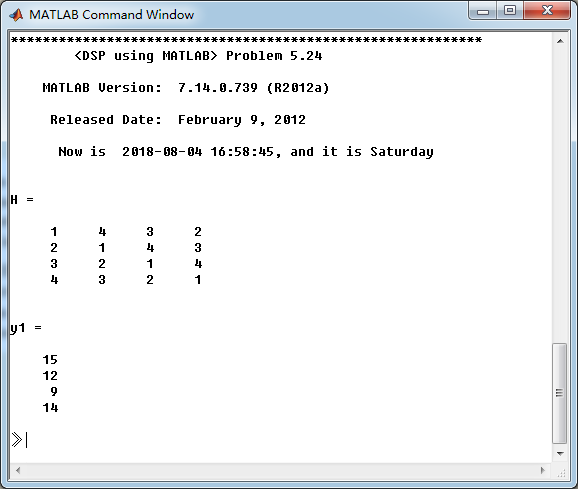
运行结果:
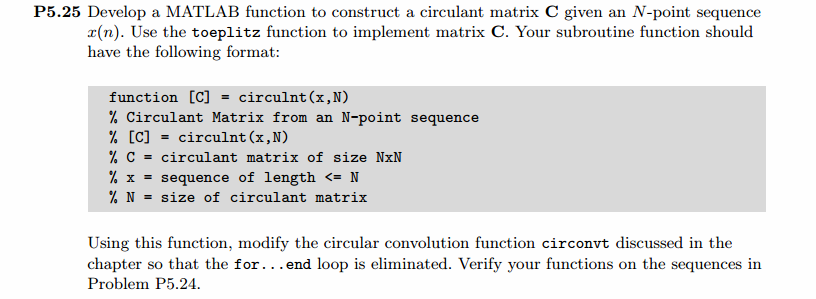
代码:
function [C] = circulnt(x, N)

	%%  Circulant Matrix from an N-point sequence

	%% ------------------------------------------------------------------

	%% [C] = circulnt(x, N)

	%%  C  = Circulant Matrix of size NxN

	%%  x  = sequence of length <= N

	%%

	%%  N  = size of circulant matrix

	if length(x) > N

		error('N must be >= the length of x !')

	end

	x = [x zeros(1, N-length(x))];

    for i = 1 : N

	    c(i) = x(i);

    end

    m = [0:1:N-1]; x_fold = x(mod_1(-m, N)+1);

    r = x_fold;

    C = toeplitz(c,r);
function y = circonvt_v3(x1,x2,N)

	%% N-point Circular convolution between x1 and x2: (time domain)

	%% ------------------------------------------------------------------

	%% [y] = circonvt(x1,x2,N)

	%% y  = output sequence containning the circular convolution

	%% x1 = input sequence of length N1 <= N

	%% x2 = input sequence of length N2 <= N

	%%

	%% N = size of circular buffer

	%% Method: y(n) = sum( x1(m)*x2((n-m) mod N) )

	%% Check for length of x1

	if length(x1) > N

		error('N must be >= the length of x1 !')

	end

	%% Check for length of x2

	if length(x2) > N

		error('N must be >= the length of x2 !')

	end

	x1 = [x1 zeros(1,N-length(x1))];

	x2 = [x2 zeros(1,N-length(x2))];

	C = circulnt(x2, N);

%	m = [0:1:N-1]; x2 = x2(mod_1(-m, N)+1); H = zeros(N,N);

%	for n = 1:1:N

%		H(n,:) = cirshftt(x2,n-1,N);

%	end

%	y = x1*conj(H');         % x1---row vector

    y = C*x1';               % x1---column vector
%% +++++++++++++++++++++++++++++++++++++++++++++++++++++++++++++++++++++++++++++++++++++

%%            Output Info about this m-file

fprintf('\n***********************************************************\n');

fprintf('        <DSP using MATLAB> Problem 5.25 \n\n');

banner();

%% +++++++++++++++++++++++++++++++++++++++++++++++++++++++++++++++++++++++++++++++++++++

% -------------------------------------------------------------------

%

% -------------------------------------------------------------------

N = 4;

n1 = [0:3];

x1 = [1, 2, 2];

x2 = [1, 2, 3, 4];

%C = circulnt(x2, 4);

y1 = circonvt_v3(x1, x2, N)
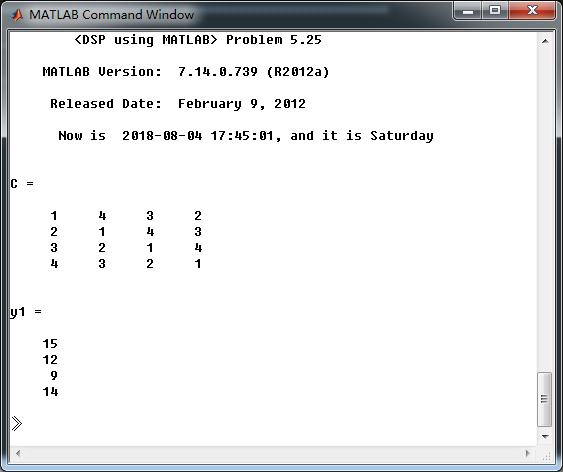
运行结果:
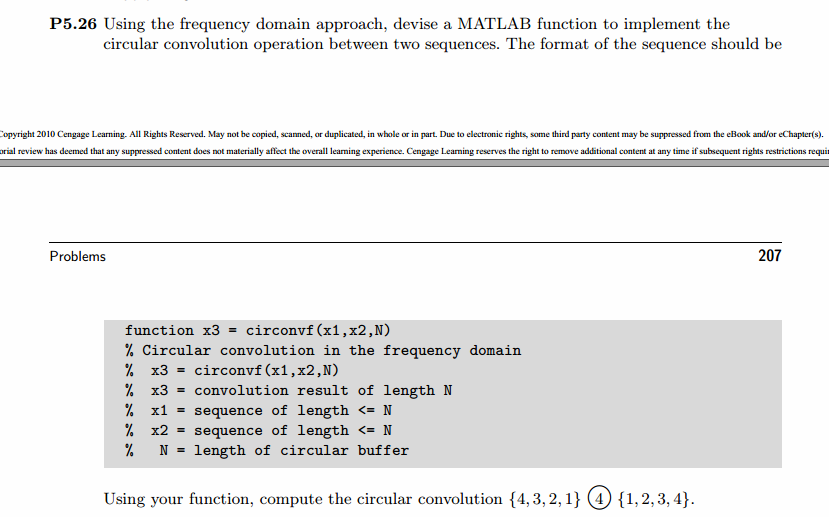
代码:
function x3 = circonvf(x1, x2, N)

	%% N-point Circular convolution between x1 and x2: (frequency domain)

	%% ------------------------------------------------------------------

	%% [x3] = circonvf(x1,x2,N)

	%% x3 = output sequence containning the circular convolution

	%% x1 = input sequence of length N1 <= N

	%% x2 = input sequence of length N2 <= N

	%%

	%% N = size of circular buffer

	%% Method: x3(n) = IDFT[X1(k)X2(k)]

	%% Check for length of x1

	if length(x1) > N

		error('N must be >= the length of x1 !')

	end

	%% Check for length of x2

	if length(x2) > N

		error('N must be >= the length of x2 !')

	end

	x1 = [x1 zeros(1,N-length(x1))];

	x2 = [x2 zeros(1,N-length(x2))];

    X1k_DFT = dft(x1, N);

    X2k_DFT = dft(x2, N);

    x3 = real(idft( X1k_DFT.* X2k_DFT, N));
%% +++++++++++++++++++++++++++++++++++++++++++++++++++++++++++++++++++++++++++++++++++++

%%            Output Info about this m-file

fprintf('\n***********************************************************\n');

fprintf('        <DSP using MATLAB> Problem 5.26 \n\n');

banner();

%% +++++++++++++++++++++++++++++++++++++++++++++++++++++++++++++++++++++++++++++++++++++

% -------------------------------------------------------------------

%

% -------------------------------------------------------------------

N = 4;

n1 = [0:3];

x1 = [4,3,2,1];

%x1 = [1,2,2];

n2 = [0:3];

x2 = [1, 2, 3, 4];

%C = circulnt(x2, 4);

y1 = circonvf(x1, x2, N)
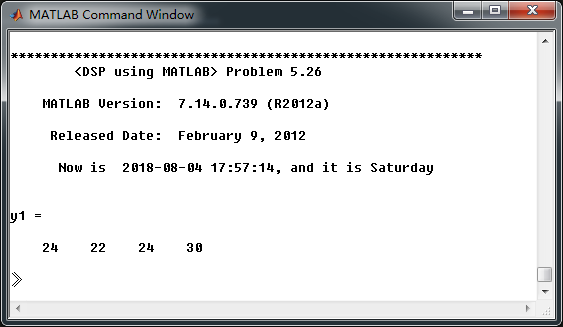
运行结果:
《DSP using MATLAB》Problem 5.24-5.25-5.26的更多相关文章
- 《DSP using MATLAB》Problem 7.24
又到清明时节,…… 注意:带阻滤波器不能用第2类线性相位滤波器实现,我们采用第1类,长度为基数,选M=61 代码: %% +++++++++++++++++++++++++++++++++++++++ ...
- 《DSP using MATLAB》Problem 6.24
代码: %% ++++++++++++++++++++++++++++++++++++++++++++++++++++++++++++++++++++++++++++++++ %% Output In ...
- 《DSP using MATLAB》Problem 4.24
Y(z)部分分式展开, 零状态响应部分分式展开, 零输入状态部分分式展开,
- 《DSP using MATLAB》Problem 6.15
代码: %% ++++++++++++++++++++++++++++++++++++++++++++++++++++++++++++++++++++++++++++++++ %% Output In ...
- 《DSP using MATLAB》Problem 6.8
代码: %% ++++++++++++++++++++++++++++++++++++++++++++++++++++++++++++++++++++++++++++++++ %% Output In ...
- 《DSP using MATLAB》Problem 4.15
只会做前两个, 代码: %% ---------------------------------------------------------------------------- %% Outpu ...
- 《DSP using MATLAB》Problem 2.16
先由脉冲响应序列h(n)得到差分方程系数,过程如下: 代码: %% ------------------------------------------------------------------ ...
- 《DSP using MATLAB》 Problem 2.3
本题主要是显示周期序列的. 1.代码: %% ------------------------------------------------------------------------ %% O ...
- 《DSP using MATLAB》Problem 7.29
代码: %% ++++++++++++++++++++++++++++++++++++++++++++++++++++++++++++++++++++++++++++++++ %% Output In ...
随机推荐
- Ubuntu16.04无法使用WiFi
本人联想431,安装ubuntu16.04 lts,打开之后没有wife,参考这个解决 http://blog.csdn.net/bubblem/article/details/53575017 U ...
- Java使用wait() notify()方法操作共享资源
Java多个线程共享资源: 1)wait().notify()和notifyAll()方法是本地方法,并且为final方法,无法被重写. 2)调用某个对象的wait()方法能让当前线程阻塞,并且当前线 ...
- prppppne2
<?xml version="1.0" encoding="UTF-8"?> <web-app xmlns:xsi="http:/ ...
- day03 字符串
今日学习 1.python的基本数据回顾 2.int--数字类型 3.bool值 取值只有True False bool值没有操作 4.字符串 1.python的基本数据回顾 1)int =>整 ...
- jQuery中的事件与驱动
1.jQuery中的事件 在jQuery中,事件总体分为俩大类:基础事件和符合事件. jQuery中的简单事件,与Javascript中的事件 几乎一样,都含有鼠标事件.键盘事件.载件事件等,只是其 ...
- java关于集合的遍历与增强for循环(foreach)的使用
java集合类的使用可以说是无处不在,总的我们可以将之分为三大块,分别是从Collection接口延伸出的List.Set和以键值对形式作存储的Map类型集合. 许多情况需要我们遍历出集合 ...
- (C/C++学习笔记) 七. 类型转换
七. 类型转换 ● 隐式类型转换 隐式类型转换 implicit type conversions #include<iostream> using namespace std; void ...
- CentOS7配置crate集群
一:编辑配置文件: 1.1配置文件: vim /etc/crate/crate.yml 1.2编辑crate.yml 的集群名称在166行附近: cluster.name: crate-xxx 1.3 ...
- OJ_查找二叉树
#include<iostream>using namespace std;int n,m;int d[120];int t=1;int re;struct Node{ int data; ...
- HDU 2063 (二分图最大匹配)
RPG girls今天和大家一起去游乐场玩,终于可以坐上梦寐以求的过山车了.可是,过山车的每一排只有两个座位,而且还有条不成文的规矩,就是每个女生必须找个个男生做partner和她同坐.但是,每个女孩 ...