
《DSP using MATLAB》 Problem 2.3
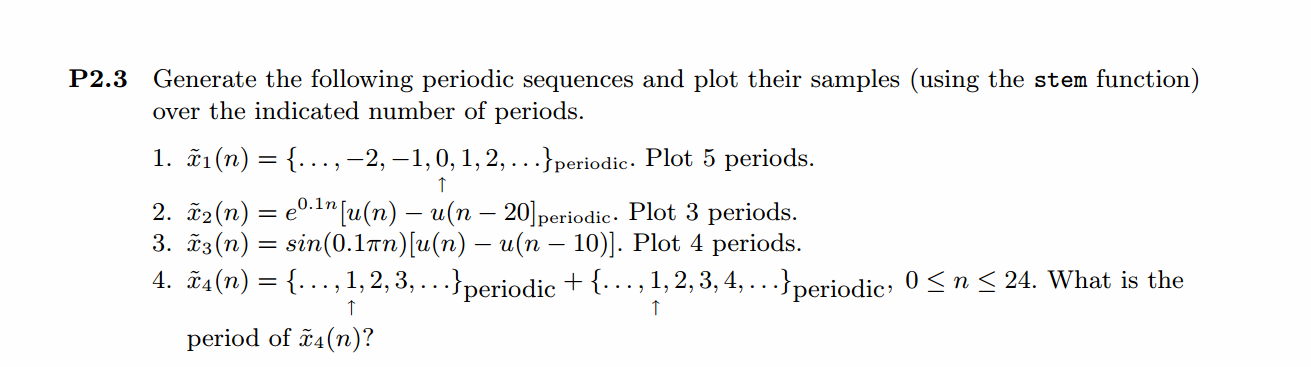
本题主要是显示周期序列的。
1、代码:
%% ------------------------------------------------------------------------

%%            Output Info about this m-file

fprintf('\n***********************************************************\n');

fprintf('        <DSP using MATLAB> Problem 2.3.1 \n\n');

time_stamp = datestr(now, 31);

[wkd1, wkd2] = weekday(today, 'long');

fprintf('      Now is %20s, and it is %7s  \n\n', time_stamp, wkd2);

%% ------------------------------------------------------------------------

%%

%% {...,-2,-1,0,1,2,...}

%%            *

%% Plot 5 periods

self_length = 5;

periods = 5;

n = [-2:(2+(periods-1) * self_length)];x = [-2,-1,0,1,2];

xtilde = x' * ones(1,periods); xtilde = (xtilde(:))';

figure('NumberTitle', 'off', 'Name', 'Problem 2.3.1');

set(gcf,'Color','white');

stem(n,xtilde); title('Sequence in Problem 2.3.1');

xlabel('n'); ylabel('xtilde(n)');grid on;
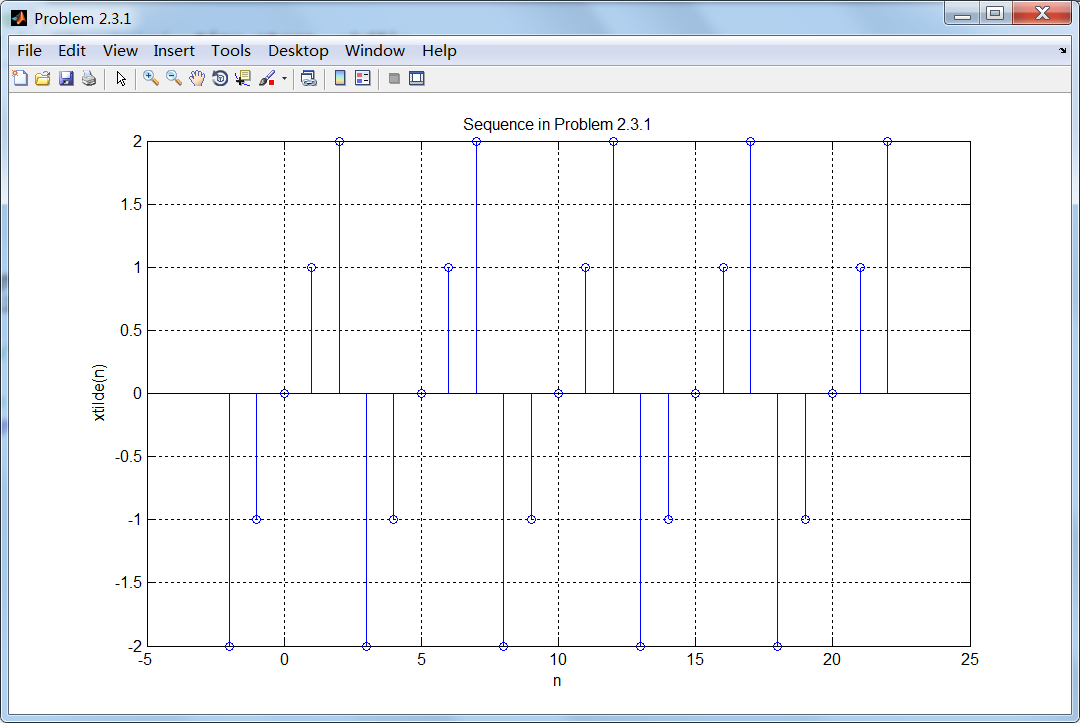
显示结果:
2、代码:
%% ------------------------------------------------------------------------

%%            Output Info about this m-file

fprintf('\n***********************************************************\n');

fprintf('        <DSP using MATLAB> Problem 2.3.2 \n\n');

time_stamp = datestr(now, 31);

[wkd1, wkd2] = weekday(today, 'long');

fprintf('      Now is %20s, and it is %7s  \n\n', time_stamp, wkd2);

%% ------------------------------------------------------------------------

%%

%% exp(0.1n)[ u(n) - u(n-20)]     0-20 valid

%%

%% Plot 3 periods    [0;3*20-1]  [0,59]

n = [0:20];   % We can get self_periods=21 from here

x = exp(0.1*n) .* (stepseq(0,0,20) - stepseq(20,0,20));

%x = (stepseq(0,0,20) - stepseq(20,0,20));

figure('NumberTitle', 'off', 'Name', 'Problem 2.3.2 x(n)');

set(gcf,'Color','white');

stem(n,x); title('x(n) Sequence');

xlabel('n'); ylabel('x(n)');grid on;

self_length = 21;

periods = 3;

n1 = [0:20 + (periods-1) * self_length];

xtilde = x' * ones(1,periods); xtilde = (xtilde(:))';

figure('NumberTitle', 'off', 'Name', 'Problem 2.3.2');

set(gcf,'Color','white');

stem(n1,xtilde); title('Sequence in Problem 2.3.2');

xlabel('n'); ylabel('xtilde(n)');grid on;
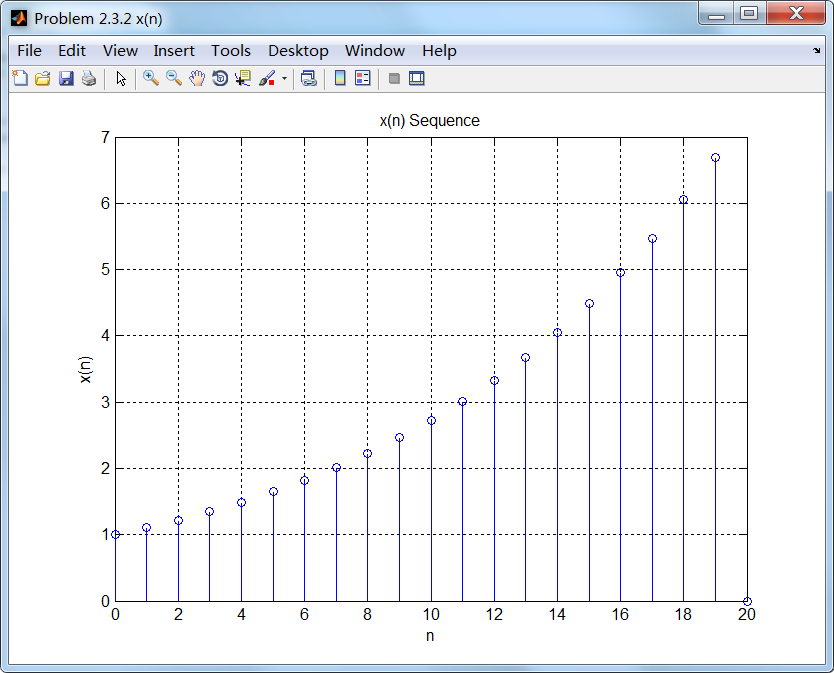
运行结果:

3、代码:
%% ------------------------------------------------------------------------

%%            Output Info about this m-file

fprintf('\n***********************************************************\n');

fprintf('        <DSP using MATLAB> Problem 2.3.3 \n\n');

time_stamp = datestr(now, 31);

[wkd1, wkd2] = weekday(today, 'long');

fprintf('      Now is %20s, and it is %7s  \n\n', time_stamp, wkd2);

%% ------------------------------------------------------------------------

%%

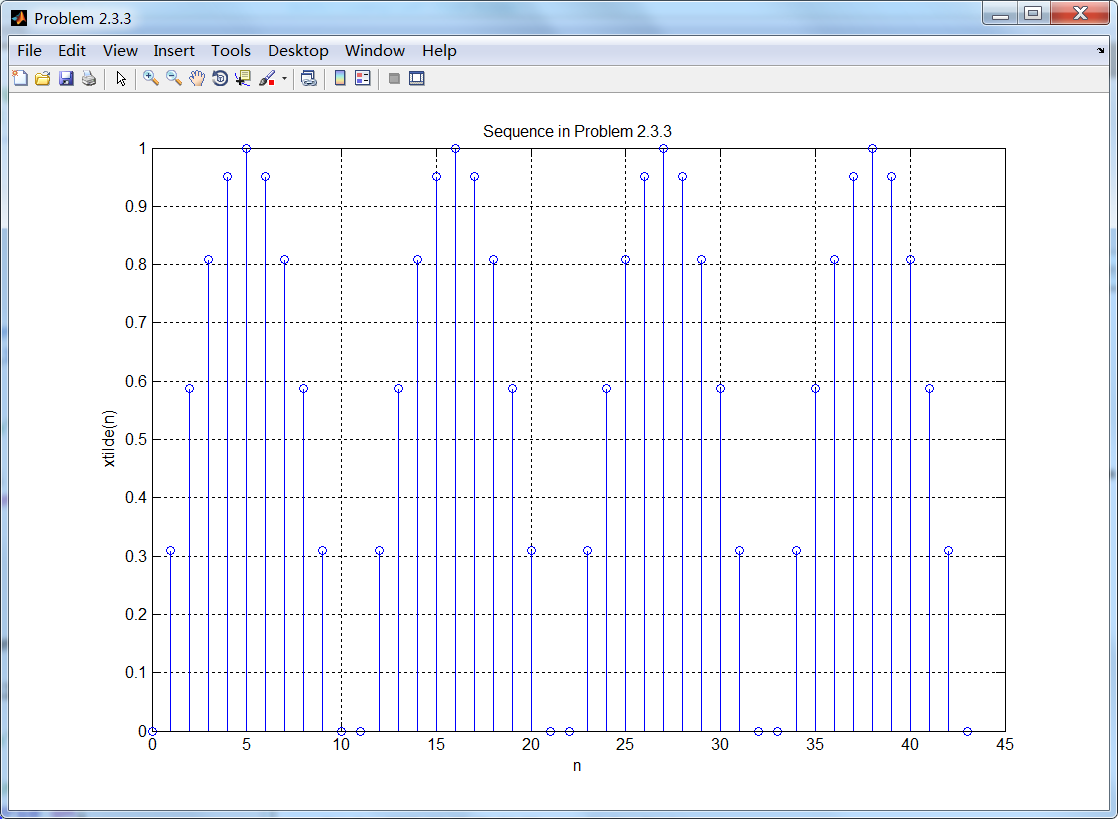
%% sin(0.1*pi*n)[ u(n) - u(n-10)]     0-10 valid

%%

%% Plot 4 periods

n = [0:10];   % We can get self_periods=11 from here

x = sin(0.1*pi*n) .* (stepseq(0,0,10) - stepseq(10,0,10));

figure('NumberTitle', 'off', 'Name', 'Problem 2.3.3 x(n)');

set(gcf,'Color','white');

stem(n,x); title('x(n) Sequence');

xlabel('n'); ylabel('x(n)');grid on;

self_length = 11;

periods = 4;

n1 = [0:10 + (periods-1) * self_length];

xtilde = x' * ones(1,periods); xtilde = (xtilde(:))';

figure('NumberTitle', 'off', 'Name', 'Problem 2.3.3');

set(gcf,'Color','white');

stem(n1,xtilde); title('Sequence in Problem 2.3.3');

xlabel('n'); ylabel('xtilde(n)');grid on;
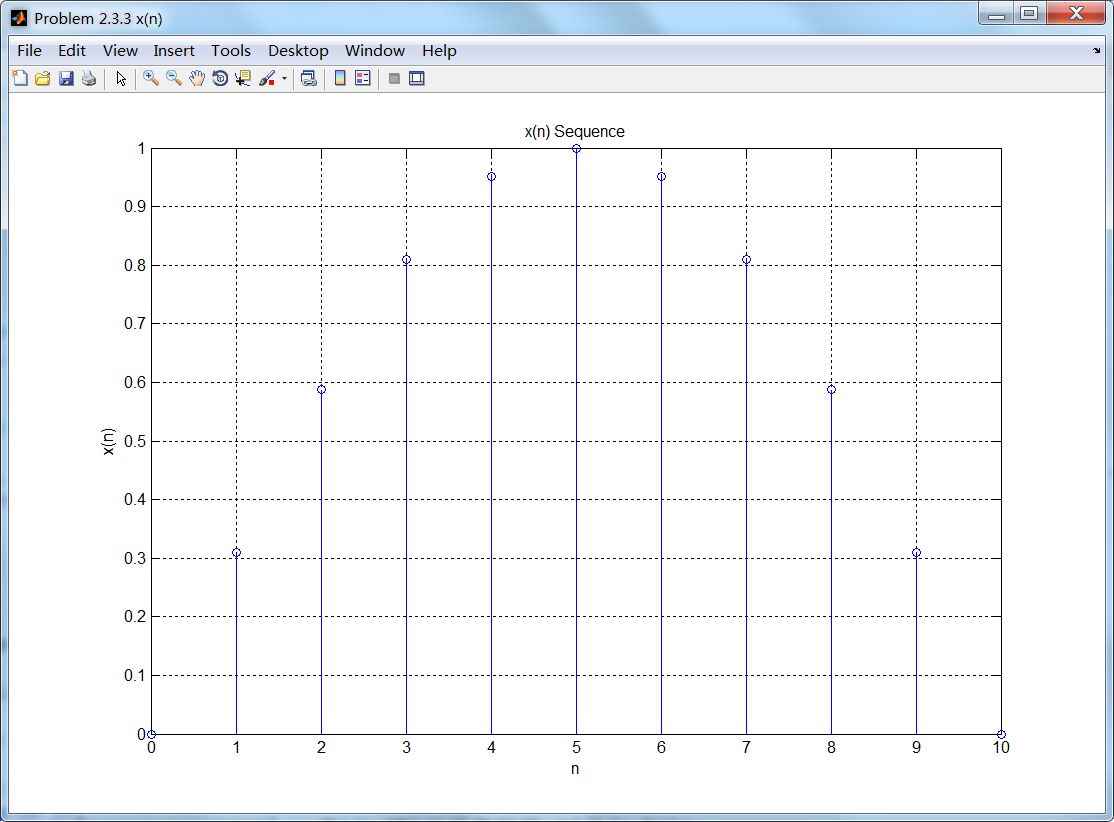
运行结果:
4、代码:
%% ------------------------------------------------------------------------

%%            Output Info about this m-file

fprintf('\n***********************************************************\n');

fprintf('        <DSP using MATLAB> Problem 2.3.4 \n\n');

time_stamp = datestr(now, 31);

[wkd1, wkd2] = weekday(today, 'long');

fprintf('      Now is %20s, and it is %7s  \n\n', time_stamp, wkd2);

%% ------------------------------------------------------------------------

%%

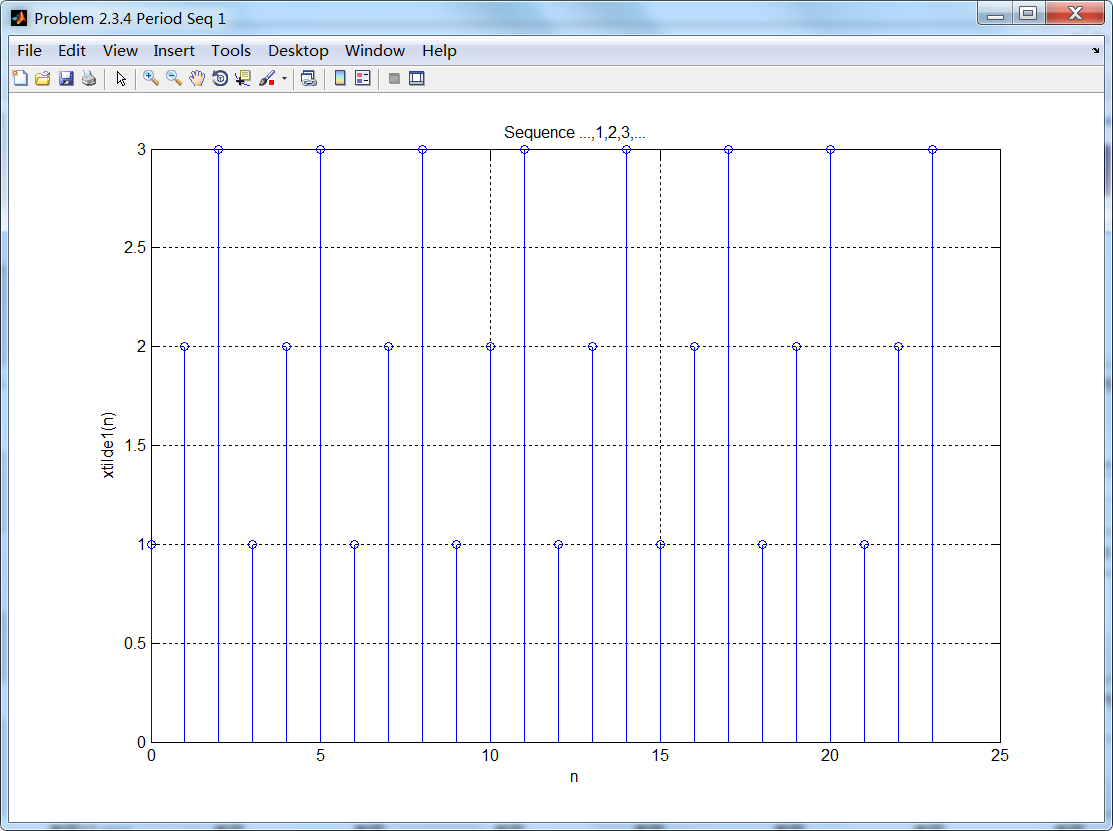
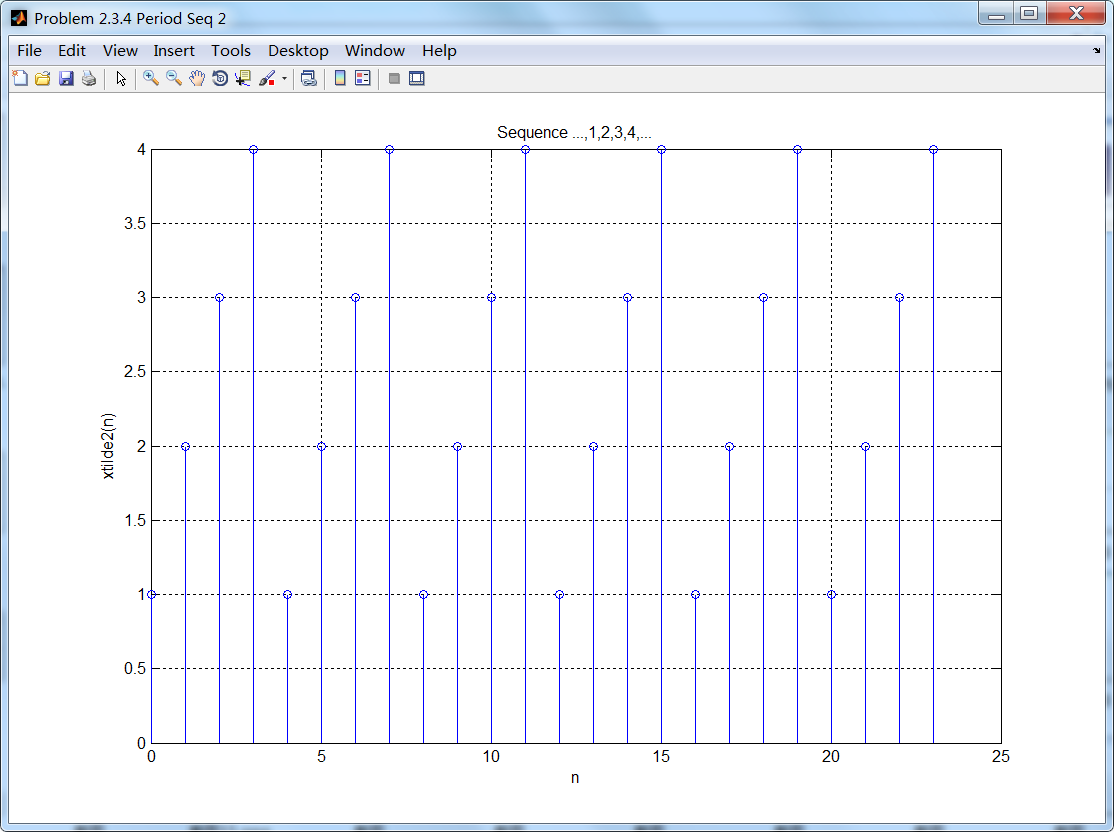
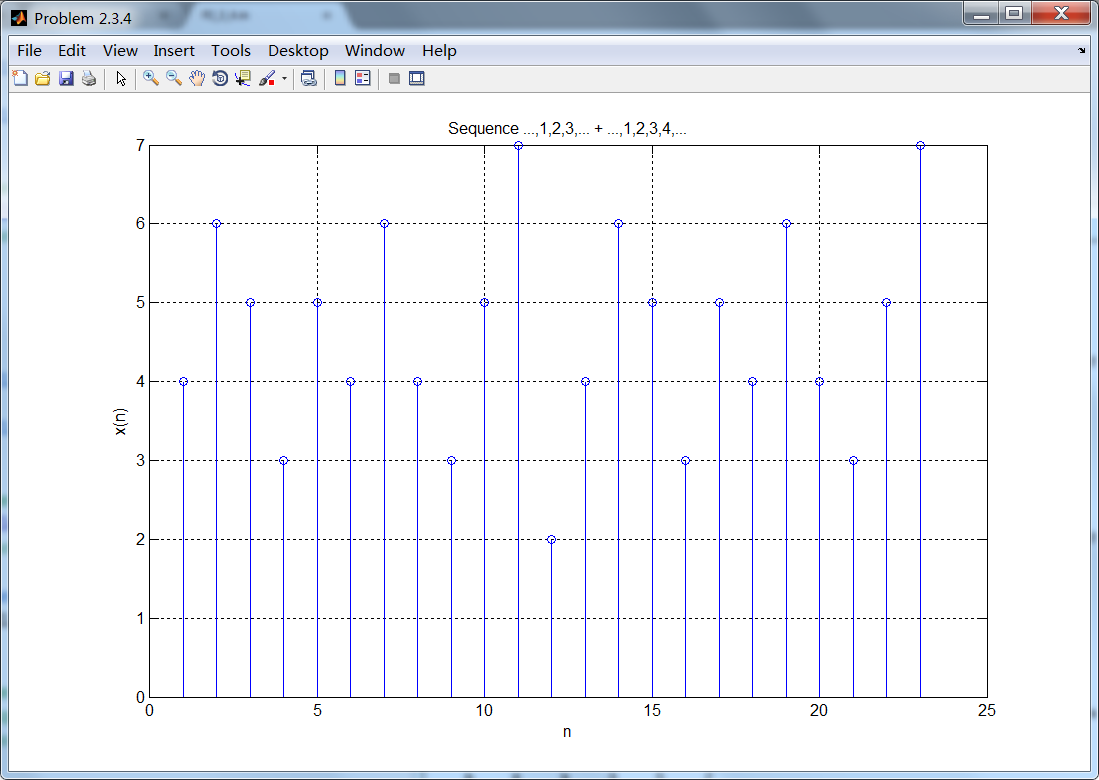
%% {...,1,2,3,...} + {...,1,2,3,4,...}     n=[0:24]

%%      *                 *

%%  what is the periods

self_length1 = 3;

periods1 = 8;

n1 = [0:(2+(periods1-1) * self_length1)];

x1 = [1, 2, 3];

xtilde1 = x1' * ones(1,periods1); xtilde1 = (xtilde1(:))';

figure('NumberTitle', 'off', 'Name', 'Problem 2.3.4 Period Seq 1');

set(gcf,'Color','white');

stem(n1,xtilde1); title('Sequence {...,1,2,3,...}');

xlabel('n'); ylabel('xtilde1(n)');grid on;

self_length2 = 4;

periods2 = 6;

n2 = [0:(3+(periods2-1) * self_length2)];

x2 = [1, 2, 3, 4];

xtilde2 = x2' * ones(1,periods2); xtilde2 = (xtilde2(:))';

figure('NumberTitle', 'off', 'Name', 'Problem 2.3.4 Period Seq 2');

set(gcf,'Color','white');

stem(n2,xtilde2); title('Sequence {...,1,2,3,4,...}');

xlabel('n'); ylabel('xtilde2(n)');grid on;

x = xtilde1 + xtilde2

%[x,n] = sigadd(xtilde1,24,xtilde2,24);

figure('NumberTitle', 'off', 'Name', 'Problem 2.3.4');

set(gcf,'Color','white');

stem(x); title('Sequence {...,1,2,3,...} + {...,1,2,3,4,...}');

xlabel('n'); ylabel('x(n)');grid on;
运行结果:

《DSP using MATLAB》 Problem 2.3的更多相关文章
- 《DSP using MATLAB》Problem 7.27
代码: %% ++++++++++++++++++++++++++++++++++++++++++++++++++++++++++++++++++++++++++++++++ %% Output In ...
- 《DSP using MATLAB》Problem 7.26
注意:高通的线性相位FIR滤波器,不能是第2类,所以其长度必须为奇数.这里取M=31,过渡带里采样值抄书上的. 代码: %% +++++++++++++++++++++++++++++++++++++ ...
- 《DSP using MATLAB》Problem 7.25
代码: %% ++++++++++++++++++++++++++++++++++++++++++++++++++++++++++++++++++++++++++++++++ %% Output In ...
- 《DSP using MATLAB》Problem 7.24
又到清明时节,…… 注意:带阻滤波器不能用第2类线性相位滤波器实现,我们采用第1类,长度为基数,选M=61 代码: %% +++++++++++++++++++++++++++++++++++++++ ...
- 《DSP using MATLAB》Problem 7.23
%% ++++++++++++++++++++++++++++++++++++++++++++++++++++++++++++++++++++++++++++++++ %% Output Info a ...
- 《DSP using MATLAB》Problem 7.16
使用一种固定窗函数法设计带通滤波器. 代码: %% ++++++++++++++++++++++++++++++++++++++++++++++++++++++++++++++++++++++++++ ...
- 《DSP using MATLAB》Problem 7.15
用Kaiser窗方法设计一个台阶状滤波器. 代码: %% +++++++++++++++++++++++++++++++++++++++++++++++++++++++++++++++++++++++ ...
- 《DSP using MATLAB》Problem 7.14
代码: %% ++++++++++++++++++++++++++++++++++++++++++++++++++++++++++++++++++++++++++++++++ %% Output In ...
- 《DSP using MATLAB》Problem 7.13
代码: %% ++++++++++++++++++++++++++++++++++++++++++++++++++++++++++++++++++++++++++++++++ %% Output In ...
- 《DSP using MATLAB》Problem 7.12
阻带衰减50dB,我们选Hamming窗 代码: %% ++++++++++++++++++++++++++++++++++++++++++++++++++++++++++++++++++++++++ ...
随机推荐
- (24)如何使用HttpClient
介绍 HttpClient是HTTP客户端的接口.HttpClient封装了各种对象,处理cookies,身份认证,连接管理等. 概念 HttpClient的使用一般包含下面6个步骤: 创建 Http ...
- Mail.Ru Cup 2018 Round 2 Solution
A. Metro Solved. 题意: 有两条铁轨,都是单向的,一条是从左往右,一条是从右往左,Bob要从第一条轨道的第一个位置出发,Alice的位置处于第s个位置,有火车会行驶在铁轨上,一共有n个 ...
- javascript模式(1)--私有成员
javascript是基于对象的一门语言,没有想java等语言那样子拥有封装的特性.但是javascript可以通过闭包来进行模拟. 1.构造函数与私有成员 可以用构造函数形成一个闭包,实现内部成员的 ...
- java压缩zip文件中文乱码问题
用java来打包文件生成压缩文件,有两个地方会出现乱码 1.内容的中文乱码问题,这个问题网上很多人给出了解决方法,两种:修改sun的源码:使用开源的类库org.apache.tools.zip.Zip ...
- bzoj1615 / P2903 [USACO08MAR]麻烦的干草打包机The Loathesome Hay Baler
P2903 [USACO08MAR]麻烦的干草打包机The Loathesome Hay Baler 细节题.$O(n^{2})$的$bfs$可过. #include<iostream> ...
- Python3.x:基础学习
Python3.x:基础学习 1,Python有五种标准数据类型 1.数字 2.字符串 3.列表 4.元组 5.字典 (1).数字 数字数据类型存储数字值.当为其分配值时,将创建数字对象. var1 ...
- 对OpenCV中seamlessClone的初步实验
seamlessClone是OpenCV中新出现的函数,应该说如果能够基于较为准确的图像分割,能够得到很好的结果. 原始的前景,背景 三种flag下的融合结果 //注意头文件中添加 #inclu ...
- 2017-2018-1 JaWorld 团队作业--冲刺2
2017-2018-1 JaWorld 团队作业--冲刺2 (20162314) 总体架构 我们本次团队项目设定为基于Android系统Java架构下的打飞机小游戏 游戏中所有模型的原型设定是精灵,因 ...
- spark 累加历史 + 统计全部 + 行转列
spark 累加历史主要用到了窗口函数,而进行全部统计,则需要用到rollup函数 1 应用场景: 1.我们需要统计用户的总使用时长(累加历史) 2.前台展现页面需要对多个维度进行查询,如:产品.地 ...
- PHP如何生成文章预览图
PHP如何生成文章预览图 一.总结 一句话总结:php的wkhtmltox扩展,php官方文档有怎么使用,或者github,或者百度,等等等等 wkhtmltox 1.PHP如何自动生成文章预览图? ...