
Machine learning第四周code 编程作业
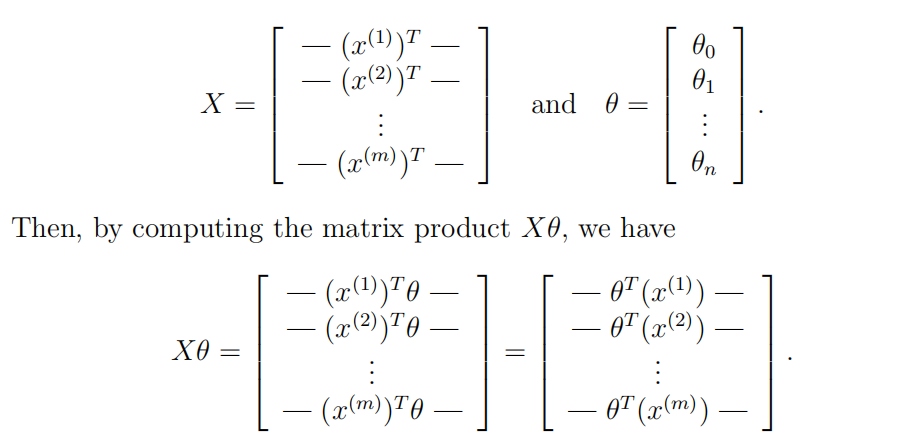
1.lrCostFunction:
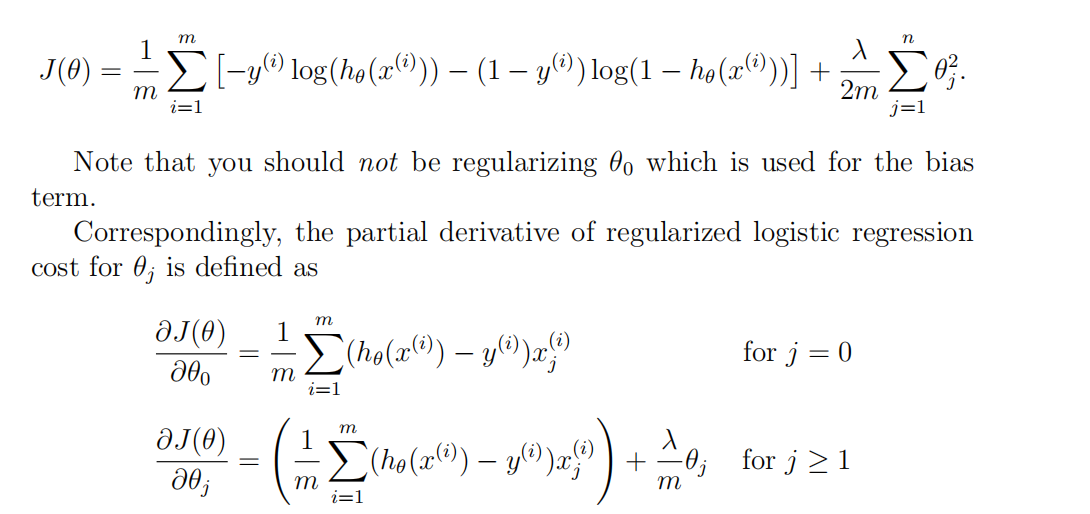
和第三周的那个一样的;
function [J, grad] = lrCostFunction(theta, X, y, lambda)

%LRCOSTFUNCTION Compute cost and gradient for logistic regression with

%regularization

%   J = LRCOSTFUNCTION(theta, X, y, lambda) computes the cost of using

%   theta as the parameter for regularized logistic regression and the

%   gradient of the cost w.r.t. to the parameters.

% Initialize some useful values

m = length(y); % number of training examples

% You need to return the following variables correctly

J = 0;

grad = zeros(size(theta));

% ====================== YOUR CODE HERE ======================

% Instructions: Compute the cost of a particular choice of theta.

%               You should set J to the cost.

%               Compute the partial derivatives and set grad to the partial

%               derivatives of the cost w.r.t. each parameter in theta

%

% Hint: The computation of the cost function and gradients can be

%       efficiently vectorized. For example, consider the computation

%

%           sigmoid(X * theta)

%

%       Each row of the resulting matrix will contain the value of the

%       prediction for that example. You can make use of this to vectorize

%       the cost function and gradient computations.

%

% Hint: When computing the gradient of the regularized cost function,

%       there're many possible vectorized solutions, but one solution

%       looks like:

%           grad = (unregularized gradient for logistic regression)

%           temp = theta;

%           temp(1) = 0;   % because we don't add anything for j = 0

%           grad = grad + YOUR_CODE_HERE (using the temp variable)

%

h=sigmoid(X*theta);

for i=1:m,

  J=J+1/m*(-y(i)*log(h(i))-(1-y(i))*log(1-h(i)));

endfor

n=length(theta);

for i=2:n,

  J=J+lambda/(2*m)*theta(i)^2;

endfor

grad(1)=1/m*(h-y)'*X(:,1);

for i=2:n,

  grad(i)=1/m*(h-y)'*X(:,i)+lambda/m*theta(i);

endfor

% =============================================================

grad = grad(:);

end
2.oneVsAll
注意的一点是:
fmincg中的 initial_theta为列向量,所以需要转置一下;
function [all_theta] = oneVsAll(X, y, num_labels, lambda)

%ONEVSALL trains multiple logistic regression classifiers and returns all

%the classifiers in a matrix all_theta, where the i-th row of all_theta

%corresponds to the classifier for label i

%   [all_theta] = ONEVSALL(X, y, num_labels, lambda) trains num_labels

%   logistic regression classifiers and returns each of these classifiers

%   in a matrix all_theta, where the i-th row of all_theta corresponds

%   to the classifier for label i

% Some useful variables

m = size(X, 1);

n = size(X, 2);

% You need to return the following variables correctly

all_theta = zeros(num_labels, n + 1);

% Add ones to the X data matrix

X = [ones(m, 1) X];

% ====================== YOUR CODE HERE ======================

% Instructions: You should complete the following code to train num_labels

%               logistic regression classifiers with regularization

%               parameter lambda.

%

% Hint: theta(:) will return a column vector.

%

% Hint: You can use y == c to obtain a vector of 1's and 0's that tell you

%       whether the ground truth is true/false for this class.

%

% Note: For this assignment, we recommend using fmincg to optimize the cost

%       function. It is okay to use a for-loop (for c = 1:num_labels) to

%       loop over the different classes.

%

%       fmincg works similarly to fminunc, but is more efficient when we

%       are dealing with large number of parameters.

%

% Example Code for fmincg:

%

%     % Set Initial theta

%     initial_theta = zeros(n + 1, 1);

%

%     % Set options for fminunc

%     options = optimset('GradObj', 'on', 'MaxIter', 50);

%

%     % Run fmincg to obtain the optimal theta

%     % This function will return theta and the cost

%     [theta] = ...

%         fmincg (@(t)(lrCostFunction(t, X, (y == c), lambda)), ...

%                 initial_theta, options);

%

options=optimset('GradObj','on','MaxIter',50);

for i=1:num_labels,

  all_theta(i,:)=fmincg(@(t)(lrCostFunction(t,X,(y==i),lambda)),all_theta(i,:)',options);

endfor

% =========================================================================

end
3.PredictOneVSAll
function p = predictOneVsAll(all_theta, X)

%PREDICT Predict the label for a trained one-vs-all classifier. The labels

%are in the range 1..K, where K = size(all_theta, 1).

%  p = PREDICTONEVSALL(all_theta, X) will return a vector of predictions

%  for each example in the matrix X. Note that X contains the examples in

%  rows. all_theta is a matrix where the i-th row is a trained logistic

%  regression theta vector for the i-th class. You should set p to a vector

%  of values from 1..K (e.g., p = [1; 3; 1; 2] predicts classes 1, 3, 1, 2

%  for 4 examples)

m = size(X, 1);

num_labels = size(all_theta, 1);

% You need to return the following variables correctly

p = zeros(size(X, 1), 1);

% Add ones to the X data matrix

X = [ones(m, 1) X];

% ====================== YOUR CODE HERE ======================

% Instructions: Complete the following code to make predictions using

%               your learned logistic regression parameters (one-vs-all).

%               You should set p to a vector of predictions (from 1 to

%               num_labels).

%

% Hint: This code can be done all vectorized using the max function.

%       In particular, the max function can also return the index of the

%       max element, for more information see 'help max'. If your examples

%       are in rows, then, you can use max(A, [], 2) to obtain the max

%       for each row.

%

[Max,p]=max(X*all_theta',[],2);

% =========================================================================

end
4.predict
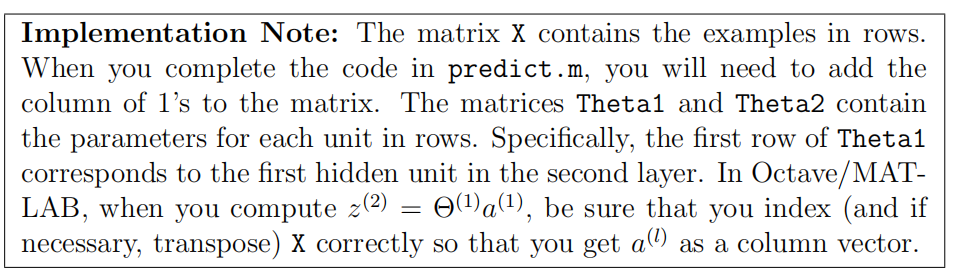
function p = predict(Theta1, Theta2, X)

%PREDICT Predict the label of an input given a trained neural network

%   p = PREDICT(Theta1, Theta2, X) outputs the predicted label of X given the

%   trained weights of a neural network (Theta1, Theta2)

% Useful values

m = size(X, 1);

num_labels = size(Theta2, 1);

% You need to return the following variables correctly

p = zeros(size(X, 1), 1);

% ====================== YOUR CODE HERE ======================

% Instructions: Complete the following code to make predictions using

%               your learned neural network. You should set p to a

%               vector containing labels between 1 to num_labels.

%

% Hint: The max function might come in useful. In particular, the max

%       function can also return the index of the max element, for more

%       information see 'help max'. If your examples are in rows, then, you

%       can use max(A, [], 2) to obtain the max for each row.

%

X=[ones(m,1) X];

a2=[ones(m,1) sigmoid(X*Theta1')];

[Max,p]=max(sigmoid(a2*Theta2'),[],2);

% =========================================================================

end
Machine learning第四周code 编程作业的更多相关文章
- Machine learning 第7周编程作业 SVM
1.Gaussian Kernel function sim = gaussianKernel(x1, x2, sigma) %RBFKERNEL returns a radial basis fun ...
- Machine learning第6周编程作业
1.linearRegCostFunction: function [J, grad] = linearRegCostFunction(X, y, theta, lambda) %LINEARREGC ...
- Machine learning 第8周编程作业 K-means and PCA
1.findClosestCentroids function idx = findClosestCentroids(X, centroids) %FINDCLOSESTCENTROIDS compu ...
- Machine learning 第5周编程作业
1.Sigmoid Gradient function g = sigmoidGradient(z) %SIGMOIDGRADIENT returns the gradient of the sigm ...
- Hand on Machine Learning第三章课后作业(1):垃圾邮件分类
import os import email import email.policy 1. 读取邮件数据 SPAM_PATH = os.path.join( "E:\\3.Study\\机器 ...
- 【machine learning通俗讲解code逐行注释】之线性回归实现
现在机器学习算法在分类.回归.数据挖掘等问题上运用的十分广泛,对于初学者来说,可能一听到'算法'或其他的专属名词都感觉高深莫测,以致很多人望而却步,这让很多人在处理很多问题上失去了一个很有用的工具.机 ...
- Hand on Machine Learning第三章课后作业(2):其余小练习
-#!/usr/bin/env python -# # # -- coding: utf-8 -- -# # # @Time : 2019.5.22 14:09 -# # # @Author : An ...
- 機器學習基石 (Machine Learning Foundations) 作业1 Q15-17的C++实现
大家好,我是Mac Jiang.今天和大家分享Coursera-台湾大学-機器學習基石 (Machine Learning Foundations) -作业1的Q15-17题的C++实现. 这部分作业 ...
- 機器學習基石(Machine Learning Foundations) 机器学习基石 作业三 课后习题解答
今天和大家分享coursera-NTU-機器學習基石(Machine Learning Foundations)-作业三的习题解答.笔者在做这些题目时遇到非常多困难,当我在网上寻找答案时却找不到,而林 ...
随机推荐
- fastdfs单机版的安装+nginx
一.FastDFS介绍 FastDFS开源地址:https://github.com/happyfish100 参考:分布式文件系统FastDFS设计原理 参考:FastDFS分布式文件系统 1.简介 ...
- DSOFramer 控件修改成功
1.Html电子印章.手写签名系统演示:http://www.dianju.com.cn/video.htm 在线试用: http://www.dianju.com.cn/websignpiaoju/ ...
- php从数组中取出一段 之 array_slice
array array_slice ( array $array , int $offset [, int $length [, bool $preserve_keys ]] ) array_slic ...
- c# 解释器模式与sping.net表达式的结合应用(金融里经常需要用到公式,这个公式是抽象的需要自己解释)
.代码 using Spring.Expressions; using System; using System.Collections.Generic; using System.Linq; usi ...
- iOS7中的多任务II
[推送唤醒(Remote Notifications)] 在iOS6和之前,推送的类型是很单一的,无非就是显示标题内容,指定声音等.用户通过解锁进入你的应用后,appDelegate中通过推送打开应用 ...
- Oracle学习笔记(十)
光标(游标)概念引入 就是一个结果集(查询或者其他操作返回的结果是多个时使用)定义一个光标 cursor c1 is select ename from emp: 从光标中取值 打开光标: --ope ...
- [转]How do I run msbuild from the command line using Windows SDK 7.1?
本文转自:http://stackoverflow.com/questions/6319274/how-do-i-run-msbuild-from-the-command-line-using-win ...
- tomcat下manager配置
1 安装Tomcat前需要先安装JDK.安装Tomcat后测试Tomcat成功安装. Tomcat Manager是Tomcat自带的.用于对Tomcat自身以及部署在Tomcat上的应用进行管理的w ...
- 基数排序简单Java实现
基数排序(radix sort)又称“桶子法”,在对多个正整数进行排序时可以使用.它的灵感来自于队列(Queue),它最独特的地方在于利用了数字的有穷性(阿拉伯数字只有0到9的10个). 基数排序使用 ...
- [翻译]Writing Custom DB Engines 编写定制的DB引擎
Writing Custom DB Engines 编写定制的DB引擎 FastReport can build reports not only with data sourced from ...