
Machine learning第6周编程作业
1.linearRegCostFunction:
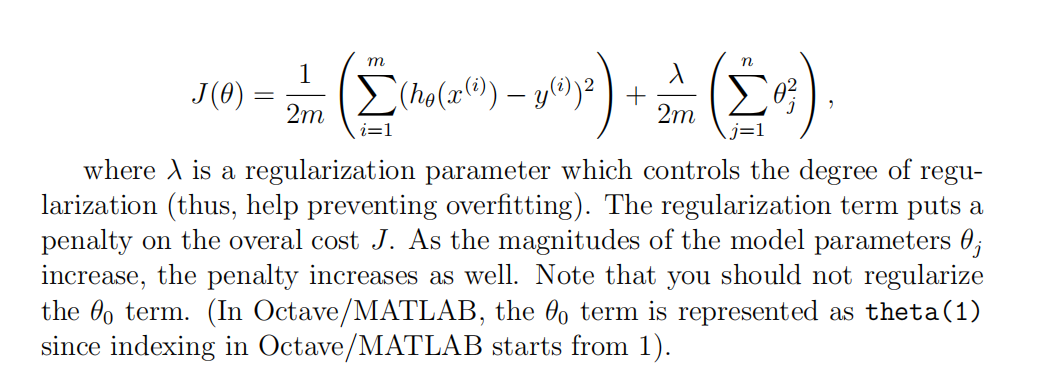
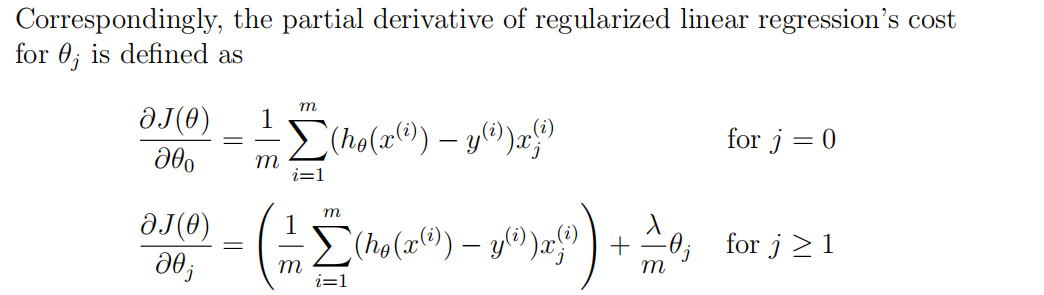
function [J, grad] = linearRegCostFunction(X, y, theta, lambda)

%LINEARREGCOSTFUNCTION Compute cost and gradient for regularized linear

%regression with multiple variables

%   [J, grad] = LINEARREGCOSTFUNCTION(X, y, theta, lambda) computes the

%   cost of using theta as the parameter for linear regression to fit the

%   data points in X and y. Returns the cost in J and the gradient in grad

% Initialize some useful values

m = length(y); % number of training examples

% You need to return the following variables correctly

J = 0;

grad = zeros(size(theta));

% ====================== YOUR CODE HERE ======================

% Instructions: Compute the cost and gradient of regularized linear

%               regression for a particular choice of theta.

%

%               You should set J to the cost and grad to the gradient.

%

h=(X*theta);

for i=1:m,

  J=J+1/(2*m)*(h(i)-y(i))^2;

endfor

n= length(theta);

for i=2:n,

  J=J+lambda/(2*m)*theta(i)^2;

endfor

grad(1)=1/m*(h-y)'*X(:,1);

for i=2:n,

  grad(i)=1/m*(h-y)'*X(:,i)+lambda/m*theta(i);

endfor

% =========================================================================

grad = grad(:);

end
2.learningCuvers

function [error_train, error_val] = ...

    learningCurve(X, y, Xval, yval, lambda)

%LEARNINGCURVE Generates the train and cross validation set errors needed

%to plot a learning curve

%   [error_train, error_val] = ...

%       LEARNINGCURVE(X, y, Xval, yval, lambda) returns the train and

%       cross validation set errors for a learning curve. In particular,

%       it returns two vectors of the same length - error_train and

%       error_val. Then, error_train(i) contains the training error for

%       i examples (and similarly for error_val(i)).

%

%   In this function, you will compute the train and test errors for

%   dataset sizes from 1 up to m. In practice, when working with larger

%   datasets, you might want to do this in larger intervals.

%

% Number of training examples

m = size(X, 1);

% You need to return these values correctly

error_train = zeros(m, 1);

error_val   = zeros(m, 1);

% ====================== YOUR CODE HERE ======================

% Instructions: Fill in this function to return training errors in

%               error_train and the cross validation errors in error_val.

%               i.e., error_train(i) and

%               error_val(i) should give you the errors

%               obtained after training on i examples.

%

% Note: You should evaluate the training error on the first i training

%       examples (i.e., X(1:i, :) and y(1:i)).

%

%       For the cross-validation error, you should instead evaluate on

%       the _entire_ cross validation set (Xval and yval).

%

% Note: If you are using your cost function (linearRegCostFunction)

%       to compute the training and cross validation error, you should

%       call the function with the lambda argument set to 0.

%       Do note that you will still need to use lambda when running

%       the training to obtain the theta parameters.

%

% Hint: You can loop over the examples with the following:

%

%       for i = 1:m

%           % Compute train/cross validation errors using training examples

%           % X(1:i, :) and y(1:i), storing the result in

%           % error_train(i) and error_val(i)

%           ....

%

%       end

%

% ---------------------- Sample Solution ----------------------

for i=1:m,

  theta=trainLinearReg(X(1:i,:),y(1:i),lambda);

  error_train(i)=linearRegCostFunction(X(1:i,:),y(1:i),theta,0);

  error_val(i)=linearRegCostFunction(Xval,yval,theta,0);

endfor

% -------------------------------------------------------------

% =========================================================================

end
3.polyFeatures

function [X_poly] = polyFeatures(X, p)

%POLYFEATURES Maps X (1D vector) into the p-th power

%   [X_poly] = POLYFEATURES(X, p) takes a data matrix X (size m x 1) and

%   maps each example into its polynomial features where

%   X_poly(i, :) = [X(i) X(i).^2 X(i).^3 ...  X(i).^p];

%

% You need to return the following variables correctly.

X_poly = zeros(numel(X), p);

% ====================== YOUR CODE HERE ======================

% Instructions: Given a vector X, return a matrix X_poly where the p-th

%               column of X contains the values of X to the p-th power.

%

%

for i=1:p,

  X_poly(:,i)=(X.^i);

endfor

% =========================================================================

end
4.ValidationCurve

function [lambda_vec, error_train, error_val] = ...

    validationCurve(X, y, Xval, yval)

%VALIDATIONCURVE Generate the train and validation errors needed to

%plot a validation curve that we can use to select lambda

%   [lambda_vec, error_train, error_val] = ...

%       VALIDATIONCURVE(X, y, Xval, yval) returns the train

%       and validation errors (in error_train, error_val)

%       for different values of lambda. You are given the training set (X,

%       y) and validation set (Xval, yval).

%

% Selected values of lambda (you should not change this)

lambda_vec = [0 0.001 0.003 0.01 0.03 0.1 0.3 1 3 10]';

% You need to return these variables correctly.

error_train = zeros(length(lambda_vec), 1);

error_val = zeros(length(lambda_vec), 1);

% ====================== YOUR CODE HERE ======================

% Instructions: Fill in this function to return training errors in

%               error_train and the validation errors in error_val. The

%               vector lambda_vec contains the different lambda parameters

%               to use for each calculation of the errors, i.e,

%               error_train(i), and error_val(i) should give

%               you the errors obtained after training with

%               lambda = lambda_vec(i)

%

% Note: You can loop over lambda_vec with the following:

%

%       for i = 1:length(lambda_vec)

%           lambda = lambda_vec(i);

%           % Compute train / val errors when training linear

%           % regression with regularization parameter lambda

%           % You should store the result in error_train(i)

%           % and error_val(i)

%           ....

%

%       end

%

%

for i=1:length(lambda_vec),

  Lam=lambda_vec(i);

  theta=trainLinearReg(X,y,Lam);

  error_train(i)=linearRegCostFunction(X,y,theta,0);

  error_val(i)=linearRegCostFunction(Xval,yval,theta,0);

endfor

% =========================================================================

end
Machine learning第6周编程作业的更多相关文章
- Machine learning 第7周编程作业 SVM
1.Gaussian Kernel function sim = gaussianKernel(x1, x2, sigma) %RBFKERNEL returns a radial basis fun ...
- Machine learning 第8周编程作业 K-means and PCA
1.findClosestCentroids function idx = findClosestCentroids(X, centroids) %FINDCLOSESTCENTROIDS compu ...
- Machine learning 第5周编程作业
1.Sigmoid Gradient function g = sigmoidGradient(z) %SIGMOIDGRADIENT returns the gradient of the sigm ...
- Machine learning第四周code 编程作业
1.lrCostFunction: 和第三周的那个一样的: function [J, grad] = lrCostFunction(theta, X, y, lambda) %LRCOSTFUNCTI ...
- 吴恩达深度学习第4课第3周编程作业 + PIL + Python3 + Anaconda环境 + Ubuntu + 导入PIL报错的解决
问题描述: 做吴恩达深度学习第4课第3周编程作业时导入PIL包报错. 我的环境: 已经安装了Tensorflow GPU 版本 Python3 Anaconda 解决办法: 安装pillow模块,而不 ...
- 吴恩达深度学习第2课第2周编程作业 的坑(Optimization Methods)
我python2.7, 做吴恩达深度学习第2课第2周编程作业 Optimization Methods 时有2个坑: 第一坑 需将辅助文件 opt_utils.py 的 nitialize_param ...
- c++ 西安交通大学 mooc 第十三周基础练习&第十三周编程作业
做题记录 风影影,景色明明,淡淡云雾中,小鸟轻灵. c++的文件操作已经好玩起来了,不过掌握好控制结构显得更为重要了. 我这也不做啥题目分析了,直接就题干-代码. 总结--留着自己看 1. 流是指从一 ...
- Machine Learning - 第7周(Support Vector Machines)
SVMs are considered by many to be the most powerful 'black box' learning algorithm, and by posing构建 ...
- Machine Learning - 第6周(Advice for Applying Machine Learning、Machine Learning System Design)
In Week 6, you will be learning about systematically improving your learning algorithm. The videos f ...
随机推荐
- Golang作用域—坑
先举个栗子,全局作用域变量,与 := 符号声明赋值新变量 package main import "fmt" var a = "GG" func main() ...
- Python爬虫利器六之PyQuery的用法
前言 你是否觉得 XPath 的用法多少有点晦涩难记呢? 你是否觉得 BeautifulSoup 的语法多少有些悭吝难懂呢? 你是否甚至还在苦苦研究正则表达式却因为少些了一个点而抓狂呢? 你是否已经有 ...
- Java NIO API详解(转)
原文连接: http://www.blogjava.net/19851985lili/articles/93524.html 感谢原作者 NIO API 主要集中在 java.nio 和它的 subp ...
- Eclipse下初用lucene
lucene是apache的一个开源项目,一个开放源代码的全文检索引擎工具包. 1. 首先下载lucene,下载地址来自<lucene实战>第2版(页面加载比较忙,等~) http://w ...
- Qracle 11g 插图安装
1.下载两个包 然后把包二的内容放入包一里 2.管理员身份运行setup 3.选择去掉复选框 4.下一步,然后选择是 5.选择第一项,然后选择下一步 6.个人使用选桌面类 7.不要放在C盘中 8.设置 ...
- UVa 1615 Highway (贪心,区间选点问题)
题意:给定一个数 n 个点,和一个d,要求在x轴上选出尽量少的点,使得对于给定的每个点,都有一个选出的点离它的欧几里德距离不超过d. 析:首先这是一个贪心的题目,并且是区间选点问题,什么是区间选点呢, ...
- windows7 不能更新,提示:"WindowsUpdate_80240016" "WindowsUpdate_dt000",如何解决?
计算机(右键) ---- 管理 -------- 服务和应用程序 -----服务(找到名称为windows update的服务,并且在windwos update服务右键 选择重新启动 ) 再次安装更 ...
- Java动态代理(一)动态类Proxy的使用
1.什么是动态代理? 答:动态代理可以提供对另一个对象的访问,同时隐藏实际对象的具体事实.代理一般会实现它所表示的实际对象的接口.代理可以访问实际对象,但是延迟实现实际对象的部分功能,实际对象实现系统 ...
- windows本地代码上传github
1.下载Git工具 https://www.git-scm.com/download/win 2.进到项目目录 cd /dir/dir/dir/file 3.初始化 git init 4.添加远程仓库 ...
- django设置cookie和session
1 设置cookie 本例中应用名称为cookie 模型model from django.db import models from django.db import models class Us ...