
[Scikit-learn] 1.5 Generalized Linear Models - SGD for Classification
NB: 因为softmax,NN看上去是分类,其实是拟合(回归),拟合最大似然。
多分类参见:[Scikit-learn] 1.1 Generalized Linear Models - Logistic regression & Softmax
感知机采用的是形式最简单的梯度
Perceptron and SGDClassifier share the same underlying implementation.In fact, Perceptron() is equivalent to SGDClassifier(loss=”perceptron”, eta0=1, learning_rate=”constant”, penalty=None).
1.5. Stochastic Gradient Descent
- 1.5.1. Classification
- 1.5.2. Regression
- 1.5.3. Stochastic Gradient Descent for sparse data
- 1.5.4. Complexity
- 1.5.5. Tips on Practical Use
- 1.5.6. Mathematical formulation
- 1.5.7. Implementation details
损失函数
需要一些背景知识,参见斯坦福 CS231n - CNN for Visual Recognition 2 - lecture3
参考:斯坦福CS231n - CNN for Visual Recognition 2 - lecture3 Optimization
一、Loss function 计算
Linear SVM classifier的一个例子。
(1) 计算损失函数:Multiclass SVM loss
一个批次,三张图片,分别得到如下的预测值;而后计算loss。
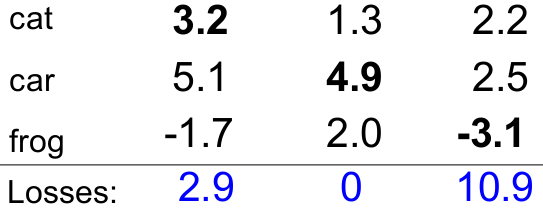
与"另外两个"的比较:
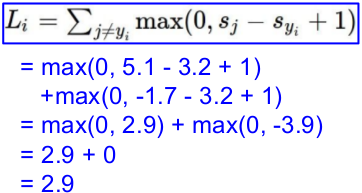
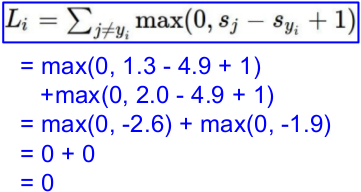
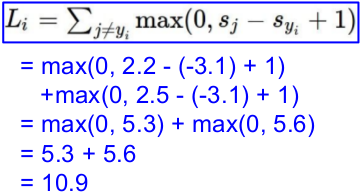
L = (2.9 + 0 + 10.9)/3
= 4.6
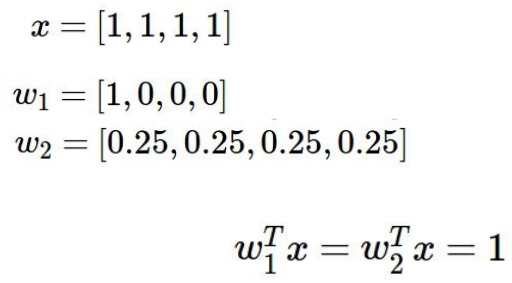
(2) 正则化

典型例子说服你:我们当然prefer后一个,w2 。
二、其他loss function
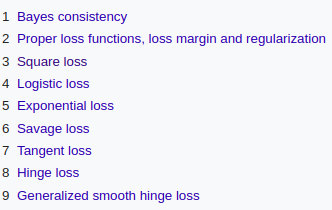
Ref: Loss functions for classification
三、loss计算对比
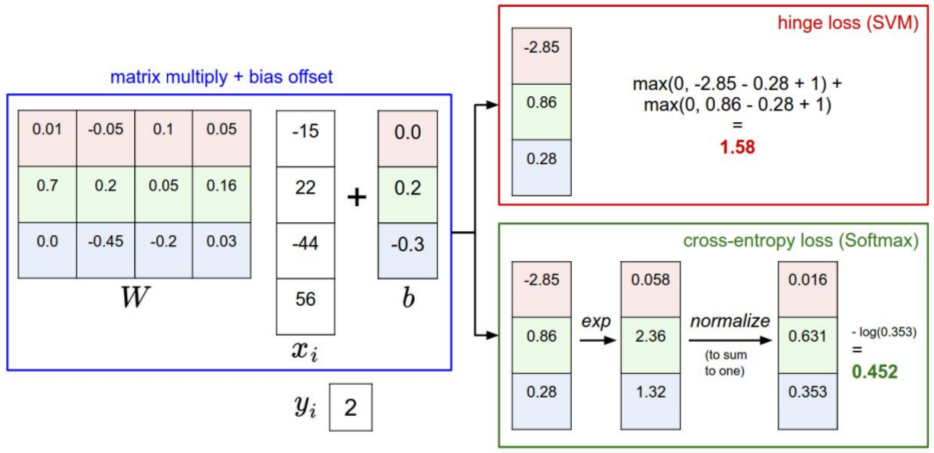
(a) Softmax classifier 的 Softmax's Loss 计算:

(b) Linear SVM classifier 的 hinge loss 计算:

通过该演示体会:http://vision.stanford.edu/teaching/cs231n-demos/linear-classify/
梯度下降
一、逻辑回归
两种损失函数
第一步,逻辑回归的损失函数可以是“得分差”,当然也可以是其他。
第二步,利用“得分差”来进行梯度下降,进行参数优化。
常见有选择两种损失函数,如下:
(1)最小二乘损失函数:逻辑回归与梯度下降法全部详细推导
(2)交叉熵损失函数:机器学习算法 --- 逻辑回归及梯度下降(正统策略)
两个函数接口
Softmax参见:[Scikit-learn] 1.1 Generalized Linear Models - Logistic regression & Softmax
LogisticRegression (交叉熵损失,迭代) versus SGDClassifier(loss="log")
the major difference is the optimization algorithm:
Question: Liblinear/Coordinate Descent vs. Stochastic Gradient Descent.
问题:线性梯度下降 vs 随机梯度下降
If your problem is high dimensional (10K or more) and you have a large
number of examples (100K or more) you should choose the latter -
otherwise, LogisticRegression should be fine.高维,更高的数据:随机梯度下降
反之:Liblinear/Coordinate梯度下降
迭代即可,
Both are not proper multinomial logistic regression models;LogisticRegression does not care and simply computes the probability
estimates of each OVR classifier and normalized to make sure they sum
to one. You could do the same for SGDClassifier(loss='log') but you
have to implement it on your own. You should be aware of the fact that
SGDClassifier(n_jobs > 1) uses multiple processes, thus, if your
dataset (``X``) is too large (more than 50% of your RAM) you'll run
into troubles.
二、梯度下降实践
SGD + Linear SVM classifier
=========================================

SGD: Maximum margin separating hyperplane

=========================================

Plot the maximum margin separating hyperplane within a two-class

separable dataset using a linear Support Vector Machines classifier

trained using SGD.

"""

print(__doc__)

import numpy as np

import matplotlib.pyplot as plt

from sklearn.linear_model import SGDClassifier

from sklearn.datasets.samples_generator import make_blobs

# we create 50 separable points

X, Y = make_blobs(n_samples=50, centers=2, random_state=0, cluster_std=0.60)


# 生成样本(上),即刻训练(下)

# fit the model

clf = SGDClassifier(loss="hinge", alpha=0.01, n_iter=200, fit_intercept=True)

clf.fit(X, Y)

# plot the line, the points, and the nearest vectors to the plane

xx = np.linspace(-1, 5, 10)

yy = np.linspace(-1, 5, 10)

X1, X2 = np.meshgrid(xx, yy)

Z = np.empty(X1.shape)

for (i, j), val in np.ndenumerate(X1):

    x1 = val

    x2 = X2[i, j]

    p = clf.decision_function([[x1, x2]])

    Z[i, j] = p[0]

levels = [-1.0, 0.0, 1.0]

linestyles = ['dashed', 'solid', 'dashed']

colors = 'k'

plt.contour(X1, X2, Z, levels, colors=colors, linestyles=linestyles)

plt.scatter(X[:, 0], X[:, 1], c=Y, cmap=plt.cm.Paired)

plt.axis('tight')

plt.show()
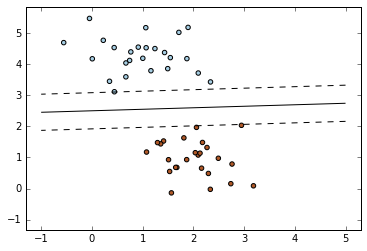
Result:
SGDClassifier 的重要参数
具体的损失函数可以通过 loss 参数来设置。SGDClassifier 支持以下几种损失函数:
loss="hinge": (soft-margin) linear Support Vector Machine,loss="modified_huber": smoothed hinge loss,loss="log": logistic regression,- and all regression losses below.
上述中前两个损失函数lazy的,它们只有在某个样本违反了margin(间隔)限制才会更新模型参数,这样的训练过程非常有效,并且可以应用在稀疏模型上,甚至当使用了L2罚项的时候。
具体的罚项可以通过 penalty 参数。SGD支持一下几种罚项:
penalty="l2": L2 norm penalty oncoef_.penalty="l1": L1 norm penalty oncoef_.penalty="elasticnet": Convex combination of L2 and L1;(1 - l1_ratio) * L2 + l1_ratio * L1.
- 默认的设置是
penalty="l2"。L1罚项会导致稀疏的解,使大多数稀疏为0。弹性网络解决了当属性高度相关情况下L1罚项的不足。参数l1_ratio控制 L1 和 L2 罚项的凸组合。
三、多类分类
SGDClassifier 通过组合多个“one versus all(OVA)”形式的二分类器来支持多类分类。
"Softmax 回归 vs. k 个二元分类器 —— 这一选择取决于你的类别之间是否互斥"
对于  类中每个类别,二分类器通过判别该类和其它
  类来学习。
类来学习。
通过随机梯度下降解线性分类问题。
"""

========================================

Plot multi-class SGD on the iris dataset

========================================

Plot decision surface of multi-class SGD on iris dataset.

The hyperplanes corresponding to the three one-versus-all (OVA) classifiers

are represented by the dashed lines.

"""

print(__doc__)

import numpy as np

import matplotlib.pyplot as plt

from sklearn import datasets

from sklearn.linear_model import SGDClassifier

# import some data to play with

iris = datasets.load_iris()

X = iris.data[:, :2]  # we only take the first two features. We could

                      # avoid this ugly slicing by using a two-dim dataset

y = iris.target

colors = "bry"

# shuffle 洗牌

idx = np.arange(X.shape[0])

np.random.seed(13)

np.random.shuffle(idx)

X = X[idx]

y = y[idx]

# standardize

mean = X.mean(axis=0)

std  = X.std(axis=0)

X    = (X - mean) / std

h = .02  # step size in the mesh

clf = SGDClassifier(alpha=0.001, n_iter=100).fit(X, y)

# create a mesh to plot in

x_min, x_max = X[:, 0].min() - 1, X[:, 0].max() + 1

y_min, y_max = X[:, 1].min() - 1, X[:, 1].max() + 1

xx, yy = np.meshgrid(np.arange(x_min, x_max, h),

                     np.arange(y_min, y_max, h))

# Plot the decision boundary. For that, we will assign a color to each

# point in the mesh [x_min, x_max]x[y_min, y_max].

Z  = clf.predict(np.c_[xx.ravel(), yy.ravel()])

# Put the result into a color plot

Z  = Z.reshape(xx.shape)

cs = plt.contourf(xx, yy, Z, cmap=plt.cm.Paired)

plt.axis('tight')

# Plot also the training points

for i, color in zip(clf.classes_, colors):

    idx = np.where(y == i)

    plt.scatter(X[idx, 0], X[idx, 1], c=color, label=iris.target_names[i],

                cmap=plt.cm.Paired)

plt.title("Decision surface of multi-class SGD")

plt.axis('tight')

# Plot the three one-against-all classifiers

xmin, xmax = plt.xlim()

ymin, ymax = plt.ylim()

coef = clf.coef_

intercept = clf.intercept_

def plot_hyperplane(c, color):

    def line(x0):

        return (-(x0 * coef[c, 0]) - intercept[c]) / coef[c, 1]

    plt.plot([xmin, xmax], [line(xmin), line(xmax)],

             ls="--", color=color)

for i, color in zip(clf.classes_, colors):

    plot_hyperplane(i, color)

plt.legend()

plt.show()
Result:

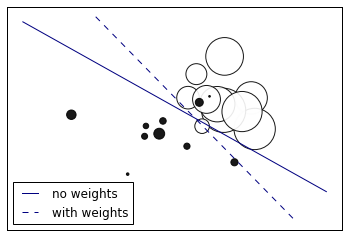
四、考虑权重的二分类
"""

=====================

SGD: Weighted samples

=====================

Plot decision function of a weighted dataset, where the size of points

is proportional to its weight.

"""

print(__doc__)

import numpy as np

import matplotlib.pyplot as plt

from sklearn import linear_model

# we create 20 points

np.random.seed(0)

X = np.r_[np.random.randn(10, 2) + [1, 1], np.random.randn(10, 2)]

y = [1] * 10 + [-1] * 10

sample_weight = 100 * np.abs(np.random.randn(20))

# and assign a bigger weight to the last 10 samples

sample_weight[:10] *= 10

# plot the weighted data points

xx, yy = np.meshgrid(np.linspace(-4, 5, 500), np.linspace(-4, 5, 500))

plt.figure()

plt.scatter(X[:, 0], X[:, 1], c=y, s=sample_weight, alpha=0.9, cmap=plt.cm.bone)  #散点图

## fit the unweighted model

clf = linear_model.SGDClassifier(alpha=0.01, n_iter=100)

clf.fit(X, y)

Z = clf.decision_function(np.c_[xx.ravel(), yy.ravel()])

Z = Z.reshape(xx.shape)

no_weights = plt.contour(xx, yy, Z, levels=[0], linestyles=['solid'])

## fit the weighted model

clf = linear_model.SGDClassifier(alpha=0.01, n_iter=100)

clf.fit(X, y, sample_weight=sample_weight)

Z = clf.decision_function(np.c_[xx.ravel(), yy.ravel()])

Z = Z.reshape(xx.shape)

samples_weights = plt.contour(xx, yy, Z, levels=[0], linestyles=['dashed'])

plt.legend([no_weights.collections[0], samples_weights.collections[0]],

           ["no weights", "with weights"], loc="lower left")

plt.xticks(())

plt.yticks(())

plt.show()
Result:
End.
[Scikit-learn] 1.5 Generalized Linear Models - SGD for Classification的更多相关文章
- [Scikit-learn] 1.5 Generalized Linear Models - SGD for Regression
梯度下降 一.亲手实现“梯度下降” 以下内容其实就是<手动实现简单的梯度下降>. 神经网络的实践笔记,主要包括: Logistic分类函数 反向传播相关内容 Link: http://pe ...
- [Scikit-learn] 1.1 Generalized Linear Models - Logistic regression & Softmax
二分类:Logistic regression 多分类:Softmax分类函数 对于损失函数,我们求其最小值, 对于似然函数,我们求其最大值. Logistic是loss function,即: 在逻 ...
- 广义线性模型(Generalized Linear Models)
前面的文章已经介绍了一个回归和一个分类的例子.在逻辑回归模型中我们假设: 在分类问题中我们假设: 他们都是广义线性模型中的一个例子,在理解广义线性模型之前需要先理解指数分布族. 指数分布族(The E ...
- Andrew Ng机器学习公开课笔记 -- Generalized Linear Models
网易公开课,第4课 notes,http://cs229.stanford.edu/notes/cs229-notes1.pdf 前面介绍一个线性回归问题,符合高斯分布 一个分类问题,logstic回 ...
- [Scikit-learn] 1.1 Generalized Linear Models - from Linear Regression to L1&L2
Introduction 一.Scikit-learning 广义线性模型 From: http://sklearn.lzjqsdd.com/modules/linear_model.html#ord ...
- Popular generalized linear models|GLMM| Zero-truncated Models|Zero-Inflated Models|matched case–control studies|多重logistics回归|ordered logistics regression
============================================================== Popular generalized linear models 将不同 ...
- Regression:Generalized Linear Models
作者:桂. 时间:2017-05-22 15:28:43 链接:http://www.cnblogs.com/xingshansi/p/6890048.html 前言 本文主要是线性回归模型,包括: ...
- Generalized Linear Models
作者:桂. 时间:2017-05-22 15:28:43 链接:http://www.cnblogs.com/xingshansi/p/6890048.html 前言 主要记录python工具包:s ...
- [Scikit-learn] 1.1 Generalized Linear Models - Comparing various online solvers
数据集分割 一.Online learning for 手写识别 From: Comparing various online solvers An example showing how diffe ...
随机推荐
- webstorm如何调试vue项目的js
webstorm如何调试vue项目的js webstormvuewebstorm调试jsjs 1.编辑调试配置,新建JavaScript调试配置,并设置要访问的url地址,如下图所示: 在URL处填写 ...
- 如何实现数组和 List 之间的转换?(未完成)
如何实现数组和 List 之间的转换?(未完成)
- CentOS7安装Ambari2.7.4过程【离线安装】
先配置免密码登录 修改所有结点的host 192.168.210.133 node1 192.168.210.134 node2 192.168.210.135 node3 192.168.210.1 ...
- 【模板】A*B Problem升级版(FFT快速傅里叶)
题目描述 给出两个 $n$ 位10进制数x和y,求x*y(详见 洛谷P1919) 分析 假设已经学会了FFT/NTT. 高精度乘法只是多项式乘法的特殊情况,相当于$x=10$ 时. 例如n=3,求12 ...
- SQL Server遇到的错误和有用的tools
1.The target principal name is incorrect. Cannot generate SSPI context. 检查IIS的profile,可能是密码错误 2.The ...
- redis系列(二):数据操作
1.string类型 字符串类型是Redis中最为基础的数据存储类型,它在Redis中是二进制安全的,这便意味着该类型可以接受任何格式的数据,如JPEG图像数据或Json对象描述信息等.在Redis中 ...
- xpath简介备查
xpath简介 xpath 使用路径表达式在xml和html中进行导航 xpath包含标准函数库 xpath是一个w3c的标准 xpath节点关系 父节点 子节点 同袍节点 先辈节点 后代节点 xpa ...
- 二十五、grub (Boot Loader) 以及修复grub
双系统安装(先Windows后Linux,以免windows NTloader会覆盖Linux loader) GRUB Grand Uniform Bootloader CentOS5,6 grub ...
- Memcached 之在win10上的安装
一.下载 http://static.runoob.com/download/memcached-win64-1.4.4-14.zip 二.安装 memcached <1.4.5 版本安装 1. ...
- Ubuntu常用命令及git常用命令
1. CMakeLists.txt中指定OpenCV路径 set(OPENCV_DIR /***/***/opencv-2.4.9) 2. cmake工程编译安装 mkdir build cd bui ...