
LCA POJ 1330 Nearest Common Ancestors
| Time Limit: 1000MS | Memory Limit: 10000K | |
| Total Submissions: 24209 | Accepted: 12604 |
Description
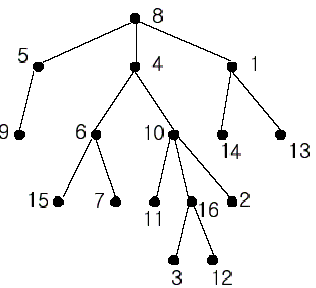
In the figure, each node is labeled with an integer from {1, 2,...,16}. Node 8 is the root of the tree. Node x is an ancestor of node y if node x is in the path between the root and node y. For example, node 4 is an ancestor of node 16. Node 10 is also an ancestor of node 16. As a matter of fact, nodes 8, 4, 10, and 16 are the ancestors of node 16. Remember that a node is an ancestor of itself. Nodes 8, 4, 6, and 7 are the ancestors of node 7. A node x is called a common ancestor of two different nodes y and z if node x is an ancestor of node y and an ancestor of node z. Thus, nodes 8 and 4 are the common ancestors of nodes 16 and 7. A node x is called the nearest common ancestor of nodes y and z if x is a common ancestor of y and z and nearest to y and z among their common ancestors. Hence, the nearest common ancestor of nodes 16 and 7 is node 4. Node 4 is nearer to nodes 16 and 7 than node 8 is.
For other examples, the nearest common ancestor of nodes 2 and 3 is node 10, the nearest common ancestor of nodes 6 and 13 is node 8, and the nearest common ancestor of nodes 4 and 12 is node 4. In the last example, if y is an ancestor of z, then the nearest common ancestor of y and z is y.
Write a program that finds the nearest common ancestor of two distinct nodes in a tree.
Input
Output
Sample Input
2

16

1 14

8 5

10 16

5 9

4 6

8 4

4 10

1 13

6 15

10 11

6 7

10 2

16 3

8 1

16 12

16 7

5

2 3

3 4

3 1

1 5

3 5
Sample Output
4

3
 #define N 10100

 #include<iostream>

 using namespace std;

 #include<cstdio>

 #include<cstring>

 struct Edge{

     int v,last;

 }edge[N*];

 bool visit[N],root[N];

 int father[N],ance[N];

 int T,n,head[N];

 int x,y;

 void add_edge(int u,int v,int k)

 {

     edge[k].v=v;

     edge[k].last=head[u];

     head[u]=k;

 }

 void input()

 {

     memset(root,false,sizeof(root));

     memset(edge,,sizeof(edge));

     memset(head,,sizeof(head));/*注意多组数据之间的衔接,把数据都清空了*/

     scanf("%d",&n);

     for(int i=;i<n;++i)

     {

         int u,v;

         scanf("%d%d",&u,&v);

         add_edge(u,v,i);

         father[i]=i;

         ance[i]=;

         root[v]=true;

         visit[i]=false;

     }

     scanf("%d%d",&x,&y);

     father[n]=n;

     ance[n]=;

     visit[n]=false;

 }

 int find(int k)

 {

     return (father[k]==k)?father[k]:father[k]=find(father[k]);

 }

 void tarjan(int k)

 {

     ance[k]=k;

     for(int l=head[k];l;l=edge[l].last)

     {

         tarjan(edge[l].v);

         father[edge[l].v]=k;

         ance[edge[l].v]=k;

     }

     visit[k]=true;

     if(k==x&&visit[y])

     {

         printf("%d\n",ance[find(y)]);

     }

     if(k==y&&visit[x])

     {

         printf("%d\n",ance[find(x)]);

     }

 }

 int main()

 {

     scanf("%d",&T);

     while(T--)

     {

         input();

         for(int i=;i<=n;++i)

           if(!root[i])

           {

                 tarjan(i);

                 break;

           }

     }

     return ;

 }
LCA POJ 1330 Nearest Common Ancestors的更多相关文章
- POJ - 1330 Nearest Common Ancestors(基础LCA)
POJ - 1330 Nearest Common Ancestors Time Limit: 1000MS Memory Limit: 10000KB 64bit IO Format: %l ...
- POJ 1330 Nearest Common Ancestors / UVALive 2525 Nearest Common Ancestors (最近公共祖先LCA)
POJ 1330 Nearest Common Ancestors / UVALive 2525 Nearest Common Ancestors (最近公共祖先LCA) Description A ...
- POJ.1330 Nearest Common Ancestors (LCA 倍增)
POJ.1330 Nearest Common Ancestors (LCA 倍增) 题意分析 给出一棵树,树上有n个点(n-1)条边,n-1个父子的边的关系a-b.接下来给出xy,求出xy的lca节 ...
- POJ 1330 Nearest Common Ancestors(lca)
POJ 1330 Nearest Common Ancestors A rooted tree is a well-known data structure in computer science a ...
- POJ 1330 Nearest Common Ancestors 倍增算法的LCA
POJ 1330 Nearest Common Ancestors 题意:最近公共祖先的裸题 思路:LCA和ST我们已经很熟悉了,但是这里的f[i][j]却有相似却又不同的含义.f[i][j]表示i节 ...
- POJ 1330 Nearest Common Ancestors 【LCA模板题】
任意门:http://poj.org/problem?id=1330 Nearest Common Ancestors Time Limit: 1000MS Memory Limit: 10000 ...
- POJ 1330 Nearest Common Ancestors (LCA,dfs+ST在线算法)
Nearest Common Ancestors Time Limit: 1000MS Memory Limit: 10000K Total Submissions: 14902 Accept ...
- POJ 1330 Nearest Common Ancestors(Targin求LCA)
传送门 Nearest Common Ancestors Time Limit: 1000MS Memory Limit: 10000K Total Submissions: 26612 Ac ...
- POJ 1330 Nearest Common Ancestors LCA题解
Nearest Common Ancestors Time Limit: 1000MS Memory Limit: 10000K Total Submissions: 19728 Accept ...
随机推荐
- 【Git】git clone与git pull区别
从字面意思也可以理解,都是往下拉代码,git clone是克隆,git pull 是拉.但是,也有区别: 从远程服务器克隆一个一模一样的版本库到本地,复制的是整个版本库,叫做clone.(clone是 ...
- dlmalloc(一)【转】
转自:http://blog.csdn.net/ycnian/article/details/12971863 我们写过很多C程序了,经常会分配内存.记得刚学C语言时老师说过,可以向两个地方申请内存: ...
- ACM International Collegiate Programming Contest World Finals 2013
ACM International Collegiate Programming Contest World Finals 2013 A - Self-Assembly 题目描述:给出\(n\)个正方 ...
- NOIP模拟赛 城市
题目描述 $ZZQ$ 是一国之主. 这个国家有$N$个城市, 第$i$个城市与第$(i + 1) (mod N)$和$(i - 1) (mod N)$在一个正$N$边形相连. $ZZQ$ 又新建了$N ...
- Django 1.10文档中文版Part4
2.10 高级教程:如何编写可重用的apps 2.10.1 重用的概念 The Python Package Index (PyPI)有大量的现成可用的Python库.https://www.djan ...
- Mysql自带profiling性能分析工具使用分享
1. show variables like '%profiling%';(查看profiling信息) 2. set profiling=1;(开启profiling) 3. 执行S ...
- vmware linux虚拟机连接ip设置
首先: 点击VMware 编辑->虚拟网络编辑器: 然后选中VMnet8的查看NAT设置: 上图第二步(记下红框中网关地址和子网掩码): 第三步(用于设置虚拟机地址范围): 接下来就是设置虚拟机 ...
- 配置Tomcat、maven远程部署调试总结。
注意:可以搞两个环境,一个本地tomcat 一个服务器上的tomcat ,然后都采用如下配置.这样就可以 在本地调试,调试好后,再发布到服务器端.非常方便. ==================== ...
- Quartz任务调度入门
Quartz任务调度入门 了解Quartz体系结构Quartz对任务调度的领域问题进行了高度的抽象,提出了调度器.任务和触发器这3个核心的概念,并在org.quartz通过接口和类对重要的这些核心概念 ...
- csu 1553(RMQ+尺取法)
1553: Good subsequence Time Limit: 2 Sec Memory Limit: 256 MBSubmit: 794 Solved: 287[Submit][Statu ...