
POJ 3463 最(次)短路条数
| Time Limit: 2000MS | Memory Limit: 65536K | |
| Total Submissions: 9497 | Accepted: 3340 |
Description
Tour operator Your Personal Holiday organises guided bus trips across the Benelux. Every day the bus moves from one city S to another city F. On this way, the tourists in the bus can see the sights alongside the route travelled. Moreover, the bus makes a number of stops (zero or more) at some beautiful cities, where the tourists get out to see the local sights.
Different groups of tourists may have different preferences for the sights they want to see, and thus for the route to be taken from S to F. Therefore, Your Personal Holiday wants to offer its clients a choice from many different routes. As hotels have been booked in advance, the starting city S and the final city F, though, are fixed. Two routes from S to F are considered different if there is at least one road from a city A to a city B which is part of one route, but not of the other route.
There is a restriction on the routes that the tourists may choose from. To leave enough time for the sightseeing at the stops (and to avoid using too much fuel), the bus has to take a short route from S to F. It has to be either a route with minimal distance, or a route which is one distance unit longer than the minimal distance. Indeed, by allowing routes that are one distance unit longer, the tourists may have more choice than by restricting them to exactly the minimal routes. This enhances the impression of a personal holiday.
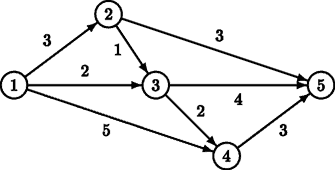
For example, for the above road map, there are two minimal routes from S = 1 to F = 5: 1 → 2 → 5 and 1 → 3 → 5, both of length 6. There is one route that is one distance unit longer: 1 → 3 → 4 → 5, of length 7.
Now, given a (partial) road map of the Benelux and two cities S and F, tour operator Your Personal Holiday likes to know how many different routes it can offer to its clients, under the above restriction on the route length.
Input
The first line of the input file contains a single number: the number of test cases to follow. Each test case has the following format:
One line with two integers N and M, separated by a single space, with 2 ≤ N ≤ 1,000 and 1 ≤ M ≤ 10, 000: the number of cities and the number of roads in the road map.
M lines, each with three integers A, B and L, separated by single spaces, with 1 ≤ A, B ≤ N, A ≠ B and 1 ≤ L ≤ 1,000, describing a road from city A to city B with length L.
The roads are unidirectional. Hence, if there is a road from A to B, then there is not necessarily also a road from B to A. There may be different roads from a city A to a city B.
One line with two integers S and F, separated by a single space, with 1 ≤ S, F ≤ N and S ≠ F: the starting city and the final city of the route.
There will be at least one route from S to F.
Output
For every test case in the input file, the output should contain a single number, on a single line: the number of routes of minimal length or one distance unit longer. Test cases are such, that this number is at most 109 = 1,000,000,000.
Sample Input
2

5 8

1 2 3

1 3 2

1 4 5

2 3 1

2 5 3

3 4 2

3 5 4

4 5 3

1 5

5 6

2 3 1

3 2 1

3 1 10

4 5 2

5 2 7

5 2 7

4 1
Sample Output
3

2
Hint
The first test case above corresponds to the picture in the problem description.
题意:旅行团每天固定的从S地出发到达T地,为了省油要求尽量走最短路径或比最短路径长1单位距离的路径,求满足条件的路径条数
算法:最短路和次短路。Dijkstra算法。采用邻接表建图。
dis[x][2]:dis[x][0]表示起点到x的最短路、dis[x][1]表示起点到x的次短路;
arr[x][2]:arr[x][0]表示起点到x的最短路条数、arr[x][1]表示起点到x的次短路的条数;
vis[x][2]对应于x和0、1功能为记录该点是否被访问!
那么如何更新最小和次小路呢?显然我们容易想到下面的方法:
1.if(x<最小)更新最小,次小;
2.else if(x==最小)更新方法数;
3.else if(x<次小)更新次小;
4.else if(x==次小)更新方法数;
最后说说dijkstra的循环部分、这也是本题的关键。为什么我们要循环2*nnum-1次?显然这道题中我们每一条边都需要考虑、这不是在求最短的一条,说白了是让你求出所有的可能组合,那么我们势必对每一种情况都需要遍历一次,虽然中间有重复。最短路里已知[start][0]已被标记为访问过,那么就只有nnum-1次遍历了,而次短路我们则需要遍历nnum次,这样两者加起来就为2*nnum-1次。这与我们平时使用优先队列+heap是一样的。只是更加细化了而已。
代码:
 //#include<bits/stdc++.h>

 //#include<regex>

 #include <vector>

 #include <cstdio>

 #include "cstring"

 #include <algorithm>

 #define db double

 #define ll long long

 #define vec vector<ll>

 #define Mt  vector<vec>

 #define ci(x) scanf("%d",&x)

 #define cd(x) scanf("%lf",&x)

 #define cl(x) scanf("%lld",&x)

 #define pi(x) printf("%d\n",x)

 #define pd(x) printf("%f\n",x)

 #define pl(x) printf("%lld\n",x)

 #define MP make_pair

 #define PB push_back

 #define fr(i,a,b) for(int i=a;i<=b;i++)

 using namespace std;

 const int N=1e6+;

 const int mod=1e9+;

 const int MOD=mod-;

 const db  eps=1e-;

 //const db  pi = acos(-1.0);

 const int inf = 0x3f3f3f3f;

 const ll  INF = 0x3f3f3f3f3f3f3f3f;

 int h[N],d[N][],c[N][];

 bool vis[N][];

 struct P

 {

     int v,w,nx;

     P(int x,int y,int z):v(x),w(y),nx(z){};

     P(){};

 };

 vector<P> e;

 int cnt,n,m,t;

 void add(int x,int y,int z)

 {

     e.push_back(P(y,z,h[x]));

     h[x]=cnt++;

 }

 void dij(int s,int g)

 {

     memset(vis,, sizeof(vis));

     memset(c,, sizeof(c));

     for(int i=;i<=n;i++){

         d[i][]=inf;

         d[i][]=inf;

     }

     int k,ok;

     d[s][]=,c[s][]=;

     for(int ii=;ii<*n;ii++)

     {

         int ans=inf;

         for(int i=;i<=n;i++){

             if(!vis[i][]&&d[i][]<ans){//取最近的点

                 k=i;

                 ok=;

                 ans=d[i][];

             }

             else if(!vis[i][]&&d[i][]<ans){

                 k=i;

                 ok=;

                 ans=d[i][];

             }

         }

         if(ans==inf) break;

         vis[k][ok]=;

         for(int j=h[k];j!=-;j=e[j].nx){

             int v=e[j].v,w=e[j].w;

             if(d[v][]>ans+w){//更新最短路

                 d[v][]=d[v][];

                 c[v][]=c[v][];

                 d[v][]=ans+w;

                 c[v][]=c[k][ok];

             }

             else if(d[v][]==ans+w){//更新最短路条数

                 c[v][]+=c[k][ok];

             }

             else if(d[v][]>ans+w)//更新次短路

                 d[v][]=ans+w,c[v][]=c[k][ok];

             else if(d[v][]==ans+w)//次短路条数

                 c[v][]+=c[k][ok];

         }

     }

     if(d[g][]==d[g][]+)

         c[g][]+=c[g][];

     pi(c[g][]);

 }

 int main()

 {

     ci(t);

     while(t--)

     {

         ci(n),ci(m);

         e.clear();

         cnt=;

         memset(h,-, sizeof(h));

         for(int i=;i<m;i++){

             int x,y,z;

             ci(x),ci(y),ci(z);

             add(x,y,z);

         }

         int s,g;

         ci(s),ci(g);

         dij(s,g);

     }

     return ;

 }
POJ 3463 最(次)短路条数的更多相关文章
- hdu3191+hdu1688(求最短路和次短路条数,模板)
hdu3191题意:求出次短路的长度和条数 #include<iostream> #include<cstdio> #include<cstring> #inclu ...
- poj 3463 Sightseeing(次短路+条数统计)
/* 对dij的再一次理解 每个点依旧永久标记 只不过这里多搞一维 0 1 表示最短路还是次短路 然后更新次数相当于原来的两倍 更新的时候搞一下就好了 */ #include<iostream& ...
- POJ 3463 Sightseeing (次短路经数)
Sightseeing Time Limit: 2000MS Memory Limit: 65536K Total Submissions:10005 Accepted: 3523 Descr ...
- POJ - 3463 Sightseeing 最短路计数+次短路计数
F - Sightseeing 传送门: POJ - 3463 分析 一句话题意:给你一个有向图,可能有重边,让你求从s到t最短路的条数,如果次短路的长度比最短路的长度多1,那么在加上次短路的条数. ...
- codeforces257 div2 D最短路条数
题意: 给一个无向图,总共有 n个点,m+k条边,给定点所连的k条边可以选择删除 问最多删除多少条可以保持该定点到其他点的最短路不变 题解: 从定点出发做单元最短路 首先如果定点到某个点的最短路小于 ...
- 紧急救援 L2-001 dijkstra 打印路径 最短路条数 权值
较为复杂的dijkstra 包含路径打印 最小路的条数 最小路径的情况下取最大权值 v0要是标记就会出错...? 有权值的题目 不能设置mp[i][i]为0 否则会无限加权 这题很有参考价值 ...
- hdu 3191 How Many Paths Are There (次短路径数)
How Many Paths Are There Time Limit: 2000/1000 MS (Java/Others) Memory Limit: 32768/32768 K (Java ...
- 关于 最短路条数 和 边不可重复最短路条数问题 /hdu3599(边不可重复最短路)
原先一直在做一道省赛题,由于题意错误理解成球最短路条数,误打误撞敲了最短路条数,又发现hdu3599(多校)求边不可重复最短路条数.下面说说俩种问题解法: 最短路条数: 求一个图一共一几条最短路径,思 ...
- poj 3463 最短路与次短路的方案数求解
Sightseeing Time Limit: 2000MS Memory Limit: 65536K Total Submissions: 8968 Accepted: 3139 Descr ...
随机推荐
- 中国象棋(IOS)
//// ViewController.m// ChineseChess//// Created by 晚起的蚂蚁 on 2016/11/20.// Copyright © 2016年 晚起的 ...
- Cocoapods 应用第一部分 - Xcode 创建 .framework 相关
问题的提出: 随着项目的越来越大,可能会出现好几个团队共同维护一个项目的情况,例如:项目组A负责其中的A块,项目组B负责其中的B块.....这几块彼此之间既独立,也相互联系.对于这种情况,可以采用约定 ...
- Git异常情况汇总
本篇博客总结下Git使用情况中遇到的异常情况并给出解决方案,关于Git的常用命令请移步我的另一篇博客<Git常用命令> 异常情况如下: 1.git远程删除分支后,本地git branch ...
- absolute 的containing block( 容器块)计算方式跟正常流有什么不同?
无论属于哪种,都要先找到其祖先元素中最近的 position 值不为 static 的元素,然后再判断:1.若此元素为 inline 元素,则 containing block 为能够包含这个元素生成 ...
- 云端TensorFlow读取数据IO的高效方式
低效的IO方式 最近通过观察PAI平台上TensoFlow用户的运行情况,发现大家在数据IO这方面还是有比较大的困惑,主要是因为很多同学没有很好的理解本地执行TensorFlow代码和分布式云端执行T ...
- 扩展Python模块系列(二)----一个简单的例子
本节使用一个简单的例子引出Python C/C++ API的详细使用方法.针对的是CPython的解释器. 目标:创建一个Python内建模块test,提供一个功能函数distance, 计算空间中两 ...
- python学习之元组与文件
元组 元组是最后一个python集合类型.元组由简单的对象构成,元组与列表非常相似,只不过元组不能在原处修改,并且通常写成圆括号,虽然元组部支持任何方法调用,但元组具有列表的大多数属性. 实际应用中的 ...
- shell脚本报错:"[: =: unary operator expected"
shell脚本报错:"[: =: unary operator expected" 在匹配字符串相等时,我用了类似这样的语句: if [ $STATUS == "OK&q ...
- oracle 11gR2 RAC安装手册
--oracle 11gR2 RAC安装手册 -----------------------------2013/10/29 参考三思笔记 http://files.cnblogs.com/jackh ...
- 0711HTML初体验
今天是正式上课的第一天.这边先记下初学的时候容易忘记的问题.在图片上链接汉子显示是<title="想在图片显示的内容">. 合并单元格,合并行<td colspa ...