
快速模式第二包: quick_inI1_ouR1()
文章目录
1. 序言
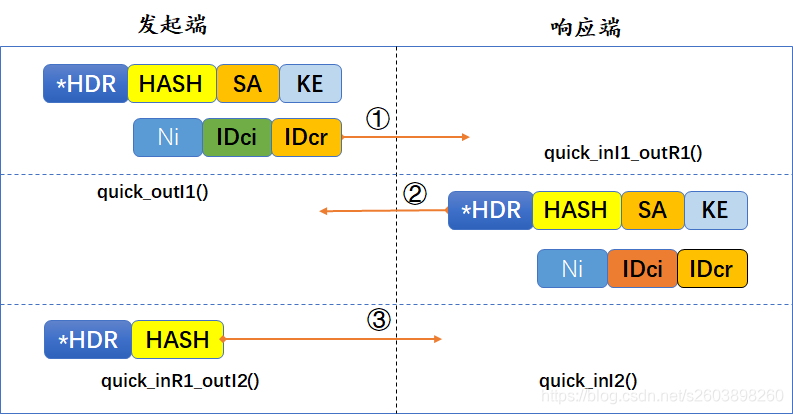
在介绍第②包quick_inI1_outR1()函数之前,先说明下处理流程中的主要的功能:
- 协商第二阶段的SA算法信息,包括AH协议、ESP协议、封装模式等重要参数。
- 密钥材料交换,包括Nonce、KE(可选)。
- 使用ID载荷来协商两端的保护子网范围。
- 建立IPSec SA结构。
- 报文的认证和加密。
从上述作用可以看出,quick_inI1_outR1()及后续函数几乎实现了第一阶段的所有基本交换(第一阶段里的重要载荷在此流程中基本都有实现),因此第二包处理流程算是IKEv1协商流程里最为复杂的流程了。这里只是做一个简单的笔记说明核心流程,无法涉及到完整的交换流程。此外响应端通过此次交换后会建立一个inbound sa,这部分流程尚未看明白处理逻辑(可能在于涉及到内核路由表等内容,目前还没有get到)。因此如果需要深入了解此流程,请参考源码实现。
2. quick_inI1_outR1()流程图
刚才已经说明第二个报文的处理流程比较复杂,实现的功能也较其他接口复杂了很多,从流程图上便可以看出:

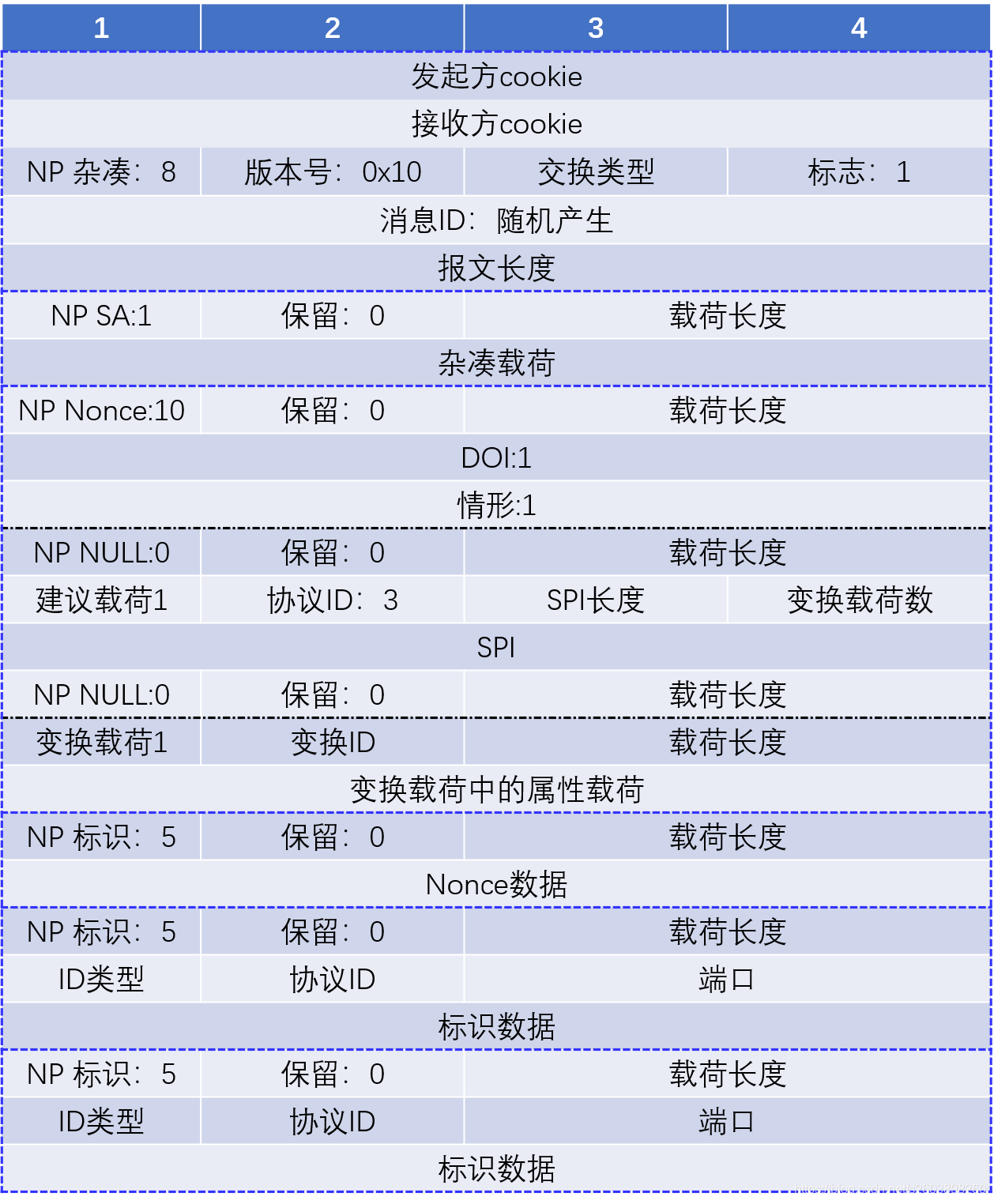
3. 快速模式消息②数据包格式
下表中的报文格式有部分字段应该为变长类型,但是并未标出,这一点请注意。
4. 源码分析
4.1 quick_inI1_outR1()
quick_inI1_outR1()接口的作用包括:
检验报文的完整性
- HASH载荷(杂凑载荷)既可以用来检验报文的完整性,也可以用来实现源认证功能,两者实际上是一致的。它计算范围是除了ISAKMP头部以外的完整报文进行杂凑运算。计算方式为:
H
A
S
H
=
P
R
F
(
S
K
E
Y
I
D
−
a
,
M
s
g
I
D
∣
N
i
∣
S
A
∣
N
r
[
∣
I
D
i
∣
I
D
r
]
)
HASH = PRF(SKEYID-a, MsgID | Ni | SA | Nr [ | IDi | IDr ] )
HASH=PRF(SKEYID−a,MsgID∣Ni∣SA∣Nr[∣IDi∣IDr])
还需要注意的是快速模式的三个报文的HASH载荷的运算模式并不相同。
- HASH载荷(杂凑载荷)既可以用来检验报文的完整性,也可以用来实现源认证功能,两者实际上是一致的。它计算范围是除了ISAKMP头部以外的完整报文进行杂凑运算。计算方式为:
解析报文中的ID载荷
- 快速模式中,身份标识ID载荷缺省定义为ISAKMP双方的协商地址。如果双方需要指定身份ID载荷,则需要按照一定的顺序进行传输:IDi + IDr。还需要注意的是协商隧道时配置的保护子网(感兴趣流)是通过ID载荷来传输并完成协商的。ID载荷可以传输IPv4和IPv6的主机地址、子网地址、地址范围。因此使用ID载荷来协商感兴趣流完全满足需求。使用
emit_subnet_id()来将保护子网填充到ID载荷,使用decode_net_id()将ID载荷解析为保护子网地址.
- 快速模式中,身份标识ID载荷缺省定义为ISAKMP双方的协商地址。如果双方需要指定身份ID载荷,则需要按照一定的顺序进行传输:IDi + IDr。还需要注意的是协商隧道时配置的保护子网(感兴趣流)是通过ID载荷来传输并完成协商的。ID载荷可以传输IPv4和IPv6的主机地址、子网地址、地址范围。因此使用ID载荷来协商感兴趣流完全满足需求。使用
保存IV值,并调用后续处理
quick_inI1_outR1()函数并没有协商保护子网信息,而是在后续接口中进行的协商。(NAT-T相关略)
stf_status

quick_inI1_outR1(struct msg_digest *md)

{

    const struct state *const p1st = md->st;

    struct connection *c = p1st->st_connection;

    struct payload_digest *const id_pd = md->chain[ISAKMP_NEXT_ID];

    struct verify_oppo_bundle b;

    /* HASH(1) in *//*使用第一阶段的算法、计算并检验报文的hash载荷*/

    CHECK_QUICK_HASH(md

	, quick_mode_hash12(hash_val, hash_pbs->roof, md->message_pbs.roof

	    , p1st, &md->hdr.isa_msgid, FALSE)

	, "HASH(1)", "Quick I1");

    /* [ IDci, IDcr ] in

     * We do this now (probably out of physical order) because

     * we wish to select the correct connection before we consult

     * it for policy.

     */

    if (id_pd != NULL)/*如果ID载荷存在*/

    {

	struct payload_digest *IDci = id_pd->next;

	/* ??? we are assuming IPSEC_DOI */

	/* IDci (initiator is peer) */

	if (!decode_net_id(&id_pd->payload.ipsec_id, &id_pd->pbs

			   , &b.his.net, "peer client"))/*获取到对端的网段*/

	    return STF_FAIL + INVALID_ID_INFORMATION;

        /* Hack for MS 818043 NAT-T Update */

        if (id_pd->payload.ipsec_id.isaiid_idtype == ID_FQDN) {/*将单个地址转换为子网地址*/

            loglog(RC_LOG_SERIOUS, "Applying workaround for MS-818043 NAT-T bug");

            memset(&b.his.net, 0, sizeof(ip_subnet));

            happy(addrtosubnet(&c->spd.that.host_addr, &b.his.net));

		}

        /* End Hack for MS 818043 NAT-T Update */

        b.his.proto = id_pd->payload.ipsec_id.isaiid_protoid;

        b.his.port = id_pd->payload.ipsec_id.isaiid_port;

        b.his.net.addr.u.v4.sin_port = htons(b.his.port);

        /* IDcr (we are responder) */

        if (!decode_net_id(&IDci->payload.ipsec_id, &IDci->pbs

                   , &b.my.net, "our client"))

            return STF_FAIL + INVALID_ID_INFORMATION;

        b.my.proto = IDci->payload.ipsec_id.isaiid_protoid;

        b.my.port = IDci->payload.ipsec_id.isaiid_port;

        b.my.net.addr.u.v4.sin_port = htons(b.my.port);

#ifdef NAT_TRAVERSAL

        /*

         * 略

         */

#endif

    }

    else

    {  /*载荷中不存在ID载荷,如果两端的地址类型不一致的化则返回错误

        *

        *如果不存在ID载荷,则使用协商地址作为保护子网

        */

        /* implicit IDci and IDcr: peer and self */

        if (!sameaddrtype(&c->spd.this.host_addr, &c->spd.that.host_addr))

            return STF_FAIL;

    /*默认使用IP地址当作ID*/

        happy(addrtosubnet(&c->spd.this.host_addr, &b.my.net));

        happy(addrtosubnet(&c->spd.that.host_addr, &b.his.net));

        b.his.proto = b.my.proto = 0;

        b.his.port = b.my.port = 0;

    }

    b.step = vos_start;

    b.md = md;

    b.new_iv_len = p1st->st_new_iv_len;

    save_new_iv(p1st, b.new_iv);

    /*

     * FIXME - DAVIDM

     * "b" is on the stack,  for OPPO  tunnels this will be bad, in

     * quick_inI1_outR1_start_query it saves a pointer to it before

     * a crypto (async op).

     */

return quick_inI1_outR1_authtail(&b, NULL);

}
4.2 quick_inI1_outR1_authtail()
quick_inI1_outR1_authtail()函数作用包括如下几个:
根据子网信息查询连接
这部分代码没有看懂。
。按常理来说,接收此报文时已经确定了连接和状态信息,直接比较连接上的保护子网信息和SA载荷中的保护子网信息,确定是否匹配即可。但是openswan源码中的逻辑负责了很多,没有看明白这部分代码,先留一个疑问吧。
根据连接创建新的状态
解析IPSec SA建议载荷
解析SA载荷:
parse_ipsec_sa_body()这个接口是快速模式协商IPSec策略的核心接口,包括封装协议 (ESP | AH | IPCOM)、加密算法、认证算法(完整性算法)、隧道模式or传输模式等等,都是在此接口中进行协商的。此外,该函数也可以完成应答报文的SA载荷的封装。
近700行的代码,不再另行说明了。
解析Nonce载荷
如果支持PFS,则解析KE载荷
- 启动PFS功能(完美向前加密),则第二阶段需要再进行一次DH交换,因此需要重新计算生成KE载荷。PFS简单的说如果第一阶段的秘钥被破解(无论采用何种方式),由第一阶段密钥衍生的第二阶段密钥则不受影响。这就要求在第二阶段再次进行DH交换。
构建密钥交换材料申请结构信息,包括:
- 本端的KE载荷
- 本端的Nonce载荷
static stf_status

quick_inI1_outR1_authtail(struct verify_oppo_bundle *b

		      , struct adns_continuation *ac)

{

    struct msg_digest *md = b->md;

    struct state *const p1st = md->st;

    struct connection *c = p1st->st_connection;

    ip_subnet *our_net = &b->my.net

	, *his_net = &b->his.net;

    struct end our, peer;

    struct hidden_variables hv;

    zero(&our); zero(&peer);

    our.host_type  = KH_IPADDR;

    our.client     = b->my.net;

    our.port       = b->my.port;

    our.protocol   = b->my.proto;

    our.has_client = TRUE;

    peer.host_type  = KH_IPADDR;

    peer.client     = b->his.net;

    peer.port       = b->his.port;

    peer.protocol   = b->his.proto;

    peer.has_client = TRUE;

    /*log信息*/

    /* Now that we have identities of client subnets, we must look for

     * a suitable connection (our current one only matches for hosts).

     */

	struct connection *p = find_client_connection(c, &our, &peer);/*根据两端的保护子网来查询连接*/

	... ...

    /* now that we are sure of our connection, create our new state */

    {

	struct state *const st = duplicate_state(p1st);

	/* first: fill in missing bits of our new state object

	 * note: we don't copy over st_peer_pubkey, the public key

	 * that authenticated the ISAKMP SA.  We only need it in this

	 * routine, so we can "reach back" to p1st to get it.

	 */

	if (st->st_connection != c)

	{

	    struct connection *t = st->st_connection;

	    st->st_connection = c;

	    set_cur_connection(c);

	    connection_discard(t);

	}

	st->st_try = 0;	/* not our job to try again from start */

	st->st_msgid = md->hdr.isa_msgid;

	st->st_new_iv_len = b->new_iv_len;

	set_new_iv(st, b->new_iv);

	set_cur_state(st);	/* (caller will reset) */

	md->st = st;	        /* feed back new state */

	st->st_peeruserprotoid = b->his.proto;

	st->st_peeruserport = b->his.port;

	st->st_myuserprotoid = b->my.proto;

	st->st_myuserport = b->my.port;

	change_state(st, STATE_QUICK_R0);

	insert_state(st);	/* needs cookies, connection, and msgid */

	/* copy hidden variables (possibly with changes) */

	st->hidden_variables = hv;

	/* copy the connection's

	 * IPSEC policy into our state.  The ISAKMP policy is water under

	 * the bridge, I think.  It will reflect the ISAKMP SA that we

	 * are using.

	 */

	st->st_policy = (p1st->st_policy & POLICY_ID_AUTH_MASK)

	    | (c->policy & ~POLICY_ID_AUTH_MASK);

#ifdef NAT_TRAVERSAL

	...

#endif

	passert(st->st_connection != NULL);

	passert(st->st_connection == c);

	/* process SA in */

	{

	    struct payload_digest *const sapd = md->chain[ISAKMP_NEXT_SA];

	    pb_stream in_pbs = sapd->pbs;

	    /* parse and accept body, setting variables, but not forming

	     * our reply. We'll make up the reply later on.

	     *

	     * note that we process the copy of the pbs, so that

	     * we can process it again in the cryptotail().

	     */

	    st->st_pfs_group = &unset_group;

	    RETURN_STF_FAILURE(parse_ipsec_sa_body(&in_pbs

						   , &sapd->payload.sa

						   , NULL

						   , FALSE, st));

	}

	/* Ni in *//*Nonce载荷存储在state上*/

	RETURN_STF_FAILURE(accept_v1_nonce(md, &st->st_ni, "Ni"));

	/* [ KE ] in (for PFS) *//*KE载荷存储在state上*/

	RETURN_STF_FAILURE(accept_PFS_KE(md, &st->st_gi

					 , "Gi", "Quick Mode I1"));

	/*本端的KE和NONCE载荷哪里进行的填充???*/

	passert(st->st_pfs_group != &unset_group);

	passert(st->st_connection != NULL);

	{/*根据发起端的KE和Nonce载荷,生成本端的ke和Nonce材料*/

	    struct qke_continuation *qke = alloc_thing(struct qke_continuation

						      , "quick_outI1 KE");

	    stf_status e;

	    enum crypto_importance ci;

	    ci = pcim_ongoing_crypto;

	    if(ci < st->st_import) ci = st->st_import;

	    qke->md = md;

	    pcrc_init(&qke->qke_pcrc);

	    qke->qke_pcrc.pcrc_func = quick_inI1_outR1_cryptocontinue1;

	    if (st->st_pfs_group != NULL) {/*支持PFS???*/

		e = build_ke(&qke->qke_pcrc, st, st->st_pfs_group, ci);

	    } else {

		e = build_nonce(&qke->qke_pcrc, st, ci);

	    }

	    passert(st->st_connection != NULL);

	    return e;

	}

    }

}
4.3 quick_inI1_outR1_cryptocontinue1()
quick_inI1_outR1_cryptocontinue1()函数的作用如下:
- 提取计算得到的Nonce载荷
- 如果启动PFS功能,则计算DH密钥信息
- 如果未启动PFS功能,则进行应答报文封装操作
static void

quick_inI1_outR1_cryptocontinue1(struct pluto_crypto_req_cont *pcrc

				 , struct pluto_crypto_req *r

				 , err_t ugh)

{

    struct qke_continuation *qke = (struct qke_continuation *)pcrc;

    struct msg_digest *md = qke->md;

    struct state *const st = state_with_serialno(qke->qke_pcrc.pcrc_serialno);/*根据序号查找状态*/

    stf_status e;

    set_cur_state(st);	/* we must reset before exit */

    st->st_calculating=FALSE;

    set_suspended(st, NULL);

    /* we always calcualte a nonce */

    unpack_nonce(&st->st_nr, r);/*提取Nonce值*/

    if (st->st_pfs_group != NULL) {/*如果支持PFS,则需要进行第二次DH协商*/

		struct dh_continuation *dh = alloc_thing(struct dh_continuation

							 , "quick outR1 DH");

		unpack_KE(st, r, &st->st_gr);

		/* set up second calculation */

		dh->md = md;

		set_suspended(st, md);

		pcrc_init(&dh->dh_pcrc);

		dh->dh_pcrc.pcrc_func = quick_inI1_outR1_cryptocontinue2;

		e = start_dh_secret(&dh->dh_pcrc, st

				    , st->st_import

				    , RESPONDER

				    , st->st_pfs_group->group);

		/* In the STF_INLINE, quick_inI1_outR1_cryptocontinue1 has already

		 * called complete_v1_state_transition and it has freed *dh. It

		 * called quick_inI1_outR1_cryptocontinue2 which did the release_md too.

		 */

		if(e != STF_SUSPEND && e != STF_INLINE) {

		    if(dh->md != NULL) {

			complete_v1_state_transition(&qke->md, e);

			if(dh->md) release_md(qke->md);

		    }

		}

    } else {/*无需第二次DH协商*/

		/* but if PFS is off, we don't do a second DH, so

		 * just call the continuation after making something up.

		 */

		struct dh_continuation dh;

		dh.md=md;

		e = quick_inI1_outR1_cryptotail(&dh, NULL);

		if(e == STF_OK) {

			if(dh.md != NULL) {

		    		/* note: use qke-> pointer */

		    		complete_v1_state_transition(&qke->md, e);

		    		if(dh.md)

					release_md(qke->md);

			}

		}

    }

    reset_cur_state();

}
4.4 quick_inI1_outR1_cryptotail()
quick_inI1_outR1_cryptotail()函数的作用如下:
构建应答报文
- ISAKMP头部
- HASH载荷
- SA载荷
- Nonce载荷
- KE载荷
- ID载荷
计算报文的哈希值
生成密钥材料:
compute_keymats不同协议生成不同的keymats, 如AH、ESP分别生成不同的keymats。
计算公式:
K
E
Y
M
A
T
=
P
R
F
(
S
K
E
Y
I
D
—
d
,
p
r
o
t
o
c
o
l
∣
S
P
I
∣
N
i
−
b
∣
N
r
−
b
)
KEYMAT = PRF(SKEYID—d, protocol | SPI | Ni-b | Nr-b)
KEYMAT=PRF(SKEYID—d,protocol∣SPI∣Ni−b∣Nr−b)
实现中将所有算法需要的密钥长度全部相加,通过反馈连接方法从而生成所需长度的密钥材料。
建立入ipsec sa:
install_inbound_ipsec_sa- 最最关键的部分没看懂…
加密报文
static stf_status

quick_inI1_outR1_cryptotail(struct dh_continuation *dh

			   , struct pluto_crypto_req *r)

{

    struct msg_digest *md = dh->md;

    struct state *st = md->st;

    struct payload_digest *const id_pd = md->chain[ISAKMP_NEXT_ID];

    struct payload_digest *const sapd = md->chain[ISAKMP_NEXT_SA];

    struct isakmp_sa sa = sapd->payload.sa;

    pb_stream r_sa_pbs;

    u_char	/* set by START_HASH_PAYLOAD: */

	*r_hashval,	/* where in reply to jam hash value */

	*r_hash_start;	/* from where to start hashing */

    /* Start the output packet.

     *

     * proccess_packet() would automatically generate the HDR*

     * payload if smc->first_out_payload is not ISAKMP_NEXT_NONE.

     * We don't do this because we wish there to be no partially

     * built output packet if we need to suspend for asynch DNS.

     *

     * We build the reply packet as we parse the message since

     * the parse_ipsec_sa_body emits the reply SA

     */

    /* HDR* out */

    echo_hdr(md, TRUE, ISAKMP_NEXT_HASH);

    /* HASH(2) out -- first pass *//*填充HASH载荷并清零hash数据部分*/

    START_HASH_PAYLOAD(md->rbody, ISAKMP_NEXT_SA);

    passert(st->st_connection != NULL);

    /* sa header is unchanged -- except for np *//*SA载荷头部未发生改变,直接填充即可*/

    sa.isasa_np = ISAKMP_NEXT_NONCE;

    if (!out_struct(&sa, &isakmp_sa_desc, &md->rbody, &r_sa_pbs))

	return STF_INTERNAL_ERROR;

    /* parse and accept body, this time recording our reply *//*再次匹配SA载荷,然后将

   * 匹配的SA载荷填充到r_sa_pbs中*/

    RETURN_STF_FAILURE(parse_ipsec_sa_body(&sapd->pbs

					   , &sapd->payload.sa

					   , &r_sa_pbs

					   , FALSE, st));

    /**** packet payload: HDR SA Nr [, KE ] [, IDci, IDcr ] ****/

    passert(st->st_pfs_group != &unset_group);

    if ((st->st_policy & POLICY_PFS) && st->st_pfs_group == NULL) {

	loglog(RC_LOG_SERIOUS, "we require PFS but Quick I1 SA specifies no GROUP_DESCRIPTION");

	return STF_FAIL + NO_PROPOSAL_CHOSEN;	/* ??? */

    }

    openswan_log("responding to Quick Mode proposal {msgid:%08x}", st->st_msgid);

    {

	char instbuf[END_BUF];

	struct connection *c = st->st_connection;

	struct spd_route *sr = &c->spd;

	format_end(instbuf, sizeof(instbuf),&sr->this,&sr->that,TRUE, LEMPTY);

	openswan_log("    us: %s", instbuf);

	format_end(instbuf, sizeof(instbuf),&sr->that,&sr->this,FALSE, LEMPTY);	openswan_log("  them: %s", instbuf);

    }

    /**** finish reply packet: Nr [, KE ] [, IDci, IDcr ] ****/

    {

	int np;

#ifdef IMPAIR_UNALIGNED_R1_MSG

	char *padstr=getenv("PLUTO_UNALIGNED_R1_MSG");

	if(padstr) {

	    np = ISAKMP_NEXT_VID;

	} else

#endif

	if(st->st_pfs_group != NULL) {

	    np = ISAKMP_NEXT_KE;

	} else if(id_pd != NULL) {

	    np = ISAKMP_NEXT_ID;

	} else {

	    np = ISAKMP_NEXT_NONE;

	}

	/* Nr out */

	if (!justship_nonce(&st->st_nr, &md->rbody, np, "Nr"))

	    return STF_INTERNAL_ERROR;

#ifdef IMPAIR_UNALIGNED_R1_MSG

	if(padstr) {

	    pb_stream vid_pbs;

	    int padsize;

	    padsize = strtoul(padstr, NULL, 0);

	    openswan_log("inserting fake VID payload of %u size", padsize);

	    if(st->st_pfs_group != NULL) {

		np = ISAKMP_NEXT_KE;

	    } else if(id_pd != NULL) {

		np = ISAKMP_NEXT_ID;

	    } else {

		np = ISAKMP_NEXT_NONE;

	    }

	    if (!out_generic(np,

			     &isakmp_vendor_id_desc, &md->rbody, &vid_pbs))

		return STF_INTERNAL_ERROR;

	    if (!out_zero(padsize, &vid_pbs, "Filler VID"))

		return STF_INTERNAL_ERROR;

	    close_output_pbs(&vid_pbs);

	}

#endif

    }

    /* [ KE ] out (for PFS) */

    if (st->st_pfs_group != NULL && r!=NULL) {

	if (!justship_KE(&st->st_gr

			 , &md->rbody

			 , id_pd != NULL? ISAKMP_NEXT_ID : ISAKMP_NEXT_NONE))

	    return STF_INTERNAL_ERROR;

	finish_dh_secret(st, r);

        if(!r->pcr_success) {

            return STF_FAIL + INVALID_KEY_INFORMATION;

        }

    }

    /* [ IDci, IDcr ] out */

    if  (id_pd != NULL)	{

	struct isakmp_ipsec_id *p = (void *)md->rbody.cur;	/* UGH! */

	if (!out_raw(id_pd->pbs.start, pbs_room(&id_pd->pbs), &md->rbody, "IDci"))

	    return STF_INTERNAL_ERROR;

	p->isaiid_np = ISAKMP_NEXT_ID;

	p = (void *)md->rbody.cur;	/* UGH! */

	if (!out_raw(id_pd->next->pbs.start, pbs_room(&id_pd->next->pbs), &md->rbody, "IDcr"))

	    return STF_INTERNAL_ERROR;

	p->isaiid_np = ISAKMP_NEXT_NONE;

    }

#ifdef TPM

    {

	pb_stream *pbs = &md->rbody;

	size_t enc_len = pbs_offset(pbs) - sizeof(struct isakmp_hdr);

	TCLCALLOUT_crypt("preHash", st,pbs,sizeof(struct isakmp_hdr),enc_len);

	r_hashval = tpm_relocateHash(pbs);

    }

#endif

    /* Compute reply HASH(2) and insert in output */

    (void)quick_mode_hash12(r_hashval, r_hash_start, md->rbody.cur

			    , st, &st->st_msgid, TRUE);

    /* Derive new keying material */

    compute_keymats(st);

    /* Tell the kernel to establish the new inbound SA

     * (unless the commit bit is set -- which we don't support).

     * We do this before any state updating so that

     * failure won't look like success.

     */

    if (!install_inbound_ipsec_sa(md->pst, st))

	return STF_INTERNAL_ERROR;	/* ??? we may be partly committed */

    /* encrypt message, except for fixed part of header */

    if (!encrypt_message(&md->rbody, st))

    {

	delete_ipsec_sa(st, TRUE);

	return STF_INTERNAL_ERROR;	/* ??? we may be partly committed */

    }

    DBG(DBG_CONTROLMORE, DBG_log("finished processing quick inI1"));

    return STF_OK;

}
5. 其他接口源码分析
5.1 decode_net_id()
decode_net_id()函数的作用:
解析报文中的ID载荷,并将主机地址、子网地址、地址范围转换为子网信息。
这里解析的子网信息用于协商感兴趣流(保护子网)参数
- 如果类型为“ID_IPV4_ADDR”或者“ID_IPV6_ADDR”,则说明为单个主机地址,解析后转换为子网地址,掩码长度为32位;
- 如果类型为"ID_IPV4_ADDR_SUBNET"或者“ID_IPV6_ADDR_RANGE”,则表明ID载荷数据部分是子网信息,包含两部分:网络地址和子网掩码。通过网络地址和子网掩码共同确定保护子网信息。
- 如果类型为“ID_IPV4_ADDR_RANGE”或者“ID_IPV6_ADDR_RANGE”,则同样表明ID载荷数据是一个地址范围,包含两部分内容:起始地址和终止地址。需要注意的时,这里目前仅支持标准的子网范围,而非任意子网范围,这点需要注意(详情参见
rangetosubnet())。
static bool

decode_net_id(struct isakmp_ipsec_id *id

, pb_stream *id_pbs

, ip_subnet *net

, const char *which)

{

    const struct af_info *afi = NULL;

    /* Note: the following may be a pointer into static memory

     * that may be recycled, but only if the type is not known.

     * That case is disposed of very early -- in the first switch.

     */

    const char *idtypename = enum_show(&ident_names, id->isaiid_idtype);

/*

* 子网ID可能为单个地址、子网、子网范围

*

*/

    switch (id->isaiid_idtype)

    {

	case ID_IPV4_ADDR:

	case ID_IPV4_ADDR_SUBNET:

	case ID_IPV4_ADDR_RANGE:

	    afi = &af_inet4_info;

	    break;

	case ID_IPV6_ADDR:

	case ID_IPV6_ADDR_SUBNET:

	case ID_IPV6_ADDR_RANGE:

	    afi = &af_inet6_info;

	    break;

	case ID_FQDN:

	    loglog(RC_COMMENT, "%s type is FQDN", which);

	    return TRUE;

	default:

	    /* XXX support more */

	    loglog(RC_LOG_SERIOUS, "unsupported ID type %s"

		, idtypename);

	    /* XXX Could send notification back */

	    return FALSE;

    }

    switch (id->isaiid_idtype)

    {

	case ID_IPV4_ADDR:/*ID载荷为单个地址*/

	case ID_IPV6_ADDR:

	{

	    ip_address temp_address;

	    err_t ughmsg;

	    ughmsg = initaddr(id_pbs->cur, pbs_left(id_pbs), afi->af, &temp_address);

	    if (ughmsg != NULL)

	    {

		loglog(RC_LOG_SERIOUS, "%s ID payload %s has wrong length in Quick I1 (%s)"

		    , which, idtypename, ughmsg);

		/* XXX Could send notification back */

		return FALSE;

	    }

	    if (isanyaddr(&temp_address))

	    {

		loglog(RC_LOG_SERIOUS, "%s ID payload %s is invalid (%s) in Quick I1"

		    , which, idtypename, ip_str(&temp_address));

		/* XXX Could send notification back */

		return FALSE;

	    }

	    happy(addrtosubnet(&temp_address, net));/*将单个地址解析为保护子网地址*/

	    DBG(DBG_PARSING | DBG_CONTROL

		, DBG_log("%s is %s", which, ip_str(&temp_address)));

	    break;

	}

	case ID_IPV4_ADDR_SUBNET:/*如果ID为子网信息*/

	case ID_IPV6_ADDR_SUBNET:

	{

	    ip_address temp_address, temp_mask;

	    err_t ughmsg;

	    if (pbs_left(id_pbs) != 2 * afi->ia_sz)/*子网信息包括IP和掩码,因此长度*2  */

	    {

		loglog(RC_LOG_SERIOUS, "%s ID payload %s wrong length in Quick I1"

		    , which, idtypename);

		/* XXX Could send notification back */

		return FALSE;

	    }

	    ughmsg = initaddr(id_pbs->cur

		, afi->ia_sz, afi->af, &temp_address);/*解析子网地址*/

	    if (ughmsg == NULL)

		ughmsg = initaddr(id_pbs->cur + afi->ia_sz

		    , afi->ia_sz, afi->af, &temp_mask);/*解析子网掩码*/

	    if (ughmsg == NULL)

		ughmsg = initsubnet(&temp_address, masktocount(&temp_mask)

		    , '0', net);

	    if (ughmsg == NULL && subnetisnone(net))

		ughmsg = "contains only anyaddr";

	    if (ughmsg != NULL)

	    {

		loglog(RC_LOG_SERIOUS, "%s ID payload %s bad subnet in Quick I1 (%s)"

		    , which, idtypename, ughmsg);

		/* XXX Could send notification back */

		return FALSE;

	    }

	    DBG(DBG_PARSING | DBG_CONTROL,

		{

		    char temp_buff[SUBNETTOT_BUF];

		    subnettot(net, 0, temp_buff, sizeof(temp_buff));

		    DBG_log("%s is subnet %s", which, temp_buff);

		});

	    break;

	}

	case ID_IPV4_ADDR_RANGE:

	case ID_IPV6_ADDR_RANGE:

	{

	    ip_address temp_address_from, temp_address_to;

	    err_t ughmsg;

	    if (pbs_left(id_pbs) != 2 * afi->ia_sz)

	    {

		loglog(RC_LOG_SERIOUS, "%s ID payload %s wrong length in Quick I1"

		    , which, idtypename);

		/* XXX Could send notification back */

		return FALSE;

	    }/*解析子网地址*/

	    ughmsg = initaddr(id_pbs->cur, afi->ia_sz, afi->af, &temp_address_from);

	    if (ughmsg == NULL)/*解析子网掩码*/

		ughmsg = initaddr(id_pbs->cur + afi->ia_sz

		    , afi->ia_sz, afi->af, &temp_address_to);

	    if (ughmsg != NULL)

	    {

		loglog(RC_LOG_SERIOUS, "%s ID payload %s malformed (%s) in Quick I1"

		    , which, idtypename, ughmsg);

		/* XXX Could send notification back */

		return FALSE;

	    }

	    ughmsg = rangetosubnet(&temp_address_from, &temp_address_to, net);

	    if (ughmsg == NULL && subnetisnone(net))

		ughmsg = "contains only anyaddr";

	    if (ughmsg != NULL)

	    {

		char temp_buff1[ADDRTOT_BUF], temp_buff2[ADDRTOT_BUF];

		addrtot(&temp_address_from, 0, temp_buff1, sizeof(temp_buff1));

		addrtot(&temp_address_to, 0, temp_buff2, sizeof(temp_buff2));

		loglog(RC_LOG_SERIOUS, "%s ID payload in Quick I1, %s"

		    " %s - %s unacceptable: %s"

		    , which, idtypename, temp_buff1, temp_buff2, ughmsg);

		return FALSE;

	    }

	    DBG(DBG_PARSING | DBG_CONTROL,

		{

		    char temp_buff[SUBNETTOT_BUF];

		    subnettot(net, 0, temp_buff, sizeof(temp_buff));

		    DBG_log("%s is subnet %s (received as range)"

			, which, temp_buff);

		});

	    break;

	}

    }

    /* set the port selector */

    setportof(htons(id->isaiid_port), &net->addr);

    DBG(DBG_PARSING | DBG_CONTROL,

        DBG_log("%s protocol/port is %d/%d", which, id->isaiid_protoid, id->isaiid_port)

    )

    return TRUE;

}
5.2 emit_subnet_id()
emit_subnet_id()函数的作用:
- 将隧道的保护子网地址转换为ID载荷内容,然后封装到报文中。
这个函数默认使用保护子网地址填充ID载荷(usehost===FALSE)。此函数与decode_net_id()共同完成保护子网地址的转换工作。
*填充的是隧道端口IP还是子网的信息?

*保护子网是如何协商的???

*/

static bool

emit_subnet_id(struct end *e

	       , u_int8_t np

               , ip_address endpoint

	       , u_int8_t protoid

	       , u_int16_t port

	       , pb_stream *outs)

{

    struct isakmp_ipsec_id id;

    pb_stream id_pbs;

    ip_address ta;

    unsigned char *tbp;

    size_t tal;

    const struct af_info *ai;

    bool usehost = FALSE;

    ip_subnet clientnet;

    clientnet = e->client;

    if(!e->has_client) {

        /* we propose the IP address of the interface that we are using. */

        /*

     * we could instead propose 0.0.0.0->255.255.255.255 and let the other

     * end narrow the TS, but if one wants that, it is easy to just specify

     * in the configuration file: rightsubnet=0.0.0.0/0.

     *

     * When there is NAT involved, we may really want a tunnel to the

     * address that this end point thinks it is.  That works only when

     * virtual_ip includes the IP involved.

     *

     */

        addrtosubnet(&endpoint, &clientnet);

    }

    ai = aftoinfo(subnettypeof(&clientnet));

    passert(ai != NULL);

    id.isaiid_np = np;

    id.isaiid_idtype = (usehost ? ai->id_addr : ai->id_subnet);/*确定使用主机ID还是子网ID*/

    id.isaiid_protoid = protoid;

    id.isaiid_port = port;

    if (!out_struct(&id, &isakmp_ipsec_identification_desc, outs, &id_pbs))

	return FALSE;

    networkof(&clientnet, &ta);/*获取保护子网*/

    tal = addrbytesptr(&ta, &tbp);

    if (!out_raw(tbp, tal, &id_pbs, "client network"))/*填充保护子网信息*/

	return FALSE;

    if(!usehost)

    {

	maskof(&clientnet, &ta);/*获取保护子网掩码*/

	tal = addrbytesptr(&ta, &tbp);

	if (!out_raw(tbp, tal, &id_pbs, "client mask"))/*填充保护子网掩码信息*/

	    return FALSE;

    }

    close_output_pbs(&id_pbs);

    return TRUE;

}
6. 小结
快速模式的第二个报文流程相对其他报文复杂了很多,尚有很多关键部分没有完全没有理解。每有会意,再做更新,如果有get到的,请分享下共同进步。
快速模式第二包: quick_inI1_ouR1()的更多相关文章
- 快速模式第一包: quick_outI1()
文章目录 1. 序言 2. quick_outI1()流程图 3. quick_outI1()源码分析 4. quick_outI1_continue()源码分析 5. quick_outI1_tai ...
- IKEv2协议协商流程: (IKE-SA-INIT 交换)第二包
IKEv2协议协商流程: (IKE-SA-INIT 交换)第二包 文章目录 IKEv2协议协商流程: (IKE-SA-INIT 交换)第二包 1. IKEv2 协商总体框架 2. 第二包流程图 3. ...
- openswan中ISAKMP交互过程关键函数接口
1. ISAKMP交互过程中关键函数接口 下面分别说明不同的阶段和模式下的函数接口以及对应的报文. 2. 第一阶段(Phase I)主模式函数接口 发送端 响应端 main_outI1 主模式第一包 ...
- IPsec 9个包分析(主模式+快速模式)
第一阶段:ISAKMP协商阶段 1.1 第一包 包1:发起端协商SA,使用的是UDP协议,端口号是500,上层协议是ISAKMP,该协议提供的是一个框架,里面的负载Next payload类似模块,可 ...
- 快速模式第三包:quick_inR1_outI2()
快速模式第三包:quick_inR1_outI2() 文章目录 快速模式第三包:quick_inR1_outI2() 1. 序言 2. quick_inR1_outI2()的处理流程 3. 快速模式第 ...
- 韩顺刚-tcp报文头协议详细分析第一包数据:序号是0,发送数据的长度是0,因为没有收到对端的数据,所以确认号是0, Syn的标志位设置成1,这里没有发送的数据,只发送TCP的20个字节的头部
TCP报文段首部格式 大部分TCP报文头部都是20个字节,有的数据包要加上选项. 上面一行代表4个字节,源端口和目的端口都是2个字节. TCP协议是面向字节流的协议 TCP是一段一段分块的发送数据的 ...
- openswan IPSec专栏目录锦集
为了方便查阅现有的文章,特准备一个目录页供后续查询使用 专栏序言 1. 基础知识 openswan任务调度基础知识之信号 2. openswan环境搭建 openswan框架和编译时说明 opensw ...
- 低功耗蓝牙BLE之连接事件、连接参数和更新方法
转自:http://blog.csdn.net/zzfenglin/article/details/51304084 连接事件 在一个连接当中,主设备会在每个连接事件里向从设备发送数据包.一个连接事件 ...
- TCP中异常关闭链接的意义 异常关闭的情况
终止一个连接的正常方式是发送FIN. 在发送缓冲区中 所有排队数据都已发送之后才发送FIN,正常情况下没有任何数据丢失. 但我们有时也有可能发送一个RST报文段而不是F IN来中途关闭一个连接.这称为 ...
随机推荐
- 大数据学习(19)—— Flume环境搭建
系统要求 Java1.8或以上 内存要足够大 硬盘足够大 Agent对源和目的要有读写权限 Flume部署 我这8G内存的电脑之前搭建Hadoop.Hive和HBase已经苟延残喘了,怀疑会卡死,硬着 ...
- SpringBoot 默认json解析器详解和字段序列化自定义
前言 在我们开发项目API接口的时候,一些没有数据的字段会默认返回NULL,数字类型也会是NULL,这个时候前端希望字符串能够统一返回空字符,数字默认返回0,那我们就需要自定义json序列化处理 Sp ...
- 学习笔记-CCS-MSP430F5529[快速入门篇一]
由于最近竞赛需要使用TI公司的MSP430系列芯片,本人在最近两天匆忙的学习了一下MSP430F5529(下文统一称作5529)的使用.写下本文是为了将这两天学习内容做一个复习,并且将学习过程中遇到的 ...
- 2010 NOIP提高组题解
机器翻译 用队列模拟题意即可 #include<cstdio> #include<iostream> #include<cstring> using namespa ...
- 苹果手机点击输入框input 页面放大 超出屏幕问题
<meta name="viewport" content="width=device-width,minimum-scale=1.0,maximum-scale ...
- linux笔记1(不全,无图版)随笔
1.ls 查看当前目录下的所有内容 黑色的是文件,蓝色的是文件夹,也就是目录 2.rm -f anaconda-ks. cfg 彻底删除文件(如不确定,则需要先保存备份,也就是快照) 3.ifconf ...
- Linux中配置ftp传输
.personSunflowerP { background: rgba(51, 153, 0, 0.66); border-bottom: 1px solid rgba(0, 102, 0, 1); ...
- 浅谈C#取消令牌CancellationTokenSource
前言 相信大家在使用C#进行开发的时候,特别是使用异步的场景,多多少少会接触到CancellationTokenSource.看名字就知道它和取消异步任务相关的,而且一看便知大名鼎鼎的Cancella ...
- vue服务端渲染之nuxtjs
前言 本篇主要针对nuxtjs中的一些重要概念整理和代码实现! 在学习vue服务端渲染之前,先搞清楚几个概念: 什么是客户端渲染(CSR) 什么是服务端渲染(SSR) CSR和SSR有什么异同 客户端 ...
- ElasticSearch进阶篇(一)--版本控制
一.前言 ElasticSearch(以下简称ES)的数据写入支持高并发,高并发就会带来很普遍的数据一致性问题.常见的解决方法就是加锁.同样,ES为了保证高并发写的数据一致性问题,加入了类似于锁的实现 ...