
卷积神经网络入门:LeNet5(手写体数字识别)详解
第一张图包括8层LeNet5卷积神经网络的结构图,以及其中最复杂的一层S2到C3的结构处理示意图。
第二张图及第三张图是用tensorflow重写LeNet5网络及其注释。
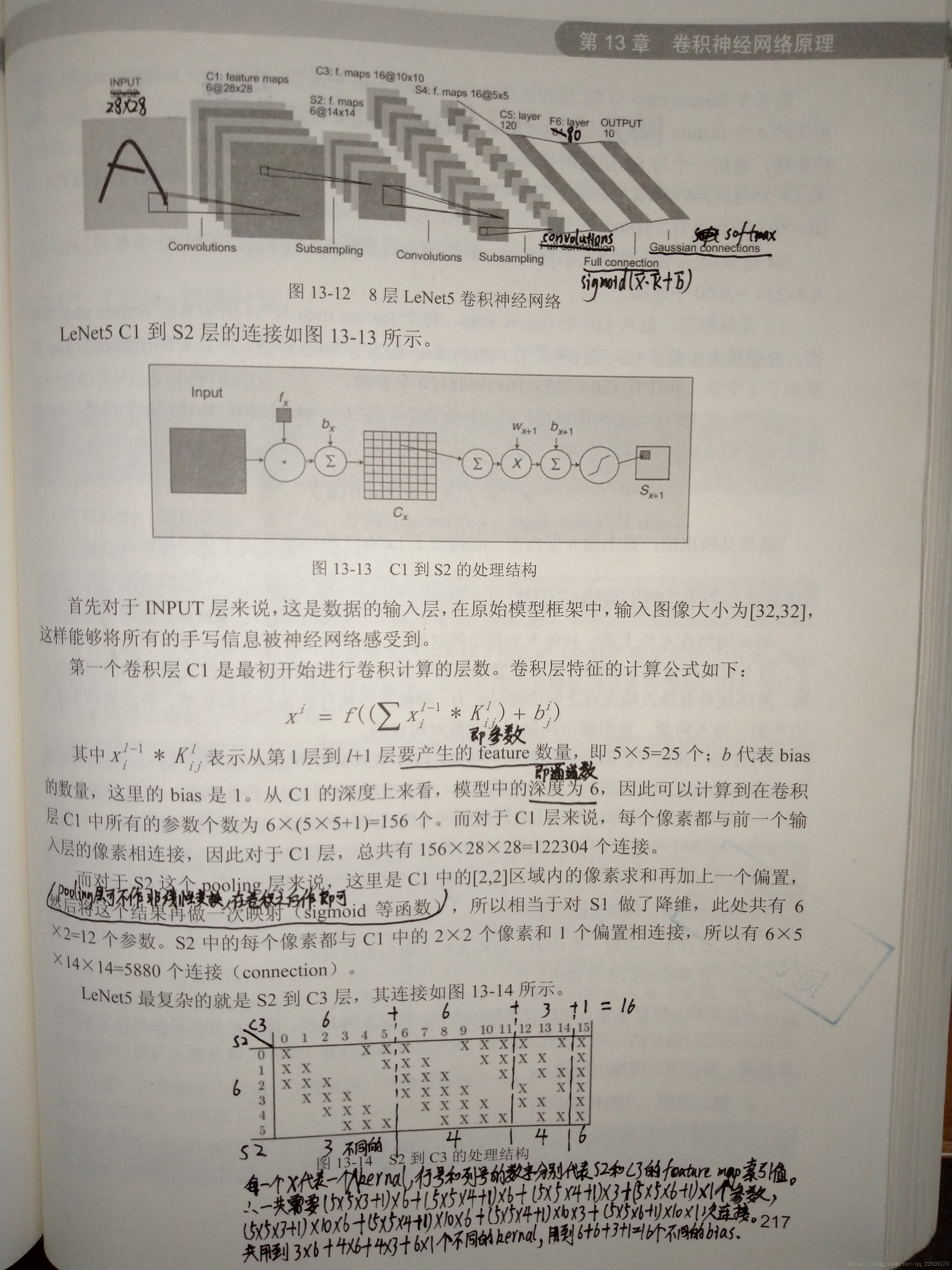
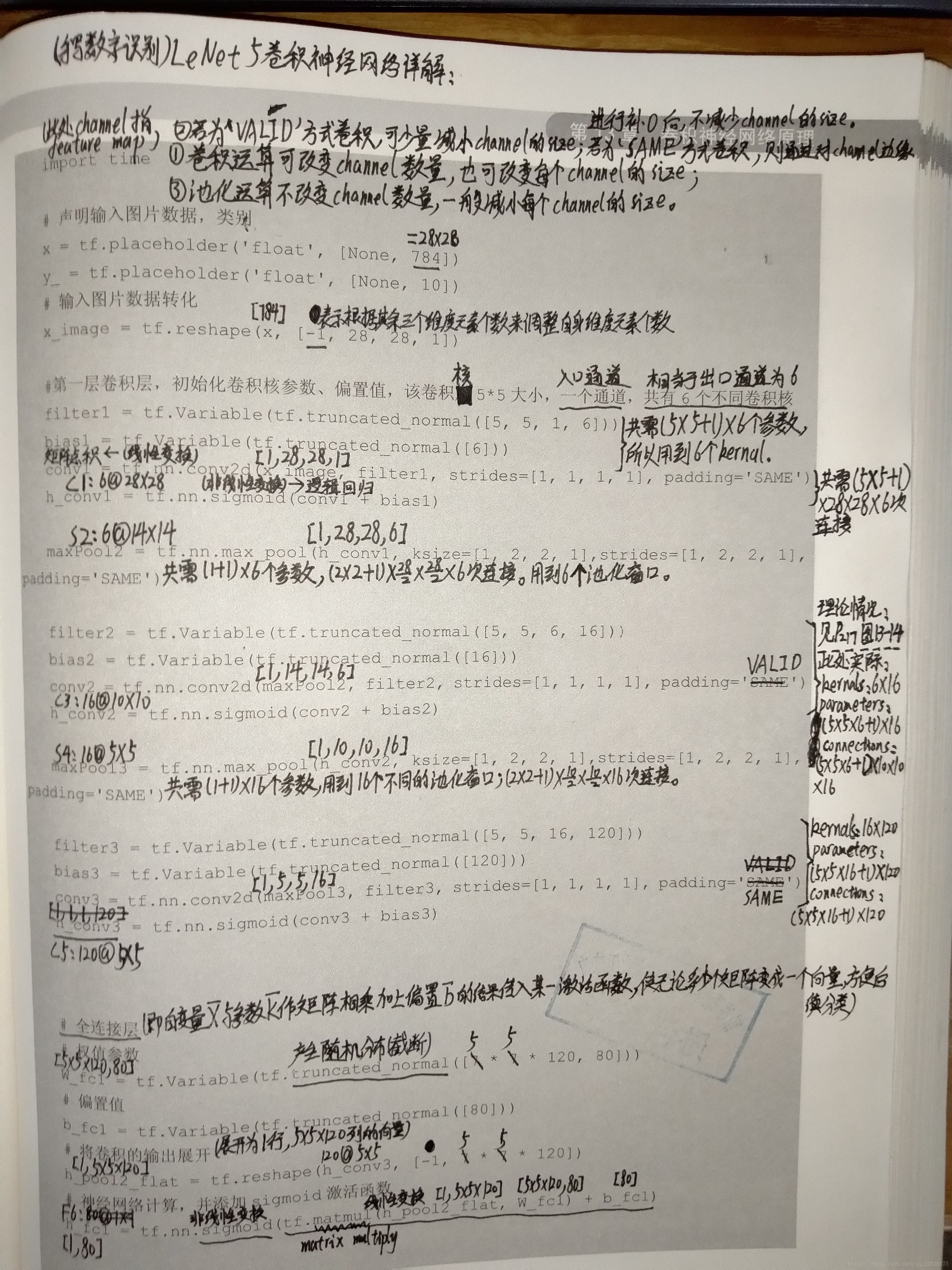
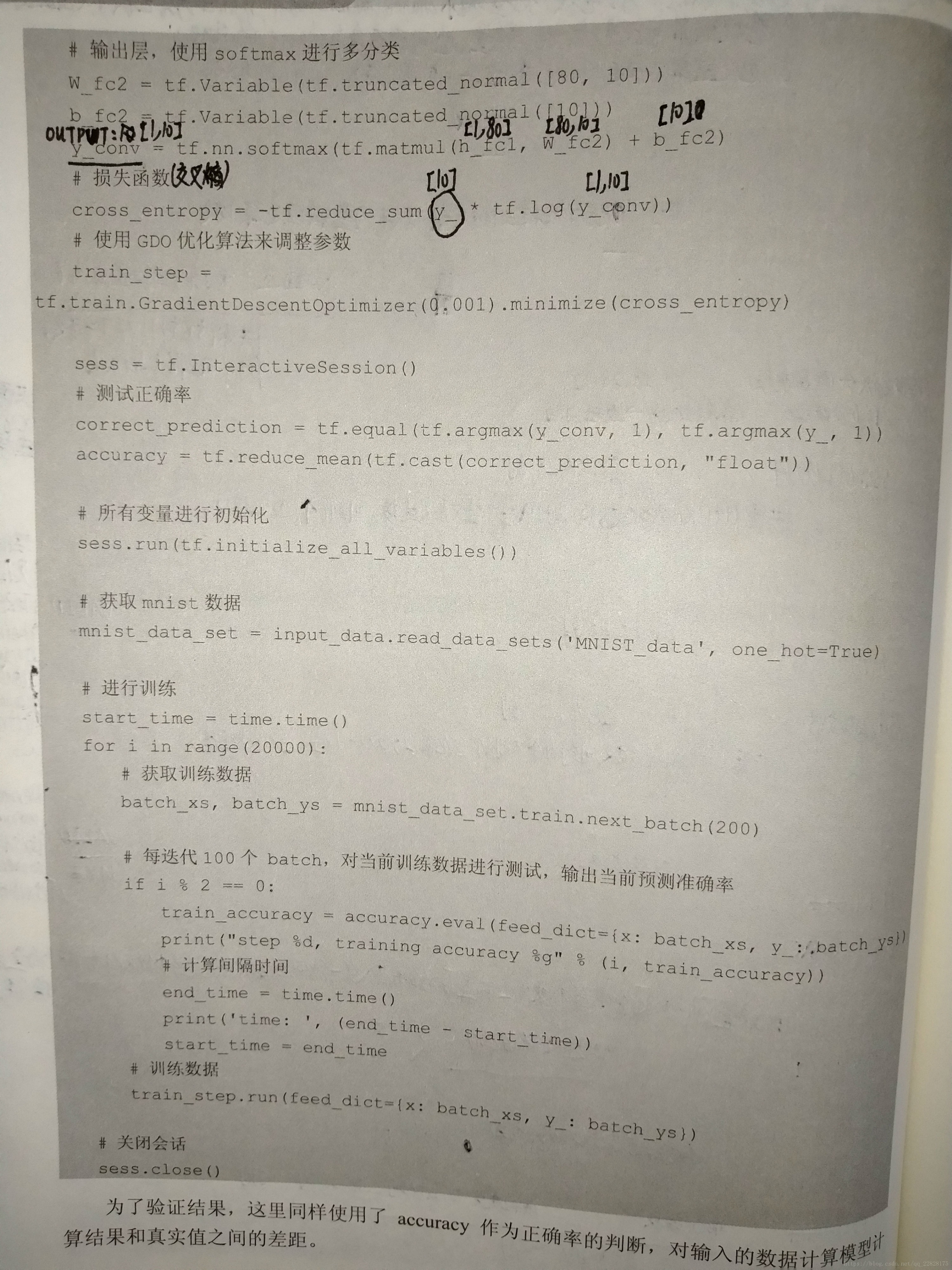
这是原始的LeNet5网络:
import tensorflow as tf

from tensorflow.examples.tutorials.mnist import input_data

import time

# 声明输入图片数据,类别

x = tf.placeholder('float', [None, 784])

y_ = tf.placeholder('float', [None, 10])

# 输入图片数据转化

x_image = tf.reshape(x, [-1, 28, 28, 1])

#第一层卷积层,初始化卷积核参数、偏置值,该卷积层5*5大小,一个通道,共有6个不同卷积核

filter1 = tf.Variable(tf.truncated_normal([5, 5, 1, 6]))

bias1 = tf.Variable(tf.truncated_normal([6]))

conv1 = tf.nn.conv2d(x_image, filter1, strides=[1, 1, 1, 1], padding='SAME')

h_conv1 = tf.nn.sigmoid(conv1 + bias1)

maxPool2 = tf.nn.max_pool(h_conv1, ksize=[1, 2, 2, 1],strides=[1, 2, 2, 1], padding='SAME')

filter2 = tf.Variable(tf.truncated_normal([5, 5, 6, 16]))

bias2 = tf.Variable(tf.truncated_normal([16]))

conv2 = tf.nn.conv2d(maxPool2, filter2, strides=[1, 1, 1, 1], padding='SAME')

h_conv2 = tf.nn.sigmoid(conv2 + bias2)

maxPool3 = tf.nn.max_pool(h_conv2, ksize=[1, 2, 2, 1],strides=[1, 2, 2, 1], padding='SAME')

filter3 = tf.Variable(tf.truncated_normal([5, 5, 16, 120]))

bias3 = tf.Variable(tf.truncated_normal([120]))

conv3 = tf.nn.conv2d(maxPool3, filter3, strides=[1, 1, 1, 1], padding='SAME')

h_conv3 = tf.nn.sigmoid(conv3 + bias3)

# 全连接层

# 权值参数

W_fc1 = tf.Variable(tf.truncated_normal([7 * 7 * 120, 80]))

# 偏置值

b_fc1 = tf.Variable(tf.truncated_normal([80]))

# 将卷积的产出展开

h_pool2_flat = tf.reshape(h_conv3, [-1, 7 * 7 * 120])

# 神经网络计算,并添加sigmoid激活函数

h_fc1 = tf.nn.sigmoid(tf.matmul(h_pool2_flat, W_fc1) + b_fc1)

# 输出层,使用softmax进行多分类

W_fc2 = tf.Variable(tf.truncated_normal([80, 10]))

b_fc2 = tf.Variable(tf.truncated_normal([10]))

y_conv = tf.nn.softmax(tf.matmul(h_fc1, W_fc2) + b_fc2)

# 损失函数

cross_entropy = -tf.reduce_sum(y_ * tf.log(y_conv))

# 使用GDO优化算法来调整参数

train_step = tf.train.GradientDescentOptimizer(0.001).minimize(cross_entropy)

sess = tf.InteractiveSession()

# 测试正确率

correct_prediction = tf.equal(tf.argmax(y_conv, 1), tf.argmax(y_, 1))

accuracy = tf.reduce_mean(tf.cast(correct_prediction, "float"))

# 所有变量进行初始化

sess.run(tf.initialize_all_variables())

# 获取mnist数据

mnist_data_set = input_data.read_data_sets('MNIST_data', one_hot=True)

# 进行训练

start_time = time.time()

for i in range(20000):

    # 获取训练数据

    batch_xs, batch_ys = mnist_data_set.train.next_batch(200)

    # 每迭代100个 batch,对当前训练数据进行测试,输出当前预测准确率

    if i % 2 == 0:

        train_accuracy = accuracy.eval(feed_dict={x: batch_xs, y_: batch_ys})

        print("step %d, training accuracy %g" % (i, train_accuracy))

        # 计算间隔时间

        end_time = time.time()

        print('time: ', (end_time - start_time))

        start_time = end_time

    # 训练数据

    train_step.run(feed_dict={x: batch_xs, y_: batch_ys})

# 关闭会话

sess.close()
下面是改进后的LeNet5网络:
import tensorflow as tf

from tensorflow.examples.tutorials.mnist import input_data

import time

import matplotlib.pyplot as plt

# 初始化单个卷积核上的权重

def weight_variable(shape):

    initial = tf.truncated_normal(shape, stddev=0.1)

    return tf.Variable(initial)

# 初始化单个卷积核上的偏置值

def bias_variable(shape):

    initial = tf.constant(0.1, shape=shape)

    return tf.Variable(initial)

# 输入特征x,用卷积核W进行卷积运算,strides为卷积核移动步长,

# padding表示是否需要补齐边缘像素使输出图像大小不变

def conv2d(x, W):

    return tf.nn.conv2d(x, W, strides=[1, 1, 1, 1], padding='SAME')

# 对x进行最大池化操作,ksize进行池化的范围,

def max_pool_2x2(x):

    return tf.nn.max_pool(x, ksize=[1, 2, 2, 1], strides=[1, 2, 2, 1], padding='SAME')

sess = tf.InteractiveSession()

# 声明输入图片数据,类别

x = tf.placeholder('float32', [None, 784])

y_ = tf.placeholder('float32', [None, 10])

# 输入图片数据转化

x_image = tf.reshape(x, [-1, 28, 28, 1])

W_conv1 = weight_variable([5, 5, 1, 32])

b_conv1 = bias_variable([32])

h_conv1 = tf.nn.relu(conv2d(x_image, W_conv1) + b_conv1)

h_pool1 = max_pool_2x2(h_conv1)

W_conv2 = weight_variable([5, 5, 32, 64])

b_conv2 = bias_variable([64])

h_conv2 = tf.nn.relu(conv2d(h_pool1, W_conv2) + b_conv2)

h_pool2 = max_pool_2x2(h_conv2)

W_fc1 = weight_variable([7 * 7 * 64, 1024])

# 偏置值

b_fc1 = bias_variable([1024])

# 将卷积的产出展开

h_pool2_flat = tf.reshape(h_pool2, [-1, 7 * 7 * 64])

# 神经网络计算,并添加relu激活函数

h_fc1 = tf.nn.relu(tf.matmul(h_pool2_flat, W_fc1) + b_fc1)

W_fc2 = weight_variable([1024, 128])

b_fc2 = bias_variable([128])

h_fc2 = tf.nn.relu(tf.matmul(h_fc1, W_fc2) + b_fc2)

W_fc3 = weight_variable([128, 10])

b_fc3 = bias_variable([10])

y_conv = tf.nn.softmax(tf.matmul(h_fc2, W_fc3) + b_fc3)

# 代价函数

cross_entropy = -tf.reduce_sum(y_ * tf.log(y_conv))

# 使用Adam优化算法来调整参数

train_step = tf.train.GradientDescentOptimizer(1e-5).minimize(cross_entropy)

# 测试正确率

correct_prediction = tf.equal(tf.argmax(y_conv, 1), tf.argmax(y_, 1))

accuracy = tf.reduce_mean(tf.cast(correct_prediction, "float32"))

# 所有变量进行初始化

sess.run(tf.initialize_all_variables())

# 获取mnist数据

mnist_data_set = input_data.read_data_sets('MNIST_data', one_hot=True)

c = []

# 进行训练

start_time = time.time()

for i in range(1000):

    # 获取训练数据

    batch_xs, batch_ys = mnist_data_set.train.next_batch(200)

    # 每迭代10个 batch,对当前训练数据进行测试,输出当前预测准确率

    if i % 2 == 0:

        train_accuracy = accuracy.eval(feed_dict={x: batch_xs, y_: batch_ys})

        c.append(train_accuracy)

        print("step %d, training accuracy %g" % (i, train_accuracy))

        # 计算间隔时间

        end_time = time.time()

        print('time: ', (end_time - start_time))

        start_time = end_time

    # 训练数据

    train_step.run(feed_dict={x: batch_xs, y_: batch_ys})

sess.close()

plt.plot(c)

plt.tight_layout()
卷积神经网络入门:LeNet5(手写体数字识别)详解的更多相关文章
- 利用c++编写bp神经网络实现手写数字识别详解
利用c++编写bp神经网络实现手写数字识别 写在前面 从大一入学开始,本菜菜就一直想学习一下神经网络算法,但由于时间和资源所限,一直未展开比较透彻的学习.大二下人工智能课的修习,给了我一个学习的契机. ...
- TensorFlow卷积神经网络实现手写数字识别以及可视化
边学习边笔记 https://www.cnblogs.com/felixwang2/p/9190602.html # https://www.cnblogs.com/felixwang2/p/9190 ...
- 卷积神经网络CNN 手写数字识别
1. 知识点准备 在了解 CNN 网络神经之前有两个概念要理解,第一是二维图像上卷积的概念,第二是 pooling 的概念. a. 卷积 关于卷积的概念和细节可以参考这里,卷积运算有两个非常重要特性, ...
- 基于卷积神经网络的手写数字识别分类(Tensorflow)
import numpy as np import tensorflow as tf from tensorflow.examples.tutorials.mnist import input_dat ...
- TensorFlow(十):卷积神经网络实现手写数字识别以及可视化
上代码: import tensorflow as tf from tensorflow.examples.tutorials.mnist import input_data mnist = inpu ...
- 莫烦pytorch学习笔记(八)——卷积神经网络(手写数字识别实现)
莫烦视频网址 这个代码实现了预测和可视化 import os # third-party library import torch import torch.nn as nn import torch ...
- keras与卷积神经网络(CNN)实现识别minist手写数字
在本篇博文当中,笔者采用了卷积神经网络来对手写数字进行识别,采用的神经网络的结构是:输入图片——卷积层——池化层——卷积层——池化层——卷积层——池化层——Flatten层——全连接层(64个神经元) ...
- 技术干货丨卷积神经网络之LeNet-5迁移实践案例
摘要:LeNet-5是Yann LeCun在1998年设计的用于手写数字识别的卷积神经网络,当年美国大多数银行就是用它来识别支票上面的手写数字的,它是早期卷积神经网络中最有代表性的实验系统之一.可以说 ...
- CNN卷积神经网络入门整合(科普向)
这是一篇关于CNN入门知识的博客,基本手法是抄.删.改.查,就算是自己的一个笔记吧,以后忘了多看看. 1.边界检测示例假如你有一张如下的图像,你想让计算机搞清楚图像上有什么物体,你可以做的事情是检 ...
- Python 3 利用机器学习模型 进行手写体数字识别
0.引言 介绍了如何生成数据,提取特征,利用sklearn的几种机器学习模型建模,进行手写体数字1-9识别. 用到的四种模型: 1. LR回归模型,Logistic Regression 2. SGD ...
随机推荐
- 使用area标签模仿a标签
众所周知,map标签可以给img图像标记热点区域,而area标签就是跟map标签一起使用的. 但area标签的作用可不止用来标记热点,因为它也有href属性,因此某些场景可以代替a标签进行页面跳转. ...
- 网络安全事件频发,全站HTTPS势在必行
报告显示,2015年互联网应急中心发现网络安全事件超过12万起,同比增长125.9%.消息一出震惊国人. 网络安全事件频发,全站HTTPS势在必行 正如习主席所讲:“互联网给人们的生产生活带来巨大变化 ...
- Mac添加命令别名
1. 切换到用户主目录 $ cd 2. 编辑或新建.bash_profile文件 3. 添加别名 命令别名设置语法: alias [别名]='[指令名称]' 注意:等号两边均无空格,指令名称中如有空格 ...
- 136 Ugly Numbers(priority_queue+逆向求解要求数)
题目链接: https://cn.vjudge.net/problem/UVA-136 /*问题 输出第1500个丑数,丑数的定义是不能被2,3,5以外的其他素数整除的数 解题思路 直接硬暴力先试一下 ...
- <mvc:annotation-driven /> 作用
<mvc:annotation-driven /> 是一种简写形式,完全可以手动配置替代这种简写形式,简写形式可以让初学都快速应用默认配置方案.<mvc:annotation-dri ...
- 集合框架(TreeSet原理)
特点: TreeSet是用来排序的,可以指定一个顺序,对象存入之后会按照指定的顺序排列 使用方式: 自然排序(Comparable) TreeSet类的add()方法中会把存入的对象提升为Compar ...
- 【15】模板方法模式(Template Method)
一.引言 提到模板,大家肯定不免想到生活中的“简历模板”.“论文模板”.“Word中模版文件”等.在现实生活中,模板的概念就是——有一个规定的格式,然后每个人都可以根据自己的需求或情况去更新它.例如简 ...
- ubuntu16.04安装ssh服务,并实现远程访问
一.查看是否安装了ssh服务 apt-cache policy openssh-client openssh-server ubuntu默认安装了openssh-client,openssh-serv ...
- apache伪静态原理图
- video 在移动端播放禁止全屏
<video src="" preload controls x5-playsinline="" playsinline="" web ...