
Spark RDD/Core 编程 API入门系列 之rdd案例(map、filter、flatMap、groupByKey、reduceByKey、join、cogroupy等)(四)
声明:
大数据中,最重要的算子操作是:join !!!
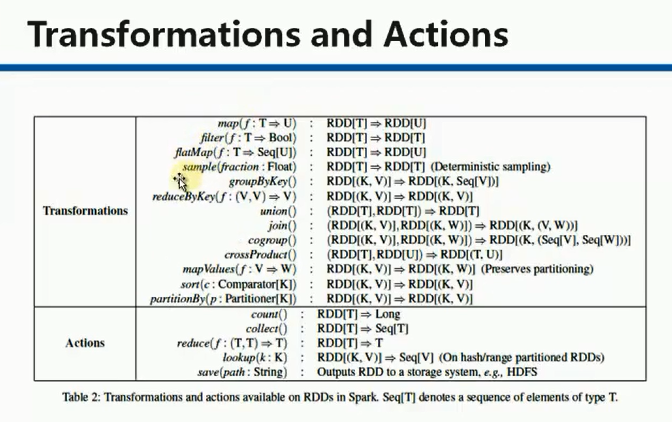
典型的transformation和action

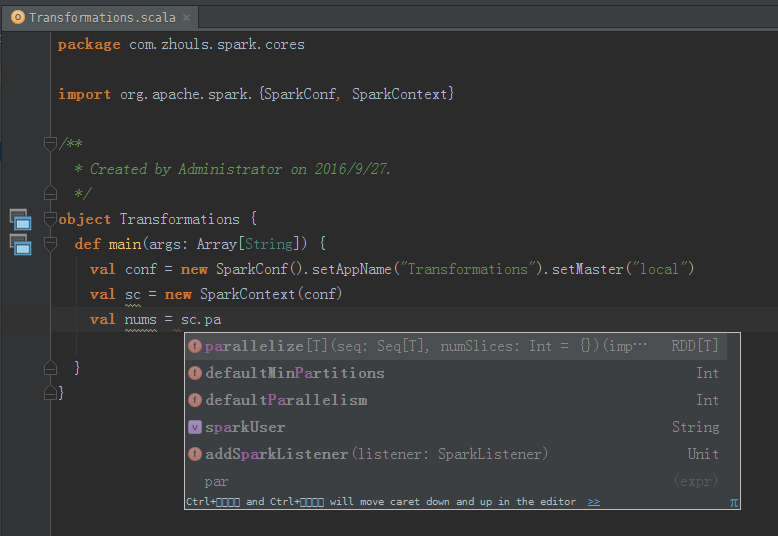
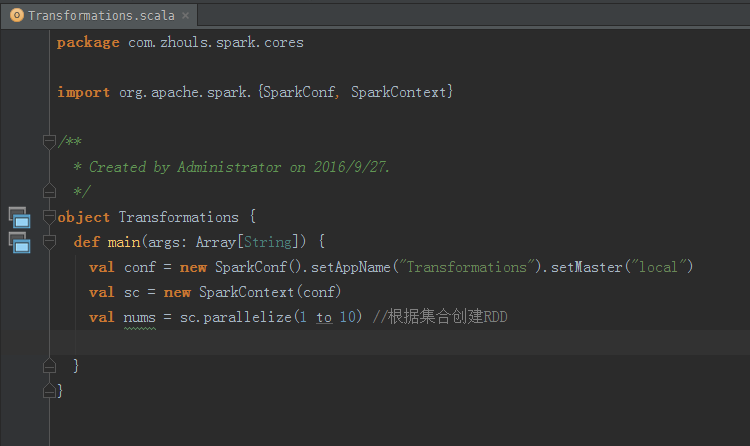
val nums = sc.parallelize(1 to 10) //根据集合创建RDD
map适用于
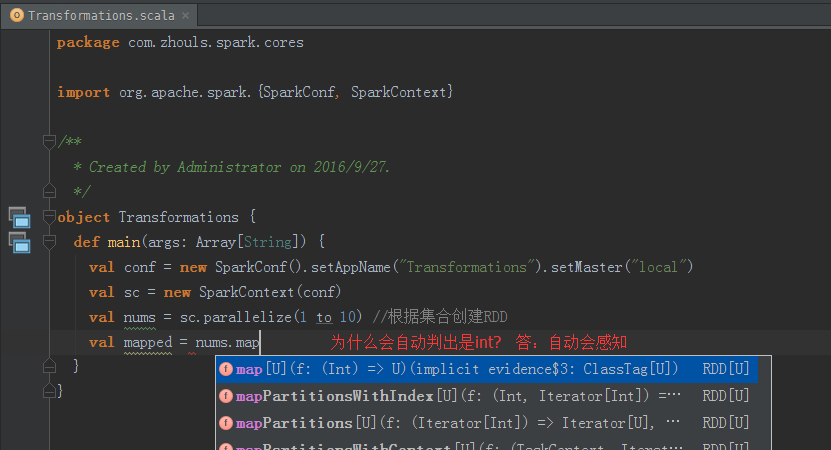
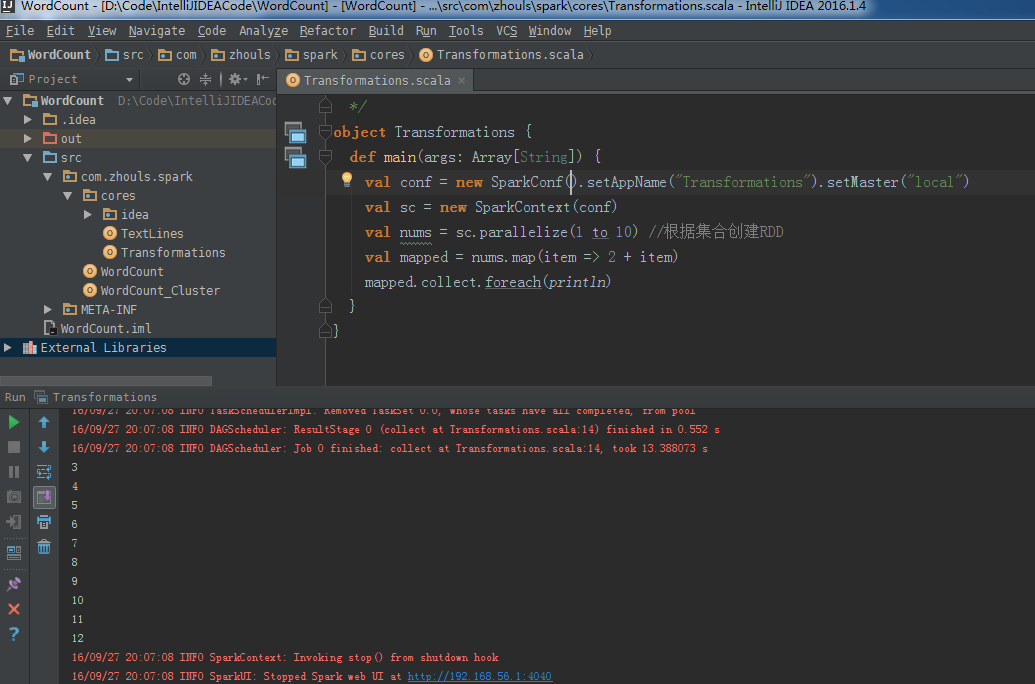
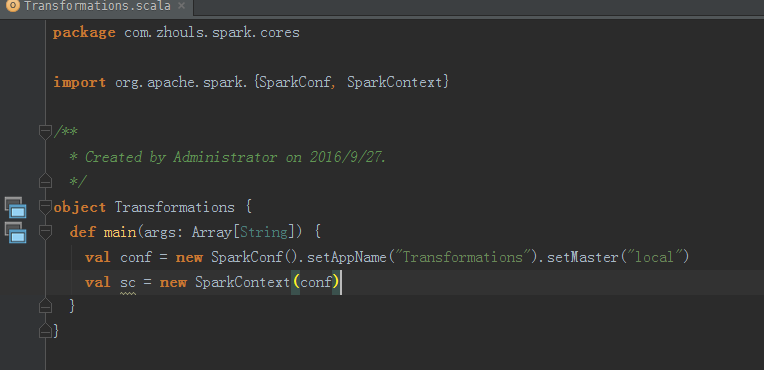
package com.zhouls.spark.cores

import org.apache.spark.{SparkConf, SparkContext}

/**
  * Created by Administrator on 2016/9/27.
  */
object Transformations {
  def main(args: Array[String]) {
    val conf = new SparkConf().setAppName("Transformations").setMaster("local")
    val sc = new SparkContext(conf)
    val nums = sc.parallelize(1 to 10) //根据集合创建RDD
    val mapped = nums.map(item => 2 + item)
    mapped.collect.foreach(println)
  }
}

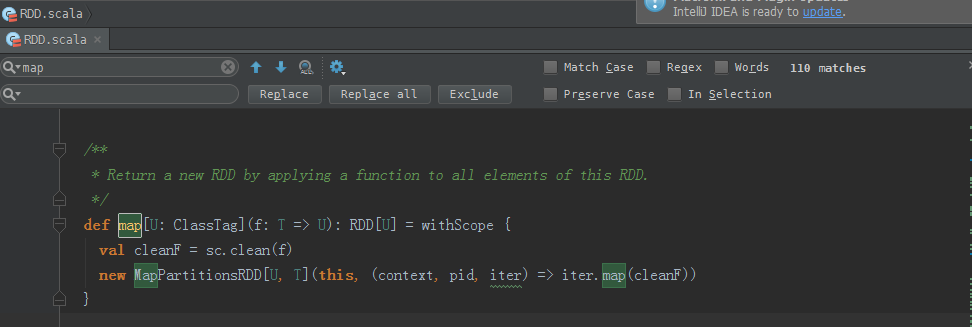
map源码
/**
 * Return a new RDD by applying a function to all elements of this RDD.
 */
def map[U: ClassTag](f: T => U): RDD[U] = withScope {
  val cleanF = sc.clean(f)
  new MapPartitionsRDD[U, T](this, (context, pid, iter) => iter.map(cleanF))
}
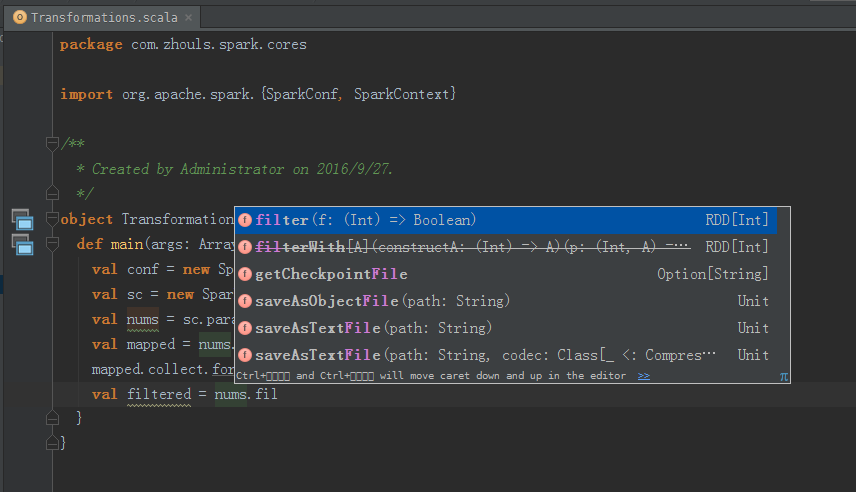
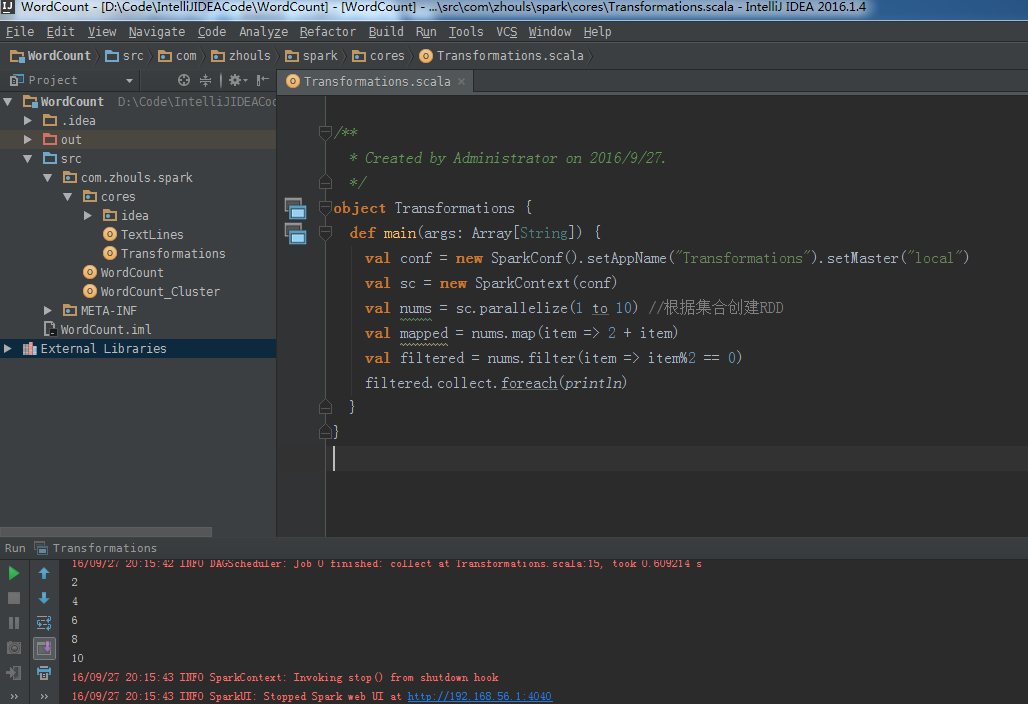
filter适用于
package com.zhouls.spark.cores

import org.apache.spark.{SparkConf, SparkContext}

/**
  * Created by Administrator on 2016/9/27.
  */
object Transformations {
  def main(args: Array[String]) {
    val conf = new SparkConf().setAppName("Transformations").setMaster("local")
    val sc = new SparkContext(conf)
    val nums = sc.parallelize(1 to 10) //根据集合创建RDD
    val mapped = nums.map(item => 2 + item)
    val filtered = nums.filter(item => item%2 == 0)
    filtered.collect.foreach(println)
  }
}
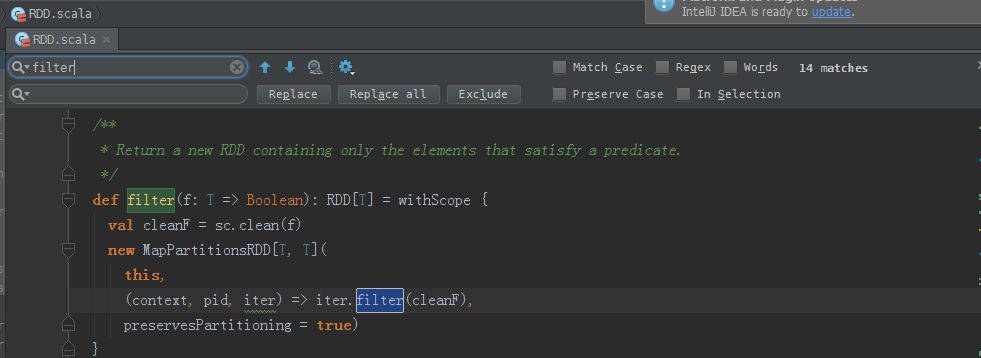
filter源码
/**
 * Return a new RDD containing only the elements that satisfy a predicate.
 */
def filter(f: T => Boolean): RDD[T] = withScope {
  val cleanF = sc.clean(f)
  new MapPartitionsRDD[T, T](
    this,
    (context, pid, iter) => iter.filter(cleanF),
    preservesPartitioning = true)
}
flatMap适用于
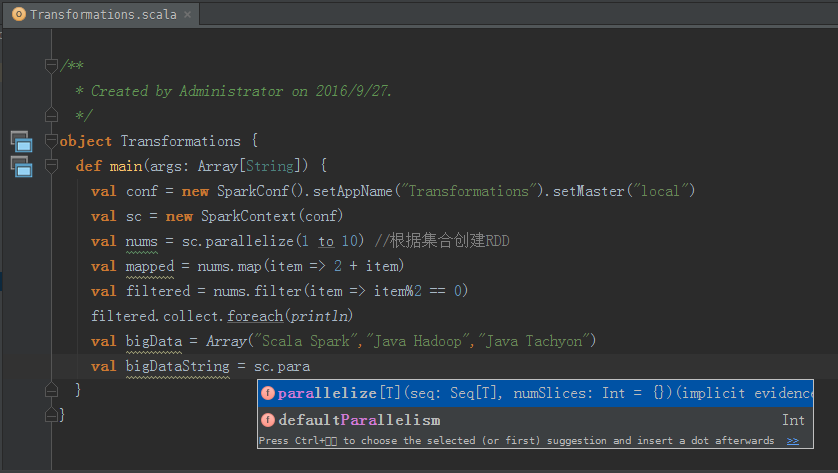
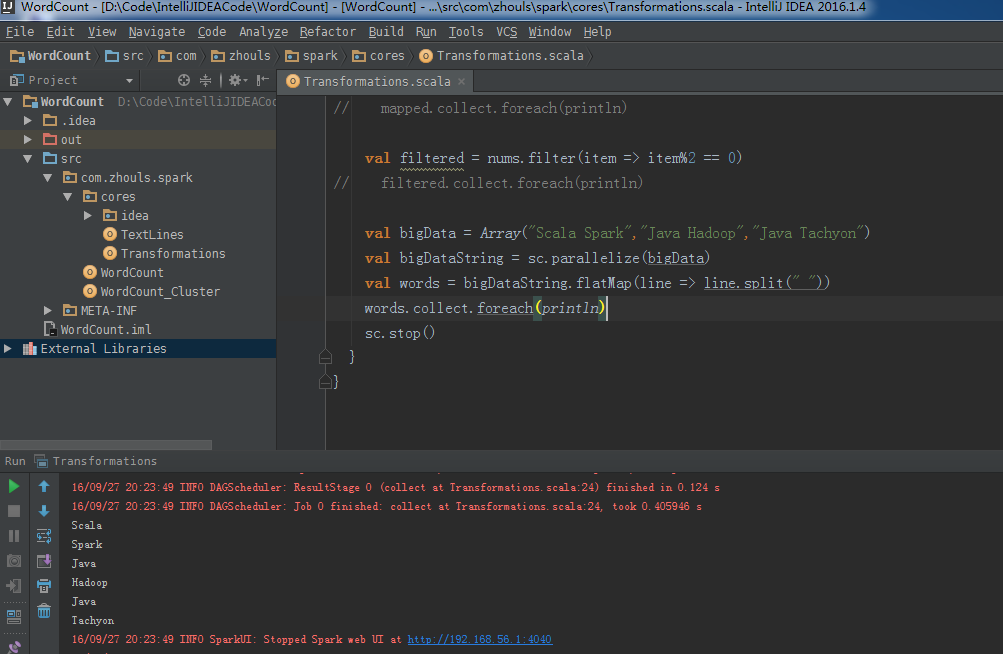
package com.zhouls.spark.cores

import org.apache.spark.{SparkConf, SparkContext}

/**
  * Created by Administrator on 2016/9/27.
  */
object Transformations {
  def main(args: Array[String]) {
    val conf = new SparkConf().setAppName("Transformations").setMaster("local")
    val sc = new SparkContext(conf)

    val nums = sc.parallelize(1 to 10) //根据集合创建RDD

    val mapped = nums.map(item => 2 + item)
//    mapped.collect.foreach(println)

    val filtered = nums.filter(item => item%2 == 0)
//    filtered.collect.foreach(println)

    val bigData = Array("Scala Spark","Java Hadoop","Java Tachyon")
    val bigDataString = sc.parallelize(bigData)
    val words = bigDataString.flatMap(line => line.split(" "))
    words.collect.foreach(println)
    sc.stop()
  }
}
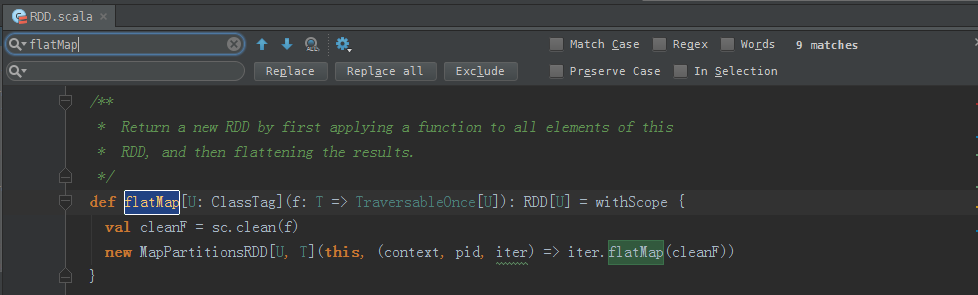
flatMap源码
/**
 *  Return a new RDD by first applying a function to all elements of this
 *  RDD, and then flattening the results.
 */
def flatMap[U: ClassTag](f: T => TraversableOnce[U]): RDD[U] = withScope {
  val cleanF = sc.clean(f)
  new MapPartitionsRDD[U, T](this, (context, pid, iter) => iter.flatMap(cleanF))
}
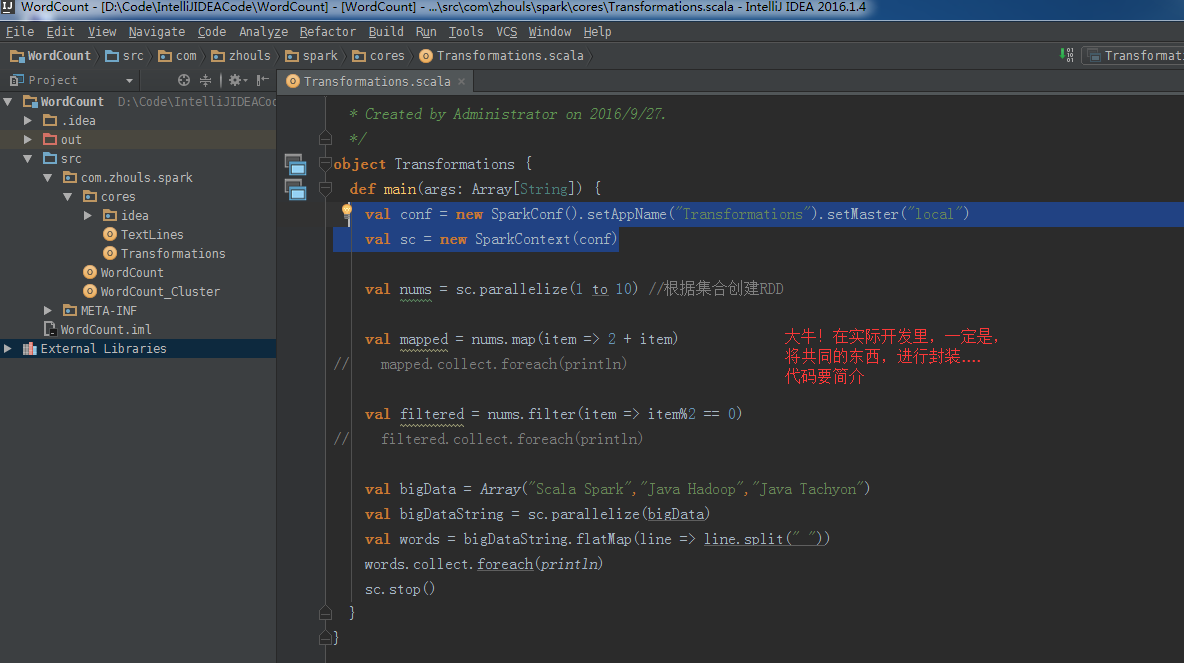
成为大牛,必写的写法 ->
groupByKey适用于
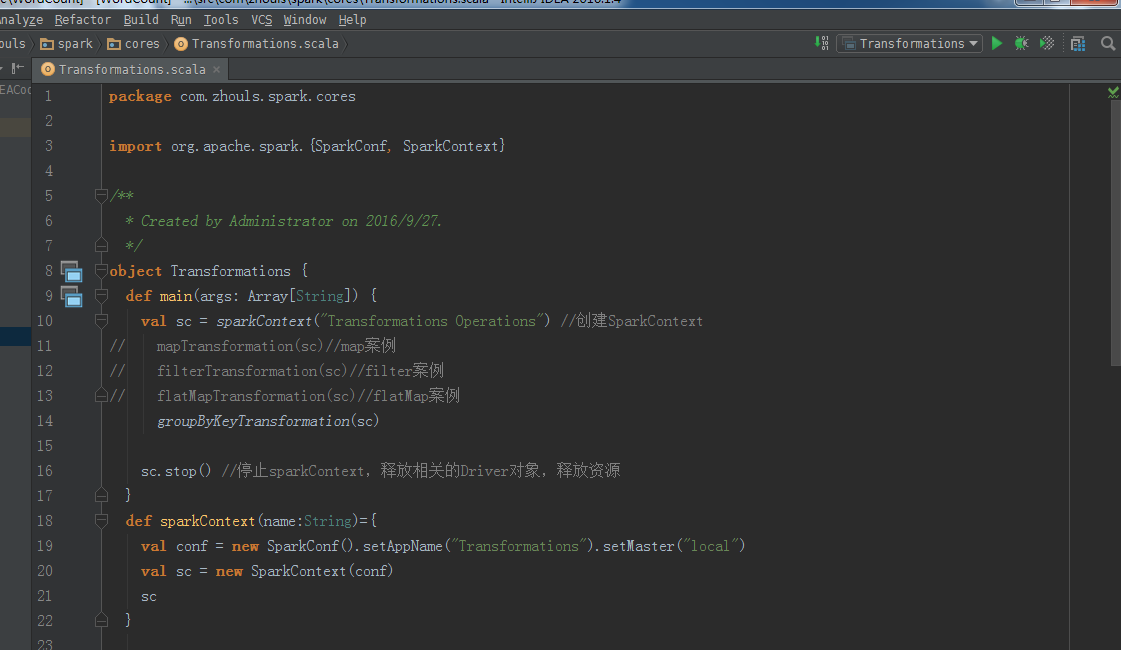
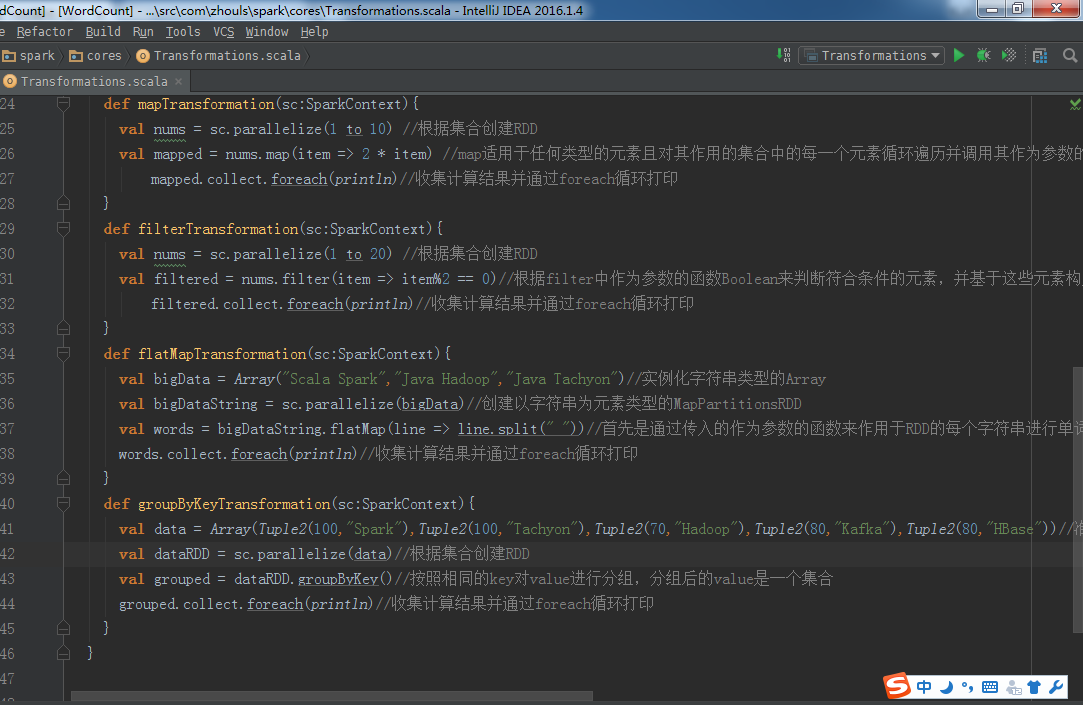
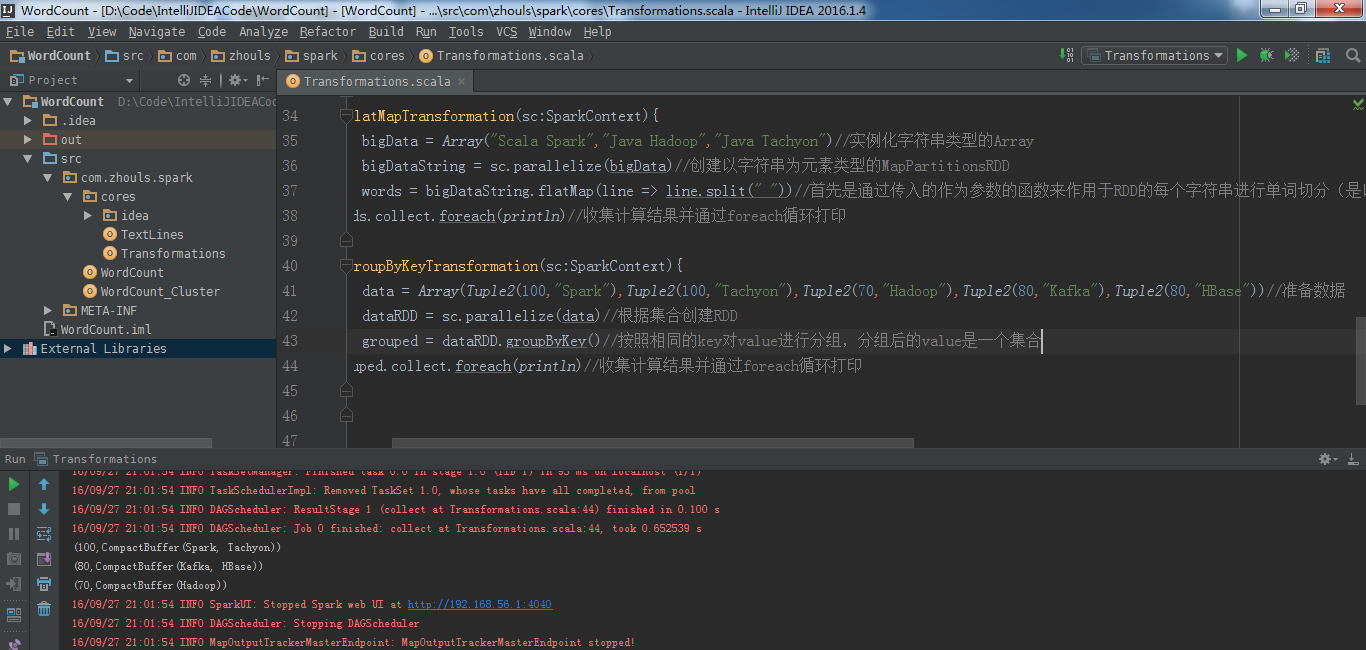
package com.zhouls.spark.cores

import org.apache.spark.{SparkConf, SparkContext}

/**
  * Created by Administrator on 2016/9/27.
  */
object Transformations {
  def main(args: Array[String]) {
    val sc = sparkContext("Transformations Operations") //创建SparkContext
//    mapTransformation(sc)//map案例
//    filterTransformation(sc)//filter案例
//    flatMapTransformation(sc)//flatMap案例
      groupByKeyTransformation(sc)

    sc.stop() //停止sparkContext,释放相关的Driver对象,释放资源
  }
  def sparkContext(name:String)={
    val conf = new SparkConf().setAppName("Transformations").setMaster("local")
    val sc = new SparkContext(conf)
    sc
  }

    def mapTransformation(sc:SparkContext){
      val nums = sc.parallelize(1 to 10) //根据集合创建RDD
      val mapped = nums.map(item => 2 * item) //map适用于任何类型的元素且对其作用的集合中的每一个元素循环遍历并调用其作为参数的函数对每一个遍历的元素进行具体化处理
          mapped.collect.foreach(println)//收集计算结果并通过foreach循环打印
    }
    def filterTransformation(sc:SparkContext){
      val nums = sc.parallelize(1 to 20) //根据集合创建RDD
      val filtered = nums.filter(item => item%2 == 0)//根据filter中作为参数的函数Boolean来判断符合条件的元素,并基于这些元素构成新的MapPartitionsRDD。
          filtered.collect.foreach(println)//收集计算结果并通过foreach循环打印
    }
    def flatMapTransformation(sc:SparkContext){
      val bigData = Array("Scala Spark","Java Hadoop","Java Tachyon")//实例化字符串类型的Array
      val bigDataString = sc.parallelize(bigData)//创建以字符串为元素类型的MapPartitionsRDD
      val words = bigDataString.flatMap(line => line.split(" "))//首先是通过传入的作为参数的函数来作用于RDD的每个字符串进行单词切分(是以集合的方式存在的),然后把切分后的结果合并成一个大的集合,是{Scala Spark Java Hadoop Java Tachyon}
      words.collect.foreach(println)//收集计算结果并通过foreach循环打印
    }
    def groupByKeyTransformation(sc:SparkContext){
      val data = Array(Tuple2(100,"Spark"),Tuple2(100,"Tachyon"),Tuple2(70,"Hadoop"),Tuple2(80,"Kafka"),Tuple2(80,"HBase"))
      val dataRDD = sc.parallelize(data)
      val grouped = dataRDD.groupByKey()
      grouped.collect.foreach(println)//收集计算结果并通过foreach循环打印
    }
  }
groupByKey源码
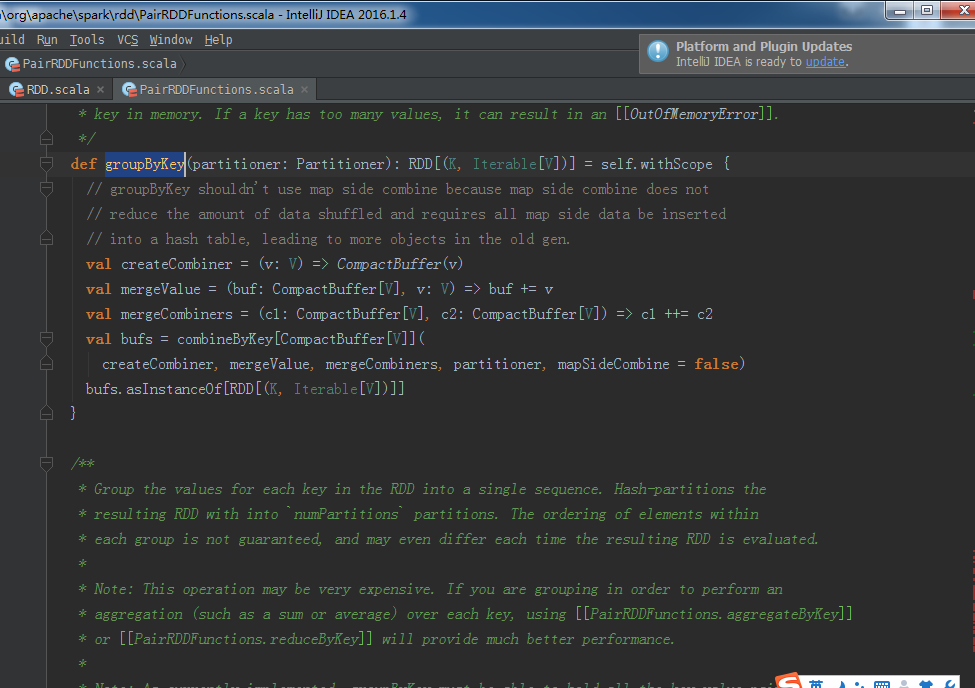
**
 * Group the values for each key in the RDD into a single sequence. Allows controlling the
 * partitioning of the resulting key-value pair RDD by passing a Partitioner.
 * The ordering of elements within each group is not guaranteed, and may even differ
 * each time the resulting RDD is evaluated.
 *
 * Note: This operation may be very expensive. If you are grouping in order to perform an
 * aggregation (such as a sum or average) over each key, using [[PairRDDFunctions.aggregateByKey]]
 * or [[PairRDDFunctions.reduceByKey]] will provide much better performance.
 *
 * Note: As currently implemented, groupByKey must be able to hold all the key-value pairs for any
 * key in memory. If a key has too many values, it can result in an [[OutOfMemoryError]].
 */
def groupByKey(partitioner: Partitioner): RDD[(K, Iterable[V])] = self.withScope {
  // groupByKey shouldn't use map side combine because map side combine does not
  // reduce the amount of data shuffled and requires all map side data be inserted
  // into a hash table, leading to more objects in the old gen.
  val createCombiner = (v: V) => CompactBuffer(v)
  val mergeValue = (buf: CompactBuffer[V], v: V) => buf += v
  val mergeCombiners = (c1: CompactBuffer[V], c2: CompactBuffer[V]) => c1 ++= c2
  val bufs = combineByKey[CompactBuffer[V]](
    createCombiner, mergeValue, mergeCombiners, partitioner, mapSideCombine = false)
  bufs.asInstanceOf[RDD[(K, Iterable[V])]]
}

/**
 * Group the values for each key in the RDD into a single sequence. Hash-partitions the
 * resulting RDD with into `numPartitions` partitions. The ordering of elements within
 * each group is not guaranteed, and may even differ each time the resulting RDD is evaluated.
 *
 * Note: This operation may be very expensive. If you are grouping in order to perform an
 * aggregation (such as a sum or average) over each key, using [[PairRDDFunctions.aggregateByKey]]
 * or [[PairRDDFunctions.reduceByKey]] will provide much better performance.
 *
 * Note: As currently implemented, groupByKey must be able to hold all the key-value pairs for any
 * key in memory. If a key has too many values, it can result in an [[OutOfMemoryError]].
 */
def groupByKey(numPartitions: Int): RDD[(K, Iterable[V])] = self.withScope {
  groupByKey(new HashPartitioner(numPartitions))
}
reduceByKey适用于
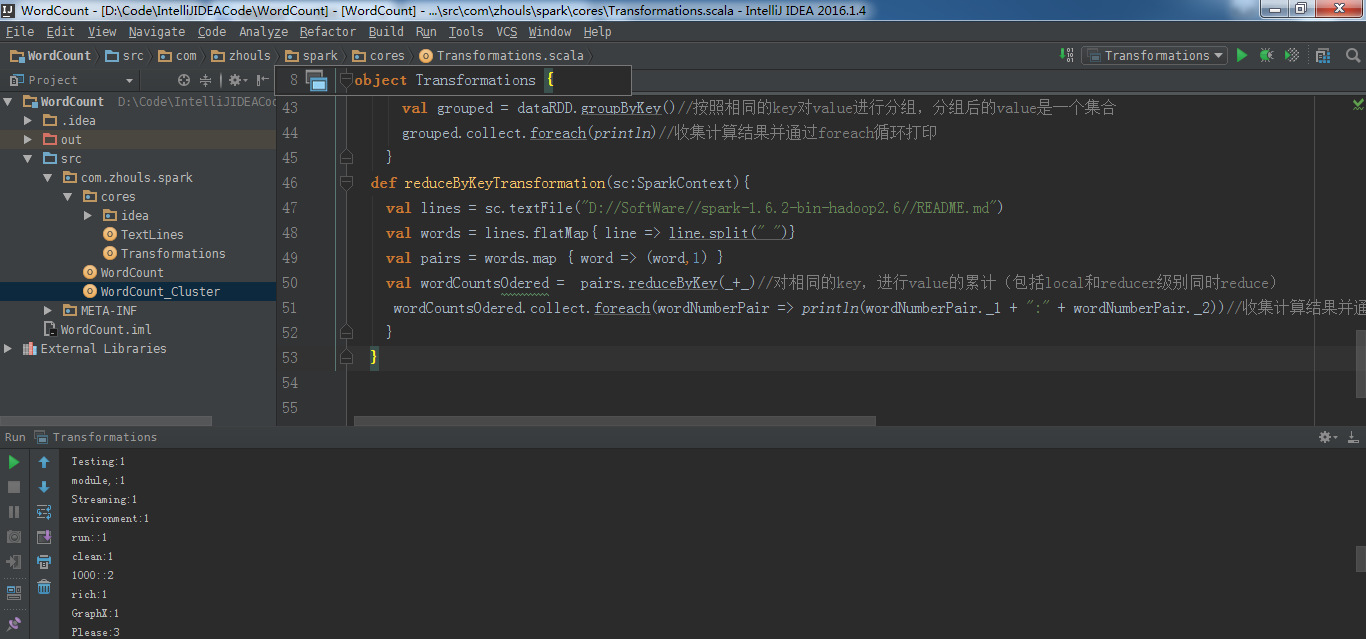
package com.zhouls.spark.cores

import org.apache.spark.{SparkConf, SparkContext}

/**
  * Created by Administrator on 2016/9/27.
  */
object Transformations {
  def main(args: Array[String]) {
    val sc = sparkContext("Transformations Operations") //创建SparkContext
//    mapTransformation(sc)//map案例
//    filterTransformation(sc)//filter案例
//    flatMapTransformation(sc)//flatMap案例
//    groupByKeyTransformation(sc)//groupByKey案例
     reduceByKeyTransformation(sc)//reduceByKey案例
       sc.stop() //停止sparkContext,释放相关的Driver对象,释放资源
  }
  def sparkContext(name:String)={
    val conf = new SparkConf().setAppName("Transformations").setMaster("local")
    val sc = new SparkContext(conf)
    sc
  }

    def mapTransformation(sc:SparkContext){
      val nums = sc.parallelize(1 to 10) //根据集合创建RDD
      val mapped = nums.map(item => 2 * item) //map适用于任何类型的元素且对其作用的集合中的每一个元素循环遍历并调用其作为参数的函数对每一个遍历的元素进行具体化处理
          mapped.collect.foreach(println)//收集计算结果并通过foreach循环打印
    }
    def filterTransformation(sc:SparkContext){
      val nums = sc.parallelize(1 to 20) //根据集合创建RDD
      val filtered = nums.filter(item => item%2 == 0)//根据filter中作为参数的函数Boolean来判断符合条件的元素,并基于这些元素构成新的MapPartitionsRDD。
          filtered.collect.foreach(println)//收集计算结果并通过foreach循环打印
    }
    def flatMapTransformation(sc:SparkContext){
      val bigData = Array("Scala Spark","Java Hadoop","Java Tachyon")//实例化字符串类型的Array
      val bigDataString = sc.parallelize(bigData)//创建以字符串为元素类型的MapPartitionsRDD
      val words = bigDataString.flatMap(line => line.split(" "))//首先是通过传入的作为参数的函数来作用于RDD的每个字符串进行单词切分(是以集合的方式存在的),然后把切分后的结果合并成一个大的集合,是{Scala Spark Java Hadoop Java Tachyon}
      words.collect.foreach(println)//收集计算结果并通过foreach循环打印
    }
    def groupByKeyTransformation(sc:SparkContext){
      val data = Array(Tuple2(100,"Spark"),Tuple2(100,"Tachyon"),Tuple2(70,"Hadoop"),Tuple2(80,"Kafka"),Tuple2(80,"HBase"))//准备数据
      val dataRDD = sc.parallelize(data)//根据集合创建RDD
      val grouped = dataRDD.groupByKey()//按照相同的key对value进行分组,分组后的value是一个集合
      grouped.collect.foreach(println)//收集计算结果并通过foreach循环打印
    }
  def reduceByKeyTransformation(sc:SparkContext){
    val lines = sc.textFile("D://SoftWare//spark-1.6.2-bin-hadoop2.6//README.md")
    val words = lines.flatMap{ line => line.split(" ")}
    val pairs = words.map { word => (word,1) }
    val wordCountsOdered =  pairs.reduceByKey(_+_)//对相同的key,进行value的累计(包括local和reducer级别同时reduce)
     wordCountsOdered.collect.foreach(wordNumberPair => println(wordNumberPair._1 + ":" + wordNumberPair._2))//收集计算结果并通过foreach循环打印
    }
  }
reduceByKey源码
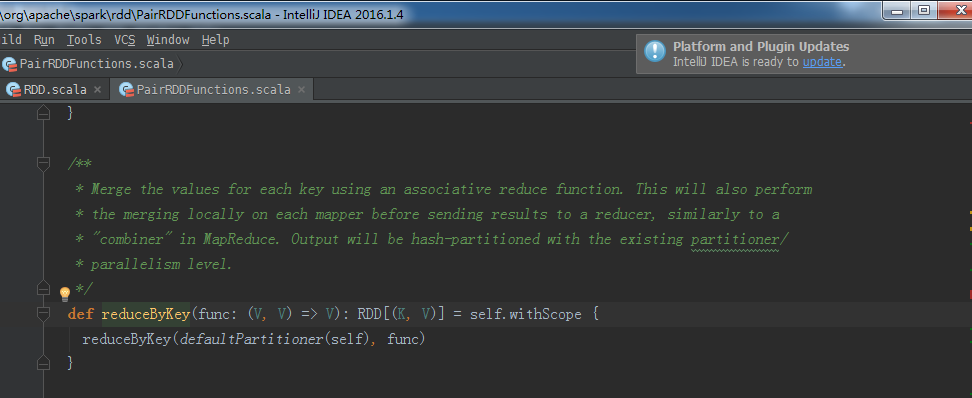
/**
 * Merge the values for each key using an associative reduce function. This will also perform
 * the merging locally on each mapper before sending results to a reducer, similarly to a
 * "combiner" in MapReduce. Output will be hash-partitioned with the existing partitioner/
 * parallelism level.
 */
def reduceByKey(func: (V, V) => V): RDD[(K, V)] = self.withScope {
  reduceByKey(defaultPartitioner(self), func)
}
join适用于
package com.zhouls.spark.cores

import org.apache.spark.{SparkConf, SparkContext}

/**
  * Created by Administrator on 2016/9/27.
  */
object Transformations {
  def main(args: Array[String]) {
    val sc = sparkContext("Transformations Operations") //创建SparkContext
//    mapTransformation(sc)//map案例
//    filterTransformation(sc)//filter案例
//    flatMapTransformation(sc)//flatMap案例
//    groupByKeyTransformation(sc)//groupByKey案例
//    reduceByKeyTransformation(sc)//reduceByKey案例
      joinTransformation(sc)//join案例
       sc.stop() //停止sparkContext,释放相关的Driver对象,释放资源
  }
  def sparkContext(name:String)={
    val conf = new SparkConf().setAppName("Transformations").setMaster("local")
    val sc = new SparkContext(conf)
    sc
  }

    def mapTransformation(sc:SparkContext){
      val nums = sc.parallelize(1 to 10) //根据集合创建RDD
      val mapped = nums.map(item => 2 * item) //map适用于任何类型的元素且对其作用的集合中的每一个元素循环遍历并调用其作为参数的函数对每一个遍历的元素进行具体化处理
          mapped.collect.foreach(println)//收集计算结果并通过foreach循环打印
    }
    def filterTransformation(sc:SparkContext){
      val nums = sc.parallelize(1 to 20) //根据集合创建RDD
      val filtered = nums.filter(item => item%2 == 0)//根据filter中作为参数的函数Boolean来判断符合条件的元素,并基于这些元素构成新的MapPartitionsRDD。
          filtered.collect.foreach(println)//收集计算结果并通过foreach循环打印
    }
    def flatMapTransformation(sc:SparkContext){
      val bigData = Array("Scala Spark","Java Hadoop","Java Tachyon")//实例化字符串类型的Array
      val bigDataString = sc.parallelize(bigData)//创建以字符串为元素类型的MapPartitionsRDD
      val words = bigDataString.flatMap(line => line.split(" "))//首先是通过传入的作为参数的函数来作用于RDD的每个字符串进行单词切分(是以集合的方式存在的),然后把切分后的结果合并成一个大的集合,是{Scala Spark Java Hadoop Java Tachyon}
      words.collect.foreach(println)//收集计算结果并通过foreach循环打印
    }
    def groupByKeyTransformation(sc:SparkContext){
      val data = Array(Tuple2(100,"Spark"),Tuple2(100,"Tachyon"),Tuple2(70,"Hadoop"),Tuple2(80,"Kafka"),Tuple2(80,"HBase"))//准备数据
      val dataRDD = sc.parallelize(data)//根据集合创建RDD
      val grouped = dataRDD.groupByKey()//按照相同的key对value进行分组,分组后的value是一个集合
      grouped.collect.foreach(println)//收集计算结果并通过foreach循环打印
    }
  def reduceByKeyTransformation(sc:SparkContext){
    val lines = sc.textFile("D://SoftWare//spark-1.6.2-bin-hadoop2.6//README.md")
    val words = lines.flatMap{ line => line.split(" ")}
    val pairs = words.map { word => (word,1) }
    val wordCountsOdered =  pairs.reduceByKey(_+_)//对相同的key,进行value的累计(包括local和reducer级别同时reduce)
     wordCountsOdered.collect.foreach(wordNumberPair => println(wordNumberPair._1 + ":" + wordNumberPair._2))//收集计算结果并通过foreach循环打印
    }
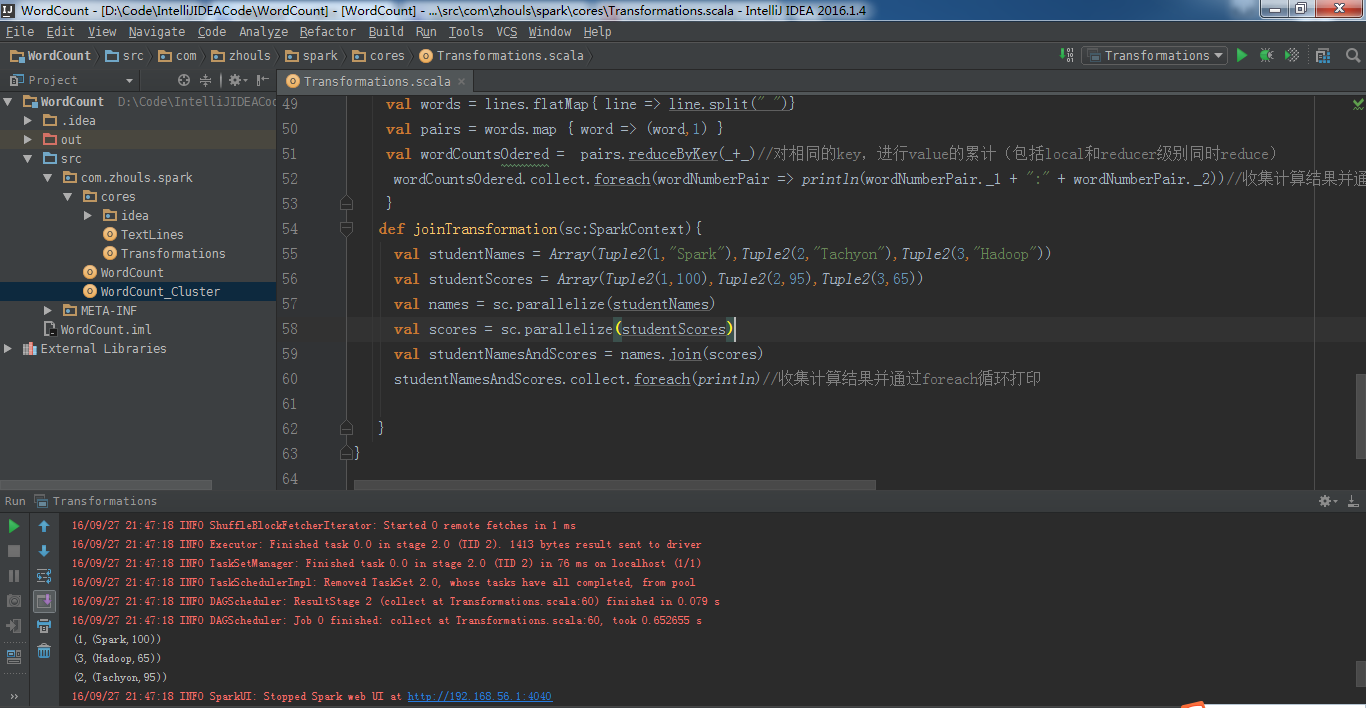
   def joinTransformation(sc:SparkContext){
     val studentNames = Array(Tuple2(1,"Spark"),Tuple2(2,"Tachyon"),Tuple2(3,"Hadoop"))
     val studentScores = Array(Tuple2(1,100),Tuple2(2,95),Tuple2(3,65))
     val names = sc.parallelize(studentNames)
     val scores = sc.parallelize(studentScores)
     val studentNamesAndScores = names.join(scores)
     studentNamesAndScores.collect.foreach(println)//收集计算结果并通过foreach循环打印

   }
}
join源码
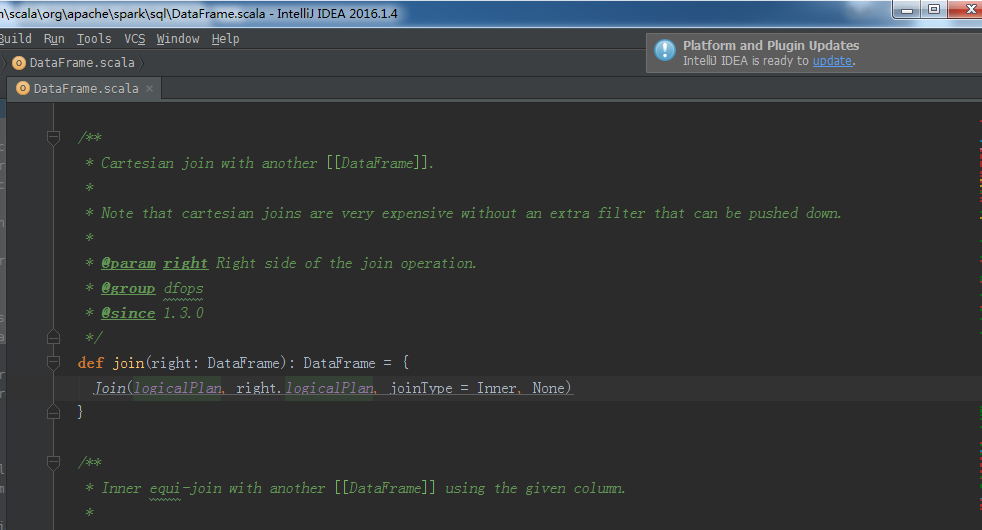
/**
 * Cartesian join with another [[DataFrame]].
 *
 * Note that cartesian joins are very expensive without an extra filter that can be pushed down.
 *
 * @param right Right side of the join operation.
 * @group dfops
 * @since 1.3.0
 */
def join(right: DataFrame): DataFrame = {
  Join(logicalPlan, right.logicalPlan, joinType = Inner, None)
}

/**
 * Inner equi-join with another [[DataFrame]] using the given column.
 *
 * Different from other join functions, the join column will only appear once in the output,
 * i.e. similar to SQL's `JOIN USING` syntax.
 *
 * {{{
 *   // Joining df1 and df2 using the column "user_id"
 *   df1.join(df2, "user_id")
 * }}}
 *
 * Note that if you perform a self-join using this function without aliasing the input
 * [[DataFrame]]s, you will NOT be able to reference any columns after the join, since
 * there is no way to disambiguate which side of the join you would like to reference.
 *
 * @param right Right side of the join operation.
 * @param usingColumn Name of the column to join on. This column must exist on both sides.
 * @group dfops
 * @since 1.4.0
 */
def join(right: DataFrame, usingColumn: String): DataFrame = {
  join(right, Seq(usingColumn))
}

/**
 * Inner equi-join with another [[DataFrame]] using the given columns.
 *
 * Different from other join functions, the join columns will only appear once in the output,
 * i.e. similar to SQL's `JOIN USING` syntax.
 *
 * {{{
 *   // Joining df1 and df2 using the columns "user_id" and "user_name"
 *   df1.join(df2, Seq("user_id", "user_name"))
 * }}}
 *
 * Note that if you perform a self-join using this function without aliasing the input
 * [[DataFrame]]s, you will NOT be able to reference any columns after the join, since
 * there is no way to disambiguate which side of the join you would like to reference.
 *
 * @param right Right side of the join operation.
 * @param usingColumns Names of the columns to join on. This columns must exist on both sides.
 * @group dfops
 * @since 1.4.0
 */
def join(right: DataFrame, usingColumns: Seq[String]): DataFrame = {
  // Analyze the self join. The assumption is that the analyzer will disambiguate left vs right
  // by creating a new instance for one of the branch.
  val joined = sqlContext.executePlan(
    Join(logicalPlan, right.logicalPlan, joinType = Inner, None)).analyzed.asInstanceOf[Join]

  // Project only one of the join columns.
  val joinedCols = usingColumns.map(col => joined.right.resolve(col))
  val condition = usingColumns.map { col =>
    catalyst.expressions.EqualTo(joined.left.resolve(col), joined.right.resolve(col))
  }.reduceLeftOption[catalyst.expressions.BinaryExpression] { (cond, eqTo) =>
    catalyst.expressions.And(cond, eqTo)
  }

  Project(
    joined.output.filterNot(joinedCols.contains(_)),
    Join(
      joined.left,
      joined.right,
      joinType = Inner,
      condition)
  )
}

/**
 * Inner join with another [[DataFrame]], using the given join expression.
 *
 * {{{
 *   // The following two are equivalent:
 *   df1.join(df2, $"df1Key" === $"df2Key")
 *   df1.join(df2).where($"df1Key" === $"df2Key")
 * }}}
 * @group dfops
 * @since 1.3.0
 */
def join(right: DataFrame, joinExprs: Column): DataFrame = join(right, joinExprs, "inner")

/**
 * Join with another [[DataFrame]], using the given join expression. The following performs
 * a full outer join between `df1` and `df2`.
 *
 * {{{
 *   // Scala:
 *   import org.apache.spark.sql.functions._
 *   df1.join(df2, $"df1Key" === $"df2Key", "outer")
 *
 *   // Java:
 *   import static org.apache.spark.sql.functions.*;
 *   df1.join(df2, col("df1Key").equalTo(col("df2Key")), "outer");
 * }}}
 *
 * @param right Right side of the join.
 * @param joinExprs Join expression.
 * @param joinType One of: `inner`, `outer`, `left_outer`, `right_outer`, `leftsemi`.
 * @group dfops
 * @since 1.3.0
 */
def join(right: DataFrame, joinExprs: Column, joinType: String): DataFrame = {
  // Note that in this function, we introduce a hack in the case of self-join to automatically
  // resolve ambiguous join conditions into ones that might make sense [SPARK-6231].
  // Consider this case: df.join(df, df("key") === df("key"))
  // Since df("key") === df("key") is a trivially true condition, this actually becomes a
  // cartesian join. However, most likely users expect to perform a self join using "key".
  // With that assumption, this hack turns the trivially true condition into equality on join
  // keys that are resolved to both sides.

  // Trigger analysis so in the case of self-join, the analyzer will clone the plan.
  // After the cloning, left and right side will have distinct expression ids.
  val plan = Join(logicalPlan, right.logicalPlan, JoinType(joinType), Some(joinExprs.expr))
    .queryExecution.analyzed.asInstanceOf[Join]

  // If auto self join alias is disabled, return the plan.
  if (!sqlContext.conf.dataFrameSelfJoinAutoResolveAmbiguity) {
    return plan
  }

  // If left/right have no output set intersection, return the plan.
  val lanalyzed = this.logicalPlan.queryExecution.analyzed
  val ranalyzed = right.logicalPlan.queryExecution.analyzed
  if (lanalyzed.outputSet.intersect(ranalyzed.outputSet).isEmpty) {
    return plan
  }

  // Otherwise, find the trivially true predicates and automatically resolves them to both sides.
  // By the time we get here, since we have already run analysis, all attributes should've been
  // resolved and become AttributeReference.
  val cond = plan.condition.map { _.transform {
    case catalyst.expressions.EqualTo(a: AttributeReference, b: AttributeReference)
        if a.sameRef(b) =>
      catalyst.expressions.EqualTo(plan.left.resolve(a.name), plan.right.resolve(b.name))
  }}
  plan.copy(condition = cond)
}
cogroup的scala版,适用于

package com.zhouls.spark.cores

import org.apache.spark.{SparkConf, SparkContext}

/**
  * Created by Administrator on 2016/9/27.
  */
object Transformations {
  def main(args: Array[String]) {
    val sc = sparkContext("Transformations Operations") //创建SparkContext
//    mapTransformation(sc)//map案例
//    filterTransformation(sc)//filter案例
//    flatMapTransformation(sc)//flatMap案例
//    groupByKeyTransformation(sc)//groupByKey案例
//    reduceByKeyTransformation(sc)//reduceByKey案例
//    joinTransformation(sc)//join案例
      cogroupTransformation(sc)//cogroup案例
       sc.stop() //停止sparkContext,释放相关的Driver对象,释放资源
  }
  def sparkContext(name:String)={
    val conf = new SparkConf().setAppName("Transformations").setMaster("local")
    val sc = new SparkContext(conf)
    sc
  }

    def mapTransformation(sc:SparkContext){
      val nums = sc.parallelize(1 to 10) //根据集合创建RDD
      val mapped = nums.map(item => 2 * item) //map适用于任何类型的元素且对其作用的集合中的每一个元素循环遍历并调用其作为参数的函数对每一个遍历的元素进行具体化处理
          mapped.collect.foreach(println)//收集计算结果并通过foreach循环打印
    }
    def filterTransformation(sc:SparkContext){
      val nums = sc.parallelize(1 to 20) //根据集合创建RDD
      val filtered = nums.filter(item => item%2 == 0)//根据filter中作为参数的函数Boolean来判断符合条件的元素,并基于这些元素构成新的MapPartitionsRDD。
          filtered.collect.foreach(println)//收集计算结果并通过foreach循环打印
    }
    def flatMapTransformation(sc:SparkContext){
      val bigData = Array("Scala Spark","Java Hadoop","Java Tachyon")//实例化字符串类型的Array
      val bigDataString = sc.parallelize(bigData)//创建以字符串为元素类型的MapPartitionsRDD
      val words = bigDataString.flatMap(line => line.split(" "))//首先是通过传入的作为参数的函数来作用于RDD的每个字符串进行单词切分(是以集合的方式存在的),然后把切分后的结果合并成一个大的集合,是{Scala Spark Java Hadoop Java Tachyon}
      words.collect.foreach(println)//收集计算结果并通过foreach循环打印
    }
    def groupByKeyTransformation(sc:SparkContext){
      val data = Array(Tuple2(100,"Spark"),Tuple2(100,"Tachyon"),Tuple2(70,"Hadoop"),Tuple2(80,"Kafka"),Tuple2(80,"HBase"))//准备数据
      val dataRDD = sc.parallelize(data)//根据集合创建RDD
      val grouped = dataRDD.groupByKey()//按照相同的key对value进行分组,分组后的value是一个集合
      grouped.collect.foreach(println)//收集计算结果并通过foreach循环打印
    }
  def reduceByKeyTransformation(sc:SparkContext){
    val lines = sc.textFile("D://SoftWare//spark-1.6.2-bin-hadoop2.6//README.md")
    val words = lines.flatMap{ line => line.split(" ")}
    val pairs = words.map { word => (word,1) }
    val wordCountsOdered =  pairs.reduceByKey(_+_)//对相同的key,进行value的累计(包括local和reducer级别同时reduce)
     wordCountsOdered.collect.foreach(wordNumberPair => println(wordNumberPair._1 + ":" + wordNumberPair._2))//收集计算结果并通过foreach循环打印
    }
   def joinTransformation(sc:SparkContext){
     val studentNames = Array(Tuple2(1,"Spark"),Tuple2(2,"Tachyon"),Tuple2(3,"Hadoop"))
     val studentScores = Array(Tuple2(1,100),Tuple2(2,95),Tuple2(3,65))
     val names = sc.parallelize(studentNames)
     val scores = sc.parallelize(studentScores)
     val studentNamesAndScores = names.join(scores)
     studentNamesAndScores.collect.foreach(println)//收集计算结果并通过foreach循环打印
   }
  def cogroupTransformation(sc:SparkContext){
    val namesLists = Array(Tuple2(1,"xiaoming"),Tuple2(2,"xiaozhou"),Tuple2(3,"xiaoliu"))
    val scoresLists = Array(Tuple2(1,100),Tuple2(2,95),Tuple2(3,85),Tuple2(1,75),Tuple2(2,65),Tuple2(3,55))
    val names = sc.parallelize(namesLists)
    val scores = sc.parallelize(scoresLists)
    val namesListsAndScores = names.cogroup(scores)
    namesListsAndScores.collect.foreach(println)//收集计算结果并通过foreach循环打印
  }
}
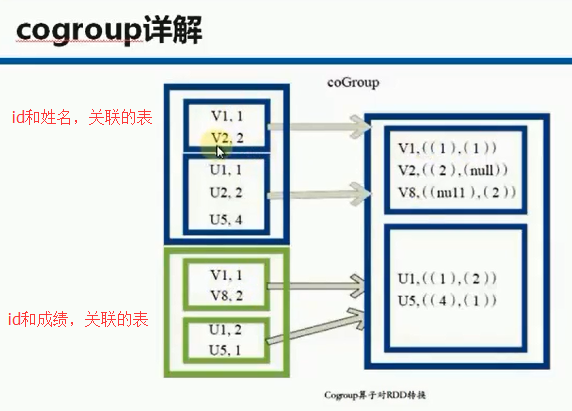
cogroup源码
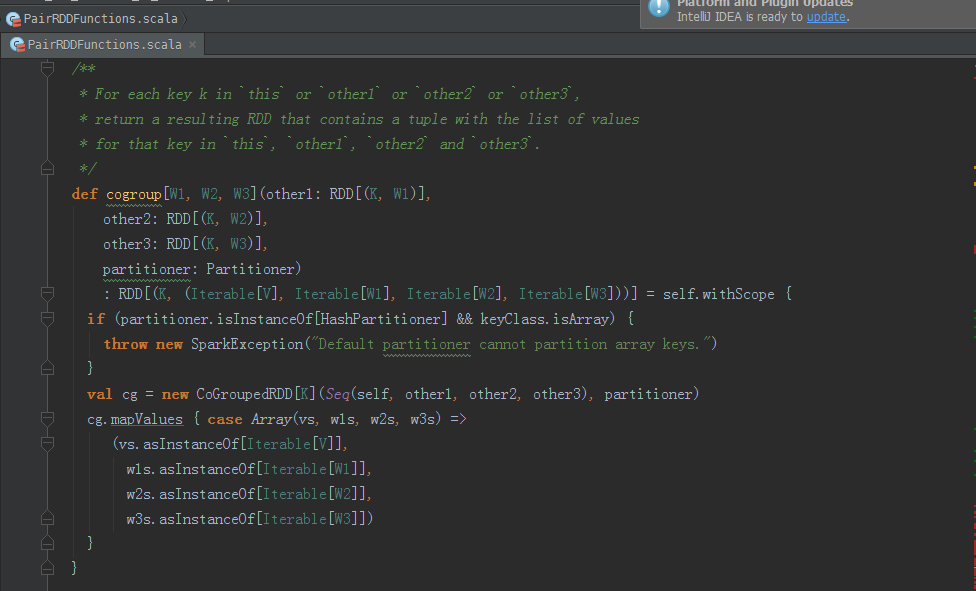
/**
 * For each key k in `this` or `other1` or `other2` or `other3`,
 * return a resulting RDD that contains a tuple with the list of values
 * for that key in `this`, `other1`, `other2` and `other3`.
 */
def cogroup[W1, W2, W3](other1: RDD[(K, W1)],
    other2: RDD[(K, W2)],
    other3: RDD[(K, W3)],
    partitioner: Partitioner)
    : RDD[(K, (Iterable[V], Iterable[W1], Iterable[W2], Iterable[W3]))] = self.withScope {
  if (partitioner.isInstanceOf[HashPartitioner] && keyClass.isArray) {
    throw new SparkException("Default partitioner cannot partition array keys.")
  }
  val cg = new CoGroupedRDD[K](Seq(self, other1, other2, other3), partitioner)
  cg.mapValues { case Array(vs, w1s, w2s, w3s) =>
     (vs.asInstanceOf[Iterable[V]],
       w1s.asInstanceOf[Iterable[W1]],
       w2s.asInstanceOf[Iterable[W2]],
       w3s.asInstanceOf[Iterable[W3]])
  }
}

/**
 * For each key k in `this` or `other`, return a resulting RDD that contains a tuple with the
 * list of values for that key in `this` as well as `other`.
 */
def cogroup[W](other: RDD[(K, W)], partitioner: Partitioner)
    : RDD[(K, (Iterable[V], Iterable[W]))] = self.withScope {
  if (partitioner.isInstanceOf[HashPartitioner] && keyClass.isArray) {
    throw new SparkException("Default partitioner cannot partition array keys.")
  }
  val cg = new CoGroupedRDD[K](Seq(self, other), partitioner)
  cg.mapValues { case Array(vs, w1s) =>
    (vs.asInstanceOf[Iterable[V]], w1s.asInstanceOf[Iterable[W]])
  }
}

/**
 * For each key k in `this` or `other1` or `other2`, return a resulting RDD that contains a
 * tuple with the list of values for that key in `this`, `other1` and `other2`.
 */
def cogroup[W1, W2](other1: RDD[(K, W1)], other2: RDD[(K, W2)], partitioner: Partitioner)
    : RDD[(K, (Iterable[V], Iterable[W1], Iterable[W2]))] = self.withScope {
  if (partitioner.isInstanceOf[HashPartitioner] && keyClass.isArray) {
    throw new SparkException("Default partitioner cannot partition array keys.")
  }
  val cg = new CoGroupedRDD[K](Seq(self, other1, other2), partitioner)
  cg.mapValues { case Array(vs, w1s, w2s) =>
    (vs.asInstanceOf[Iterable[V]],
      w1s.asInstanceOf[Iterable[W1]],
      w2s.asInstanceOf[Iterable[W2]])
  }
}

/**
 * For each key k in `this` or `other1` or `other2` or `other3`,
 * return a resulting RDD that contains a tuple with the list of values
 * for that key in `this`, `other1`, `other2` and `other3`.
 */
def cogroup[W1, W2, W3](other1: RDD[(K, W1)], other2: RDD[(K, W2)], other3: RDD[(K, W3)])
    : RDD[(K, (Iterable[V], Iterable[W1], Iterable[W2], Iterable[W3]))] = self.withScope {
  cogroup(other1, other2, other3, defaultPartitioner(self, other1, other2, other3))
}

/**
 * For each key k in `this` or `other`, return a resulting RDD that contains a tuple with the
 * list of values for that key in `this` as well as `other`.
 */
def cogroup[W](other: RDD[(K, W)]): RDD[(K, (Iterable[V], Iterable[W]))] = self.withScope {
  cogroup(other, defaultPartitioner(self, other))
}

/**
 * For each key k in `this` or `other1` or `other2`, return a resulting RDD that contains a
 * tuple with the list of values for that key in `this`, `other1` and `other2`.
 */
def cogroup[W1, W2](other1: RDD[(K, W1)], other2: RDD[(K, W2)])
    : RDD[(K, (Iterable[V], Iterable[W1], Iterable[W2]))] = self.withScope {
  cogroup(other1, other2, defaultPartitioner(self, other1, other2))
}

/**
 * For each key k in `this` or `other`, return a resulting RDD that contains a tuple with the
 * list of values for that key in `this` as well as `other`.
 */
def cogroup[W](
    other: RDD[(K, W)],
    numPartitions: Int): RDD[(K, (Iterable[V], Iterable[W]))] = self.withScope {
  cogroup(other, new HashPartitioner(numPartitions))
}

/**
 * For each key k in `this` or `other1` or `other2`, return a resulting RDD that contains a
 * tuple with the list of values for that key in `this`, `other1` and `other2`.
 */
def cogroup[W1, W2](other1: RDD[(K, W1)], other2: RDD[(K, W2)], numPartitions: Int)
    : RDD[(K, (Iterable[V], Iterable[W1], Iterable[W2]))] = self.withScope {
  cogroup(other1, other2, new HashPartitioner(numPartitions))
}

/**
 * For each key k in `this` or `other1` or `other2` or `other3`,
 * return a resulting RDD that contains a tuple with the list of values
 * for that key in `this`, `other1`, `other2` and `other3`.
 */
def cogroup[W1, W2, W3](other1: RDD[(K, W1)],
    other2: RDD[(K, W2)],
    other3: RDD[(K, W3)],
    numPartitions: Int)
    : RDD[(K, (Iterable[V], Iterable[W1], Iterable[W2], Iterable[W3]))] = self.withScope {
  cogroup(other1, other2, other3, new HashPartitioner(numPartitions))
}
cogroup的java版,适用于,转自
http://blog.csdn.net/kimyoungvon/article/details/51417910
另推荐一篇好的博客,https://www.iteblog.com/archives/1280
感谢!
Spark RDD/Core 编程 API入门系列 之rdd案例(map、filter、flatMap、groupByKey、reduceByKey、join、cogroupy等)(四)的更多相关文章
- Spark RDD/Core 编程 API入门系列 之rdd实战(rdd基本操作实战及transformation和action流程图)(源码)(三)
本博文的主要内容是: 1.rdd基本操作实战 2.transformation和action流程图 3.典型的transformation和action RDD有3种操作: 1. Trandform ...
- Spark RDD/Core 编程 API入门系列之简单移动互联网数据(五)
通过对移动互联网数据的分析,了解移动终端在互联网上的行为以及各个应用在互联网上的发展情况等信息. 具体包括对不同的应用使用情况的统计.移动互联网上的日常活跃用户(DAU)和月活跃用户(MAU)的统计, ...
- Spark RDD/Core 编程 API入门系列之map、filter、textFile、cache、对Job输出结果进行升和降序、union、groupByKey、join、reduce、lookup(一)
1.以本地模式实战map和filter 2.以集群模式实战textFile和cache 3.对Job输出结果进行升和降序 4.union 5.groupByKey 6.join 7.reduce 8. ...
- Spark RDD/Core 编程 API入门系列之动手实战和调试Spark文件操作、动手实战操作搜狗日志文件、搜狗日志文件深入实战(二)
1.动手实战和调试Spark文件操作 这里,我以指定executor-memory参数的方式,启动spark-shell. 启动hadoop集群 spark@SparkSingleNode:/usr/ ...
- Spark SQL 编程API入门系列之SparkSQL的依赖
不多说,直接上干货! 不带Hive支持 <dependency> <groupId>org.apache.spark</groupId> <artifactI ...
- Hadoop MapReduce编程 API入门系列之压缩和计数器(三十)
不多说,直接上代码. Hadoop MapReduce编程 API入门系列之小文件合并(二十九) 生成的结果,作为输入源. 代码 package zhouls.bigdata.myMapReduce. ...
- HBase编程 API入门系列之create(管理端而言)(8)
大家,若是看过我前期的这篇博客的话,则 HBase编程 API入门系列之put(客户端而言)(1) 就知道,在这篇博文里,我是在HBase Shell里创建HBase表的. 这里,我带领大家,学习更高 ...
- HBase编程 API入门系列之delete(客户端而言)(3)
心得,写在前面的话,也许,中间会要多次执行,连接超时,多试试就好了. 前面的基础,如下 HBase编程 API入门系列之put(客户端而言)(1) HBase编程 API入门系列之get(客户端而言) ...
- HBase编程 API入门系列之get(客户端而言)(2)
心得,写在前面的话,也许,中间会要多次执行,连接超时,多试试就好了. 前面是基础,如下 HBase编程 API入门系列之put(客户端而言)(1) package zhouls.bigdata.Hba ...
随机推荐
- 判断JS对象是否拥有某属性的方法举例
判断JS对象是否拥有某属性 JS是否拥有某属性的判断方法,这里提供两种方式,供大家参考. 1.in 运算符 var obj = {name:'jack'}; alert('name' in obj); ...
- 清理SQL多余登录信息
服务器列表.登陆帐户.密码等信息都记录在 %AppData%\Microsoft\Microsoft SQL Server\100\Tools\Shell\SqlStudio.bin (2008)%A ...
- IE6背景图片闪动问题
在IE6中,当JS触发事件时或者hover的时候,如果网速过慢 IE6背景图片重新加载会闪一下. 好的一个解决方案是 <!--[if IE 6]><script> try{do ...
- echo和print语句
在php中,有两种基本的输出方法:echo 和 print echo 和 print 之间的差异: echo——能够输出一个以上的字符串,无返回值 print——只能输出一个字符串,并始终返回值为 ...
- Sass 编译的几种方法
常常有人会问,使用 Sass 进行开发,那么是不是直接通过“<link>”引用“.scss”或“.sass”文件呢? 那么这里告诉大家,在项目中还是引用“.css”文件,Sass 只不过是 ...
- What is Windows Clustering
A cluster is a group of independent computer systems, referred to as nodes, working together as a un ...
- 使用South时候由于两个相同id的文件引起的问题
由于之前版本控制的一个小失误, 在主分子上面调用python manage.py makemigrations生成了 0058_auto__add_unique_setting_name_value. ...
- centos6.5搭建vpn服务器
1 安装ppp yum install -y ppp 2 安装pptpd yum install pptpd // rpm -Uvh http://poptop.sourceforge.net ...
- http://www.w3cplus.com/animation/create-animated-text-fills.html
关于svg的资料: http://www.w3cplus.com/animation/create-animated-text-fills.html asp.net中jquery的ajax调用cs文件 ...
- jersey REST的接口简述
GET方法:只读,是幂等和安全的.在接口中抽象地定义了资源的请求方法类型后,其全部实现类都无须再定义. HEAD方法:与GET方法相似,只是服务器端的返回值不包括HTTP实体. OPTIONS方法:与 ...