
cs244a-Introduction to Computer Networking-Unit1
Unit 1
学习目标:
- how an application use the Internet
- The structure of the Internet:The 4 layer model
- The Internet protocol(IP)
- Basic architectural ideas and principles:
- Packet switching
- Layering
- Encapsulation
1.1 A Day in the life of an Application
- Dominant model:
- bidrectional
- reliable byte stream connection
1. World Wide Web (HTTP)
- C/S架构
- 发送commands,接收responses
- request:"GET / HTTP/1.1"
- response: "HTTP/1.1 200 OK"
2. BitTorrent
- P2P架构
- break files into "pieces"
- 所有存有pieces file的client被称为swarm,client join and leave swarms
- tracker追踪swarm的成员,通过torrent file向一个tracker获取swarm中的client列表
- request: "GET list of clients in swarm"
- response: "200 OK list of clients"
3. Skype
- mixed架构
- 如果两个client能互联,就在client间建立连接--->P2P
- 如果有一方存在NAT:Client A-----Internet-----NAT---ClientB
- 由于NAT,B可以连接A,但A无法连接B
- A cannot open connection to B
- B在一个Rendezvous上注册,A向Rendezvous发送请求,Rendezvous转发请求给B,B主动和A建立连接
- 双方均存在NAT
- 通过一个Relay转发服务器作为中转,转发双方的消息
1.2 What the Internet is: The 4 Layer Internet Model
- Application:(http, bit-torrent)
- application-specific semantics
- Transport:(tcp, udp)
- guarantees correct, in-order delivery of data end-to-end
- controls congestion
- Network:(IP)
- must use the Internet Protocol(IP)
- best-effort attempt to deliver datagrams, no promises
- IP datagrams can get lost, out of order, and can be corrupted
- Link:(802.11, 3G, DSL, Ethernet)
- one-hop control
- delivers data over a single link between an end host and router, or between routers
two extra things need to know:
- IP is the "thin waist"
- the 7-layer OSI Model
- Application------http--------Application----7
- Application------ASCII-----Presentation--6
- Transport--------TCP-------Session--------5
- Transport--------TCP-------Transport------4
- Network----------IP----------Network--------3
- Link---------------Ethernet----Link------------2
- Link---------------Ethernet----Physical------1
1.3 What the Internet is: The IP service model
The Internet Protocol(IP)
- Transport Segment
- IP Datagram、Packets
- Link Frame
The IP service Model
Property Behavior Datagram Hop by hop routing Unreliable Packets might be dropped because of full wait queue Best effort Connectionless No per-flow state. Might be mis-sequenced why simple?
- faster, more streamlined and lower cost to build and maintain
- The end-to-end principle: implement features in the end hosts if possible
- Allows a variety of reliable(or not) services to be built on top
- Works over any link layer: IP makes very few assumptions about the link layer below
The IP service model
- Tries to prevent packets looping forever(TTL, time to live)
- Will fragment packets if they are too long
- Uses a header checksum to reduce chances of delivering datagram to wrong destination
- Allows for new versions of IP
- IPv4: 32 bit
- IPv6: 128 bit
- Allows for new options to be added to header
Quiz:
In an alternative to the Internet Protocol called "ATM" proposed in the 1990s, the source and destination address is replaced by a unique "flow" identifier that is dynamically created for each new end-to-end communication. Before the communication starts, the flow identifier is added to each router along the path, to indicate the next hop, and then removed when the communication is over. Which of the following statements are implications of this design? Check all that apply.
- (+)There is state in the network for every communication flow, rather than just for every destination.
- (-)If a link fails, there is no need to update any state in the network.
- (-)There must be a centralized controller to manage the insertion and removal of identifiers, as well as update them whenever a flow needs to be re-routed.
- (-)It means we no longer need a transport layer to reliably deliver correct, in-order data to applications.
1.4 A day in the life of a packet
- application: stream of data
- transport: segment of data
- network: packet of data
TCB Byte Stream
- "3-way handshaking"
- "SYN" "SYN/ACK" "ACK"
- To computer:network layer address: IP address
- To application:transport layer address: port
- web server: port 80
Inside the Stream
- hops: a link of two nodes
- access point
Inside Each Hop
- forwarding table
- key: IP address pattern, value: link
- longest prefix match
- default entry: least specific router
- mostly used in edge network
- forwarding table
1.5 Principle: Packet Switching
- Packet: A self-contained unit of data that carries information necessary for it to reach its destination.
- Flow: A collection of datagrams belonging to the same end-to-end communicaition, e.g. a TCP connection
- two consequences
- Simple: no per-flow state required, self-contained
- Efficient: allows flows to use all available link capacity
- Staticstical Multiplexing: taking a single resource and sharing it across multiple users in a probabilistic way
1.6 Principle: Layering
- layering: the organizaiton of a system into a number of separate functional components or layers
- Reasons for layering:
- Modularity
- Well defined service
- Reuse
- Separation of concerns
- Continuous improvement
- Peer to peer communications
1.7 Principle: Encapsulation
- layering:
- Transport: segment, inter-application communication
- Link: frame, inter-host communication on a shared link
- How layering manifests in data representation?
- layer N data is payload to layer N - 1
- allows to layer recursively
- Example: VPN(Virtual Private Network)
- VPN open a secure connection to a network you trust (like your office network)
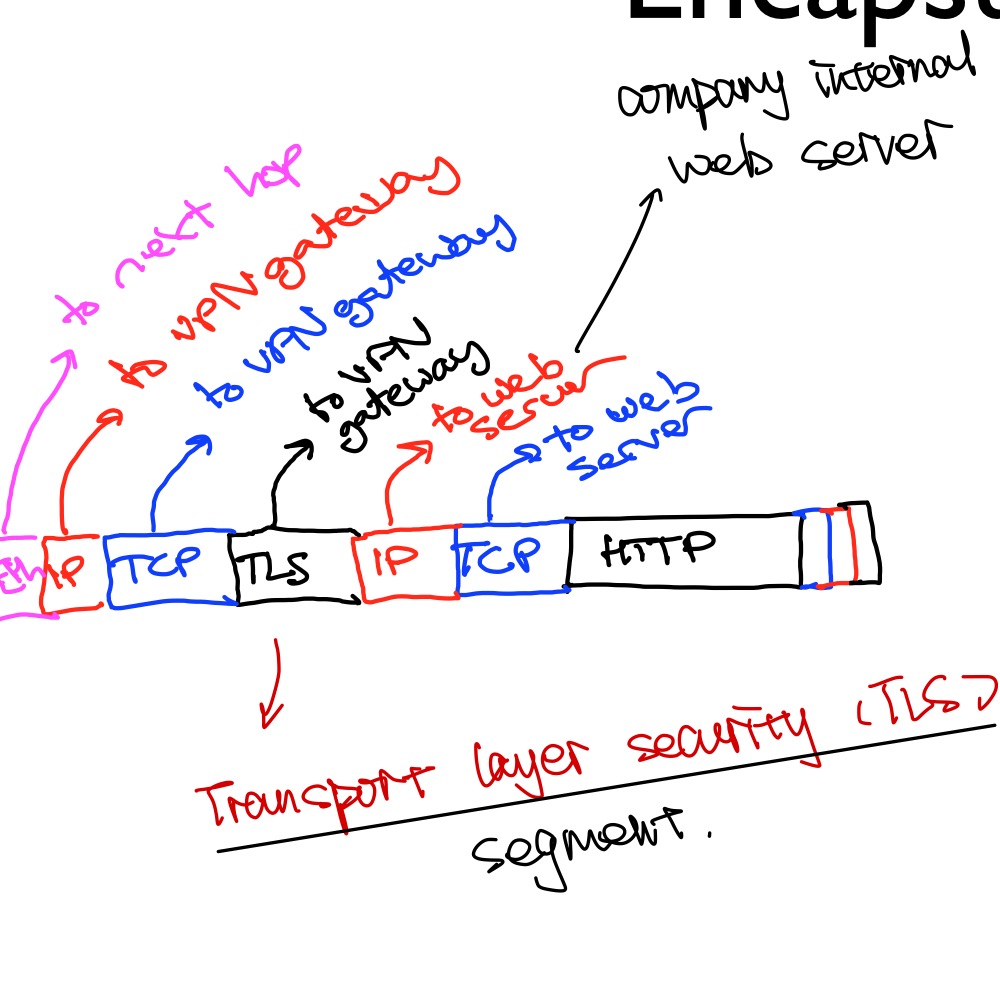
- VPN open a secure connection to a network you trust (like your office network)
- Encapsulated payloads
- Help separation of concerns
- Help enforce boundaries/layering
- Simplify layer implementations
- Can not protect from malicious attacks
1.8 Byte order and Packet format
- Network byte order is big endian
- Helper functions: htons(), ntohs(), htonl(), ntohl()
- htons:"host to network short"
uint16_t http_port = 80; //Host order

if (packet->port == http_port) { ... //network vs. host order

uint16_t http_port = 80;//Host order

uint16_t packet_port = ntohs(packet->port);

if (packet_port == http_port) { ... //OK
Quiz:
(+)The layout of a character string in memory is the same on big-endian and little-endian architectures.
1.9 IPv4 addresses and CIDR
- Goal of Internet Protocal(IP) Addresses
- Stitch many different networks together
- Need network-independent, unique address
- Internet Protocal, Version 4
- Layer 3(network) address
- 32 bits long(4 octets):a.b.c.d
- ex: 171.64.64.64
- Netmask: tells the device which IP addresses are local -- on the same link -- and which require going through an IP router.
if (A & netmask == B & netmask) {

    on the same network

}
- 如果dest和src的掩码相同就不用经过路由器转发,可以直接发送
- smaller netmask means larger network
- Classes Inter-Domain Routing(CIDR, 无类别域间路由)
- 最初架构:将所有IP地址分成3类,每一类将IP地址分成两个部分,network和host,分别表示
- network part: administrative domain, such as MIT, BBN
- host part: which device within that network
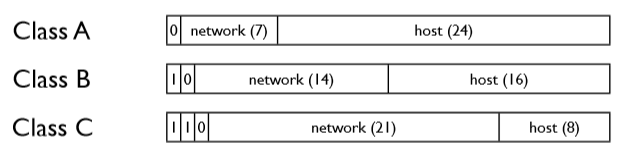
- 当前CIDR架构:
- Rather than hava prefixes only of length 8, 16, and 24 bits, CIDR allows prefixes to be any number of bits
- Address block is pair: address, count
- All CIDR prefixes define a block of addresses that is a power of 2
- 因此描述IP地址时需要附带其掩码长度
- eg: 171.64.0.0/16 means any address in the range 171.64.0.0 to 171.64.255.255
- IPv4 Address Assignment
- IANA: Internet Assigned Numbers Authority
- Internet Corporation for Assignment of Names and Numbers(ICANN)'s job
- IANA gives out /8s(16百万个地址) to Regional Internet Registries(RIRs,每个大陆有一个,每个RIR有自己的分配政策)
- Ran out in Feburary 2011, 当只剩下最后5个/8s时,IANA给每个RIR一个/8
- IANA: Internet Assigned Numbers Authority
- 最初架构:将所有IP地址分成3类,每一类将IP地址分成两个部分,network和host,分别表示
- Longest prefix match(LPM)
- forwarding table is a set of CIDR entries
1.10 Address resolution protocol(ARP)
- Layers of Address
- ARP: The mechanism by which the network layer can discover the link address associated with a network address it's directly connected.
- A link address describes a particular network card. eg: Ethernet has 48 bit addresses
- Host: 171.67.76.65
- Interface: 00:13:72:4c:d9:6a
- Addressing Problem
- 因为子网掩码的概念,router或gateway通常有多个interface,每个接口(interface)对应一个识别自身网卡link address以及一个识别host主机的network layer address,例如下图中的网关(gateway),具有两个network cards:
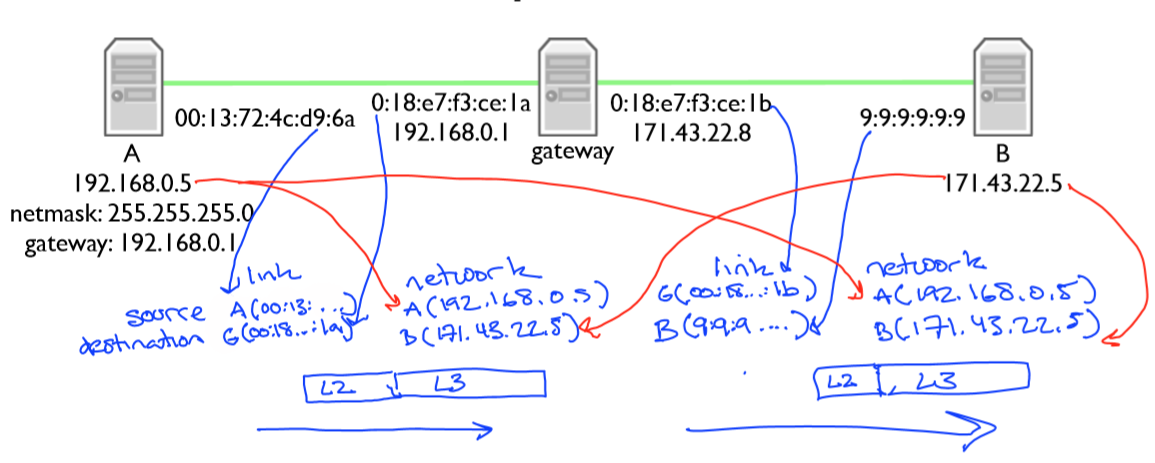
- 当A向B发送IP packet时,通过子网掩码知道A和B不在一个网络中,因此首先需要经过gateway,A虽然知道gateway的IP地址,但是不一定知道gateway的link address
- 因为子网掩码的概念,router或gateway通常有多个interface,每个接口(interface)对应一个识别自身网卡link address以及一个识别host主机的network layer address,例如下图中的网关(gateway),具有两个network cards:
- Encapsulation
- 在IP层,Ip packet只需要知道dest和source host的ip地址
- 在Link layer,负责一段链路,因此每一段链路的link layer address
- Address Resolution Protocol
- request-reply protocal
- Each node keeps a cache of mappings from IP addresses on its network to link layer addresses
- 请求发送方式:广播(Link address全1,48个1)
- 请求中包含请求者的ip和link address,因此所有收到该ARP请求的节点都可以insert or refresh a mapping from their cache
- 响应发送方式:协议要求unicast(单播),通常实现为广播
- 节点仅响应对他们自己的请求
- 因此,如果一个节点断开连接或crash,当所有mappings过期后才算离开网络
- mappings存储时间取决于设备,Mac OSX保持20min。Cicso设备保持4hours
- 节点进入网络也可以发送gratuitour(免费) ARP packets,requesting non-existent mappings,in order to advertise themselves on a network
- ARP Packet Format(RFC826)
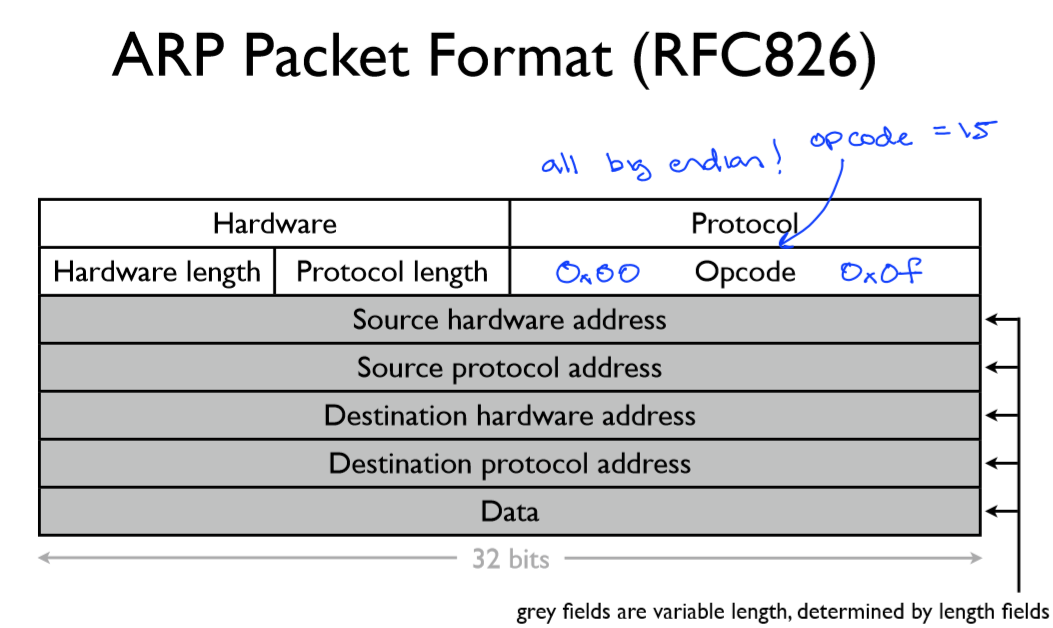
- Hardware: what link layer this request or response is for
- Protocol: what network protocol this request is for
- length fields: 长度
- opcode:packet类型是发送还是响应
cs244a-Introduction to Computer Networking-Unit1的更多相关文章
- A Simple Introduction To Computer Networking
Most networking discussions are a jumble of acronyms. Forget the configuration details - what are th ...
- MIT Introduction to Computer Science and Programming (Lesson one )
MIT Introduction to Computer Science and Programming (Lesson one ) 这篇文是记载 MIT 计算机科学及编程导论 第一集 的笔记 Les ...
- Computer Networking: A Top Down Approach
目录 Chapter 1: Computer Networks and the Internet 1. What is the Internet? 2. The Network Edge 3. The ...
- Note 2 for <Pratical Programming : An Introduction to Computer Science Using Python 3>
Book Imformation : <Pratical Programming : An Introduction to Computer Science Using Python 3> ...
- Note 1 for <Pratical Programming : An Introduction to Computer Science Using Python 3>
Book Imformation : <Pratical Programming : An Introduction to Computer Science Using Python 3> ...
- Introduction to Computer Science and Programming in Python--MIT
学习总结--(Introduction to Computer Science and Programming in Python--MIT) 导论 主题 重新利用数据结构来表达知识 理解算法的复杂性 ...
- Introduction to Computer Networks(网络架构与七层参考模式)
Network Connectivity 1. Important terminologies 1) Link 设备连接的连线.Link本身既可以是有线的,也可以是无线的. 2) Node 设备.电脑 ...
- An Introduction to Computer Thinking
1.Die Grundlage des Computers 1.1 Binärzahl in die Dezimalzahl umsetzen Bereiten nach Gewicht,dann b ...
- MITx: 6.00.1x Introduction to Computer Science and Programming Using Python Week 2: Simple Programs 4. Functions
ESTIMATED TIME TO COMPLETE: 18 minutes We can use the idea of bisection search to determine if a cha ...
- edX MITx: 6.00.1x Introduction to Computer Science and Programming Using Python 课程 Week 1: Python Basics Problem Set 1 Problem 3
Assume s is a string of lower case characters. Write a program that prints the longest substring of ...
随机推荐
- C++入门经典-例5.9-使用空类型指针执行函数
1:运行代码: // 5.9.cpp : 定义控制台应用程序的入口点. // #include "stdafx.h" #include <iostream> using ...
- gdb调试时忽略SIGPIPE 等信号
GDB调试网络程序时,会遇到SIGPIPE信息,默认GDB会把程序停下来,即使程序使用signal(SIGPIPE, SIG_IGN);来忽略信号.用handle命令设置一下缺省的signal的处理行 ...
- 套接字之 getsockname && getpeername
getsockname-获取本地地址:比如,在绑定的时候设置端口号为0由系统自动选择端口绑定,或者使用了INADDR_ANY通配所有地址的情况下,后面需要用到具体的地址和端口,就可以用getsockn ...
- 第七周总结&第五次实验报告
学习总结 这周我们加深了对抽象类与接口的学习,获得的知识点也比上周多了许多,抽象类与接口很相似,就比如别人还没有做完的是交给你来做,而他那些样式都做好了,你只需要完善即可 但也有不同点. 区别点 抽象 ...
- linux如何查看所有的用户和组信息(转载)
[步骤一]cat /etc/passwdcat /etc/passwd查看所有的用户信息,详情如下图 [步骤二]cat /etc/passwd|grep 用户名 cat /etc/passwd|gre ...
- Hadoop之集群搭建
准备 需要准备多台主机(已经安装并且配置好hadoop和jdk) 需要配置ssh免密服务 下面我们开始进行配置,拿到已经准备好的主机,主机名分别为: centos101 centos102 cento ...
- 二、Smarty中的三种主要变量
1.从PHP中分配的变量 $smarty -> assign(); 从PHP分配给模板使用的变量:动态变量 2.从配置文件中读取的变量 $smarty配置文件中的内容不是PHP读取,而是就在sm ...
- java 对象引用为null时,出现的bug问题
在Java中,对象往往包含属性.方法及一个存储空间,若一个对象的属性和方法是空的则可认为这是一个空对象. 一个空对象也是对象,同样通过对象名引用方法或属性,但和一般对象有点不同. 1.空对象调用非静态 ...
- layui学习地址
--layui学习地址 ,相当之好用,非常感谢为我们工作和学习提供方便的才子们,谢谢~https://www.layui.com/demo/layim.html
- 浏览器端-W3School-JavaScript:JavaScript 事件参考手册
ylbtech-浏览器端-W3School-JavaScript:JavaScript 事件参考手册 1.返回顶部 1. JavaScript 事件参考手册 事件通常与函数配合使用,这样就可以通过发生 ...