
python,tensorflow,CNN实现mnist数据集的训练与验证正确率
1.工程目录
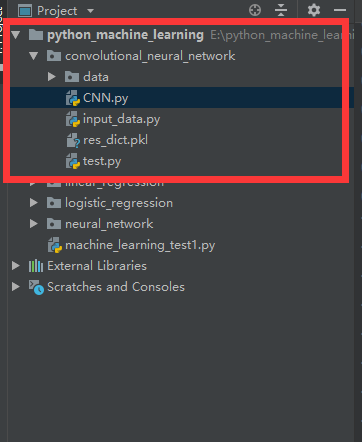
2.导入data和input_data.py
链接:https://pan.baidu.com/s/1EBNyNurBXWeJVyhNeVnmnA
提取码:4nnl
3.CNN.py
import tensorflow as tf

import matplotlib.pyplot as plt

import input_data

mnist = input_data.read_data_sets('data/', one_hot=True)

trainimg = mnist.train.images

trainlabel = mnist.train.labels

testimg = mnist.test.images

testlabel = mnist.test.labels

print('MNIST ready')

n_input = 784

n_output = 10

weights = {

    'wc1': tf.Variable(tf.truncated_normal([3, 3, 1, 64], stddev=0.1)),

    'wc2': tf.Variable(tf.truncated_normal([3, 3, 64, 128], stddev=0.1)),

    'wd1': tf.Variable(tf.truncated_normal([7*7*128, 1024], stddev=0.1)),

    'wd2': tf.Variable(tf.truncated_normal([1024, n_outpot], stddev=0.1)),

}

biases = {

    'bc1': tf.Variable(tf.random_normal([64], stddev=0.1)),

    'bc2': tf.Variable(tf.random_normal([128], stddev=0.1)),

    'bd1': tf.Variable(tf.random_normal([1024], stddev=0.1)),

    'bd2': tf.Variable(tf.random_normal([n_outpot], stddev=0.1)),

}

def conv_basic(_input, _w, _b, _keepratio):

    _input_r = tf.reshape(_input, shape=[-1, 28, 28, 1])

    _conv1 = tf.nn.conv2d(_input_r, _w['wc1'], strides=[1, 1, 1, 1], padding='SAME')

    _conv1 = tf.nn.relu(tf.nn.bias_add(_conv1, _b['bc1']))

    _pool1 = tf.nn.max_pool(_conv1, ksize=[1, 2, 2, 1], strides=[1, 2, 2, 1], padding='SAME')

    _pool_dr1 = tf.nn.dropout(_pool1, _keepratio)

    _conv2 = tf.nn.conv2d(_pool_dr1, _w['wc2'], strides=[1, 1, 1, 1], padding='SAME')

    _conv2 = tf.nn.relu(tf.nn.bias_add(_conv2, _b['bc2']))

    _pool2 = tf.nn.max_pool(_conv2, ksize=[1, 2, 2, 1], strides=[1, 2, 2, 1], padding='SAME')

    _pool_dr2 = tf.nn.dropout(_pool2, _keepratio)

    _densel = tf.reshape(_pool_dr2, [-1, _w['wd1'].get_shape().as_list()[0]])

    _fc1 = tf.nn.relu(tf.add(tf.matmul(_densel, _w['wd1']), _b['bd1']))

    _fc_dr1 = tf.nn.dropout(_fc1, _keepratio)

    _out = tf.add(tf.matmul(_fc_dr1, _w['wd2']), _b['bd2'])

    out = {

        'input_r': _input_r, 'conv1': _conv1, 'pool1': _pool1, 'pool_dr1': _pool_dr1,

        'conv2': _conv2, 'pool2': _pool2, 'pool_dr2': _pool_dr2, 'densel': _densel,

        'fc1': _fc1, 'fc_dr1': _fc_dr1, 'out': _out

    }

    return out

print('CNN READY')

x = tf.placeholder(tf.float32, [None, n_input])

y = tf.placeholder(tf.float32, [None, n_output])

keepratio = tf.placeholder(tf.float32)

_pred = conv_basic(x, weights, biases, keepratio)['out']

cost = tf.reduce_mean(tf.nn.softmax_cross_entropy_with_logits(_pred, y))

optm = tf.train.AdamOptimizer(learning_rate=0.01).minimize(cost)

_corr = tf.equal(tf.argmax(_pred, 1), tf.argmax(y, 1))

accr = tf.reduce_mean(tf.cast(_corr, tf.float32))

init = tf.global_variables_initializer()

print('GRAPH READY')

sess = tf.Session()

sess.run(init)

training_epochs = 15

batch_size = 16

display_step = 1

for epoch in range(training_epochs):

    avg_cost = 0.

    total_batch = 10

    for i in range(total_batch):

        batch_xs, batch_ys = mnist.train.next_batch(batch_size)

        sess.run(optm, feed_dict={x: batch_xs, y: batch_ys, keepratio: 0.7})

        avg_cost += sess.run(cost, feed_dict={x: batch_xs, y: batch_ys, keepratio: 1.0})/total_batch

    if epoch % display_step == 0:

        print('Epoch: %03d/%03d cost: %.9f' % (epoch, training_epochs, avg_cost))

        train_acc = sess.run(accr, feed_dict={x: batch_xs, y: batch_ys, keepratio: 1.})

        print('Training accuracy: %.3f' % (train_acc))

res_dict = {'weight': sess.run(weights), 'biases': sess.run(biases)}

import pickle

with open('res_dict.pkl', 'wb') as f:

    pickle.dump(res_dict, f, pickle.HIGHEST_PROTOCOL)
4.test.py
import pickle

import numpy as np

def load_file(path, name):

    with open(path+''+name+'.pkl', 'rb') as f:

        return pickle.load(f)

res_dict = load_file('', 'res_dict')

print(res_dict['weight']['wc1'])

index = 0

import input_data

mnist = input_data.read_data_sets('data/', one_hot=True)

test_image = mnist.test.images

test_label = mnist.test.labels

import tensorflow as tf

def conv_basic(_input, _w, _b, _keepratio):

    _input_r = tf.reshape(_input, shape=[-1, 28, 28, 1])

    _conv1 = tf.nn.conv2d(_input_r, _w['wc1'], strides=[1, 1, 1, 1], padding='SAME')

    _conv1 = tf.nn.relu(tf.nn.bias_add(_conv1, _b['bc1']))

    _pool1 = tf.nn.max_pool(_conv1, ksize=[1, 2, 2, 1], strides=[1, 2, 2, 1], padding='SAME')

    _pool_dr1 = tf.nn.dropout(_pool1, _keepratio)

    _conv2 = tf.nn.conv2d(_pool_dr1, _w['wc2'], strides=[1, 1, 1, 1], padding='SAME')

    _conv2 = tf.nn.relu(tf.nn.bias_add(_conv2, _b['bc2']))

    _pool2 = tf.nn.max_pool(_conv2, ksize=[1, 2, 2, 1], strides=[1, 2, 2, 1], padding='SAME')

    _pool_dr2 = tf.nn.dropout(_pool2, _keepratio)

    _densel = tf.reshape(_pool_dr2, [-1, _w['wd1'].shape[0]])

    _fc1 = tf.nn.relu(tf.add(tf.matmul(_densel, _w['wd1']), _b['bd1']))

    _fc_dr1 = tf.nn.dropout(_fc1, _keepratio)

    _out = tf.add(tf.matmul(_fc_dr1, _w['wd2']), _b['bd2'])

    out = {

        'input_r': _input_r, 'conv1': _conv1, 'pool1': _pool1, 'pool_dr1': _pool_dr1,

        'conv2': _conv2, 'pool2': _pool2, 'pool_dr2': _pool_dr2, 'densel': _densel,

        'fc1': _fc1, 'fc_dr1': _fc_dr1, 'out': _out

    }

    return out

n_input = 784

n_output = 10

x = tf.placeholder(tf.float32, [None, n_input])

y = tf.placeholder(tf.float32, [None, n_output])

keepratio = tf.placeholder(tf.float32)

_pred = conv_basic(x, res_dict['weight'], res_dict['biases'], keepratio)['out']

cost = tf.reduce_mean(tf.nn.softmax_cross_entropy_with_logits(_pred, y))

_corr = tf.equal(tf.argmax(_pred, 1), tf.argmax(y, 1))

accr = tf.reduce_mean(tf.cast(_corr, tf.float32))

init = tf.global_variables_initializer()

sess = tf.Session()

sess.run(init)

training_epochs = 1

batch_size = 1

display_step = 1

for epoch in range(training_epochs):

    avg_cost = 0.

    total_batch = 10

    for i in range(total_batch):

        batch_xs, batch_ys = mnist.train.next_batch(batch_size)

    if epoch % display_step == 0:

        print('_pre:', np.argmax(sess.run(_pred, feed_dict={x: batch_xs, keepratio: 1. })))

        print('answer:', np.argmax(batch_ys))
python,tensorflow,CNN实现mnist数据集的训练与验证正确率的更多相关文章
- tensorflow中使用mnist数据集训练全连接神经网络-学习笔记
tensorflow中使用mnist数据集训练全连接神经网络 ——学习曹健老师“人工智能实践:tensorflow笔记”的学习笔记, 感谢曹老师 前期准备:mnist数据集下载,并存入data目录: ...
- tensorflow读取本地MNIST数据集
tensorflow读取本地MNIST数据集 数据放入文件夹(不要解压gz): >>> import tensorflow as tf >>> from tenso ...
- Ubuntu14.04+caffe+cuda7.5 环境搭建以及MNIST数据集的训练与测试
Ubuntu14.04+caffe+cuda 环境搭建以及MNIST数据集的训练与测试 一.ubuntu14.04的安装: ubuntu的安装是一件十分简单的事情,这里给出一个参考教程: http:/ ...
- 十折交叉验证10-fold cross validation, 数据集划分 训练集 验证集 测试集
机器学习 数据挖掘 数据集划分 训练集 验证集 测试集 Q:如何将数据集划分为测试数据集和训练数据集? A:three ways: 1.像sklearn一样,提供一个将数据集切分成训练集和测试集的函数 ...
- [Python]基于CNN的MNIST手写数字识别
目录 一.背景介绍 1.1 卷积神经网络 1.2 深度学习框架 1.3 MNIST 数据集 二.方法和原理 2.1 部署网络模型 (1)权重初始化 (2)卷积和池化 (3)搭建卷积层1 (4)搭建卷积 ...
- 学习TensorFlow,邂逅MNIST数据集
如果说"Hello Word!"是程序员的第一个程序,那么MNIST数据集,毫无疑问是机器学习者第一个训练的数据集,本文将使用Google公布的TensorFLow来学习训练MNI ...
- mnist的格式说明,以及在python3.x和python 2.x读取mnist数据集的不同
有一个关于mnist的一个事例可以参考,我觉得写的很好:http://www.cnblogs.com/x1957/archive/2012/06/02/2531503.html #!/usr/bin/ ...
- Python Tensorflow CNN 识别验证码
Python+Tensorflow的CNN技术快速识别验证码 文章来源于: https://www.jianshu.com/p/26ff7b9075a1 验证码处理的流程是:验证码分析和处理—— te ...
- TensorFlow CNN 测试CIFAR-10数据集
本系列文章由 @yhl_leo 出品,转载请注明出处. 文章链接: http://blog.csdn.net/yhl_leo/article/details/50738311 1 CIFAR-10 数 ...
随机推荐
- linux下查找命令总结
查找命令总结,which,whereis,find,locate,type http://blog.csdn.net/jessica1201/article/details/8139249 1.f ...
- random 模块常用方法学习
>>> import random#随机小数>>> random.random() # 大于0且小于1之间的小数0.7664338663654585>> ...
- linux 将进程或者线程绑定到指定的cpu上
基本概念 cpu亲和性(affinity) CPU的亲和性, 就是进程要在指定的 CPU 上尽量长时间地运行而不被迁移到其他处理器,也称为CPU关联性:再简单的点的描述就将指定的进程或线程绑定到相应的 ...
- [HNOI2019]鱼
Luogu5286 \(2019.4.14\),新生第一题,改了\(3\)个小时 题解-租酥雨,和出题人给的正解一模一样 枚举\(AD\),分别考虑鱼身\(BC\)和鱼尾\(EF\) 到\(E\),\ ...
- php 判断两个时间段是否有交集
一开始,没啥思路,全靠百度,记录一下哈 public function demo(){ //例子 $astart = strtotime("1995-06-16 12:00:00" ...
- ZigZag编码
ZigZag编码 在网络传输和数据存储场景中,需要对数据进行压缩.数据压缩的算法非常多,但大部分的数据压缩算法的原理是通过某种编码方式不存储数据中的0比特位,因此0比特位越多,数据压缩的效果越好.Zi ...
- 异常捕获设置HTTPStatus
第一步:创建一个异常类 package com.payease.exception; /** * @Created By liuxiaoming * @CreateTime 2017/12/12 下午 ...
- tomcat无法登录
最近开始学JEE,在配置环境时,使用了tomcat 7.x的版本,然而点击manager app时无法登录. 按照网络上的教程(如:http://www.oschina.net/question/19 ...
- 【Maven学习】maven-enforcer-plugin的使用
我们会经常碰到这样的问题,在pom中引入了一个jar,里面默认依赖了其他的jar包.jar包一多的时候,我们很难确认哪些jar是我们需要的,哪些jar是冲突的.此时会出现很多莫名其妙的问题,什么类找不 ...
- hibernate基本配置show_sql、sql_format
show_sql是否打印生成的sql语句: <property name="show_sql">false</property> sql_format,格式 ...