
How to evaluate a transimpedance amplifier (part 2)
In my previous blog on "How to evaluate a transimpedance amplifier, part 1", we looked at the OPA857 performance, but didn’t go in depth in explaining how those measurements were taken. Now that we’ve have established a reference, let’s work through the implementation.
To summarize, the main challenges to taking measurements with the OPA857 include:
- Transimpedance configuration
- Low input capacitance
- High output impedance
With a 20kW gain and a 1VPP output voltage swing the input current needs to be 50mAPP. Since the output voltage swing of the OPA857 is class A and the current flowing through a transimpedance is unipolar, the output common-mode voltage will need to be set appropriately.
The current source needs to be low capacitance, less than 1.5pF, to maintain the bandwidth. The output needs to be high output impedance to control the loading on the OPA857’s output. Since most of the test equipments we have are 50W input and output impedance, how do we resolve that problem while not impacting bandwidth, slew rate or distortion performance of the DUT (Device Under Test)?
This leads to individual solution for each measurement type.
The first measurement we will look at is the frequency response, or S21 parameter. For that we’ll use an HP 8753ES Network analyzer, a 30kHz to 6GHz S Parameter Network Analyzer. Both input and output are 50W impedance and AC-coupled. There are two ports in the back of the analyzer that allow controlling the DC voltage on either the input or output.
The two proposed signal chains to measure the OPA857 frequency response include:
- Using a high speed differential probe, see figure 1.
- Using a high speed buffer to isolate the network analyzer’s load, see figure 2.
Note that the Test_SD pin is set to a logic high (+3.3V) for the internal current source to operate properly. This implies that the DC voltage present on the Test_IN input will set the output voltage appearing on OUT and requires you implement the following procedure to ensure that the OPA857 operates optimally for an AC response.
- Minimize the AC signal.
- Set DC voltage at input such that the output voltage can swing around it preset common-mode voltage. For example, if the signal swing is 500mVPP, then the OUT DC voltage needs to be set to ≤1.4V. If this is not the case, the output swing will clip as the current in the class-A output stage runs out.
- After completion of #1, do not leave anything connected on the output. A probe lead or a voltage will add several pF to the load, altering the frequency response.
- Set the AC amplitude to the desired peak-peak output signal swing.
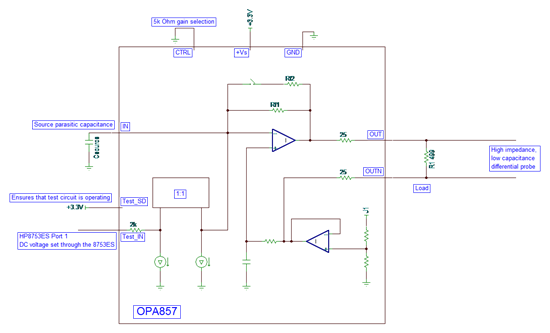
Figure 1: Circuit #1 using a fully differential probe to interface to the HP8753ES.
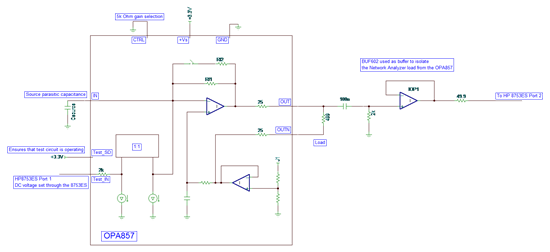
Figure 2: Circuit #2 using a BUF602 to interface to the HP8753ES.
The same approach is used to evaluate pulse response or any time domain measurement. Note however that since no resistor tolerance inside theOPA857 is better than ±15%, the setup will have to be calibrated device by device.
The approach described above will not work for measuring harmonic distortion, so how does this new problem get resolved?
The traditional approach for measuring harmonic distortion requires:
- A low distortion source
- A high dynamic range spectrum analyzer
The low distortion source is further improved by using a high order filter. The dynamic range of the spectrum analyzer can be improved by filtering the fundamental and measuring only the harmonics. The setup is shown in figure 3. The notch filter that can is placed after the DUT is omitted in this diagram.
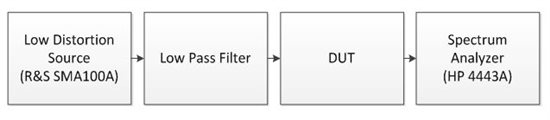
Figure 3: Traditional harmonic distortion bench measurement setup.
In the case of the OPA857, we have two problems. The first one is that the source is a voltage source and that the input signal requires a current source. The internal current source cannot be used here as it does not have sufficient linearity. So we will have to develop a low distortion current source to enable the measurement. The second problem is the interface to the spectrum analyzer. The output of the OPA857 is pseudo-differential and requires driving a light load, whereas the spectrum analyzer requires a single-ended input and expects 50W.
A current source has high output impedance. In our case, the current source will need to have low input capacitance as well, so it cannot be generated using transistor-based circuit as a large transistor will also have a high intrinsic capacitance, not considering the package and board layout parasitic. This limits the approach to using a voltage source and converting it to a current using a resistor. In order to ensure that the noise gain of the OPA857 is close to 1V/V, the same as the transimpedance configuration, the source capacitance is minimal and the resistance is large enough to approximate this.
The source capacitance is minimized by careful insertion of a series resistor on the inverting pin. Please refer to the OPA857 EVM for the layout.
In our case, the gain resistor is five times the value of the transimpedance gain, so for 20kΩ, the current source impedance is 100kΩ. It is a compromise as the noise gain is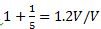 . This represents a degradation of ~1.6dB due to the loss in loop-gain in the measurement which would not be present in a transimpedance configuration.
The OPA857 is operating in an attenuator configuration, so a 0.5VPP on its output now requires 2.5VPP from the generator further increasing the non-linearity from the source.
Looking at the output of the OPA857, we need to measure the nominal 500Ω load and also measure the non-linearity of the amplifier as the load is decreased to 5kΩ. So, again the interface between the OPA857 and the spectrum analyzer is not purely resistive as there is too much attenuation of the signal and parasitic capacitance on the output after the resistance would limit the effective bandwidth. If an active element is inserted in the signal chain, its distortion must be 15dB better than the expected measurement to degrade the measurement by 0.1dB. This tends to be a relatively easy requirement at low frequency, but is quickly unmanageable as the frequency increases. The solution here is to use a DVGA developed for the telecommunication market as it provides sufficient gain to compensate for attenuation in the signal path, since those DVGAs have a 200Ω input impedance, as well as convert the pseudo differential signal to fully differential and have sufficient linearity up to the frequency of interest. A transformer on the output of the DVGA converts the amplified fully differential signal and converts it to the single-ended input the spectrum analyzer expects. We will have some attenuation losses here as well to match the 50Ω input impedance of the test equipment. Finally the signal chain on the output of the OPA857 will look like the diagram shown in figure 4.
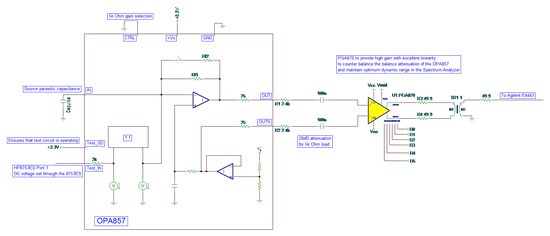
Figure 4: OPA857 with PGA870 used to adapt the OPA857 load into the Spectrum Analyzer.
The PGA870 provides additional gain with high linearity minimizing the measured linearity degradation. Looking into the PGA870 datasheet, we see that operating at high gain (> +10dB), both the 2nd and the 3rd harmonic distortion is greater than 90dBc for a 2VPP output swing. This ensures that theOPA857 measurement is degraded by less than 0.1dB.
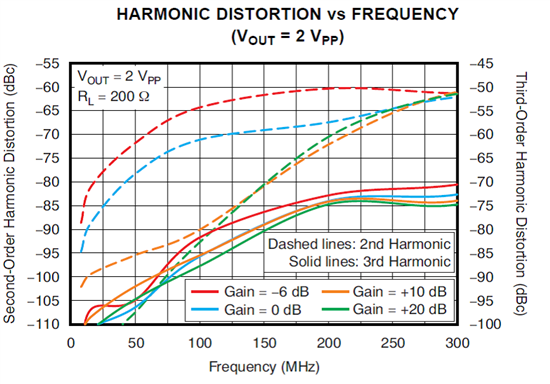
Figure 5: PGA870 Harmonic distortion for 200Ω load.
In this blog, I have shown the techniques used to measure most of the typical characteristic curves shown in the OPA857 datasheet. For application information or how to implement the OPA857, refer to the datasheet and EVM user guide.
How to evaluate a transimpedance amplifier (part 2)的更多相关文章
- How to evaluate a transimpedance amplifier (part 1)
In this blog, I want take a different approach and describe the technical challenge encountered whil ...
- [转]What you need to know about transimpedance amplifiers – part 1
Transimpedance amplifiers (TIAs) act as front-end amplifiers for optical sensors such as photodiodes ...
- Could not evaluate expression
VS15 调试变量不能显示值,提示:Could not evaluate expression 解决办法: 选择"在调试时显示运行以单击编辑器中的按钮"重启VS即可. 可参考:Vi ...
- [LeetCode] Evaluate Reverse Polish Notation 计算逆波兰表达式
Evaluate the value of an arithmetic expression in Reverse Polish Notation. Valid operators are +, -, ...
- Evaluate Math Expression
Evaluate Math Expression eryar@163.com 摘要Abstract:本文简要介绍了数学表达式解析求值的几款开源软件,并结合程序代码说明了OpenCascade中表达式包 ...
- RobotFrameWork(四)变量运算与Evaluate
一.特殊变量运算: 执行结果: 二.Evaluate使用 函数释义:Evaluate是执行Python表达式,并返回执行结果 示例1: 执行结果: 示例2: 执行结果:
- 【leetcode】Evaluate Reverse Polish Notation
Evaluate Reverse Polish Notation 题目描述: Evaluate the value of an arithmetic expression in Reverse Pol ...
- 使用centos引导内核错误:kernel: pnp 00:0b: can't evaluate _CRS: 8
CentOS系统在开机过程中,一直遇到黑屏提示:“kernel: pnp 00:0b: can't evaluate _CRS: 8”,不理会它仍能启动系统并正常工作,未知何故. 经查,这是内核引导的 ...
- The Non-Inverting Amplifier Output Resistance by Adrian S. Nastase [ Copied ]
Source Address: http://masteringelectronicsdesign.com/the-non-inverting-amplifier-output-resistance/ ...
随机推荐
- mysql 优化之注意
1.如果你真的想把返回的数据行打乱了,你有N种方法可以达到这个目的.这样使用只让你的数据库的性能呈指数级的下降.这里的问题是:MySQL会不得不去执 行RAND()函数(很耗CPU时间),而且这是为了 ...
- scrapy学习记录
scrapy是一个用来爬取一个或多个网站的数据,提取数据的应用框架.下载过程非常复杂,而且会遇到各种问题.所以写个博客来记录下. 安装好python2.7之后,就可以开始.安装scrapy前还需要安装 ...
- halcon学习笔记——机器视觉工程应用的开发思路【转】
转自:http://www.cnblogs.com/hanzhaoxin/archive/2013/02/15/2912879.html 机器视觉工程应用主要可划分为硬件和软件两大部分. 硬件:工程应 ...
- 正确配置Linux系统ulimit值的方法【转】
转自:http://www.cnblogs.com/ibook360/archive/2012/05/11/2495405.html 在Linux下面部署应用的时候,有时候会遇上Socket/File ...
- flex 调用gp服务
同步异步说明: gp服务分为同步和异步两种模式,两者的区别是:同步:适合于快速的处理,数据量较小,本质区别在于同步模式,服务器处理之后,处理结果并不在服务器端保存,而是将结果发送至客户端,由客户端去显 ...
- Majority Element
#include<map> using namespace std;class Solution {public: int majorityElement(vector<int ...
- Docker第三方项目小结
软件项目的成功常常根据其催生的生态系统来衡量.围绕或基于核心技术构建的项目增添了功能和易用性,它们常常日臻完善.Docker就是一个典例,有众多第三方项目扩展.补充或改进Docker. •Docker ...
- golang的helloworld
新建源码文件hello.go mkdir -p /work/goTest/ cd /work/goTest/ vim hello.go 编码hello.go文件: package main impor ...
- PHP面向对象的一些深入理解
1.$this就是这个对象的地址,$this不能在类外部使用.2.构造函数 __construct 和析构函数都没有返回值:一旦一个对象成为垃圾对象(没有任何变量引用的对象,或者=null),析构函数 ...
- HDU 5794:A Simple Chess(Lucas + DP)
题目链接:http://acm.split.hdu.edu.cn/showproblem.php?pid=5794 题意:让一个棋子从(1,1)走到(n,m),要求像马一样走日字型并只能往右下角走.里 ...