
【python技巧】替换文件中的某几行
【python技巧】替换文件中的某几行
1. 背景描述
最近在写一个后端项目,主要的操作就是根据用户的前端数据,在后端打开项目中的代码文件,修改对应位置的参数,因为在目前的后端项目中经常使用这个操作,所以简单总结一下。
1. 文件路径:./test.c

2. 文件内容

……

case EPA:

      chan_desc->nb_taps        = 7;

      chan_desc->Td             = .410;

      chan_desc->channel_length = (int) (2*chan_desc->sampling_rate*chan_desc->Td + 1 + 2/(M_PI*M_PI)*log(4*M_PI*chan_desc->sampling_rate*chan_desc->Td));

      sum_amps = 0;

      chan_desc->amps           = (double *) malloc(chan_desc->nb_taps*sizeof(double));

      chan_desc->free_flags=chan_desc->free_flags|CHANMODEL_FREE_AMPS ;

      for (i = 0; i<chan_desc->nb_taps; i++) {

        chan_desc->amps[i]      = pow(10,.1*epa_amps_dB[i]);

        sum_amps += chan_desc->amps[i];

      }

      for (i = 0; i<chan_desc->nb_taps; i++)

        chan_desc->amps[i] /= sum_amps;

      chan_desc->delays         = epa_delays;

      chan_desc->ricean_factor  = 1;//待修改位置

      chan_desc->aoa            = 0;//待修改位置

      chan_desc->random_aoa     = 0;//待修改位置

      chan_desc->ch             = (struct complexd **) malloc(nb_tx*nb_rx*sizeof(struct complexd *));

      chan_desc->chF            = (struct complexd **) malloc(nb_tx*nb_rx*sizeof(struct complexd *));

      chan_desc->a              = (struct complexd **) malloc(chan_desc->nb_taps*sizeof(struct complexd *));

……
2. 单行修改-操作步骤
- 读取文件
使用python中的open()函数进行文件读取,将数据存储在缓冲区。
#1. 读取文件

path='./test.c'

with open(path, 'r') as file:

    file_content = file.read()
- 查找文件替换位置
以查找chan_desc->ricean_factor = 1;//待修改位置为例,查找这句话的起点和终点。
## 注:此步骤需要import re

#2. 查找文件替换位置

start_index=file_content.find('chan_desc->ricean_factor  = ')#起点

end_index=file_content.find('chan_desc->aoa            = ',start_index)#终点

if end_index==-1 or start_index==-1:

    print('未找到待修改位置')

#此时得到的两个指针,分别指向了待修改位置的起点和终点,如下图所示:
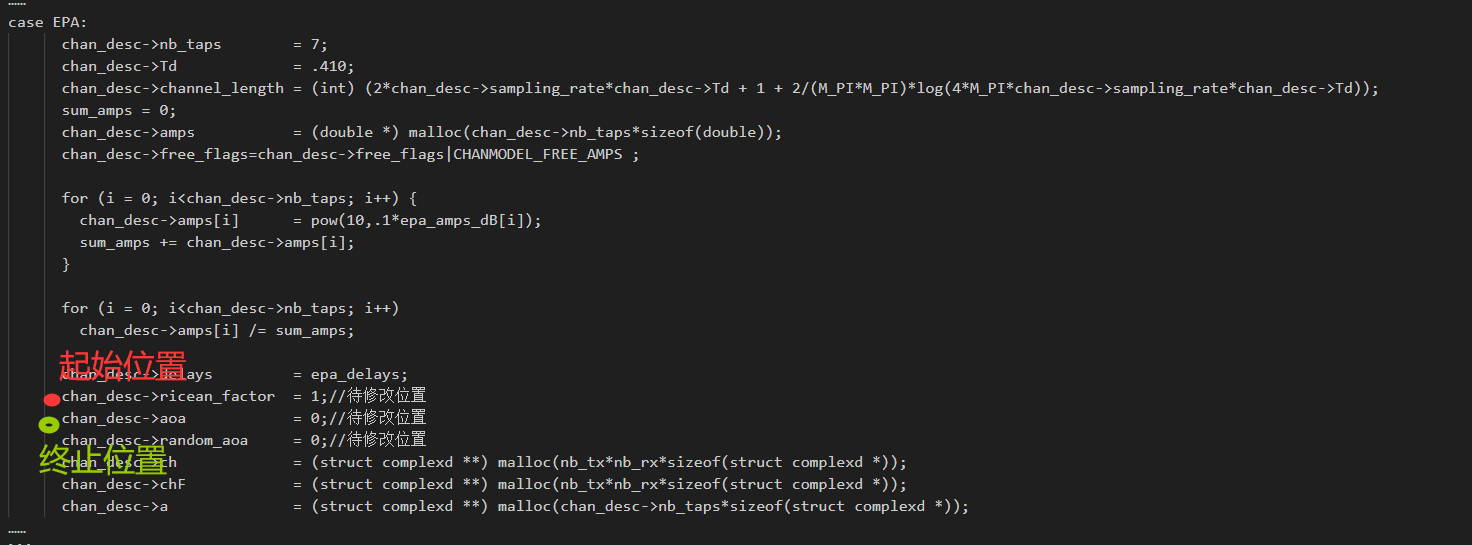
- 设置替换文件内容
假设目前只修改这一行的参数,
#3. 设置替换文件内容

ricean_factor=3#假设这是要修改的参数信息

updata_content=file_content[:start_index]#获取这行代码之前的内容

update_content+='chan_desc->ricean_factor  = '+str(ricean_factor)+';//待修改位置'#修改这行代码

update_content+=file_content[end_index:]#获取这行代码之后的内容

#此时得到的update_content就是修改后的完整文件内容,只修改了ricean_factor这一行的值
- 写入文件
同样使用python中的open函数。
#4. 写入文件

if update_content!="":#如果修改内容不为空

    with open(path, 'w') as file:#w表示覆盖写入,之前的内容都会被覆盖

        file.write(update_content)
- 总代码
整体的代码如下所示:
import re

#1. 读取文件

path='./test.c'

with open(path, 'r') as file:

    file_content = file.read()

#2. 查找文件替换位置

start_index=file_content.find('chan_desc->ricean_factor  = ')#起点

end_index=file_content.find('chan_desc->aoa            = ',start_index)#终点

if end_index==-1 or start_index==-1:

    print('未找到待修改位置')

#3. 设置替换文件内容

ricean_factor=3#假设这是要修改的参数信息

updata_content=file_content[:start_index]#获取这行代码之前的内容

update_content+='chan_desc->ricean_factor  = '+str(ricean_factor)+';//待修改位置'#修改这行代码

update_content+=file_content[end_index:]#获取这行代码之后的内容

#4. 写入文件

if update_content!="":#如果修改内容不为空

    with open(path, 'w') as file:#w表示覆盖写入,之前的内容都会被覆盖

        file.write(update_content)
3. 多行修改-操作步骤
- 多行修改思路
多行修改有两种修改思路,如果修改部分比较集中,则可直接替换一整块的字符串内容,如果修改部分较为分散,则需要单独查找修改位置,然后再分别进行替换。 - 多行修改-整块替换
try:

    with open(file_path, "r") as file:

            file_content = file.read()

except Exception as e:

    return str(e)

# 设置改写内容

updated_content = ""

 # 查找修改

start_index_1 = file_content.find("start_sentence")#要确保查找元素的唯一性

end_index_1 = file_content.find("end_sentence",start_index_1,)

if start_index_1 == -1 or end_index_1 == -1:

    print("未找到待修改位置")

     return -1

 #

 updated_content = file_content[:start_index_1]#获取这行代码之前的内容

 updated_content += "start_sentence和end_sentence之间的sentence_1;\n"

 updated_content += "start_sentence和end_sentence之间的sentence_2;\n"

 updated_content +=file_content[end_index_1:]

 ##此时updated_content就是修改后的完整文件内容

 if updated_content != "":

     with open(file_path, "w") as file:

         file.write(updated_content)

else:

    print("修改失败")

    return -1
- 多行修改-局部替换
try:

    with open(file_path, "r") as file:

            file_content = file.read()

except Exception as e:

    return str(e)

# 设置改写内容

updated_content = ""

 # 查找修改

start_index_1 = file_content.find("start_sentence_1")#要确保查找元素的唯一性

end_index_1 = file_content.find("end_sentence_1",start_index_1,)

start_index_2 = file_content.find("start_sentence_2",end_index_1)

end_index_2 = file_content.find("end_sentence_2",start_index_2,)

start_index_3 = file_content.find("start_sentence_3",end_index_2)

end_index_3 = file_content.find("end_sentence_3",start_index_3,)

start_index_4 = file_content.find("start_sentence_4",end_index_3)

end_index_4 = file_content.find("end_sentence_4",start_index_4,)

if (

     start_index_1 == -1

     or end_index_1 == -1

     or start_index_2 == -1

     or end_index_2 == -1

     or start_index_3 == -1

     or end_index_3 == -1

     or start_index_4 == -1

     or end_index_4 == -1

 ):

    print("未找到待修改位置")

     return -1

 #

 updated_content = file_content[:start_index_1]#获取这行代码之前的内容

 updated_content += "start_sentence_1和end_sentence_1之间的内容"

 updated_content +=file_content[end_index_1:start_index_2]

 updated_content += "start_sentence_2和end_sentence_2之间的内容"

 updated_content +=file_content[end_index_2:start_index_3]

 updated_content += "start_sentence_3和end_sentence_3之间的内容"

 updated_content +=file_content[end_index_3:start_index_4]

 updated_content += "start_sentence_4和end_sentence_4之间的内容"

 updated_content += file_content[end_index_4:]

 ##此时updated_content就是修改后的完整文件内容

 if updated_content != "":

     with open(file_path, "w") as file:

         file.write(updated_content)

else:

    print("修改失败")

    return -1
【python技巧】替换文件中的某几行的更多相关文章
- linux 小技巧(查找替换文件中的ascii编码字符)
这里纪录一些linux下用到的小技巧,以免遗忘 在linux中经常碰见各种文件处理.最常用的就是替换文件中的某些字符.常见字符替换还是很容易完成.但是有些不可见字符以及ascii编码字符等等都无法直接 ...
- 用python 替换文件中的git地址
有个需求要替换文件中git地址,要替换成的git地址是一个变量 本来想用sed替换但是git地址中有斜杠符号 需要转义,提前知道还好弄,如果是变量就不好处理了 #!/usr/bin/python3 # ...
- python逐行读取替换文件中的字符串
用列表中的值逐行替换文件中符合条件的字符串,并保存为新的文件, open("file").readlines 方案1: 逐行替换并保存为新的文件 import re def rep ...
- python操作txt文件中数据教程[4]-python去掉txt文件行尾换行
python操作txt文件中数据教程[4]-python去掉txt文件行尾换行 觉得有用的话,欢迎一起讨论相互学习~Follow Me 参考文章 python操作txt文件中数据教程[1]-使用pyt ...
- python操作txt文件中数据教程[3]-python读取文件夹中所有txt文件并将数据转为csv文件
python操作txt文件中数据教程[3]-python读取文件夹中所有txt文件并将数据转为csv文件 觉得有用的话,欢迎一起讨论相互学习~Follow Me 参考文献 python操作txt文件中 ...
- python操作txt文件中数据教程[2]-python提取txt文件
python操作txt文件中数据教程[2]-python提取txt文件中的行列元素 觉得有用的话,欢迎一起讨论相互学习~Follow Me 原始txt文件 程序实现后结果-将txt中元素提取并保存在c ...
- python操作txt文件中数据教程[1]-使用python读写txt文件
python操作txt文件中数据教程[1]-使用python读写txt文件 觉得有用的话,欢迎一起讨论相互学习~Follow Me 原始txt文件 程序实现后结果 程序实现 filename = '. ...
- linux sed 批量替换文件中的字符串或符号
sed -i :直接修改读取的文件内容,而不是输出到终端. sed -i 就是直接对文本文件进行操作的 替换每行第一次出现的字符串 sed -i 's/查找的字符串/替换的字符串/' 文件 ...
- Python 调用JS文件中的函数
Python 调用JS文件中的函数 1.安装PyExecJS第三方库 2.导入库:import execjs 3.调用JS文件中的方法 Passwd = execjs.compile(open(r&q ...
- 使用 sed 命令查找和替换文件中的字符串的 16 个示例
当你在使用文本文件时,很可能需要查找和替换文件中的字符串.sed 命令主要用于替换一个文件中的文本.在 Linux 中这可以通过使用 sed 命令和 awk 命令来完成. 在本教程中,我们将告诉你使用 ...
随机推荐
- Elasticsearch 之 join 关联查询及使用场景
在Elasticsearch这样的分布式系统中执行类似SQL的join连接是代价是比较大的,然而,Elasticsearch却给我们提供了基于水平扩展的两种连接形式 .这句话摘自Elasticsear ...
- 代码随想录算法训练营Day5 数组、链表复习
数组部分 数组最重要的思维方式是双指针的使用. 快慢指针 在进行元素移除和元素操作时会使用两个for循环嵌套,此时时间复杂度为O(n²).在for循环中通过双指针(快慢指针)的使用可以使时间复杂度将为 ...
- 如何让Task在非线程池线程中执行?
Task承载的操作需要被调度才能被执行,由于.NET默认采用基于线程池的调度器,所以Task默认在线程池线程中执行.但是有的操作并不适合使用线程池,比如我们在一个ASP.NET Core应用中承载了一 ...
- 初识volatile
案例1:是否存在我不是我的问题 flag==!flag flag是boolean类型 了解volatile 概念 1.volatile如何保证内存可见性 2.volatile如何禁止指令重排序 ...
- 【技术积累】JavaSciprt中的函数【一】
什么是函数?如何声明函数? JavaScript中的函数是一段可重复使用的代码块,它可以接受输入并返回输出. 在JavaScript中,函数是一种特殊的对象,因此可以将其存储在变量中,将其作为参数传递 ...
- 浅聊一下 C#程序的 内存映射文件 玩法
一:背景 1. 讲故事 前段时间训练营里有朋友问 内存映射文件 是怎么玩的?说实话这东西理论我相信很多朋友都知道,就是将文件映射到进程的虚拟地址,说起来很容易,那如何让大家眼见为实呢?可能会难倒很多人 ...
- 高效处理报表,掌握原生JS打印和导出报表为PDF的顺畅技巧!
摘要:本文由葡萄城技术团队于博客园原创并首发.转载请注明出处:葡萄城官网,葡萄城为开发者提供专业的开发工具.解决方案和服务,赋能开发者. 前言篇 在日常工作中,报表打印和导出为PDF是经常要处理的任务 ...
- ApacheSpark:HowtoBuildandDeployaRealtimeDataProcessinga
目录 2.1 基本概念解释 2.2 技术原理介绍 2.3 相关技术比较 3.1 准备工作:环境配置与依赖安装 3.2 核心模块实现 3.3 集成与测试 4.1 应用场景介绍 4.2 应用实例分析 4. ...
- Self-Instruct 论文解读:利用大模型自己给自己生成指令数据,指令数据自动生成
总览 大规模"指令调整"的语言模型,即指令微调的LLM,已经表现出非凡的零样本能力,尤其是推广新任务上. 然而,这些模型严重依赖于人类编写的指令数据,而这些数据通常在数量.多样性和 ...
- Go 语言的 nil 能比较自己吗
nil 是什么? 可以看看官方的描述,在 buildin/buildin.go 里: // nil is a predeclared identifier representing the zero ...