
3-2 C++ string类型
3.2.1 定义和初始化
- 直接初始化(direct initialization):直接调用对应的构造函数,对于string而言,不带“=”即为直接初始化,主要就是列表初始化(间2-2-1),可用圆括号或者大括号
- 拷贝初始化(copy initialization):间接调用构造函数(一般是拷贝构造函数),对于string而言,带“=”即为拷贝初始化

- 具体辨析
3.2.2 对string的操作
(一)重要操作一览
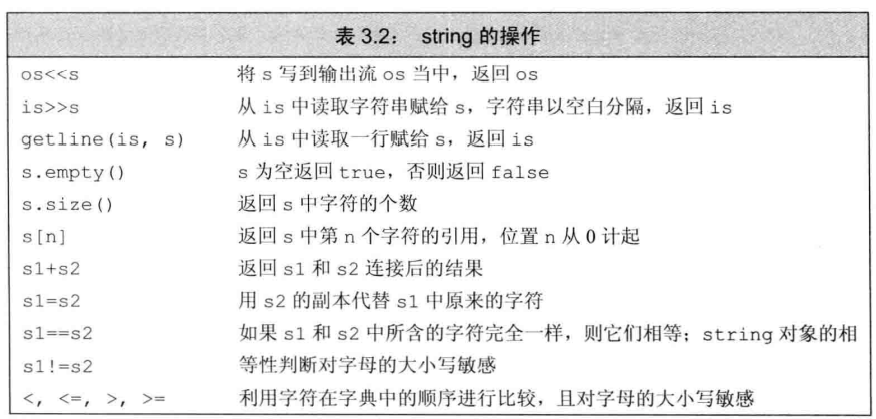
(二)读写操作
cin/cout
- 读入
cin>>s;:遇到空格就停止读入 - 输出
cout<<s;
#include<iostream>

#include<string>

using namespace std;

int main(){

    string s1;

    cin>>s1;  //读入s1

    cout<<s1;  //输出s1

    return 0;

}
当输入Hello World时,s1只读取到Hello,World在缓冲区没被读取,所以值输出Hello
getline : 可读取整行
基本语法
getline(cin, s);
- 参数:输入流,字符串s
- 副作用:
- 读取输入流的一行,包括
/n - 将内容去除
/n后存入字符串s
- 读取输入流的一行,包括
- 返回值:输入流对象
#include<iostream>

#include<string>

using namespace std;

int main(){

    string s;

    getline(cin, s); //读入整行

    cout<<s<<endl;  //输出

    return 0;

}
输入Hello World时,s全部读取,输出Hello World
注意
- 如果一行的首字符就是
/n,那么字符串s为空 - 因为
getline不读取换行符,所以在输出时一般加上<<endl进行换行并清空缓冲区
(三)获取大小 .size()
string s; unsigned int = s.size();
是string类的一个成员函数
返回字符串s的字符个数,类型是unsigned int【其实是string::size_type,但string::size_type底层就是unsigned int】
避免unsigned int 与 int 混用
string s = "hello";

if(s.size() < -1)  //该条件判断式永真,因为-1会转换为一个很大的unsigned int

    cout<<"in if statement"<<endl;

int length = s.size();

if(length < -1)  //判断式为假,因为length是int类型

    cout<<"in if statement"<<endl;
(四)比较、赋值与增加
比较: ==
- 参数:string 或 字符串字面量(string literals)
- 副作用:按字典序比较
- 返回值:返回比较结果,bool类型
#include<iostream>

#include<string>

using namespace std;

int main(){

    string s1 = "h";

    string s2 = "h";

    char s3[] = "h";

    bool i = (s1 == s2);  //比较s1与s2

    bool j = (s1 == s3);  //比较s1和s3

    cout<<"i = "<<i<<endl;  //输出 “i = 1”

    cout<<"j = "<<j<<endl;  //输出 “j = 1“

    return 0;

}
- 注
- string == string:比较内容
- string == string literals:比较内容
- string == char:不可比较
- string literals == string literals:比较指针地址【比较内容要用strcmp()函数】
赋值: =
参数:string对象 或 字符串字面量
副作用:把string对象或字符串字面量的值赋值到另一个string中
返回值:string对象
#include<iostream>

#include<string>

using namespace std;

int main(){

    string s1 = "h";  //把字符串字面量的值赋给s1

    string s2;

    s2 = s1;  //把s1的值赋给s2

    cout<<s1<<endl;  //输出 "h"

    return 0;

}
增添: +
参数:string对象 或 字符串字面量 或 字符字面量, 但是
+的其中一个操作数必须是string对象副作用:生成一个新string对象,把
+左边操作数的内容赋给生成的string对象,再把右边操作数的内容赋给string对象返回值:string对象的引用
#include<iostream>

#include<string>

using namespace std;

int main(){

    string s1 = "Hello";

    string s2 = "World";

    string s3 = s1 + s2;  //链接s1,s2,把值赋给s3

    cout<<s3<<endl;  //输出 “HelloWorld”

    return 0;

}
辨析:+`的其中一个操作数必须是string对象
string s1 = "a";

string s2 = s1 + "bc" + '\n'; //合法: 第一个+返回一个string对象,继续和'\n'相加【类似cin/cout链式法则】

string s3 = "bc" + '\n' + s1; //不合法:第一个+两侧的操作数没有string对象。
3.2.3 对string中字符的操作
(一)处理string的所有字符
遍历的三种方式
- 迭代器(Iterator):暂略
- 范围for
- 下标与一般for
范围for
语法
for (declaration : expression) //expression:可遍历序列; declaration:expression基本元素的类型

    statement;  //对每个元素执行的操作
举例:输出string的每个字符
#include<iostream>

#include<string>

using namespace std;

int main(){

    string s = "hello world";

    for(auto c : s)

        cout<<c<<endl;

    return 0;

}
cctype头文件
继承自c语言的ctype.h,但在c++最好写作cctype
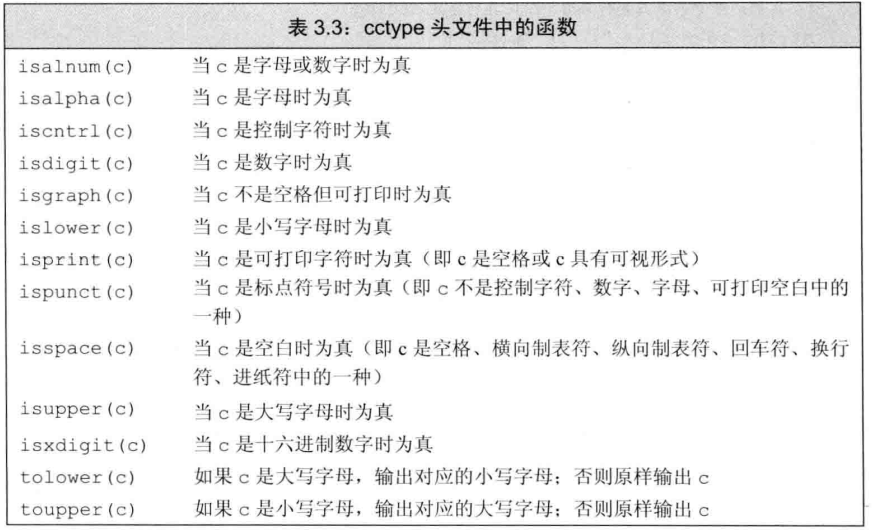
isnum(c)isalpha(c)isupper(c)&&toupper(c)islower(c)&&tolower(c)
isdigit(c)
ispunct(c)isspace(c)
几个应用实例
统计输入的字符串
s中 标点符号的个数#include<iostream>
#include<string>
#include<cctype>
using namespace std;
int main(){
string s = "Hello,,world!!!";
int num = 0;
for(char &c : s){
if(ispunct(c))
num++;
}
//输出 "the number of punctuation is 5"
cout<<"the number of punctuation is "<<num<<endl;
return 0;
}
将输入的字符串
s中的 所有小写字母转为大写【注意使用引用!】#include<iostream>
#include<string>
#include<cctype>
using namespace std;
int main(){
string s = "Hello,,world!!!";
for(char &c : s){
if(islower(c))
c = toupper(c);
}
//输出 “HELLO,,WORLD!!!”
cout<<s<<endl;
return 0;
}
(二)处理string中的部分字符:下标(subscripts)
相关说明
可以使用下标直接访问并修改对应的字符值【随机访问并且可以直接修改】
s[inxdex] = 'n'下标
index的类型是 string::size_type,即unsigned int,但也可以被自动类型转换为intindex范围: 0<= index < s.size()
用下标遍历
#include<iostream>

#include<string>

#include<cctype>

using namespace std;

int main(){

    string s = "Hello world!!!";

    for(decltype(s.size()) index = 0; index < s.size(); ++index)  //index类型也可以直接写为int

        cout<<s[index];

    return 0;

}
引用实例:输出string s的第一个单词
以空格符号为分隔
#include<iostream>

#include<string>

#include<cctype>

using namespace std;

int main(){

    string s = "Hello world!!!";

    for(int index = 0; index != s.size() && !isspace(s[index]);

        ++index)

        cout<<s[index];

    //输出 “Hello”

    return 0;

}
也可写作
#include<iostream>

#include<string>

#include<cctype>

using namespace std;

int main(){

    string s = "Hello world!!!";

    for(char c : s){

        if(isspace(c))  break;

        cout<<c;

    }

    //最终输出 "Hello"

    return 0;

}
3-2 C++ string类型的更多相关文章
- ElasticSearch 5学习(9)——映射和分析(string类型废弃)
在ElasticSearch中,存入文档的内容类似于传统数据每个字段一样,都会有一个指定的属性,为了能够把日期字段处理成日期,把数字字段处理成数字,把字符串字段处理成字符串值,Elasticsearc ...
- 每日一记-mybatis碰到的疑惑:String类型可以传入多个参数吗
碰到一个觉得很疑惑的问题,Mybatis的parameterType为String类型的时候,能够接收多个参数的吗? 背景 初学Mybatis的时候,看的教程和书籍上都是在说基本的数据类型如:int. ...
- C#string类型总结
字符串的特性:不可变性,每对字符串做拼接或者重新赋值之类的操作,都会在内存中产生一个新的实例. 所以说,在.Net平台下,如果你对一个字符串进行大量的拼接赋值等操作,会产生大量的垃圾. --- ...
- 把《c++ primer》读薄(3-1 标准库string类型初探)
督促读书,总结精华,提炼笔记,抛砖引玉,有不合适的地方,欢迎留言指正. 问题1:养成一个好习惯,在头文件中只定义确实需要的东西 using namespace std; //建议需要什么再using声 ...
- 【原创】Java和C#下String类型中的==和equals的原理与区别
一.Java下 1.几个例子 public static void main(String[] arge) { String str1 = new String("1234"); ...
- String类型的属性和方法
× 目录 [1]属性 [2]对象通用方法 [3]访问字符方法[4]字符串拼接[5]创建子串方法[6]大小写转换[7]查找子串位置[8]正则匹配方法[9]去除首尾空格[10]字符串比较 前面的话 前面已 ...
- String类型传值以及对象传值
package Virtual; class Stan{ String mm = "hello"; } class Virtual { public static void mai ...
- java动手动脑和课后实验型问题String类型
1.请运行以下示例代码StringPool.java,查看其输出结果.如何解释这样的输出结果?从中你能总结出什么? true true false 总结: 使用new关键字创建字符串对象时, 每次申请 ...
- java内存分配和String类型的深度解析
[尊重原创文章出自:http://my.oschina.net/xiaohui249/blog/170013] 摘要 从整体上介绍java内存的概念.构成以及分配机制,在此基础上深度解析java中的S ...
- javascript类型系统——字符串String类型
× 目录 [1]定义 [2]引号 [3]反斜线[4]特点[5]转字符串 前面的话 javascript没有表示单个字符的字符型,只有字符串String类型,字符型相当于仅包含一个字符的字符串 字符串S ...
随机推荐
- nvic stm32g0
STM32G0 32个可屏蔽中断通道 4个可编程优先等级(抢占等级:0~3) 低延时异常和中断处理 电源管理控制
- Java 读取 IP 地址
使用 InetAddress 类 可以利用 Java 自带的 InetAddress 类来检查一个字符串是否为有效的 IP 地址: import java.net.InetAddress; // 导入 ...
- Linux 安装 TeX Live
安装新版本 cd /tmp # 下载安装压缩包 wget https://mirror.ctan.org/systems/texlive/tlnet/install-tl-unx.tar.gz # 解 ...
- 探索一下 Enum 优化
探索一下 Enum 优化 SV.Enums主要是探索如何让 enum 更高效 其中涉及的优化手段并非完全自创 很多内容参考于以下项目 NetEscapades.EnumGenerators FastE ...
- windows 误删除\AppData\Local\文件夹后 异常的修复
背景:清除Temp文件夹时,路径复制错误,少复制了Temp,导致删除了文件夹 C:\Users\username\AppData\Local\ 异常现象: 估计删除Local文件夹后,出现的问题应该会 ...
- 深入浅出Stream流
Java 8的新特性之一就是流stream,配合同版本出现的 Lambda ,使得操作集合(Collection)提供了极大的便利. 案例引入 在JAVA中,涉及到对数组.Collection等集合类 ...
- 录音转文字SDK哪家强?
最近在做一款录音App,有一个模块是录音转文字功能,于是对比了市面上常见的API,国内做的比较大的主要有讯飞.腾讯.阿里.百度.华为. 讯飞 讯飞在国内做语音SDK是做的比较早的,翻译出来的准确率挺不 ...
- Azure 入门系列 (第一篇 Virtual Machine 和 SQL Server)
前言 终于有机会自己搞 Azure 了. 以前都是找代理做,近期代理 support 越来越弱了. 看来是 right time 自己搞了. 以前写过一些关于 Azure 的笔记: Azure key ...
- BOOT跳转APP,STM32F4正常,但是GD32F4起不来的问题
问题描述: stm32F4可以正常从BOOT跳转执行APP,到了GD32F4,卡死在APP程序的这里. 临时解决办法: APP程序内 把这两句代码都屏蔽掉就好了. 相关资料搜索: 最佳解决方案: ...
- Swift查看变量内存地址
withUnsafePointer 不说话,先放代码 withUnsafeBufferPointer(to: a) { point in let address = UnsafeRawPointer( ...