
Springboot 系列(七)Spring Boot web 开发之异常错误处理机制剖析
前言
相信大家在刚开始体验 Springboot 的时候一定会经常碰到这个页面,也就是访问一个不存在的页面的默认返回页面。
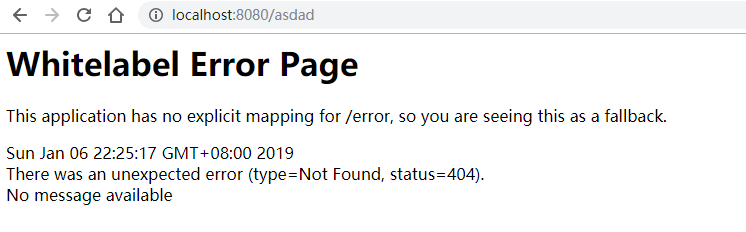
如果是其他客户端请求,如接口测试工具,会默认返回JSON数据。
{

        "timestamp":"2019-01-06 22:26:16",

        "status":404,

        "error":"Not Found",

        "message":"No message available",

        "path":"/asdad"

}
很明显,SpringBoot 根据 HTTP 的请求头信息进行了不同的响应处理。HTTP 相关知识可以参考此处。
1. SpringBoot 异常处理机制
追随 SpringBoot 源码可以分析出默认的错误处理机制。
// org.springframework.boot.autoconfigure.web.servlet.error.ErrorMvcAutoConfiguration

// 绑定一些错误信息 记为 1

	@Bean

	@ConditionalOnMissingBean(value = ErrorAttributes.class, search = SearchStrategy.CURRENT)

	public DefaultErrorAttributes errorAttributes() {

		return new DefaultErrorAttributes(

				this.serverProperties.getError().isIncludeException());

	}

// 默认处理 /error 记为 2

	@Bean

	@ConditionalOnMissingBean(value = ErrorController.class, search = SearchStrategy.CURRENT)

	public BasicErrorController basicErrorController(ErrorAttributes errorAttributes) {

		return new BasicErrorController(errorAttributes, this.serverProperties.getError(),

				this.errorViewResolvers);

	}

// 错误处理页面 记为3

	@Bean

	public ErrorPageCustomizer errorPageCustomizer() {

		return new ErrorPageCustomizer(this.serverProperties, this.dispatcherServletPath);

	}

	@Configuration

	static class DefaultErrorViewResolverConfiguration {

		private final ApplicationContext applicationContext;

		private final ResourceProperties resourceProperties;

		DefaultErrorViewResolverConfiguration(ApplicationContext applicationContext,

				ResourceProperties resourceProperties) {

			this.applicationContext = applicationContext;

			this.resourceProperties = resourceProperties;

		}

// 决定去哪个错误页面 记为4

		@Bean

		@ConditionalOnBean(DispatcherServlet.class)

		@ConditionalOnMissingBean

		public DefaultErrorViewResolver conventionErrorViewResolver() {

			return new DefaultErrorViewResolver(this.applicationContext,

					this.resourceProperties);

		}

	}
结合上面的注释,上面代码里的四个方法就是 Springboot 实现默认返回错误页面主要部分。
1.1. errorAttributes
errorAttributes直译为错误属性,这个方法确实如此,直接追踪源代码。
代码位于:
// org.springframework.boot.web.servlet.error.DefaultErrorAttributes
这个类里为错误情况共享很多错误信息,如。
errorAttributes.put("timestamp", new Date());

errorAttributes.put("status", status);

errorAttributes.put("error", HttpStatus.valueOf(status).getReasonPhrase());

errorAttributes.put("errors", result.getAllErrors());

errorAttributes.put("exception", error.getClass().getName());

errorAttributes.put("message", error.getMessage());

errorAttributes.put("trace", stackTrace.toString());

errorAttributes.put("path", path);
这些信息用作共享信息返回,所以当我们使用模版引擎时,也可以像取出其他参数一样轻松取出。
1.2. basicErrorControll
直接追踪 BasicErrorController 的源码内容可以发现下面的一段代码。
// org.springframework.boot.autoconfigure.web.servlet.error.BasicErrorController

@Controller

// 定义请求路径,如果没有error.path路径,则路径为/error

@RequestMapping("${server.error.path:${error.path:/error}}")

public class BasicErrorController extends AbstractErrorController {

    // 如果支持的格式 text/html

	@RequestMapping(produces = MediaType.TEXT_HTML_VALUE)

	public ModelAndView errorHtml(HttpServletRequest request,

			HttpServletResponse response) {

		HttpStatus status = getStatus(request);

        // 获取要返回的值

		Map<String, Object> model = Collections.unmodifiableMap(getErrorAttributes(

				request, isIncludeStackTrace(request, MediaType.TEXT_HTML)));

		response.setStatus(status.value());

        // 解析错误视图信息,也就是下面1.4中的逻辑

		ModelAndView modelAndView = resolveErrorView(request, response, status, model);

		// 返回视图,如果没有存在的页面模版,则使用默认错误视图模版

        return (modelAndView != null) ? modelAndView : new ModelAndView("error", model);

	}

	@RequestMapping

	public ResponseEntity<Map<String, Object>> error(HttpServletRequest request) {

		// 如果是接受所有格式的HTTP请求

        Map<String, Object> body = getErrorAttributes(request,

				isIncludeStackTrace(request, MediaType.ALL));

		HttpStatus status = getStatus(request);

        // 响应HttpEntity

		return new ResponseEntity<>(body, status);

	}

}
由上可知,basicErrorControll 用于创建用于请求返回的 controller类,并根据HTTP请求可接受的格式不同返回对应的信息,所以在使用浏览器和接口测试工具测试时返回结果存在差异。
1.3. ererrorPageCustomizer
直接查看方法里的new ErrorPageCustomizer(this.serverProperties, this.dispatcherServletPath);
//org.springframework.boot.autoconfigure.web.servlet.error.ErrorMvcAutoConfiguration.ErrorPageCustomizer

	/**

	 * {@link WebServerFactoryCustomizer} that configures the server's error pages.

	 */

	private static class ErrorPageCustomizer implements ErrorPageRegistrar, Ordered {

		private final ServerProperties properties;

		private final DispatcherServletPath dispatcherServletPath;

		protected ErrorPageCustomizer(ServerProperties properties,

				DispatcherServletPath dispatcherServletPath) {

			this.properties = properties;

			this.dispatcherServletPath = dispatcherServletPath;

		}

		// 注册错误页面

        // this.dispatcherServletPath.getRelativePath(this.properties.getError().getPath())

		@Override

		public void registerErrorPages(ErrorPageRegistry errorPageRegistry) {

            //getPath()得到如下地址,如果没有自定义error.path属性,则去/error位置

            //@Value("${error.path:/error}")

			//private String path = "/error";

			ErrorPage errorPage = new ErrorPage(this.dispatcherServletPath

					.getRelativePath(this.properties.getError().getPath()));

			errorPageRegistry.addErrorPages(errorPage);

		}

		@Override

		public int getOrder() {

			return 0;

		}

	}
由上可知,当遇到错误时,如果没有自定义 error.path 属性,则请求转发至 /error.
1.4. conventionErrorViewResolver
根据上面的代码,一步步深入查看 SpringBoot 的默认错误处理实现,查看看 conventionErrorViewResolver方法。下面是 DefaultErrorViewResolver 类的部分代码,注释解析。
// org.springframework.boot.autoconfigure.web.servlet.error.DefaultErrorViewResolver

// 初始化参数,key 是HTTP状态码第一位。

	static {

		Map<Series, String> views = new EnumMap<>(Series.class);

		views.put(Series.CLIENT_ERROR, "4xx");

		views.put(Series.SERVER_ERROR, "5xx");

		SERIES_VIEWS = Collections.unmodifiableMap(views);

	}

	@Override

	public ModelAndView resolveErrorView(HttpServletRequest request, HttpStatus status,

			Map<String, Object> model) {

        // 使用HTTP完整状态码检查是否有页面可以匹配

		ModelAndView modelAndView = resolve(String.valueOf(status.value()), model);

		if (modelAndView == null && SERIES_VIEWS.containsKey(status.series())) {

			// 使用 HTTP 状态码第一位匹配初始化中的参数创建视图对象

            modelAndView = resolve(SERIES_VIEWS.get(status.series()), model);

		}

		return modelAndView;

	}

	private ModelAndView resolve(String viewName, Map<String, Object> model) {

		// 拼接错误视图路径 /eroor/[viewname]

        String errorViewName = "error/" + viewName;

		// 使用模版引擎尝试创建视图对象

        TemplateAvailabilityProvider provider = this.templateAvailabilityProviders

				.getProvider(errorViewName, this.applicationContext);

		if (provider != null) {

			return new ModelAndView(errorViewName, model);

		}

        // 没有模版引擎,使用静态资源文件夹解析视图

		return resolveResource(errorViewName, model);

	}

	private ModelAndView resolveResource(String viewName, Map<String, Object> model) {

		// 遍历静态资源文件夹,检查是否有存在视图

        for (String location : this.resourceProperties.getStaticLocations()) {

			try {

				Resource resource = this.applicationContext.getResource(location);

				resource = resource.createRelative(viewName + ".html");

				if (resource.exists()) {

					return new ModelAndView(new HtmlResourceView(resource), model);

				}

			}

			catch (Exception ex) {

			}

		}

		return null;

	}
而 Thymeleaf 对于错误页面的解析实现。
//org.springframework.boot.autoconfigure.thymeleaf.ThymeleafTemplateAvailabilityProvider

public class ThymeleafTemplateAvailabilityProvider

		implements TemplateAvailabilityProvider {

	@Override

	public boolean isTemplateAvailable(String view, Environment environment,

			ClassLoader classLoader, ResourceLoader resourceLoader) {

		if (ClassUtils.isPresent("org.thymeleaf.spring5.SpringTemplateEngine",

				classLoader)) {

			String prefix = environment.getProperty("spring.thymeleaf.prefix",

					ThymeleafProperties.DEFAULT_PREFIX);

			String suffix = environment.getProperty("spring.thymeleaf.suffix",

					ThymeleafProperties.DEFAULT_SUFFIX);

			return resourceLoader.getResource(prefix + view + suffix).exists();

		}

		return false;

	}

}
从而我们可以得知,错误页面首先会检查模版引擎文件夹下的 /error/HTTP状态码 文件,如果不存在,则检查去模版引擎下的/error/4xx或者 /error/5xx 文件,如果还不存在,则检查静态资源文件夹下对应的上述文件。
2. 自定义异常页面
经过上面的 SpringBoot 错误机制源码分析,知道当遇到错误情况时候,SpringBoot 会首先返回到模版引擎文件夹下的 /error/HTTP状态码 文件,如果不存在,则检查去模版引擎下的/error/4xx或者 /error/5xx 文件,如果还不存在,则检查静态资源文件夹下对应的上述文件。并且在返回时会共享一些错误信息,这些错误信息可以在模版引擎中直接使用。
errorAttributes.put("timestamp", new Date());

errorAttributes.put("status", status);

errorAttributes.put("error", HttpStatus.valueOf(status).getReasonPhrase());

errorAttributes.put("errors", result.getAllErrors());

errorAttributes.put("exception", error.getClass().getName());

errorAttributes.put("message", error.getMessage());

errorAttributes.put("trace", stackTrace.toString());

errorAttributes.put("path", path);
因此,需要自定义错误页面,只需要在模版文件夹下的 error 文件夹下防止4xx 或者 5xx 文件即可。
<!doctype html>

<html lang="en" xmlns:th="http://www.thymeleaf.org">

<head>

    <meta charset="UTF-8">

    <meta name="viewport" content="width=device-width, initial-scale=1.0">

    <title>[[${status}]]</title>

    <!-- Bootstrap core CSS -->

    <link href="/webjars/bootstrap/4.1.3/css/bootstrap.min.css" rel="stylesheet">

</head>

<body >

<div class="m-5" >

    <p>错误码:[[${status}]]</p>

    <p >信息:[[${message}]]</p>

    <p >时间:[[${#dates.format(timestamp,'yyyy-MM-dd hh:mm:ss ')}]]</p>

    <p >请求路径:[[${path}]]</p>

</div>

</body>

</html>
随意访问不存在路径得到。
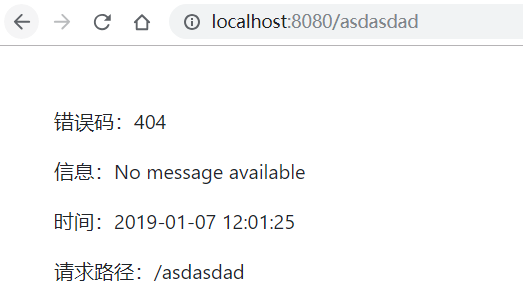
3. 自定义错误JSON
根据上面的 SpringBoot 错误处理原理分析,得知最终返回的 JSON 信息是从一个 map 对象中转换出来的,那么,只要能自定义 map 中的值,就可以自定义错误信息的 json 格式了。直接重写 DefaultErrorAttributes类的 getErrorAttributes 方法即可。
import org.springframework.boot.web.servlet.error.DefaultErrorAttributes;

import org.springframework.stereotype.Component;

import org.springframework.web.context.request.WebRequest;

import java.util.HashMap;

import java.util.Map;

/**

 * <p>

 * 自定义错误信息JSON值

 *

 * @Author niujinpeng

 * @Date 2019/1/7 15:21

 */

@Component

public class ErrorAttributesCustom extends DefaultErrorAttributes {

    @Override

    public Map<String, Object> getErrorAttributes(WebRequest webRequest, boolean includeStackTrace) {

        Map<String, Object> map = super.getErrorAttributes(webRequest, includeStackTrace);

        String code = map.get("status").toString();

        String message = map.get("error").toString();

        HashMap<String, Object> hashMap = new HashMap<>();

        hashMap.put("code", code);

        hashMap.put("message", message);

        return hashMap;

    }

}
使用 postman 请求测试。
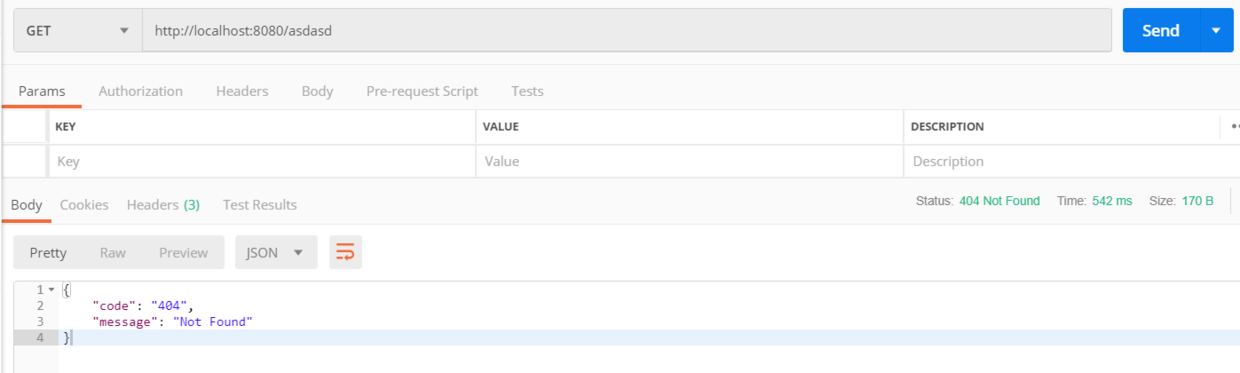
4. 统一异常处理
使用 @ControllerAdvice 结合@ExceptionHandler 注解可以实现统一的异常处理,@ExceptionHandler 注解的类会自动应用在每一个被 @RequestMapping 注解的方法。当程序中出现异常时会层层上抛
import lombok.extern.slf4j.Slf4j;

import net.codingme.boot.domain.Response;

import net.codingme.boot.enums.ResponseEnum;

import net.codingme.boot.utils.ResponseUtill;

import org.springframework.web.bind.annotation.ControllerAdvice;

import org.springframework.web.bind.annotation.ExceptionHandler;

import org.springframework.web.bind.annotation.ResponseBody;

import javax.servlet.http.HttpServletRequest;

/**

 * <p>

 * 统一的异常处理

 *

 * @Author niujinpeng

 * @Date 2019/1/7 14:26

 */

@Slf4j

@ControllerAdvice

public class ExceptionHandle {

    @ResponseBody

    @ExceptionHandler(Exception.class)

    public Response handleException(Exception e) {

        log.info("异常 {}", e);

        if (e instanceof BaseException) {

            BaseException exception = (BaseException) e;

            String code = exception.getCode();

            String message = exception.getMessage();

            return ResponseUtill.error(code, message);

        }

        return ResponseUtill.error(ResponseEnum.UNKNOW_ERROR);

    }

}
请求异常页面得到响应如下。
{

 "code": "-1",

 "data": [],

 "message": "未知错误"

}
文章代码已经上传到 GitHub Spring Boot Web开发 - 错误机制。
<完>
欢迎点赞关注!
本文原发于个人博客:https://www.codingme.net 转载请注明出处
Springboot 系列(七)Spring Boot web 开发之异常错误处理机制剖析的更多相关文章
- Springboot 系列(五)Spring Boot web 开发之静态资源和模版引擎
前言 Spring Boot 天生的适合 web 应用开发,它可以快速的嵌入 Tomcat, Jetty 或 Netty 用于包含一个 HTTP 服务器.且开发十分简单,只需要引入 web 开发所需的 ...
- Springboot 系列(六)Spring Boot web 开发之拦截器和三大组件
1. 拦截器 Springboot 中的 Interceptor 拦截器也就是 mvc 中的拦截器,只是省去了 xml 配置部分.并没有本质的不同,都是通过实现 HandlerInterceptor ...
- spring boot系列(二)spring boot web开发
json 接口开发 在以前的spring 开发的时候需要我们提供json接口的时候需要做如下配置: 1 添加jackjson等jar包 2 配置spring controller扫描 3 对接的方法添 ...
- SpringBoot系列:Spring Boot使用模板引擎FreeMarker
一.Java模板引擎 模板引擎(这里特指用于Web开发的模板引擎)是为了使用户界面与业务数据(内容)分离而产生的,它可以生成特定格式的文档,用于网站的模板引擎就会生成一个标准的HTML文档. 在jav ...
- SpringBoot系列:Spring Boot使用模板引擎Thymeleaf
一.Java模板引擎 模板引擎(这里特指用于Web开发的模板引擎)是为了使用户界面与业务数据(内容)分离而产生的,它可以生成特定格式的文档,用于网站的模板引擎就会生成一个标准的HTML文档. 在jav ...
- SpringBoot系列:Spring Boot使用模板引擎JSP
一.Java模板引擎 模板引擎(这里特指用于Web开发的模板引擎)是为了使用户界面与业务数据(内容)分离而产生的,它可以生成特定格式的文档,用于网站的模板引擎就会生成一个标准的HTML文档. 在jav ...
- Spring Boot Web 开发注解篇
本文提纲 1. spring-boot-starter-web 依赖概述 1.1 spring-boot-starter-web 职责 1.2 spring-boot-starter-web 依赖关系 ...
- 四、Spring Boot Web开发
四.Web开发 1.简介 使用SpringBoot: 1).创建SpringBoot应用,选中我们需要的模块: 2).SpringBoot已经默认将这些场景配置好了,只需要在配置文件中指定少量配置就可 ...
- SpringBoot系列:Spring Boot集成Spring Cache,使用RedisCache
前面的章节,讲解了Spring Boot集成Spring Cache,Spring Cache已经完成了多种Cache的实现,包括EhCache.RedisCache.ConcurrentMapCac ...
随机推荐
- BZOJ_2792_[Poi2012]Well_二分答案
BZOJ_2792_[Poi2012]Well_二分答案 Description 给出n个正整数X1,X2,...Xn,可以进行不超过m次操作,每次操作选择一个非零的Xi,并将它减一. 最终要求存在某 ...
- HttpClient4 TIME_WAIT和CLOSE_WAIT
最近,公司的接口服务器(客户端,向外发送数据)频繁出现了connect timeout 以及readtime out 的情况,经过运维平台检测,并没有网络延时的情况.于是,开始怀疑连接池出了问题. 使 ...
- 求二维数组的最大子数组———曹玉松&&蔡迎盈
继上节课老师让求了一维数组最大的子数组后,这节课堂上,老师加深了难度,给了一个二维数组,求最大子数组,开始觉得很容易,但是自己思考起来感觉这个算法很困难,既需要考虑数组直接的连续,又要求出最大的,老师 ...
- 并发的核心:CAS 是什么?Java8是如何优化 CAS 的?
大家可能都听说说 Java 中的并发包,如果想要读懂 Java 中的并发包,其核心就是要先读懂 CAS 机制,因为 CAS 可以说是并发包的底层实现原理. 今天就带大家读懂 CAS 是如何保证操作的原 ...
- 循环神经网络之LSTM和GRU
看了一些LSTM的博客,都推荐看colah写的博客<Understanding LSTM Networks> 来学习LSTM,我也找来看了,写得还是比较好懂的,它把LSTM的工作流程从输入 ...
- 重磅!!!微软发布ASP.NET Core 2.2,先睹为快。
我很高兴地宣布ASP.NET Core 2.2现在作为.NET Core 2.2的一部分提供! 如何获取? 您可以从.NET Core 2.2下载页面下载适用于您的开发机器和构建服务器的新.NET C ...
- 死磕 java集合之LinkedBlockingQueue源码分析
问题 (1)LinkedBlockingQueue的实现方式? (2)LinkedBlockingQueue是有界的还是无界的队列? (3)LinkedBlockingQueue相比ArrayBloc ...
- WebWorker 中将已处理好的 VDOM 数据提交主线程渲染 DOM
上篇文章讲了 WebWorker 的简单用法,其实网上很多类似的文章,我写的也比较垃圾.不会的建议可以网上看比较好点的资料. 这里我会先讲下我的大致思路.然后会贴上一堆不实用的垃圾代码供参考. Web ...
- Git常用命令拾遗
git三个区 下图是git的提交流程,是入门或者说是理解git的重要图谱. 我们可以看到这里有三个区:工作区.暂存区.提交区.截止到commit阶段,其实都只是在本地离线操作,真正同步到中心服务器,需 ...
- .NET CAD二次开发学习 对称画线功能
[CommandMethod("CBline")] //对称画线 public void CBline() { Document doc = Application.Documen ...