
编译原理 算法3.8 LR分析 c++11实现
LR分析简介
LR分析是应用最广泛的一类分析方法,它是实用的编译器功能中最强的分析器,其特点是:
1,采用最一般的无回溯移进-规约方法。
2,可分析的文法是LL文法的真超集。
3,能够及时发现错误,及时从左扫描输入序列的最大可能。
4,分析表较为复杂,难以手工构造。
实验内容
根据LR分析表action和goto实现LR分析。
实验步骤
输入 序列$\omega$和文法$G$的LR分析表action与goto。
输出 若$\omega \in L(G)$,得到$\omega$的规范规约,否则指出一个错误。
具体实现
见代码。
 #include <algorithm>

 #include <fstream>

 #include <iostream>

 #include <map>

 #include <set>

 #include <stack>

 #include <vector>

 using namespace std;

 using Production = pair<string, vector<string>>;

 const int max_state = ;

 const int delay_num = 5e8;

 struct ParserLR

 {

     map<string, int> mp_n; //非终结符映射

     map<string, int> mp_t; //终结符映射

     vector<Production> P;  //产生式

     vector<string> N, T;   //非终结符,终结符

     int state_num, operator_num, nonterminal_num, terminal_num, production_num;

     vector<string> action[max_state];

     vector<int> _goto[max_state];

     int init(string filename)

     {

         N.clear();

         T.clear();

         P.clear();

         mp_n.clear();

         mp_t.clear();

         for (int i = ; i < max_state; i++)

         {

             action[i].clear();

             _goto[i].clear();

         }

         state_num = operator_num = nonterminal_num = terminal_num = production_num = ;

         ifstream in(filename, ios::in);

         if (!in.is_open())

             return ;

         in >> terminal_num;

         for (int i = ; i < terminal_num; i++)

         {

             string tmp;

             in >> tmp;

             T.emplace_back(tmp);

             mp_t[tmp] = i;

         }

         in >> nonterminal_num;

         for (int i = ; i < nonterminal_num; i++)

         {

             string tmp;

             in >> tmp;

             N.emplace_back(tmp);

             mp_n[tmp] = i;

         }

         in >> production_num;

         for (int i = ; i < production_num; i++)

         {

             Production cur;

             in >> cur.first;

             int sz;

             in >> sz;

             for (int j = ; j < sz; j++)

             {

                 string t;

                 in >> t;

                 cur.second.emplace_back(t);

             }

             P.emplace_back(cur);

         }

         in >> state_num;

         for (int i = ; i <= state_num; i++)

             for (int j = ; j < terminal_num; j++)

             {

                 string tmp;

                 in >> tmp;

                 action[i].emplace_back(tmp);

             }

         for (int i = ; i <= state_num; i++)

             for (int j = ; j < nonterminal_num; j++)

             {

                 int tmp;

                 in >> tmp;

                 _goto[i].emplace_back(tmp);

             }

         return ;

     }

     Production getProduction(int idx)

     {

         return P[idx - ];

     }

     pair<int, vector<Production>> analyze(vector<string> input) //first->出错位置,-1代表无错

     {

         vector<Production> error;

         vector<Production> success;

         stack<string> ch; //符号栈

         stack<int> st;    //状态栈

         ch.emplace("#");

         st.emplace();

         input.emplace_back("#");

         int sz = input.size();

         for (int i = ; i < sz;)

         {

             string now = input[i];

             if (!mp_t.count(now))

                 return make_pair(i, success);

             int ip = mp_t[now];

             int top = st.top(); //栈顶状态

             string at = action[top][ip];

             if (at[] == 'r') //规约

             {

                 string res = at.substr(, at.size());

                 int num = stoi(res);

                 Production trans = getProduction(num);

                 for (int i = ; i < trans.second.size(); i++)

                 {

                     st.pop();

                     ch.pop();

                 }

                 top = st.top();

                 string cur = trans.first;

                 ch.emplace(cur);

                 st.emplace(_goto[top][mp_n[cur]]);

                 success.emplace_back(trans);

             }

             else if (at[] == 's') //移进

             {

                 string res = at.substr(, at.size());

                 int to_state = stoi(res);

                 st.emplace(to_state);

                 ch.emplace(now);

                 i++;

             }

             else if (at == "acc") //接受

                 return make_pair(-, success);

             else //error

             {

                 if (now == "#")

                     return make_pair(i - , success);

                 return make_pair(i, success);

             }

         }

         return make_pair(, error);

     }

 };

 inline void delay()

 {

     for (int i = ; i < delay_num; i++)

         ;

 }

 inline void display(const pair<int, vector<Production>> &out)

 {

     if (out.first == -)

     {

         for (int i = ; i < out.second.size(); i++)

         {

             cout << out.second[i].first << "->";

             for (int j = ; j < out.second[i].second.size(); j++)

                 cout << out.second[i].second[j];

             cout << "\n";

         }

     }

     else

         cout << "在第" << out.first +  << "个终结符出错.\n";

 }

 int main(int argc, char const *argv[])

 {

     ParserLR app;

     string filename = "prj3_8_in.txt";

     if (app.init(filename))

     {

         cout << "构建分析器中";

         delay();

         cout << ".";

         delay();

         cout << ".";

         delay();

         cout << ".\n";

         delay();

         cout << "构建成功.\n";

         cout << "请输入终结符个数:";

         int sz;

         cin >> sz;

         cout << "请输入包含" << sz << "个终结符的待分析序列, 终结符间需用空格分离:";

         vector<string> al;

         for (int i = ; i < sz; i++)

         {

             string tmp;

             cin >> tmp;

             al.emplace_back(tmp);

         }

         cout << "开始分析";

         delay();

         cout << ".";

         delay();

         cout << ".";

         delay();

         cout << ".\n";

         delay();

         cout << "分析结束.\n";

         pair<int, vector<Production>> out = app.analyze(al);

         cout << "分析成功,结果如下:\n";

         display(out);

     }

     return ;

 }
源代码
id - * #

E T F

E  E - T

E  T

T  T * F

T  F

F  - F

F  id

s4 s5 null null

null s6 null acc

null r2 s7 r2

null r4 r4 r4

null r6 r6 r6

s4 s5 null null

s4 s5 null null

s4 s5 null null

null r5 r5 r5

null r1 s7 r1

null r3 r3 r3

- - -

- - -

- - -

- - -

- -

-

- -

- - -

- - -

- - -
输入文件
效果展示
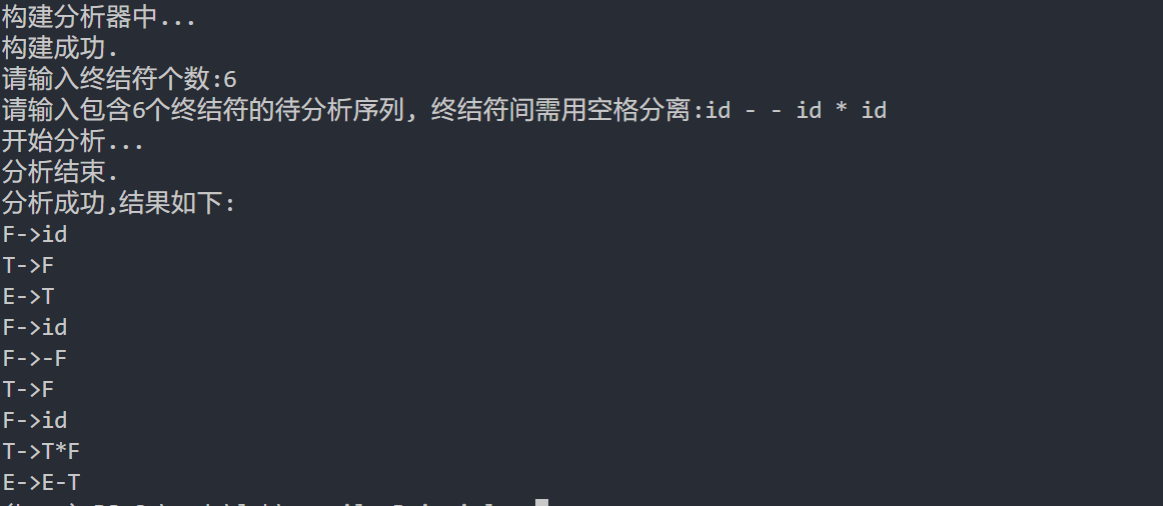
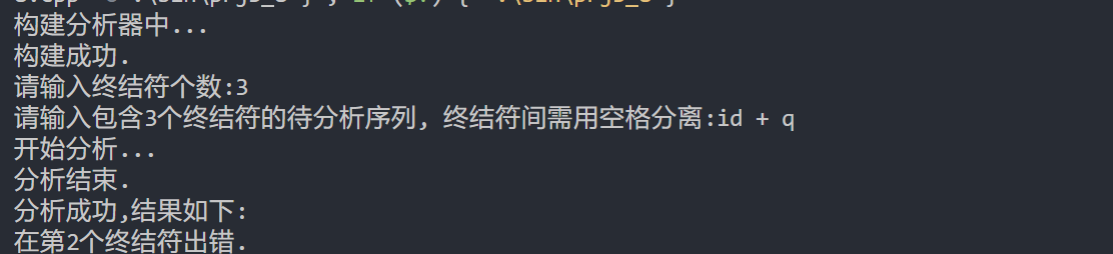
代码使用部分c++11特性,如有本地编译需要,请确认环境。
欢迎下方留言。
编译原理 算法3.8 LR分析 c++11实现的更多相关文章
- 《编译原理》构造 LL(1) 分析表的步骤 - 例题解析
<编译原理>构造 LL(1) 分析表的步骤 - 例题解析 易错点及扩展: 1.求每个产生式的 SELECT 集 2.注意区分是对谁 FIRST 集 FOLLOW 集 3.开始符号的 FOL ...
- 编译原理实验之SLR1文法分析
---内容开始--- 这是一份编译原理实验报告,分析表是手动造的,可以作为借鉴. 基于 SLR(1) 分析法的语法制导翻译及中间代码生成程序设计原理与实现1 .理论传授语法制导的基本概念,目标代码结 ...
- 编译原理(六)自底向上分析之LR分析法
自底向上分析之LR分析法 说明:以老师PPT为标准,借鉴部分教材内容,AlvinZH学习笔记. 基本概念 1. LR分析:从左到右扫描(L)自底向上进行规约(R),是规范规约,也即最右推导(规范推导) ...
- 【编译原理】语法分析LL(1)分析法的FIRST和FOLLOW集
近来复习编译原理,语法分析中的自上而下LL(1)分析法,需要构造求出一个文法的FIRST和FOLLOW集,然后构造分析表,利用分析表+一个栈来做自上而下的语法分析(递归下降/预测分析),可是这个FIR ...
- 编译原理实习(应用预测分析法LL(1)实现语法分析)
#include<iostream> #include<fstream> #include<iomanip> #include<cstdio> #inc ...
- 编译原理 #02# 简易递归下降分析程序(js实现)
// 实验存档 截图: 代码: <!DOCTYPE html> <html> <head> <meta charset="UTF-8"&g ...
- 【编译原理】c++实现自下而上语法分析器
写在前面:本博客为本人原创,严禁任何形式的转载!本博客只允许放在博客园(.cnblogs.com),如果您在其他网站看到这篇博文,请通过下面这个唯一的合法链接转到原文! 本博客全网唯一合法URL:ht ...
- 编译原理根据项目集规范族构造LR(0)分析表
转载于https://blog.csdn.net/Johan_Joe_King/article/details/79058597?utm_medium=distribute.pc_relevant.n ...
- 《编译原理》LR 分析法与构造 LR(1) 分析表的步骤 - 例题解析
<编译原理>LR 分析法与构造 LR(1) 分析表的步骤 - 例题解析 笔记 直接做题是有一些特定步骤,有技巧.但也必须先了解一些基本概念,本篇会通过例题形式解释概念,会容易理解和记忆,以 ...
随机推荐
- hadoop2.6集群环境搭建
版权声明:本文为博主原创文章,未经博主允许不得转载. 一.环境说明 1.机器:一台物理机 和一台虚拟机 2.Linux版本:[Spark@S1PA11 ~]$ cat /etc/issueRed Ha ...
- [LINQ2Dapper]最完整Dapper To Linq框架(五)---查看Linq实际执行的SQL
此例子是使用LINQ2Dapper封装,效率优于EntityFramwork,并且支持.NetFramework和.NetCore框架,只依赖于Dapper支持.net framework4.6.1及 ...
- day1-python条件语句和基本数据类型
一.if 条件语句 1. if 条件语句 if 条件: 代码块 else: 代码块 2. if 支持嵌套 if 1 == 1: if 2 == 2: print("欢迎进入blog1&quo ...
- Comet OJ - 2019国庆欢乐赛 C题 两排房子
###题目链接### 题目大意:这里有横着的两排房子,给你每个房子的左端点和右端点.若两排房子中分别有两个房子 x y ,他们在横坐标上有重叠部分(端点重叠也算),则被称为 “对门” 关系. 问你总共 ...
- tornado的使用-参数篇
tornado的使用-参数篇
- C++中对C的扩展学习新增语法——lambda 表达式(匿名函数)
1.匿名函数基础语法.调用.保存 1.auto lambda类型 2.函数指针来保存注意点:[]只能为空,不能写东西 3.std::function来保存 2.匿名函数捕捉外部变量(值方式.引用方式) ...
- [LC]206题 Reverse Linked List (反转链表)(链表)
①英文题目 Reverse a singly linked list. Example: Input: 1->2->3->4->5->NULL Output: 5-> ...
- python高阶函数的使用
目录 python高阶函数的使用 1.map 2.reduce 3.filter 4.sorted 5.小结 python高阶函数的使用 1.map Python内建了map()函数,map()函数接 ...
- scrapy_redis分布式爬虫
文章来源:https://github.com/rmax/scrapy-redis Scrapy-Redis Documentation: https://scrapy-redis.readthedo ...
- 关闭Eslint检查
Eslint是一个JavaScript的校验插件,通常用来校验语法或代码的书写风格.不过有点过于严格,通常缩减不同也会报错... 这会影响工作效率啊,最好就是在创建项目的时候不要ESlint(选择No ...