
POJ 1696 Space Ant 卷包裹法
Space Ant
Time Limit: 1000MS Memory Limit: 10000K Total Submissions: 3316 Accepted: 2118 Description
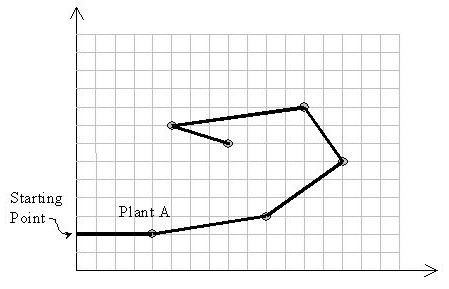
The most exciting space discovery occurred at the end of the 20th century. In 1999, scientists traced down an ant-like creature in the planet Y1999 and called it M11. It has only one eye on the left side of its head and just three feet all on the right side of its body and suffers from three walking limitations:
- It can not turn right due to its special body structure.
- It leaves a red path while walking.
- It hates to pass over a previously red colored path, and never does that.
The pictures transmitted by the Discovery space ship depicts that plants in the Y1999 grow in special points on the planet. Analysis of several thousands of the pictures have resulted in discovering a magic coordinate system governing the grow points of the plants. In this coordinate system with x and y axes, no two plants share the same x or y.
An M11 needs to eat exactly one plant in each day to stay alive. When it eats one plant, it remains there for the rest of the day with no move. Next day, it looks for another plant to go there and eat it. If it can not reach any other plant it dies by the end of the day. Notice that it can reach a plant in any distance.
The problem is to find a path for an M11 to let it live longest.
Input is a set of (x, y) coordinates of plants. Suppose A with the coordinates (xA, yA) is the plant with the least y-coordinate. M11 starts from point (0,yA) heading towards plant A. Notice that the solution path should not cross itself and all of the turns should be counter-clockwise. Also note that the solution may visit more than two plants located on a same straight line.Input
The first line of the input is M, the number of test cases to be solved (1 <= M <= 10). For each test case, the first line is N, the number of plants in that test case (1 <= N <= 50), followed by N lines for each plant data. Each plant data consists of three integers: the first number is the unique plant index (1..N), followed by two positive integers x and y representing the coordinates of the plant. Plants are sorted by the increasing order on their indices in the input file. Suppose that the values of coordinates are at most 100.Output
Output should have one separate line for the solution of each test case. A solution is the number of plants on the solution path, followed by the indices of visiting plants in the path in the order of their visits.Sample Input
2

10

1 4 5

2 9 8

3 5 9

4 1 7

5 3 2

6 6 3

7 10 10

8 8 1

9 2 4

10 7 6

14

1 6 11

2 11 9

3 8 7

4 12 8

5 9 20

6 3 2

7 1 6

8 2 13

9 15 1

10 14 17

11 13 19

12 5 18

13 7 3

14 10 16
Sample Output
10 8 7 3 4 9 5 6 2 1 10

14 9 10 11 5 12 8 7 6 13 4 14 1 3 2
Source
/*************************************************************************

    > File Name:            poj_1696.cpp

    > Author:               Howe_Young

    > Mail:                 1013410795@qq.com

    > Created Time:         2015年04月14日 星期二 16时41分10秒

 ************************************************************************/

#include <cstdio>

#include <iostream>

#include <cstring>

#include <cmath>

#include <cstdlib>

#include <algorithm>

#include <cstdio>

#define EPS 1e-8

using namespace std;

const int maxn = ;

struct point{

    double x, y;

    int num;//定点序号

};

point p[maxn];

bool vis[maxn];//标记是否已经取到

int ans[maxn];//保存取的顺序

int m, n;

int k;

bool cmp(const point p1, const point p2)//排序比较函数,这个题其实不用排序,找到y最小的点那个就行了

{

    return (p1.y == p2.y && p1.x < p2.x || p1.y < p2.y);

}

int sgn(double x)

{

    if (fabs(x) < EPS)

        return ;

    return x <  ? - : ;

}

double get_direction(point p1, point p2, point p3)//p1p3在p1p2的左侧的时候小于0

{

    return (p3.x - p1.x) * (p2.y - p1.y) - (p2.x - p1.x) * (p3.y - p1.y);

}

double get_distance(point p1, point p2)//两点之间的距离

{

    return sqrt((p1.x - p2.x) * (p1.x - p2.x) + (p1.y - p2.y) * (p1.y - p2.y));

}

void jarvis()//卷包裹法

{

    memset(vis, false, sizeof(vis));

    vis[] = vis[] = true;//其中p[0]是构造出来的,由题意可知,第一个点在y轴上

    int optimal, cur = ;//optimal保存最优的(最靠外的)那个点,cur是当前点

    for (int i = ; i <= n; i++)

    {

        for (int j = ; j <= n; j++)

        {

            if (!vis[j])

            {

                optimal = j; break;//从待选泽的点中随便找一个点让optimal等于它,因为下面要和其他的点比较

            }

        }

        for (int j = ; j <= n; j++)

        {

            if (!vis[j] && optimal != j && sgn(get_direction(p[cur], p[j], p[optimal])) < )//这里是没有共线的情况,如果有共线的话必须严格的判断

            {

                optimal = j;

            }

        }

        vis[optimal] = true;

        cur = optimal;

        ans[k++] = p[optimal].num;

    }

}

int main()

{

    //freopen("in.txt", "r", stdin);

    scanf("%d", &m);

    while (m--)

    {

        k = ;

        memset(ans, , sizeof(ans));

        scanf("%d", &n);

        for (int i = ; i <= n; i++)

            scanf("%d %lf %lf", &p[i].num, &p[i].x, &p[i].y);

        sort(p + , p + n + , cmp);//排序

        p[].num = ; p[].x = ; p[].y = p[].y;//构造第一个点

        ans[k++] = p[].num;

        jarvis();

        printf("%d ", n);

        for (int i = ; i < k; i++)

            printf("%d ", ans[i]);

        puts("");

    }

    return ;

}
其中上面有个步骤是没有严格的判断是否共线的问题,不过也能AC,可能数据比较少把,下面给出严格的判断共线问题的代码
void jarvis()

{

    memset(vis, false, sizeof(vis));

    vis[] = vis[] = true;

    int optimal, cur = ;

    for (int i = ; i <= n; i++)

    {

        for (int j = ; j <= n; j++)

        {

            if (!vis[j])

            {

                optimal = j; break;

            }

        }

        for (int j = ; j <= n; j++)

        {

            if (!vis[j] && optimal != j && sgn(get_direction(p[cur], p[j], p[optimal])) <= )

            {

                if (sgn(get_direction(p[cur], p[j], p[optimal])) == )//如果共线

                {

                    if (get_distance(p[cur], p[j]) < get_distance(p[cur], p[optimal]))//判断距离小的点是哪个

                        optimal = j;

                }

                else

                    optimal = j;

            }

        }

        vis[optimal] = true;

        cur = optimal;

        ans[k++] = p[optimal].num;

    }

}
POJ 1696 Space Ant 卷包裹法的更多相关文章
- poj 1696 Space Ant (极角排序)
链接:http://poj.org/problem?id=1696 Space Ant Time Limit: 1000MS Memory Limit: 10000K Total Submissi ...
- 简单几何(凸包) POJ 1696 Space Ant
题目传送门 题意:一个蚂蚁一直往左边走,问最多能走多少步,且输出路径 分析:就是凸包的变形题,凸包性质,所有点都能走.从左下角开始走,不停排序.有点纠结,自己的凸包不能AC.待理解透凸包再来写.. 好 ...
- 2018.07.04 POJ 1696 Space Ant(凸包卷包裹)
Space Ant Time Limit: 1000MS Memory Limit: 10000K Description The most exciting space discovery occu ...
- POJ 1696 Space Ant(极角排序)
Space Ant Time Limit: 1000MS Memory Limit: 10000K Total Submissions: 2489 Accepted: 1567 Descrip ...
- poj 1696 Space Ant(模拟+叉积)
Space Ant Time Limit: 1000MS Memory Limit: 10000K Total Submissions: 3840 Accepted: 2397 Descrip ...
- POJ 1696 Space Ant(点积的应用)
Space Ant 大意:有一仅仅蚂蚁,每次都仅仅向当前方向的左边走,问蚂蚁走遍全部的点的顺序输出.開始的点是纵坐标最小的那个点,開始的方向是開始点的x轴正方向. 思路:从開始点開始,每次找剩下的点中 ...
- poj 1696:Space Ant(计算几何,凸包变种,极角排序)
Space Ant Time Limit: 1000MS Memory Limit: 10000K Total Submissions: 2876 Accepted: 1839 Descrip ...
- POJ 1696 - Space Ant 凸包的变形
Technorati Tags: POJ,计算几何,凸包 初学计算几何,引入polygon后的第一个挑战--凸包 此题可用凸包算法做,只要把压入凸包的点从原集合中排除即可,最终形成图形为螺旋线. 关于 ...
- POJ 1696 Space Ant(凸包变形)
Description The most exciting space discovery occurred at the end of the 20th century. In 1999, scie ...
随机推荐
- utf8_general utf8_general utf8_bin区别
对与general来说 ß = s 是为true的 但是对于unicode来说 ß = ss 才是为true的, 其实他们的差别主要在德语和法语上,所以对于我们中国人来说,一般使用general,因为 ...
- bzoj1038: [ZJOI2008]瞭望塔
Description 致力于建设全国示范和谐小村庄的H村村长dadzhi,决定在村中建立一个瞭望塔,以此加强村中的治安.我们将H村抽象为一维的轮廓.如下图所示 我们可以用一条山的上方轮廓折线(x1, ...
- 批处理WMIC查看补丁情况
最近补丁比较多,需要看系统打了些啥,哪些没打的BAT: wmic qfe GET hotfixid > a.txt&(for %i in (KB3076321 KB3072604 KB3 ...
- java和javascript获取word文档的书签位置对比
1.javascript:把IE浏览器的activex都打开,使用如下网页,可以看到书签顺序和位置: ? 1 2 3 4 5 6 7 8 9 10 11 12 13 14 15 16 17 18 19 ...
- 只要是从事IT,会些CSS,XHTML总归是有好处的
上次是十多年前看了的,这次又系统看了下.. 这系统的HEAD FIRST,我很喜欢...收藏过三四本啦...
- VS在Release模式下,难道还可以Debug?
就是这段代码: int main(int argc, char *argv[]) { QApplication a(argc, argv); cxcxsdee w; w.show(); QString ...
- Java关键字this的用法总结
大飞_Rflyee:http://blog.csdn.net/rflyee/article/details/12057289 首先了解一下java中类的引用, 对于java中类的引用,可以这样理解: ...
- 【动态规划】Vijos P1121 马拦过河卒
题目链接: https://vijos.org/p/1616 题目大意: 卒从(0,0)走到(n,m),只能向下或向右,不能被马一步碰到或走到马,有几种走法. 题目思路: [动态规划] 把马控制的地方 ...
- 【动态规划】【归并】Vijos P1412 多人背包
题目链接: https://vijos.org/p/1412 题目大意: 求01背包的前K优解,要求必须装满(1<=K<=50 0<=V<=5000 1<=N<=2 ...
- C++程序原码
直接插入排序基本算法 #include<iostream.h> #include<stdlib.h> #include<time.h> const int n=10 ...