
Linear Decoders
Sparse Autoencoder Recap
In the sparse autoencoder, we had 3 layers of neurons: an input layer, a hidden layer and an output layer. In our previous description of autoencoders (and of neural networks), every neuron in the neural network used the same activation function. In these notes, we describe a modified version of the autoencoder in which some of the neurons use a different activation function. This will result in a model that is sometimes simpler to apply, and can also be more robust to variations in the parameters.
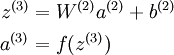
Recall that each neuron (in the output layer) computed the following:
where a(3) is the output. In the autoencoder, a(3) is our approximate reconstruction of the input x = a(1).
Because we used a sigmoid activation function for f(z(3)), we needed to constrain or scale the inputs to be in the range[0,1], since the sigmoid function outputs numbers in the range [0,1].
引入 —— 相同的activation function ,非线性映射会导致输入和输出不等
Linear Decoder
One easy fix for this problem is to set a(3) = z(3). Formally, this is achieved by having the output nodes use an activation function that's the identity function f(z) = z, so that a(3) = f(z(3)) = z(3). 输出结点不适用sigmoid 函数
This particular activation function
is called the linear activation function。Note however that in the hidden layer of the network, we still use a sigmoid (or tanh) activation function, so that the hidden unit activations are given by (say)
, where
is the sigmoid function, x is the input, and W(1) andb(1) are the weight and bias terms for the hidden units. It is only in the output layer that we use the linear activation function.
An autoencoder in this configuration--with a sigmoid (or tanh) hidden layer and a linear output layer--is called a linear decoder.
In this model, we have
. Because the output
is a now linear function of the hidden unit activations, by varying W(2), each output unit a(3) can be made to produce values greater than 1 or less than 0 as well. This allows us to train the sparse autoencoder real-valued inputs without needing to pre-scale every example to a specific range.
Since we have changed the activation function of the output units, the gradients of the output units also change. Recall that for each output unit, we had set set the error terms as follows:
where y = x is the desired output,
output结点
Of course, when using backpropagation to compute the error terms for the hidden layer:
hidden结点
Because the hidden layer is using a sigmoid (or tanh) activation f, in the equation above
should still be the derivative of the sigmoid (or tanh) function.

Linear Decoders的更多相关文章
- (六)6.16 Neurons Networks linear decoders and its implements
Sparse AutoEncoder是一个三层结构的网络,分别为输入输出与隐层,前边自编码器的描述可知,神经网络中的神经元都采用相同的激励函数,Linear Decoders 修改了自编码器的定义,对 ...
- CS229 6.16 Neurons Networks linear decoders and its implements
Sparse AutoEncoder是一个三层结构的网络,分别为输入输出与隐层,前边自编码器的描述可知,神经网络中的神经元都采用相同的激励函数,Linear Decoders 修改了自编码器的定义,对 ...
- Unsupervised Feature Learning and Deep Learning(UFLDL) Exercise 总结
7.27 暑假开始后,稍有时间,“搞完”金融项目,便开始跑跑 Deep Learning的程序 Hinton 在Nature上文章的代码 跑了3天 也没跑完 后来Debug 把batch 从200改到 ...
- Deep learning:三十八(Stacked CNN简单介绍)
http://www.cnblogs.com/tornadomeet/archive/2013/05/05/3061457.html 前言: 本节主要是来简单介绍下stacked CNN(深度卷积网络 ...
- [UFLDL] Basic Concept
博客内容取材于:http://www.cnblogs.com/tornadomeet/archive/2012/06/24/2560261.html 参考资料: UFLDL wiki UFLDL St ...
- [UFLDL] Dimensionality Reduction
博客内容取材于:http://www.cnblogs.com/tornadomeet/archive/2012/06/24/2560261.html Deep learning:三十五(用NN实现数据 ...
- Deep Learning 教程翻译
Deep Learning 教程翻译 非常激动地宣告,Stanford 教授 Andrew Ng 的 Deep Learning 教程,于今日,2013年4月8日,全部翻译成中文.这是中国屌丝军团,从 ...
- ICLR 2013 International Conference on Learning Representations深度学习论文papers
ICLR 2013 International Conference on Learning Representations May 02 - 04, 2013, Scottsdale, Arizon ...
- Deep Learning基础--线性解码器、卷积、池化
本文主要是学习下Linear Decoder已经在大图片中经常采用的技术convolution和pooling,分别参考网页http://deeplearning.stanford.edu/wiki/ ...
随机推荐
- Futures and promises
In computer science, future, promise, delay, and deferred refer to constructs used for synchronizing ...
- Unified BeginFrame scheduling for Chrome
Unified BeginFrame scheduling for Chrome http://goo.gl/D1Qxrr Status: http://crbug.com/401331 and ht ...
- UI Framework-1: Browser Window
Browser Window The Chromium browser window is represented by several objects, some of which are incl ...
- 优秀的Linux文本编辑器 (转载)
想要挑起狂热Linux爱好者之间的激烈争辩吗?那就问问他们最喜欢的文本编辑器是什么吧.在开源社区中,选择一个用来写文本,或者更进一步,用来写代码的编辑器,比选择一个球队或者游戏控制器还要重要.但是任何 ...
- decision tree 决策树(一)
一 决策树 原理:分类决策树模型是一种描述对实例进行分类的树形结构.决策树由结点(node)和有向边(directed edge)组成.结点有两种类型:内部结点(internal node)和叶结点( ...
- bzoj 2287: 【POJ Challenge】消失之物 动态规划
Code: #include<cstdio> #include<algorithm> #include<queue> #include<cstring> ...
- JS动态创建表单post提交
<script> //@创建表单方法 function post(URL, PARAMS) { var temp = document.createElement("form&q ...
- 监控mysqld服务
#!/bin/bash #监控mysqld服务 #telnet 192.168.122.171 3306 | grep Connected | wc -l #远程检查 #num=`netstat -n ...
- caioj 1074 动态规划入门(中链式1:最小交换合并问题)
经典的石子合并问题!!! 设f[i][j]为从i到j的最大值 然后我们先枚举区间大小,然后枚举起点终点来更新 f[i][j] = min(f[i][k] + f[k+1][j] + sum(i, j) ...
- ArcGIS api for javascript——加载图标
描述 这个示例展示了如何能用一个动画图片显示地图正在加载.在这个示例中,图片是一个小的动画GIF.当地图第一次加载或用户缩放和平移地图时显示图片.当所有图层加载完成图片消失. 这个示例是通过event ...