
Entity Framework Tutorial Basics(2):What is Entity Framework?
What is Entity Framework?
Writing and managing ADO.Net code for data access is a tedious and monotonous job. Microsoft has provided an O/RM framework called "Entity Framework" to automate database related activities for your application.
Microsoft has given the following definition of Entity Framework:
The Microsoft ADO.NET Entity Framework is an Object/Relational Mapping (ORM) framework that enables developers to work with relational data as domain-specific objects, eliminating the need for most of the data access plumbing code that developers usually need to write. Using the Entity Framework, developers issue queries using LINQ, then retrieve and manipulate data as strongly typed objects. The Entity Framework's ORM implementation provides services like change tracking, identity resolution, lazy loading, and query translation so that developers can focus on their application-specific business logic rather than the data access fundamentals.
Entity framework is an Object/Relational Mapping (O/RM) framework. It is an enhancement to ADO.NET that gives developers an automated mechanism for accessing & storing the data in the database.
Entity framework is useful in three scenarios. First, if you already have existing database or you want to design your database ahead of other parts of the application. Second, you want to focus on your domain classes and then create the database from your domain classes. Third, you want to design your database schema on the visual designer and then create the database and classes.
The following figure illustrates the above scenarios.
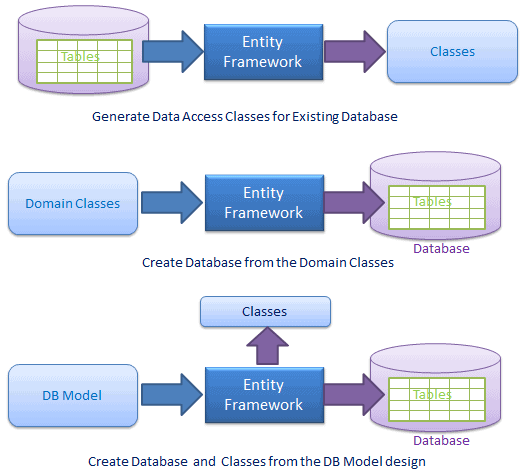
As per the above figure, EF creates data access classes for your existing database, so that you can use these classes to interact with the database instead of ADO.Net directly.
EF can also create the database from your domain classes, thus you can focus on your domain-driven design.
EF provides you a model designer where you can design your DB model and then EF creates database and classes based on your DB model.
What is O/RM?
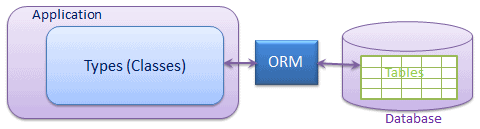
ORM is a tool for storing data from domain objects to relational database like MS SQL Server, in an automated way, without much programming. O/RM includes three main parts: Domain class objects, Relational database objects and Mapping information on how domain objects map to relational database objects (tables, views & storedprocedures). ORM allows us to keep our database design separate from our domain class design. This makes the application maintainable and extendable. It also automates standard CRUD operation (Create, Read, Update & Delete) so that the developer doesn't need to write it manually.
A typical ORM tool generates classes for the database interaction for your application as shown below.
Visit wikipedia for more information on Object-relational Mapping
There are many ORM frameworks for .net in the market such as DataObjects.Net, NHibernate, OpenAccess, SubSonic etc. Entity Framework is an open source ORM framework from Microsoft.
Please note that Entity Framework is an open source framework by Microsoft. You can contribute to the Entity Framework project on codeplex.
Entity Framework Tutorial Basics(2):What is Entity Framework?的更多相关文章
- Entity Framework Tutorial Basics(20):Persistence in Entity Framework
Persistence in Entity Framework There are two scenarios when persisting an entity using EntityFramew ...
- Entity Framework Tutorial Basics(8):Types of Entity in Entity Framework
Types of Entity in Entity Framework: We created EDM for existing database in the previous section. A ...
- Entity Framework Tutorial Basics(25):Delete Single Entity
Delete Entity using DBContext in Disconnected Scenario: We used the Entry() method of DbContext to m ...
- Entity Framework Tutorial Basics(24):Update Single Entity
Update Existing Entity using DBContext in Disconnected Scenario: In this chapter, you will learn how ...
- Entity Framework Tutorial Basics(23):Add Single Entity
Add New Entity using DBContext in Disconnected Scenario: In this chapter you will learn how to add n ...
- Entity Framework Tutorial Basics(1):Introduction
以下系列文章为Entity Framework Turial Basics系列 http://www.entityframeworktutorial.net/EntityFramework5/enti ...
- Entity Framework Tutorial Basics(31):Migration from EF 4.X
Migration from Entity Framework 4.1/4.3 to Entity Framework 5.0/6.0 To migrate your existing Entity ...
- Entity Framework Tutorial Basics(27):Update Entity Graph
Update Entity Graph using DbContext: Updating an entity graph in disconnected scenario is a complex ...
- Entity Framework Tutorial Basics(22):Disconnected Entities
Disconnected Entities: Before we see how to perform CRUD operation on disconnected entity graph, let ...
随机推荐
- Codeforces Round #266 (Div. 2)B(暴力枚举)
很简单的暴力枚举,却卡了我那么长时间,可见我的基本功不够扎实. 两个数相乘等于一个数6*n,那么我枚举其中一个乘数就行了,而且枚举到sqrt(6*n)就行了,这个是暴力法解题中很常用的性质. 这道题找 ...
- pdp 的连接方法
<?php $dsn = "mysql:host=127.0.0.1;dbname=blog_edu"; try{ $pdo = new PDO($dsn,'root','' ...
- PHP提供的数组比较函数总结
在我们看PHP手册的时候发现,PHP提供了许多数组元素比较的函数,看起来又多又烦又不好记,现在我们来总结一下: sort() — 本函数对数组进行排序,当本函数结束时数组单元将被从最低到最高重新安排. ...
- BZOJ4923 [Lydsy1706月赛]K小值查询
题意 维护一个长度为n的正整数序列a_1,a_2,...,a_n,支持以下两种操作: 1 k,将序列a从小到大排序,输出a_k的值. 2 k,将所有严格大于k的数a_i减去k. \(n \leq 10 ...
- 2017.10.7北京清北综合强化班DAY7
1.计数 (count.cpp/c/pas) 时间限制:1s 内存限制:256MB [问题描述] 给出m个数a[1],a[2],…,a[m] 求1~n中有多少数不是a[1],a[2],…,a[m]的倍 ...
- webpack里CommonJS的require与ES6 的module.exports加载模块有何不同
只需明白commonjs的规则即可,import会被转化为commonjs格式的,babel默认会把ES6的模块转化为commonjs规范的. import vue from 'vue'; //等价于 ...
- 【转】深入剖析Java中的装箱和拆箱
深入剖析Java中的装箱和拆箱 自动装箱和拆箱问题是Java中一个老生常谈的问题了,今天我们就来一些看一下装箱和拆箱中的若干问题.本文先讲述装箱和拆箱最基本的东西,再来看一下面试笔试中经常遇到的与装箱 ...
- Makefile中的路径
使用 $(shell pwd) 可以在Makefile中指定为当前Makefile所在目录的路径
- try catch(java)
1 try.catch.finally语句中,在如果try语句有return语句,则返回的之后当前try中变量此时对应的值,此后对变量做任何的修改,都不影响try中return的返回值 2 如果fin ...
- DIDAO.Common --- 项目中的常用类及其中函数
常用函数: CommonHelper.cs using System; using System.Collections.Generic; using System.IO; using System. ...