
caffe 中base_lr、weight_decay、lr_mult、decay_mult代表什么意思?
在机器学习或者模式识别中,会出现overfitting,而当网络逐渐overfitting时网络权值逐渐变大,因此,为了避免出现overfitting,会给误差函数添加一个惩罚项,常用的惩罚项是所有权重的平方乘以一个衰减常量之和。其用来惩罚大的权值。
The learning rate is a parameter that determines how much an updating step influences the current value of the weights. While weight decay is an additional term in the weight update rule that causes the weights to exponentially decay to zero, if no other update is scheduled.
So let's say that we have a cost or error function E(w) that we want to minimize. Gradient descent tells us to modify the weights w in the direction of steepest descent in E:
where η is the learning rate, and if it's large you will have a correspondingly large modification of the weights wi(in general it shouldn't be too large, otherwise you'll overshoot the local minimum in your cost function).
In order to effectively limit the number of free parameters in your model so as to avoid over-fitting, it is possible to regularize the cost function. An easy way to do that is by introducing a zero mean Gaussian prior over the weights, which is equivalent to changing the cost function to E˜(w)=E(w)+λ2w2. In practice this penalizes large weights and effectively limits the freedom in your model. The regularization parameter λ determines how you trade off the original cost E with the large weights penalization.
Applying gradient descent to this new cost function we obtain:
The new term −ηλwi coming from the regularization causes the weight to decay in proportion to its size.
In your solver you likely have a learning rate set as well as weight decay. lr_mult indicates what to multiply the learning rate by for a particular layer. This is useful if you want to update some layers with a smaller learning rate (e.g. when finetuning some layers while training others from scratch) or if you do not want to update the weights for one layer (perhaps you keep all the conv layers the same and just retrain fully connected layers). decay_mult is the same, just for weight decay.
参考资料:http://stats.stackexchange.com/questions/29130/difference-between-neural-net-weight-decay-and-learning-rate
http://blog.csdn.net/u010025211/article/details/50055815
https://groups.google.com/forum/#!topic/caffe-users/8J_J8tc1ZHc
视觉层(Vision Layers)及参数
所有的层都具有的参数,如name, type, bottom, top和transform_param请参看我的前一篇文章:Caffe学习系列(2):数据层及参数
本文只讲解视觉层(Vision Layers)的参数,视觉层包括Convolution, Pooling, Local Response Normalization (LRN), im2col等层。
1、Convolution层:
就是卷积层,是卷积神经网络(CNN)的核心层。
层类型:Convolution
lr_mult: 学习率的系数,最终的学习率是这个数乘以solver.prototxt配置文件中的base_lr。如果有两个lr_mult, 则第一个表示权值的学习率,第二个表示偏置项的学习率。一般偏置项的学习率是权值学习率的两倍。
在后面的convolution_param中,我们可以设定卷积层的特有参数。
必须设置的参数:
num_output: 卷积核(filter)的个数
kernel_size: 卷积核的大小。如果卷积核的长和宽不等,需要用kernel_h和kernel_w分别设定
其它参数:
stride: 卷积核的步长,默认为1。也可以用stride_h和stride_w来设置。
pad: 扩充边缘,默认为0,不扩充。 扩充的时候是左右、上下对称的,比如卷积核的大小为5*5,那么pad设置为2,则四个边缘都扩充2个像素,即宽度和高度都扩充了4个像素,这样卷积运算之后的特征图就不会变小。也可以通过pad_h和pad_w来分别设定。

layer {

  name: "conv1"

  type: "Convolution"

  bottom: "data"

  top: "conv1"

  param {

    lr_mult: 1

  }

  param {

    lr_mult: 2

  }

  convolution_param {

    num_output: 20

    kernel_size: 5

    stride: 1

    weight_filler {

      type: "xavier"

    }

    bias_filler {

      type: "constant"

    }

  }

}
layer {

  name: "pool1"

  type: "Pooling"

  bottom: "conv1"

  top: "pool1"

  pooling_param {

    pool: MAX

    kernel_size: 3

    stride: 2

  }

}
pooling层的运算方法基本是和卷积层是一样的。
 ,得到归一化后的输出
layers {
name: "norm1"
type: LRN
bottom: "pool1"
top: "norm1"
lrn_param {
local_size: 5
alpha: 0.0001
beta: 0.75
}
}
4、im2col层
如果对matlab比较熟悉的话,就应该知道im2col是什么意思。它先将一个大矩阵,重叠地划分为多个子矩阵,对每个子矩阵序列化成向量,最后得到另外一个矩阵。
看一看图就知道了:
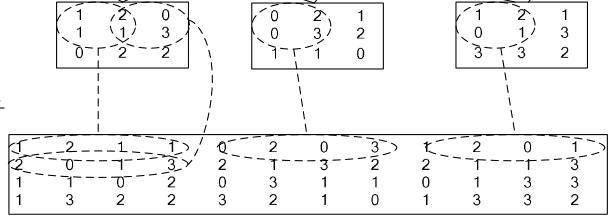
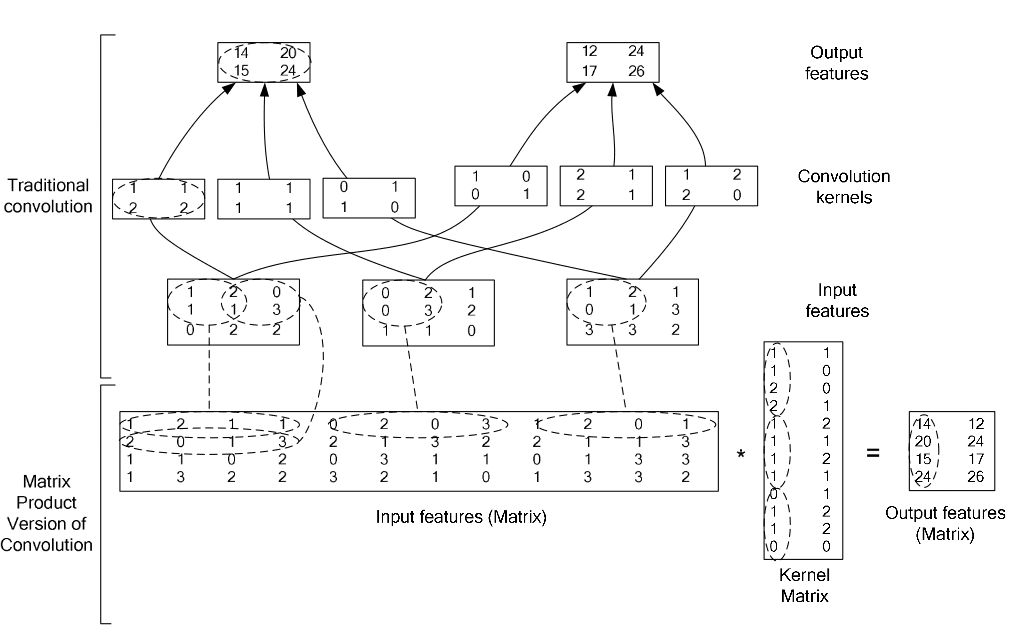
在caffe中,卷积运算就是先对数据进行im2col操作,再进行内积运算(inner product)。这样做,比原始的卷积操作速度更快。
看看两种卷积操作的异同:
caffe 中base_lr、weight_decay、lr_mult、decay_mult代表什么意思?的更多相关文章
- 在Caffe中实现模型融合
模型融合 有的时候我们手头可能有了若干个已经训练好的模型,这些模型可能是同样的结构,也可能是不同的结构,训练模型的数据可能是同一批,也可能不同.无论是出于要通过ensemble提升性能的目的,还是要设 ...
- caffe中lenet_solver.prototxt配置文件注解
caffe框架自带的例子mnist里有一个lenet_solver.prototxt文件,这个文件是具体的训练网络的引入文件,定义了CNN网络架构之外的一些基础参数,如总的迭代次数.测试间隔.基础学习 ...
- caffe中权值初始化方法
首先说明:在caffe/include/caffe中的 filer.hpp文件中有它的源文件,如果想看,可以看看哦,反正我是不想看,代码细节吧,现在不想知道太多,有个宏观的idea就可以啦,如果想看代 ...
- caffe中各层的作用:
关于caffe中的solver: cafffe中的sover的方法都有: Stochastic Gradient Descent (type: "SGD"), AdaDelta ( ...
- caffe中的Accuracy+softmaxWithLoss
转:http://blog.csdn.net/tina_ttl/article/details/51556984 今天才偶然发现,caffe在计算Accuravy时,利用的是最后一个全链接层的输出(不 ...
- caffe中LetNet-5卷积神经网络模型文件lenet.prototxt理解
caffe在 .\examples\mnist文件夹下有一个 lenet.prototxt文件,这个文件定义了一个广义的LetNet-5模型,对这个模型文件逐段分解一下. name: "Le ...
- 【神经网络与深度学习】如何在Caffe中配置每一个层的结构
如何在Caffe中配置每一个层的结构 最近刚在电脑上装好Caffe,由于神经网络中有不同的层结构,不同类型的层又有不同的参数,所有就根据Caffe官网的说明文档做了一个简单的总结. 1. Vision ...
- (原)torch和caffe中的BatchNorm层
转载请注明出处: http://www.cnblogs.com/darkknightzh/p/6015990.html BatchNorm具体网上搜索. caffe中batchNorm层是通过Batc ...
- CAFFE中训练与使用阶段网络设计的不同
神经网络中,我们通过最小化神经网络来训练网络,所以在训练时最后一层是损失函数层(LOSS), 在测试时我们通过准确率来评价该网络的优劣,因此最后一层是准确率层(ACCURACY). 但是当我们真正要使 ...
随机推荐
- 使用HtmlAgilityPack解析html
HtmlAgilityPack是.net下使用xPath来解析html的类库,可以方便的做html的页面分析处理 项目地址: http://htmlagilitypack.codeplex.com/ ...
- TX大手笔做业务必然失败的原因
首先说一个伪命题: 物体会向下落这是一个基本的定律,一个小小的物理规则会覆盖所有物体的行为准则. 那么,当地球上的所有东西都下落的时候,你指望整个地球,月球,太阳也会下落么? 事实上大家都知道星球在宇 ...
- python selenium操作表格式元素实例
很多时候,网页上的布局都是表格形式的,如出下面这样的 这种网页类型在自动化中比较头痛,需要很多判断,下面就举个例子,这里以深圳出入境网页为例,http://yysl.sz3e.com/wsyysq/s ...
- vue之修饰符
修饰符 .lazy 在默认情况下,v-model 在每次 input 事件触发后将输入框的值与数据进行同步 .你可以添加 lazy 修饰符,从而转变为使用 change 事件进行同步: <!-- ...
- POJ 2342 - Anniversary party - [树形DP]
题目链接:http://poj.org/problem?id=2342 Description There is going to be a party to celebrate the 80-th ...
- LDA模型数据的可视化
""" 执行lda2vec.ipnb中的代码 模型LDA 功能:训练好后模型数据的可视化 """ from lda2vec import p ...
- MySQL在linux上(cmake)的source code安装方法
1.安装前准备: 1)必备的包和工具 gcc/g++ :MySQL 5.6开始,需要使用g++进行编译. cmake :MySQL 5.5开始,使用cmake进行工程管理,cmake需要2.8以 ...
- Linux crontab下关于使用date命令和sudo命令的坑
想要在root 的crontab里面加一些任务计划,希望以www用户运行命令,并且将输出重定向到某处以当时时间命名的日志文件,大致如下 /usr/bin/sudo -u www /usr/local/ ...
- Can you answer these queries?---hdu4027
题目链接 有n个数:当操作为1时求L到R的和: 当操作为0时更新L到R为原来的平方根: 不过如果仔细演算的话会发现一个2^64数的平方根开8次也就变成了 1,所以也更新不了多少次,所以可以每次更新到底 ...
- 洛谷P3368 树状数组2 树状数组+差分
正解:树状数组+差分 解题报告: 戳我! 不得不说灵巧真滴是越来越弱了...连模板题都要放上来了QAQ 因为今天考试的T3正解要用到树状数组这才惊觉树状数组掌握得太太太太差了...之前一直靠线段树续着 ...