
GMM实战
一道作业题:
https://www.kaggle.com/c/speechlab-aug03
就是给你训练集,验证集,要求用GMM(混合高斯模型)预测 测试集的分类,这是个2分类的问题。
$ head train.txt dev.txt test.txt

==> train.txt <==

1.124586 1.491173

2.982154 0.275734

-0.367243 0.068235

1.216709 -0.804729

3.077832 0.307613

1.165453 1.627965

0.737648 1.055470

0.838988 1.355942

1.452510 -0.056967

-0.570093 -0.355338

==> dev.txt <==

0.900742 1.933559

3.112402 -0.817857

0.989450 1.605954

0.759107 -1.214189

1.433045 -0.986053

1.072825 1.654026

2.174214 0.638420

1.135233 -1.055797

-0.328072 -0.091407

1.220020 1.116177

==> test.txt <==

0.916983 0.353964

1.921382 1.958336

1.822650 2.328900

-0.786640 -0.059369

1.018302 1.406017

0.660574 0.847398

2.747331 0.910621

0.662462 1.935314

2.955916 -0.317031

-0.213735 0.126742
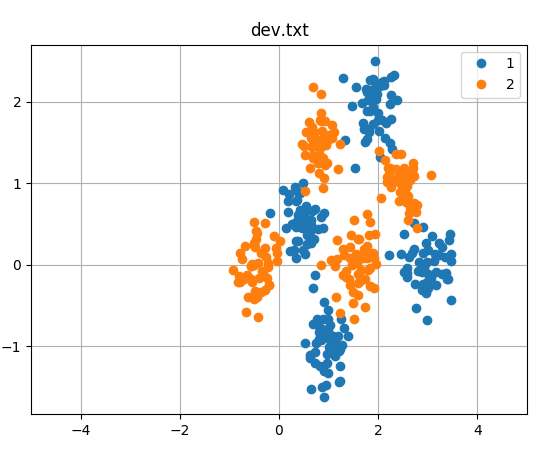

这里我已经把图画出来了,因为特征是2维的,所以可以用平面上的点来表示,不同的颜色代表不同的分类。
这个题的思路就是:用两个GMM来做,每个GMM有4个组分,最后要看属于哪一类,就看两个GMM模型的概率,谁高就属于哪一类。
要对两个GMM模型做初始化,在这里用Kmeans来做初始化,比随机初始化要好。
1.Kmeans初始化:
# from numpy import *

import numpy as np

import matplotlib.pyplot as plt

import os

use_new_data=0

#-------------------new-----------------

if use_new_data:

    colour=['lightblue','sandybrown']

    _path='/home/dahu/myfile/tianchi/kaggle/gmm_em/my_test/new'

    train_file=os.path.join(_path,'train.txt1')

    dev_file=os.path.join(_path,'dev.txt1')

    test_file=os.path.join(_path,'test.txt1')

#-------------------old-----------------

else :

    _path='/home/dahu/myfile/tianchi/kaggle/gmm_em/my_test/old'

    train_file=os.path.join(_path,'train.txt')

    dev_file=os.path.join(_path,'dev.txt')

    test_file=os.path.join(_path,'test.txt')

feature_num=2

n_classes = 4

plt.rc('figure', figsize=(10, 6))

def loadDataSet(fileName):  # 解析文件,按tab分割字段,得到一个浮点数字类型的矩阵

    dataMat = []              # 文件的最后一个字段是类别标签

    fr = open(fileName)

    for line in fr.readlines():

        curLine = line.strip().split(' ')

#         fltLine = map(float, curLine)    # 将每个元素转成float类型

        fltLine=[float(i) for i in curLine]

        dataMat.append(fltLine)

    return dataMat

# 计算欧几里得距离

def distEclud(vecA, vecB):

    return np.sqrt(np.sum(np.power(vecA - vecB, 2))) # 求两个向量之间的距离

# 构建聚簇中心,取k个(此例中k=4)随机质心

def randCent(dataSet, k):

    np.random.seed(1)

    n = np.shape(dataSet)[1]

    centroids = np.mat(np.zeros((k,n)))   # 每个质心有n个坐标值,总共要k个质心

    for j in range(n):

        minJ = min(dataSet[:,j])

        maxJ = max(dataSet[:,j])

        rangeJ = float(maxJ - minJ)

        centroids[:,j] = minJ + rangeJ * np.random.rand(k, 1)

    return centroids

# k-means 聚类算法

def kMeans(dataSet, k, distMeans =distEclud, createCent = randCent):

    '''

    :param dataSet:  没有lable的数据集  (本例中是二维数据)

    :param k:  分为几个簇

    :param distMeans:    计算距离的函数

    :param createCent:   获取k个随机质心的函数

    :return: centroids: 最终确定的 k个 质心

            clusterAssment:  该样本属于哪类  及  到该类质心距离

    '''

    m = np.shape(dataSet)[0]   #m=80,样本数量

    clusterAssment = np.mat(np.zeros((m,2)))

    # clusterAssment第一列存放该数据所属的中心点,第二列是该数据到中心点的距离,

    centroids = createCent(dataSet, k)

    clusterChanged = True   # 用来判断聚类是否已经收敛

    while clusterChanged:

        clusterChanged = False;

        for i in range(m):  # 把每一个数据点划分到离它最近的中心点

            minDist = np.inf; minIndex = -1;

            for j in range(k):

                distJI = distMeans(centroids[j,:], dataSet[i,:])

                if distJI < minDist:

                    minDist = distJI; minIndex = j  # 如果第i个数据点到第j个中心点更近,则将i归属为j

            if clusterAssment[i,0] != minIndex:

                clusterChanged = True  # 如果分配发生变化,则需要继续迭代

            clusterAssment[i,:] = minIndex,minDist**2   # 并将第i个数据点的分配情况存入字典

        # print centroids

        for cent in range(k):   # 重新计算中心点

#             ptsInClust = dataSet[clusterAssment.A[:,0]==cent]

            ptsInClust = dataSet[np.nonzero(clusterAssment[:,0].A == cent)[0]]

            centroids[cent,:] = np.mean(ptsInClust, axis = 0)  # 算出这些数据的中心点

    return centroids, clusterAssment

# --------------------测试----------------------------------------------------

# 用测试数据及测试kmeans算法

data=np.mat(loadDataSet(train_file))

# data=np.mat(loadDataSet('/home/dahu/myfile/my_git/pytorch_learning/pytorch_lianxi/gmm_em.lastyear/train.txt'))

# print(data)

kmeans=[]

colors = ['lightblue','sandybrown']

for i in [1,2]:

    datMat = data[np.nonzero(data[:,feature_num].A == i)[0]]  #选取某一标注的所有样例

#     datMat = data[data.A[:,2]==i]

#     print(datMat)

    myCentroids,clustAssing = kMeans(datMat,n_classes)

    print('Kmeans 中心点坐标展示')

    print(myCentroids)

    x=np.array(datMat[:,0]).ravel()

    y=np.array(datMat[:,1]).ravel()

    plt.scatter(x,y, marker='o',color=colors[i-1],label=i)

    xcent=np.array(myCentroids[:,0]).ravel()

    ycent=np.array(myCentroids[:,1]).ravel()

    plt.scatter(xcent, ycent, marker='x', color='r', s=50)

#     print(myCentroids[:,:2])

    kmeans.append(myCentroids[:,:feature_num])

plt.legend(scatterpoints=1, loc='lower right', prop=dict(size=12))

plt.title('kmeans get center')

plt.show()

kmeans的方法之前的博客已经说了,方法是一样的,在这里,已经把分类和各组分的中心点已经标出了。
kmeans找到的中心点,我们准备用来作为GMM的初始化。
2.GMM训练
f_train=open(train_file,'r')

f_dev=open(dev_file,'r')

x_train=[]

Y_train=[]

x_test=[]

Y_test=[]

for line in f_train:

    a=line.split(' ')

    x_train.append([float(i) for i in a[:feature_num]])

    Y_train.append(int(a[-1]))

X_train=np.array(x_train)

y_train=np.array(Y_train)

for line in f_dev:

    a=line.split(' ')

    x_test.append([float(i) for i in a[:feature_num]])

    Y_test.append(int(a[-1]))

X_test=np.array(x_test)

y_test=np.array(Y_test)

c=[X_train,y_train,X_test,y_test]

# print(X_train[:5],y_train[:5],'\n\n',X_test[:5],y_test[:5],'\n',type(X_train))

# print(X_train[y_train==1])

x1=X_train[y_train==1]

x2=X_train[y_train==2]

xt1=X_test[y_test==1]

xt2=X_test[y_test==2]

print(x1[:5],x1.shape)

# for i in c:

#     print(i.shape)

# --------------------------GMM----------------------------------------------------
# 在这里准备开始搞GMM了,这里用了2个GMM模型

estimator1 = GaussianMixture(n_components=n_classes,

                   covariance_type='full', max_iter=200, random_state=0,tol=1e-5)

estimator2 = GaussianMixture(n_components=n_classes,

                   covariance_type='full', max_iter=200, random_state=0,tol=1e-5)

# estimator.means_init = np.array([X_train[y_train == i+1].mean(axis=0)

#                                     for i in range(n_classes)])

estimator1.means_init = np.array(kmeans[0])    #在这里初始化的,这个值就是我们之前kmeans得到的

estimator2.means_init = np.array(kmeans[1])

# estimator.fit(X_train)

estimator1.fit(x1)

estimator2.fit(x2)

x1_p= np.exp(estimator1.score_samples(X_train))

x2_p= np.exp(estimator2.score_samples(X_train))

# 写了两个函数,一个是预测分类的,其实就是根据 哪个GMM模型的得分高,就是哪一类  这样来分类的, 另一个是根据分类结果,和标注对比,算一个准确率

def predict(x1test_p,x2test_p):

    res=[]

    for i in range(x1test_p.shape[0]):

        if x1test_p[i]>x2test_p[i]:

            res.append(1)

        else:

            res.append(2)

    res=np.array(res)

    return res

def calculate_accuracy(x1test_p,x2test_p,y_test):

    res=predict(x1test_p,x2test_p)

    test_accuracy = np.mean(res.ravel() == y_test.ravel()) * 100

    return test_accuracy

print('开发集train准确率',calculate_accuracy(x1_p,x2_p,y_train))

print('-'*60)

x1test_p=np.exp(estimator1.score_samples(X_test))

x2test_p=np.exp(estimator2.score_samples(X_test))

# print(x1test_p[:5],x1test_p.shape)

# print(x2test_p[:5],x2test_p.shape)

# print(y_test[:5],y_test.shape)

print('验证集dev准确率',calculate_accuracy(x1test_p,x2test_p,y_test))
[[ 2.982154  0.275734]

 [ 1.216709 -0.804729]

 [ 3.077832  0.307613]

 [ 0.710813  0.241071]

 [ 0.599696  0.490842]] (, )

开发集train准确率 98.375

------------------------------------------------------------

验证集dev准确率 97.875
当然这里算 测试集 的 分类,我没有贴上去啊,最后提交的时候,准确率是98% ,当然前面还有得分更高的。。。
最后
经数学帝的提醒,对于 确定 是哪一个分类 这一块的描述不够准确,重新描述一下:
a.我们求的2个GMM的概率其实是 p(x|y=1) ,p(x|y=2) ,在给定分类情况下,x的概率
b.而我们需要的是p(y=1|x) ,p(y=2|x) ,已经知道是x了,求是哪个分类的概率。
两个不是同一个东西,需要转化一下: p(y=1|x) = p(x|y=1)*p(y=1)/p(x) , p(y=2|x) = p(x|y=2)*p(y=2)/p(x)
分母p(x)是一样的,可以约掉,分子上还有一个p(y=1) 和 p(y=2) 这是先验概率,在题目中,分类1和分类2的数量是一样多的,所以我们求 a ,能反应出我们求b ,如果题目中不一样,还要把它考虑进去。
GMM实战的更多相关文章
- 【转】GMM与K-means聚类效果实战
原地址: GMM与K-means聚类效果实战 备注 分析软件:python 数据已经分享在百度云:客户年消费数据 密码:lehv 该份数据中包含客户id和客户6种商品的年消费额,共有440个样本 正文 ...
- sklearn GMM模型介绍
参考 SKlearn 库 EM 算法混合高斯模型参数说明及代码实现 和 sklearn.mixture.GaussianMixture 以前的推导内容: GMM 与 EM 算法 记录下 ...
- 机器学习_线性回归和逻辑回归_案例实战:Python实现逻辑回归与梯度下降策略_项目实战:使用逻辑回归判断信用卡欺诈检测
线性回归: 注:为偏置项,这一项的x的值假设为[1,1,1,1,1....] 注:为使似然函数越大,则需要最小二乘法函数越小越好 线性回归中为什么选用平方和作为误差函数?假设模型结果与测量值 误差满足 ...
- Python 机器学习实战 —— 无监督学习(上)
前言 在上篇<Python 机器学习实战 -- 监督学习>介绍了 支持向量机.k近邻.朴素贝叶斯分类 .决策树.决策树集成等多种模型,这篇文章将为大家介绍一下无监督学习的使用.无监督学习顾 ...
- Python 机器学习实战 —— 无监督学习(下)
前言 在上篇< Python 机器学习实战 -- 无监督学习(上)>介绍了数据集变换中最常见的 PCA 主成分分析.NMF 非负矩阵分解等无监督模型,举例说明使用使用非监督模型对多维度特征 ...
- Ignite实战
1.概述 本篇博客将对Ignite的基础环境.集群快照.分布式计算.SQL查询与处理.机器学习等内容进行介绍. 2.内容 2.1 什么是Ignite? 在学习Ignite之前,我们先来了解一下什么是I ...
- SSH实战 · 唯唯乐购项目(上)
前台需求分析 一:用户模块 注册 前台JS校验 使用AJAX完成对用户名(邮箱)的异步校验 后台Struts2校验 验证码 发送激活邮件 将用户信息存入到数据库 激活 点击激活邮件中的链接完成激活 根 ...
- GitHub实战系列汇总篇
基础: 1.GitHub实战系列~1.环境部署+创建第一个文件 2015-12-9 http://www.cnblogs.com/dunitian/p/5034624.html 2.GitHub实战系 ...
- MySQL 系列(四)主从复制、备份恢复方案生产环境实战
第一篇:MySQL 系列(一) 生产标准线上环境安装配置案例及棘手问题解决 第二篇:MySQL 系列(二) 你不知道的数据库操作 第三篇:MySQL 系列(三)你不知道的 视图.触发器.存储过程.函数 ...
随机推荐
- BZOJ2729 HNOI2012排队(组合数学+高精度)
组合入门题.高精度入门题. #include<iostream> #include<cstdio> #include<cstdlib> #include<cs ...
- Voltage Keepsake CodeForces - 801C(思维)
题意: 有n台机器,第i台机器每个单位时间消耗ai的功率,初始有bi的功率储备,有一个充电器每个单位时间充p单位的功率 问经过多长时间才能有一个功率位0的机器,如果能够无限使用输出-1: 解析: 时间 ...
- SPOJ DQUERY - D-query (莫队算法|主席树|离线树状数组)
DQUERY - D-query Given a sequence of n numbers a1, a2, ..., an and a number of d-queries. A d-query ...
- MT【181】横穿四象限
设函数$f(x)=\dfrac{1}{x-a}-\dfrac{\lambda}{x-2}$,其中$a,\lambda\in R$记$A_1=\{(x,y)|x>0,y>0\},A_2=\{ ...
- 【CH6201】走廊泼水节
题目大意:给定一棵树,要求增加若干条边,将其转化为完全图,且该完全图以该树为唯一的最小生成树,求增加的边权最小是多少. 题解:完全图的问题一般要考虑组合计数.重新跑一遍克鲁斯卡尔算法,每次并查集在合并 ...
- 1: mysql left join,right join,inner join用法分析
下面是例子分析表A记录如下: aID aNum 1 a20050111 2 a20050112 3 a20050113 4 ...
- AngularJS学习笔记3——AngularJS的工作原理
个人觉得,要很好的理解AngularJS的运行机制,才能尽可能避免掉到坑里面去.在这篇文章中,我将根据网上的资料和自己的理解对AngularJS的在启动后,每一步都做了些什么,做一个比较清楚详细的解析 ...
- map经典代码---java基础
package com.mon11.day6; import java.util.HashMap; import java.util.Map; /** * 类说明 :实现英文简称和中文全名之间的键值对 ...
- springSecurity自定义认证配置
上一篇讲了springSecurity的简单入门的小demo,认证用户是在xml中写死的.今天来说一下自定义认证,读取数据库来实现认证.当然,也是非常简单的,因为仅仅是读取数据库,权限是写死的,因为相 ...
- HTTP记录-HTTP介绍
超文本传输协议 (HTTP-Hypertext transfer protocol) 是一种详细规定了浏览器和万维网服务器之间互相通信的规则,通过因特网传送万维网文档的数据传送协议.是一个应用程序级的 ...