
HDU4453--Looploop (Splay伸展树)
Looploop
XXX gets a new toy named Looploop. The toy has N elements arranged in a loop, an arrow pointing to one of the elements, and two preset parameters k1 and k2. Every element has a number on it.
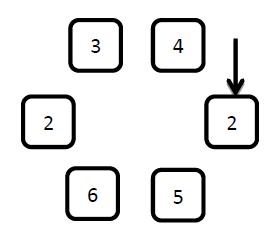
The figure above shows a Looploop of 6 elments. Let's assuming the preset parameter k1 is 3, and k2 is 4.
XXX can do six operations with the toy.
1: add x
Starting from the arrow pointed element, add x to the number on the clockwise first k2 elements.
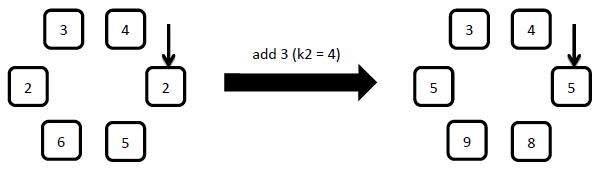
2: reverse
Starting from the arrow pointed element, reverse the first k1 clockwise elements.
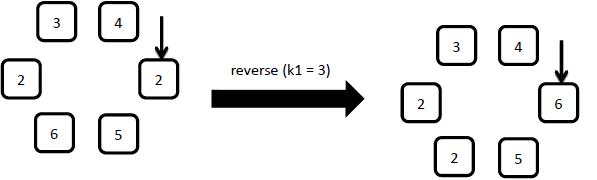
3: insert x
Insert a new element with number x to the right (along clockwise) of the arrow pointed element.
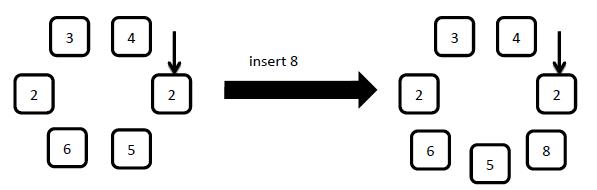
4: delete
Delete the element the arrow pointed and then move the arrow to the right element.
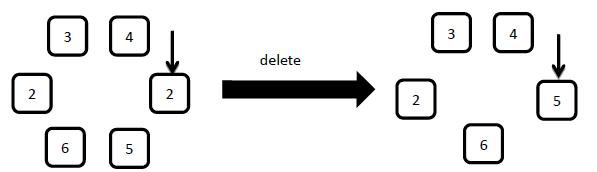
5: move x
x can only be 1 or 2. If x = 1 , move the arrow to the left(along the counterclockwise) element, if x = 2 move the arrow to the right element.
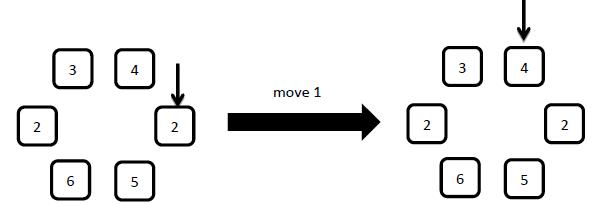
6: query
Output the number on the arrow pointed element in one line.
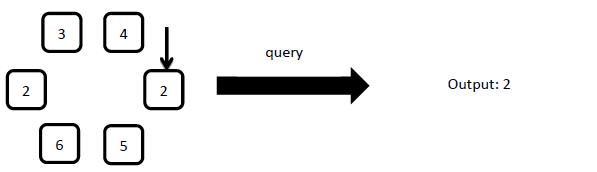
XXX wants to give answers to every query in a serial of operations.
For each test case the first line contains N,M,k1,k2(2≤k1<k2≤N≤105, M≤105) indicating the initial number of elements, the total number of operations XXX will do and the two preset parameters of the toy.
Second line contains N integers ai(-104≤ai≤104) representing the N numbers on the elements in Looploop along clockwise direction. The arrow points to first element in input at the beginning.
Then m lines follow, each line contains one of the six operations described above.
It is guaranteed that the "x" in the "add","insert" and "move" operations is always integer and its absolute value ≤104. The number of elements will never be less than N during the operations.
The input ends with a line of 0 0 0 0.
3 4 5 6 7
query
5 13 2 4
1 2 3 4 5
move 2
query
insert 8
reverse
query
add 2
query
move 1
query
move 1
query
delete
query
0 0 0 0
题意很简单,就像题目中 图片中描述的一样。Splay大法好啊。
 #include <cstdio>

 #include <cstdlib>

 #include <cstring>

 #include <algorithm>

 using namespace std;

 const int inf = 0x3f3f3f3f;

 const int maxn = ;

 int pre[maxn],ch[maxn][],key[maxn],addv[maxn],rev[maxn],siz[maxn];

 int tot1,tot2,root,s[maxn];  //s为内存池

 int a[maxn],n,m,k1,k2;

 void update_add(int r,int val)

 {

     if (!r)

         return;

     key[r] += val;

     addv[r] += val;

 }

 void update_rev(int r)

 {

     if (!r)

         return;

     swap(ch[r][],ch[r][]);

     rev[r] ^= ;

 }

 void push_down(int r)

 {

     if (rev[r])

     {

         update_rev(ch[r][]);

         update_rev(ch[r][]);

         rev[r] = ;

     }

     if (addv[r])

     {

         update_add(ch[r][],addv[r]);

         update_add(ch[r][],addv[r]);

         addv[r] = ;

     }

 }

 void push_up(int r)

 {

     siz[r] = siz[ch[r][]] + siz[ch[r][]] + ;

 }

 void NewNode (int &r,int father,int k)

 {

     if (tot2)

         r = s[tot2--];

     else

         r = ++tot1;

     pre[r] = father;

     siz[r] = ;

     rev[r] = ;

     addv[r] = ;

     ch[r][] = ch[r][] = ;

     key[r] = k;

 }

 void build(int &x,int l,int r,int father)

 {

     if (l > r)

         return ;

     int mid = (l + r) >> ;

     NewNode(x,father,a[mid]);

     build(ch[x][],l,mid-,x);

     build(ch[x][],mid+,r,x);

     push_up(x);

 }

 void init()

 {

     tot1 = tot2 = root = ;

     for (int i = ; i <= n; i++)

         scanf ("%d",a+i);

     NewNode(root,,inf);

     NewNode(ch[root][],root,inf);

     build(ch[ch[root][]][],,n,ch[root][]);

     push_up(root);

     push_up(ch[root][]);

 }

 void Rotate(int r,int kind)

 {

     int y = pre[r];

     push_down(y);

     push_down(r);

     ch[y][!kind] = ch[r][kind];

     pre[ch[r][kind]] = y;

     if (pre[y])

         ch[pre[y]][ch[pre[y]][] == y] = r;

     ch[r][kind] = y;

     pre[r] = pre[y];

     pre[y] = r;

     push_up(y);

 }

 void Splay(int r,int goal)

 {

     push_down(r);

     while (pre[r] != goal)

     {

         if (pre[pre[r]] == goal)

         {

             push_down(pre[r]);

             push_down(r);

             Rotate(r,ch[pre[r]][] == r);

         }

         else

         {

             int y = pre[r];

             int kind = (ch[pre[y]][] == y);

             push_down(pre[y]);

             push_down(y);

             push_down(r);

             if (ch[y][kind] == r)

             {

                 Rotate(y,!kind);

                 Rotate(r,!kind);

             }

             else

             {

                 Rotate(r,kind);

                 Rotate(r,!kind);

             }

         }

     }

     push_up(r);

     if (goal == )

         root = r;

 }

 int Get_kth(int r,int k)

 {

     push_down(r);

     int t = siz[ch[r][]] + ;

     if (t == k)

         return r;

     if (t > k)

         return Get_kth(ch[r][],k);

     else

         return Get_kth(ch[r][],k-t);

 }

 void ADD(int x)

 {

     Splay (Get_kth(root,),);

     Splay(Get_kth(root,k2+),root);

     update_add(ch[ch[root][]][],x);

     push_up(ch[root][]);

     push_up(root);

 }

 void Reverse(int u,int v)

 {

     Splay(Get_kth(root,u),);

     Splay(Get_kth(root,v+),root);

     update_rev(ch[ch[root][]][]);

     push_up(ch[root][]);

     push_up(root);

 }

 void Insert(int x)

 {

     Splay(Get_kth(root,),);

     Splay(Get_kth(root,),root);

     NewNode(ch[ch[root][]][],ch[root][],x);

     push_up(ch[root][]);

     push_up(root);

 }

 void eraser(int r)

 {

     if (!r)

         return;

     s[++tot2] = r;

     eraser(ch[r][]);

     eraser(ch[r][]);

 }

 void Delete()

 {

     Splay(Get_kth(root,),);

     Splay(Get_kth(root,),root);

     eraser(ch[ch[root][]][]);

     pre[ch[ch[root][]][]] = ;

     ch[ch[root][]][] = ;

     push_up(ch[root][]);

     push_up(root);

 }

 void Move(int x)               //Move操作就是两个 区间reverse操作。

 {

     if (x == )

     {

         Reverse(,n);

         Reverse(,n);

     }

     if (x == )

     {

         Reverse(,n);

         Reverse(,n-);

     }

 }

 int query()

 {

     Splay(Get_kth(root,),);

     Splay(Get_kth(root,),root);

     return key[ch[ch[root][]][]];

 }

 int main(void)

 {

     #ifndef ONLINE_JUDGE

         freopen("in.txt","r",stdin);

     #endif

     int cas = ;

     while (~scanf ("%d%d%d%d",&n,&m,&k1,&k2))

     {

         if (n ==  && m ==  && k1 ==  && k2 == )

             break;

         printf("Case #%d:\n",cas++);

         init();

         for (int i = ; i < m; i++)

         {

             char op[];

             int x;

             scanf ("%s",op);

             if (op[] == 'a')

             {

                 scanf ("%d",&x);

                 ADD(x);

             }

             if (op[] == 'r')

                 Reverse(,k1);

             if (op[] == 'i')

             {

                 scanf ("%d",&x);

                 Insert(x);

                 n++;           // insert一个数  n自然加1

             }

             if (op[] == 'd')

             {

                 Delete();

                 n--;          //delete一个数 n减1

             }

             if (op[] == 'm')

             {

                 scanf ("%d",&x);

                 Move(x);

             }

             if (op[] == 'q')

                 printf("%d\n",query());

         }

     }

     return ;

 }
HDU4453--Looploop (Splay伸展树)的更多相关文章
- Splay伸展树学习笔记
Splay伸展树 有篇Splay入门必看文章 —— CSDN链接 经典引文 空间效率:O(n) 时间效率:O(log n)插入.查找.删除 创造者:Daniel Sleator 和 Robert Ta ...
- 【学时总结】◆学时·VI◆ SPLAY伸展树
◆学时·VI◆ SPLAY伸展树 平衡树之多,学之不尽也…… ◇算法概述 二叉排序树的一种,自动平衡,由 Tarjan 提出并实现.得名于特有的 Splay 操作. Splay操作:将节点u通过单旋. ...
- Splay 伸展树
废话不说,有篇论文可供参考:杨思雨:<伸展树的基本操作与应用> Splay的好处可以快速分裂和合并. ===============================14.07.26更新== ...
- [Splay伸展树]splay树入门级教程
首先声明,本教程的对象是完全没有接触过splay的OIer,大牛请右上角.. 首先引入一下splay的概念,他的中文名是伸展树,意思差不多就是可以随意翻转的二叉树 PS:百度百科中伸展树读作:BoGa ...
- Splay伸展树入门(单点操作,区间维护)附例题模板
Pps:终于学会了伸展树的区间操作,做一个完整的总结,总结一下自己的伸展树的单点操作和区间维护,顺便给未来的自己总结复习用. splay是一种平衡树,[平均]操作复杂度O(nlogn).首先平衡树先是 ...
- Codeforces 675D Tree Construction Splay伸展树
链接:https://codeforces.com/problemset/problem/675/D 题意: 给一个二叉搜索树,一开始为空,不断插入数字,每次插入之后,询问他的父亲节点的权值 题解: ...
- UVA 11922 Permutation Transformer —— splay伸展树
题意:根据m条指令改变排列1 2 3 4 … n ,每条指令(a, b)表示取出第a~b个元素,反转后添加到排列尾部 分析:用一个可分裂合并的序列来表示整个序列,截取一段可以用两次分裂一次合并实现,粘 ...
- [算法] 数据结构 splay(伸展树)解析
前言 splay学了已经很久了,只不过一直没有总结,鸽了好久来写一篇总结. 先介绍 splay:亦称伸展树,为二叉搜索树的一种,部分操作能在 \(O( \log n)\) 内完成,如插入.查找.删除. ...
- HDU 4453 Looploop (伸展树splay tree)
Looploop Time Limit: 2000/1000 MS (Java/Others) Memory Limit: 32768/32768 K (Java/Others)Total Su ...
- ZOJ3765---Lights (Splay伸展树)
Lights Time Limit: 8 Seconds Memory Limit: 131072 KB Now you have N lights in a line. Don't wor ...
随机推荐
- UVa 10048: Audiophobia
这道题要求我们求出图中的给定的两个节点(一个起点一个终点,但这是无向图)之间所有“路径中最大权值”的最小值,这无疑是动态规划. 我开始时想到根据起点和终点用动态规划直接求结果,但最终由于题中S过大,会 ...
- 【转】ASP.NET MVC框架下使用MVVM模式-KnockOutJS+JQ模板例子
KnockOutJS学习系列----(一) 好几个月没去写博客了,最近也是因为项目紧张,不过这个不是借口,J. 很多时候可能是因为事情一多,然后没法静下来心来去写点东西,学点东西. 也很抱歉,突然看到 ...
- C++编程规范之12:懂得何时和如何进行并发性编程
摘要: 如果应用程序使用了多个线程或者进程,应该知道如何尽量减少共享对象,以及如何安全地共享必须共享的对象. 在多线程和并发编程中最重要的是要避免死锁.活锁和恶性的竞争条件. 在编写多线程程序时要注意 ...
- Eclipse中设置编码的方式
如果要使插件开发应用能有更好的国际化支持,能够最大程度的支持中文输出,则最好使 Java文件使用UTF-8编码.然而,Eclipse工 作空间(workspace)的缺省字符编码是操作系统缺省的编码, ...
- android工程gen目录中R.java包名是怎么确定
新建一个工程,包名用的com.mythroad.adskiller, 后来觉得不好,又改成com.mythroad.adsinscepter,但是我发现gen下的R.java文件的包名还是原来的com ...
- leetcodequestion_56 Merge Intervals
Given a collection of intervals, merge all overlapping intervals. For example, Given [1,3],[2,6],[8, ...
- Swift之高德地图自定义标注弹出气泡样式
在用到地图类的sdk,sdk自带的样式必定不能满足开发者的需求,于是开发者不得不进行自定义,由于官方同样是object-c 版语法,不得不将其转为swift语法,以满足项目需求. 新建两个类 Cust ...
- (转)检测到在集成的托管管道模式下不适用的ASP.NET设置的解决方法(转)
我们将ASP.NET程序从IIS6移植到IIS7,可能运行提示以下错误: HTTP 错误 500.23 - Internal Server Error 检测到在集成的托管管道模式下不适用的 ASP.N ...
- Java(TM) SE Development Kit 6 卸载不掉怎么办
错误描述:Java 安装时断电,再次安装java时,提示“您的电脑上已经安装了此软件.是否要重新安装”,点“是”后出现“内部错误2753:RegUtils”,点“确定”又出现上述提示. 解决办法 :使 ...
- 一步一步教你使用Git
一步一步教你使用Git 互联网给我们带来方便的同时,也时常让我们感到困惑.随便搜搜就出一大堆结果,然而总是有大量的重复和错误.小妖发出的内容,都是自己实测过的,有问题请留言. 现在,你已经安装了Git ...