
Focal Loss笔记
论文:《Focal Loss for Dense Object Detection》
Focal Loss 是何恺明设计的为了解决one-stage目标检测在训练阶段前景类和背景类极度不均衡(如1:1000)的场景的损失函数。它是由二分类交叉熵改造而来的。
标准交叉熵

其中,p是模型预测属于类别y=1的概率。为了方便标记,定义:
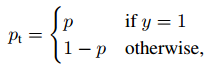
交叉熵CE重写为:

α-平衡交叉熵:
有一种解决类别不平衡的方法是引入一个值介于[0; 1]之间的权重因子α:当y=1时,取α; 当y=0时,取1-α。
这种方法,当y=0(即背景类)时,随着α的增大,会对损失进行很大惩罚(降低权重),从而减轻背景类
太多对训练的影响。
类似Pt,可将α-CE重写为:

Focal Loss定义
虽然α-CE起到了平衡正负样本的在损失函数值中的贡献,但是它没办法区分难易样本的样本对损失的贡献。因此就有了Focal Loss,定义如下:

其中,alpha和gamma均为可以调节的超参数。y'为模型预测,其值介于(0-1)之间。
当y=1时,y'->1,表示easy positive,它对权重的贡献->0;
当y=0是,y'->0,表示easy negative,它对权重的贡献->0.
因此,Focal Loss不仅降低了背景类的权重,还降低了easy positive/negative的权重。
gamma是对损失函数的调节,当gamma=0是,Focal Loss与α-CE等价。以下是gamma
对Focal Loss的调节。

Focal Loss的Pytorch实现(蓝色字体)
以下Focal Loss=Focal Loss + Regress Loss;
代码来自:https://github.com/yhenon/pytorch-retinanet
 import numpy as np

 import torch

 import torch.nn as nn

 def calc_iou(a, b):

     area = (b[:, 2] - b[:, 0]) * (b[:, 3] - b[:, 1])

     iw = torch.min(torch.unsqueeze(a[:, 2], dim=1), b[:, 2]) - torch.max(torch.unsqueeze(a[:, 0], 1), b[:, 0])

     ih = torch.min(torch.unsqueeze(a[:, 3], dim=1), b[:, 3]) - torch.max(torch.unsqueeze(a[:, 1], 1), b[:, 1])

     iw = torch.clamp(iw, min=0)

     ih = torch.clamp(ih, min=0)

     ua = torch.unsqueeze((a[:, 2] - a[:, 0]) * (a[:, 3] - a[:, 1]), dim=1) + area - iw * ih

     ua = torch.clamp(ua, min=1e-8)

     intersection = iw * ih

     IoU = intersection / ua

     return IoU

 class FocalLoss(nn.Module):

     #def __init__(self):

     def forward(self, classifications, regressions, anchors, annotations):

         alpha = 0.25

         gamma = 2.0

         batch_size = classifications.shape[0]

         classification_losses = []

         regression_losses = []

         anchor = anchors[0, :, :]

         anchor_widths  = anchor[:, 2] - anchor[:, 0]

         anchor_heights = anchor[:, 3] - anchor[:, 1]

         anchor_ctr_x   = anchor[:, 0] + 0.5 * anchor_widths

         anchor_ctr_y   = anchor[:, 1] + 0.5 * anchor_heights

         for j in range(batch_size):

             classification = classifications[j, :, :]

             regression = regressions[j, :, :]

             bbox_annotation = annotations[j, :, :]

             bbox_annotation = bbox_annotation[bbox_annotation[:, 4] != -1]

             if bbox_annotation.shape[0] == 0:

                 regression_losses.append(torch.tensor(0).float().cuda())

                 classification_losses.append(torch.tensor(0).float().cuda())

                 continue

             classification = torch.clamp(classification, 1e-4, 1.0 - 1e-4)

             IoU = calc_iou(anchors[0, :, :], bbox_annotation[:, :4]) # num_anchors x num_annotations

             IoU_max, IoU_argmax = torch.max(IoU, dim=1) # num_anchors x 1

             #import pdb

             #pdb.set_trace()

             # compute the loss for classification

             targets = torch.ones(classification.shape) * -1

             targets = targets.cuda()

             targets[torch.lt(IoU_max, 0.4), :] = 0

             positive_indices = torch.ge(IoU_max, 0.5)

             num_positive_anchors = positive_indices.sum()

             assigned_annotations = bbox_annotation[IoU_argmax, :]

             targets[positive_indices, :] = 0

             targets[positive_indices, assigned_annotations[positive_indices, 4].long()] = 1

             alpha_factor = torch.ones(targets.shape).cuda() * alpha

             alpha_factor = torch.where(torch.eq(targets, 1.), alpha_factor, 1. - alpha_factor)

 82             focal_weight = torch.where(torch.eq(targets, 1.), 1. - classification, classification)

 83             focal_weight = alpha_factor * torch.pow(focal_weight, gamma)

 84

 85             bce = -(targets * torch.log(classification) + (1.0 - targets) * torch.log(1.0 - classification))

 86

 87             # cls_loss = focal_weight * torch.pow(bce, gamma)

 88             cls_loss = focal_weight * bce

 89

 90             cls_loss = torch.where(torch.ne(targets, -1.0), cls_loss, torch.zeros(cls_loss.shape).cuda())


             classification_losses.append(cls_loss.sum()/torch.clamp(num_positive_anchors.float(), min=1.0))

             # compute the loss for regression

             if positive_indices.sum() > 0:

                 assigned_annotations = assigned_annotations[positive_indices, :]

                 anchor_widths_pi = anchor_widths[positive_indices]

                 anchor_heights_pi = anchor_heights[positive_indices]

                 anchor_ctr_x_pi = anchor_ctr_x[positive_indices]

                 anchor_ctr_y_pi = anchor_ctr_y[positive_indices]

                 gt_widths  = assigned_annotations[:, 2] - assigned_annotations[:, 0]

                 gt_heights = assigned_annotations[:, 3] - assigned_annotations[:, 1]

                 gt_ctr_x   = assigned_annotations[:, 0] + 0.5 * gt_widths

                 gt_ctr_y   = assigned_annotations[:, 1] + 0.5 * gt_heights

                 # clip widths to 1

                 gt_widths  = torch.clamp(gt_widths, min=1)

                 gt_heights = torch.clamp(gt_heights, min=1)

                 targets_dx = (gt_ctr_x - anchor_ctr_x_pi) / anchor_widths_pi

                 targets_dy = (gt_ctr_y - anchor_ctr_y_pi) / anchor_heights_pi

                 targets_dw = torch.log(gt_widths / anchor_widths_pi)

                 targets_dh = torch.log(gt_heights / anchor_heights_pi)

                 targets = torch.stack((targets_dx, targets_dy, targets_dw, targets_dh))

                 targets = targets.t()

                 targets = targets/torch.Tensor([[0.1, 0.1, 0.2, 0.2]]).cuda()

                 negative_indices = 1 - positive_indices

                 regression_diff = torch.abs(targets - regression[positive_indices, :])

                 regression_loss = torch.where(

                     torch.le(regression_diff, 1.0 / 9.0),

                     0.5 * 9.0 * torch.pow(regression_diff, 2),

                     regression_diff - 0.5 / 9.0

                 )

                 regression_losses.append(regression_loss.mean())

             else:

                 regression_losses.append(torch.tensor(0).float().cuda())

 return torch.stack(classification_losses).mean(dim=0, keepdim=True), torch.stack(regression_losses).mean(dim=0, keepdim=True)
Focal Loss笔记的更多相关文章
- 论文阅读笔记四十四:RetinaNet:Focal Loss for Dense Object Detection(ICCV2017)
论文原址:https://arxiv.org/abs/1708.02002 github代码:https://github.com/fizyr/keras-retinanet 摘要 目前,具有较高准确 ...
- 深度学习笔记(八)Focal Loss
论文:Focal Loss for Dense Object Detection 论文链接:https://arxiv.org/abs/1708.02002 一. 提出背景 object detect ...
- 目标检测 | RetinaNet:Focal Loss for Dense Object Detection
论文分析了one-stage网络训练存在的类别不平衡问题,提出能根据loss大小自动调节权重的focal loss,使得模型的训练更专注于困难样本.同时,基于FPN设计了RetinaNet,在精度和速 ...
- Focal Loss理解
1. 总述 Focal loss主要是为了解决one-stage目标检测中正负样本比例严重失衡的问题.该损失函数降低了大量简单负样本在训练中所占的权重,也可理解为一种困难样本挖掘. 2. 损失函数形式 ...
- Focal Loss
为了有效地同时解决样本类别不均衡和苦难样本的问题,何凯明和RGB以二分类交叉熵为例提出了一种新的Loss----Focal loss 原始的二分类交叉熵形式如下: Focal Loss形式如下: 上式 ...
- Focal Loss(RetinaNet) 与 OHEM
Focal Loss for Dense Object Detection-RetinaNet YOLO和SSD可以算one-stage算法里的佼佼者,加上R-CNN系列算法,这几种算法可以说是目标检 ...
- Focal Loss for Dense Object Detection 论文阅读
何凯明大佬 ICCV 2017 best student paper 作者提出focal loss的出发点也是希望one-stage detector可以达到two-stage detector的准确 ...
- Focal Loss 的前向与后向公式推导
把Focal Loss的前向和后向进行数学化描述.本文的公式可能数学公式比较多.本文尽量采用分解的方式一步一步的推倒.达到能易懂的目的. Focal Loss 前向计算 其中 是输入的数据 是输入的标 ...
- focal loss和ohem
公式推导:https://github.com/zimenglan-sysu-512/paper-note/blob/master/focal_loss.pdf 使用的代码:https://githu ...
随机推荐
- 【BZOJ4035】数组游戏(博弈论)
[BZOJ4035]数组游戏(博弈论) 题面 BZOJ 洛谷 题解 很明显是一个翻硬币游戏的变形,因此当前局面的\(SG\)函数值就是所有白格子单独存在的\(SG\)函数的异或和. 那么,对于每一个位 ...
- BZOJ 3527 力 | FFT
BZOJ 3527 力 | 分治 题意 给出数组q,$E_i = \sum_{i < j} \frac{q_i}{(i - j) ^ 2} - \sum_{i > j} \frac{q_i ...
- uoj35 后缀排序
题目链接:http://uoj.ac/problem/35 这是一道模板题. 读入一个长度为 n 的由小写英文字母组成的字符串,请把这个字符串的所有非空后缀按字典序从小到大排序,然后按顺序输出后缀的第 ...
- KEIL工程中头文件包含的一些小记
@2018-4-25 11:02:27 > 源文件包含自身头文件无须指出其路径
- 解题:USACO13FEB Taxi
题面 因为每次只能载一头牛,所以总路程=每头牛的距离+回头路的最短距离,于是问题变成了如何求回头路的最短距离 我们可以把起点和终点存在两个数组里,然后将两个数组排序后取对应位置相减的绝对值就是每次走回 ...
- HTTP状态码的含义: 200:400:403:404:408:500:503:504
http协议的状态码 1xx(临时响应) 表示临时响应并需要请求者继续执行操作的状态码. 100(继续) 请求者应当继续提出请求.服务器返回此代码表示已收到请求的第一部分,正在等待其余部分. 101( ...
- cpplint
Cpplint是一个Python脚本,作为一款开源免费的代码静态检测工具,Google也使用它作为自己的C++代码检测工具,也就是说,只要你的代码遵从Google C++代码规范,那么Cpplint将 ...
- Hibernate中常见问题 No row with the given identifier exists问题
收集:Hibernate中常见问题 No row with the given identifier exists问题的原因及解决 2007年11月21日 15:02:00 eyejava 阅读数:2 ...
- jquery如何实现点击LI标签和下面的LI互换顺序? 超简单代码
转: jquery如何实现点击LI标签和下面的LI互换顺序? 上面的效果涉及jquery的两个方法: next() : 获得匹配元素集合中每个元素紧邻的下一个同胞元素. after() :在被选元 ...
- D. Petya and Array 树状数组
题意: 给出一个数组,元素有正有负有0,问其区间和小于 t 的子区间的个数. sum[ r ]-sum[ l-1 ]<t,其中sum是a的前缀和. 实现的方法就是从前往后对于每一个sum[ i ...