
TensorFlow使用记录 (六): 优化器
0. tf.train.Optimizer
tensorflow 里提供了丰富的优化器,这些优化器都继承与 Optimizer 这个类。class Optimizer 有一些方法,这里简单介绍下:
0.1. minimize
minimize(

    loss,

    global_step=None,

    var_list=None,

    gate_gradients=GATE_OP,

    aggregation_method=None,

    colocate_gradients_with_ops=False,

    name=None,

    grad_loss=None

)
- loss: A Tensor containing the value to minimize.
- global_step: Optional Variable to increment by one after the variables have been updated.
- var_list: Optional list or tuple of Variable objects to update to minimize loss. Defaults to the list of variables collected in the graph under the key GraphKeys.TRAINABLE_VARIABLES.
- gate_gradients: How to gate the computation of gradients. Can be GATE_NONE, GATE_OP, orGATE_GRAPH.
- aggregation_method: Specifies the method used to combine gradient terms. Valid values are defined in the class AggregationMethod.
- colocate_gradients_with_ops: If True, try colocating gradients with the corresponding op.
- name: Optional name for the returned operation.
- grad_loss: Optional. A Tensor holding the gradient computed for loss.
compute_gradients(

    loss,

    var_list=None,

    gate_gradients=GATE_OP,

    aggregation_method=None,

    colocate_gradients_with_ops=False,

    grad_loss=None

)
这是优化 minimize() 的第一步,计算梯度,返回 (gradient, variable) 列表。
0.3. apply_gradients
apply_gradients(

    grads_and_vars,

    global_step=None,

    name=None

)
这是优化 minimize() 的第二步,返回一个执行梯度更新的 ops。
TensorFlow使用记录 (八): 梯度修剪 就用到了这两个函数。
1. tf.train.GradientDescentOptimizer
__init__(

    learning_rate,

    use_locking=False,

    name='GradientDescent'

)
\begin{equation}
\label{a}
\theta \gets \theta - \eta \nabla_{\theta}J(\theta)
\end{equation}
标准的梯度下降法优化器。
Recall that Gradient Descent simply updates the weights $\theta$ by directly subtracting the gradient of the cost function $J(\theta)$ with regards to the weights ($\nabla_{\theta}J(\theta)$) multiplied by the learning rate $\eta$. It does not care about what the earlier gradients were. If the local gradient is tiny, it goes very slowly.
2. tf.train.MomentumOptimizer
__init__(

    learning_rate,

    momentum,

    use_locking=False,

    name='Momentum',

    use_nesterov=False

)
Momentum optimization cares a great deal about what previous gradients were: at each iteration, it adds the local gradient to the momentum vector m (multiplied by the learning rate $\eta$), and it updates the weights by simply subtracting this momentum vector.
\begin{equation}
\label{b}
\begin{split}
& \mathbf{m} \gets \beta \mathbf{m} + \eta \nabla_{\theta}J(\theta) \\
& \theta \gets \theta - \mathbf{m}
\end{split}
\end{equation}
调用方式:
optimizer = tf.train.MomentumOptimizer(learning_rate=learning_rate, momentum=0.9)
除了标准的 MomentumOptimizer 外,还有一个变体 Nesterov Accelerated Gradient:
The idea of Nesterov Momentum optimization, or Nesterov Accelerated Gradient (NAG), is to measure the gradient of the cost function not at the local position but slightly ahead in the direction of the momentum.
\begin{equation}
\label{c}
\begin{split}
& \mathbf{m} \gets \beta \mathbf{m} + \eta \nabla_{\theta}J(\theta + \beta \mathbf{m}) \\
& \theta \gets \theta - \mathbf{m}
\end{split}
\end{equation}
调用方式:
optimizer = tf.train.MomentumOptimizer(learning_rate=learning_rate, momentum=0.9, use_nesterov=True)
3. tf.train.AdagradOptimizer
__init__(

    learning_rate,

    initial_accumulator_value=0.1,

    use_locking=False,

    name='Adagrad'

)
\begin{equation}
\label{d}
\begin{split}
& \mathbf{s} \gets \mathbf{s} + \nabla_{\theta}J(\theta) \otimes \nabla_{\theta}J(\theta) \\
& \theta \gets \theta - \eta \nabla_{\theta}J(\theta) \oslash \sqrt{\mathbf{s} + \epsilon}
\end{split}
\end{equation}
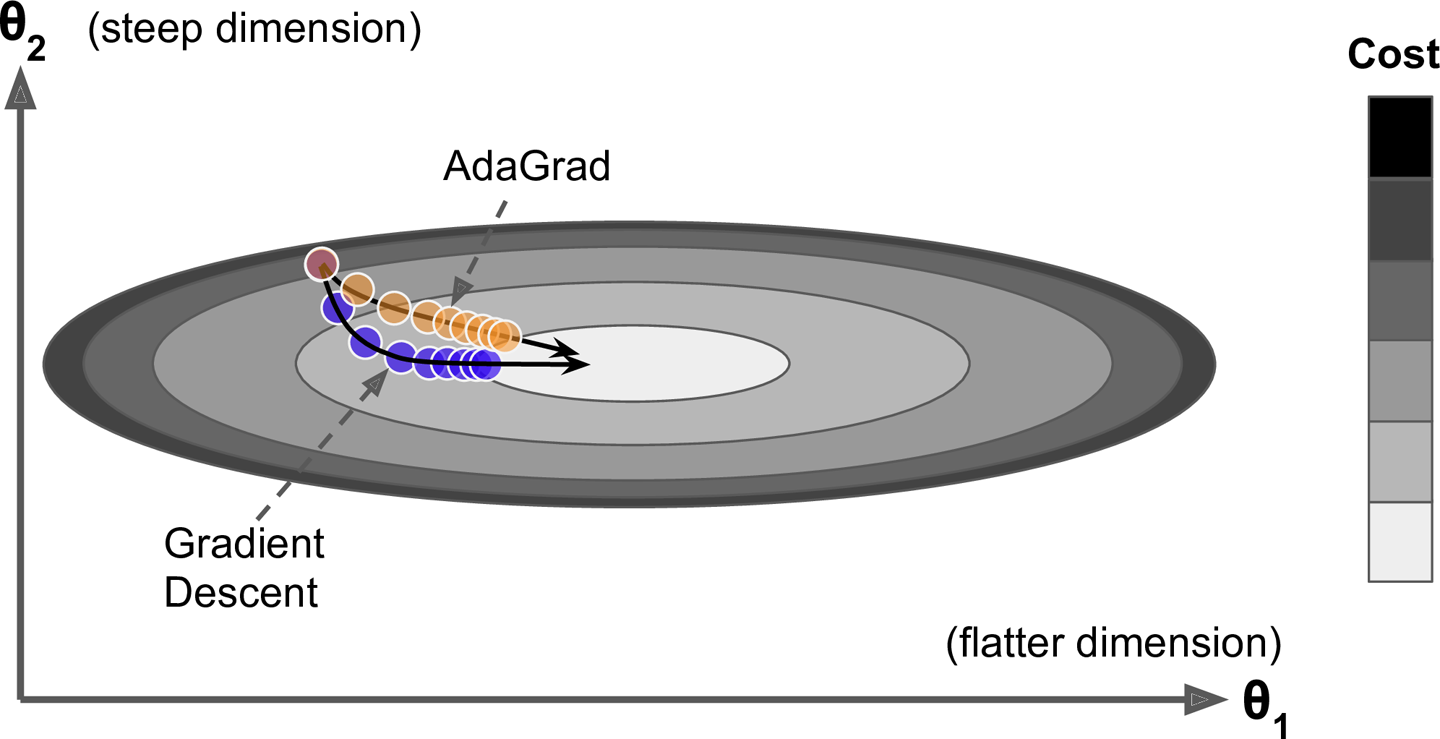
The first step accumulates the square of the gradients into the vector $\mathbf{s}$ (the $\otimes$ symbol represents the element-wise multiplication). This vectorized form is equivalent to computing $s_i \gets s_i + (\partial / \partial \theta_i J(\theta))^2$ for each element $s_i$ of the vector $\mathbf{s}$; in other words, each $s_i$ accumulates the squares of the partial derivative of the cost function with regards to parameter $\theta_i$. If the cost function is steep along the ith dimension, then $s_i$ will get larger and larger at each iteration.
The second step is almost identical to Gradient Descent, but with one big difference: the gradient vector is scaled down by a factor of $\sqrt{\mathbf{s} + \epsilon}$ (the $\oslash$ symbol represents the element-wise division, and $\epsilon$ is a smoothing term to avoid division by zero, typically set to $10^{-10}$). This vectorized form is equivalent to computing $θ_i \gets θ_i − \eta \partial / \partial θ_i J(θ) / \sqrt{\mathbf{s_i} + \epsilon}$ for all parameters $\theta_i$ (simultaneously).
In short, this algorithm decays the learning rate, but it does so faster for steep dimensions than for dimensions with gentler slopes. This is called an adaptive learning rate. It helps point the resulting updates more directly toward the global optimum. One additional benefit is that it requires much less tuning of the learning rate hyperparameter $\eta$.
调用方式:
optimizer = tf.train.AdagradOptimizer(learning_rate=learning_rate)
不推荐使用:
AdaGrad often performs well for simple quadratic problems, but unfortunately it often stops too early when training neural networks. The learning rate gets scaled down so much that the algorithm ends up stopping entirely before reaching the global optimum. So even though TensorFlow has an AdagradOptimizer, you should not use it to train deep neural networks (it may be efficient for simpler tasks such as Linear Regression, though).
4. tf.train.RMSPropOptimizer
__init__(

    learning_rate,

    decay=0.9,

    momentum=0.0,

    epsilon=1e-10,

    use_locking=False,

    centered=False,

    name='RMSProp'

)
Although AdaGrad slows down a bit too fast and ends up never converging to the global optimum, the RMSProp algorithm14 fixes this by accumulating only the gradients from the most recent iterations (as opposed to all the gradients since the beginning of training). It does so by using exponential decay in the first step.
\begin{equation}
\label{e}
\begin{split}
& \mathbf{s} \gets \beta \mathbf{s} + (1 - \beta) \nabla_{\theta}J(\theta) \otimes \nabla_{\theta}J(\theta) \\
& \theta \gets \theta - \eta \nabla_{\theta}J(\theta) \oslash \sqrt{\mathbf{s} + \epsilon}
\end{split}
\end{equation}
The decay rate $\beta$ is typically set to 0.9. Yes, it is once again a new hyperparameter, but this default value often works well, so you may not need to tune it at all.
调用方式:
optimizer = tf.train.RMSPropOptimizer(learning_rate=learning_rate,

                                      momentum=0.9, decay=0.9, epsilon=1e-10)
Except on very simple problems, this optimizer almost always performs much better than AdaGrad. It also generally performs better than Momentum optimization and Nesterov Accelerated Gradients. In fact, it was the preferred optimization algorithm of many researchers until Adam optimization came around.
5. tf.train.AdamOptimizer
__init__(

    learning_rate=0.001,

    beta1=0.9,

    beta2=0.999,

    epsilon=1e-08,

    use_locking=False,

    name='Adam'

)
Adam, which stands for adaptive moment estimation, combines the ideas of Momentum optimization and RMSProp: just like Momentum optimization it keeps track of an exponentially decaying average of past gradients, and just like RMSProp it keeps track of an exponentially decaying average of past squared gradients
\begin{equation}
\label{f}
\begin{split}
& \mathbf{m} \gets \beta_1 \mathbf{m} + (1 - \beta_1) \nabla_{\theta}J(\theta) \\
& \mathbf{s} \gets \beta_2 \mathbf{s} + (1 - \beta_2) \nabla_{\theta}J(\theta) \otimes \nabla_{\theta}J(\theta) \\
& \mathbf{m} \gets \frac{\mathbf{m}}{1 - \beta_1^t} \\
& \mathbf{s} \gets \frac{\mathbf{s}}{1 - \beta_2^t} \\
& \theta \gets \theta - \eta \mathbf{m} \oslash \sqrt{\mathbf{s} + \epsilon}
\end{split}
\end{equation}
$t$ is time step. The momentum decay hyperparameter $\beta_1$ is typically initialized to 0.9, while the scaling decay hyperparameter $\beta_2$ is often initialized to 0.999. As earlier, the smoothing term $\epsilon$ is usually initialized to a tiny number such as $10^{–8}$
调用方式:
optimizer = tf.train.AdamOptimizer(learning_rate=learning_rate)
6. tf.train.FtrlOptimizer
__init__(

    learning_rate,

    learning_rate_power=-0.5,

    initial_accumulator_value=0.1,

    l1_regularization_strength=0.0,

    l2_regularization_strength=0.0,

    use_locking=False,

    name='Ftrl',

    accum_name=None,

    linear_name=None,

    l2_shrinkage_regularization_strength=0.0

)
See this paper. This version has support for both online L2 (the L2 penalty given in the paper above) and shrinkage-type L2 (which is the addition of an L2 penalty to the loss function).
TensorFlow使用记录 (六): 优化器的更多相关文章
- tensorflow的几种优化器
最近自己用CNN跑了下MINIST,准确率很低(迭代过程中),跑了几个epoch,我就直接stop了,感觉哪有问题,随即排查了下,同时查阅了网上其他人的blog,并没有发现什么问题 之后copy了一篇 ...
- tensorflow API _ 4 (优化器配置)
"""Configures the optimizer used for training. Args: learning_rate: A scalar or `Tens ...
- Tensorflow 中的优化器解析
Tensorflow:1.6.0 优化器(reference:https://blog.csdn.net/weixin_40170902/article/details/80092628) I: t ...
- TensorFlow从0到1之TensorFlow优化器(13)
高中数学学过,函数在一阶导数为零的地方达到其最大值和最小值.梯度下降算法基于相同的原理,即调整系数(权重和偏置)使损失函数的梯度下降. 在回归中,使用梯度下降来优化损失函数并获得系数.本节将介绍如何使 ...
- TensorFlow优化器及用法
TensorFlow优化器及用法 函数在一阶导数为零的地方达到其最大值和最小值.梯度下降算法基于相同的原理,即调整系数(权重和偏置)使损失函数的梯度下降. 在回归中,使用梯度下降来优化损失函数并获得系 ...
- Tensorflow 2.0 深度学习实战 —— 详细介绍损失函数、优化器、激活函数、多层感知机的实现原理
前言 AI 人工智能包含了机器学习与深度学习,在前几篇文章曾经介绍过机器学习的基础知识,包括了监督学习和无监督学习,有兴趣的朋友可以阅读< Python 机器学习实战 >.而深度学习开始只 ...
- DNN网络(三)python下用Tensorflow实现DNN网络以及Adagrad优化器
摘自: https://www.kaggle.com/zoupet/neural-network-model-for-house-prices-tensorflow 一.实现功能简介: 本文摘自Kag ...
- tensorflow优化器-【老鱼学tensorflow】
tensorflow中的优化器主要是各种求解方程的方法,我们知道求解非线性方程有各种方法,比如二分法.牛顿法.割线法等,类似的,tensorflow中的优化器也只是在求解方程时的各种方法. 比较常用的 ...
- 莫烦大大TensorFlow学习笔记(8)----优化器
一.TensorFlow中的优化器 tf.train.GradientDescentOptimizer:梯度下降算法 tf.train.AdadeltaOptimizer tf.train.Adagr ...
随机推荐
- 并不对劲的复健训练-p5212 SubString
题目大意 有一个串\(s\),一开始只知道它的一个前缀.有\(q\)(\(q\leq 10^4\))个操作,操作有两种:1.给一个字符串,表示\(s\)(\(s\)总长\(\leq 6\times 1 ...
- java中成员变量和局部变量在内存中的分配
对于成员变量和局部变量:成员变量就是方法外部,类的内部定义的变量:局部变量就是方法或语句块内部定义的变量.局部变量必须初始化. 形式参数是局部变量,局部变量中基础数据类型的引用和值都存储在栈中,对象引 ...
- 一个小时前,美国主流媒体,头条,谷歌两位创始人突然宣布退下来,把万亿美元的帝国交给Sundar Pichai
一个小时前,美国各大主流媒体头条,谷歌两位创始人,放弃了万亿美元的帝国控制权,交给了CEO Sundar Pichai.
- O032、Nova reboot 和 lock 操作
参考https://www.cnblogs.com/CloudMan6/p/5479408.html 前面通过日志详细分析了 nova 的 launch.shutoff .start 操作. ...
- 向PHP使用Post方式上传文件
欢迎访问我的个人博客,获取更多有用的东西 链接一 链接二 也可以关注我的微信订阅号:CN丶Moti 1.post-file.html form表单提交方式一定要是post,而且添加属性enctype= ...
- postgresql与mysql 优缺点
MySQL的主要优点 (速度,流行,window,线程,事务) 1. 首先是速度,MySQL通常要比PostgreSQL快得多.MySQL自已也宣称速度是他们追求的主要目标之一,基于这个原因,MySQ ...
- Golang Gateway API 搭建教程
原文链接 随着微服务的兴起,行业里出现了非常多优秀的微服务网关框架,今天教大家搭建一套国人,用Golang写的微服务网关框架. 这里啰嗦一句,可能到今天还有人不理解什么是微服务,为什么要用微服务.目前 ...
- 解决 /etc/init.d/php-fpm no such file or directory等相关问题
vi /etc/init.d/php-fpm #! /bin/sh # Comments to support chkconfig on CentOS # chkconfig: 2345 65 37 ...
- 《Linux就该这么学》day3
ps:原谅我的书法出自鲁迅的<野草> <Linux就该这么学>书本介绍: 本书是由全国多名红帽架构师(RHCA)基于最新Linux系统共同编写的高质量Linux技术自学教程,极 ...
- markdown实现点击链接下载文件
今天用Markdown工具,需要实现一个点连接下载文件的功能,看起来很多简单我也没多想就直接写了,并且单个页面测试的时候也挺正常,就发布了,但是发布后使用的时候发现问题了,浏览器中直接点击链接没反应, ...