
skb head/data/tail/end/介绍
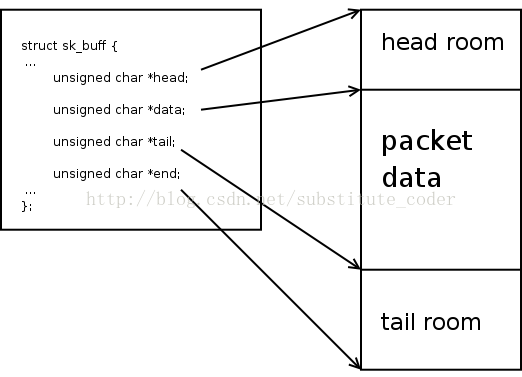
This first diagram illustrates the layoutof the SKB data area and where in that area the various pointers in 'structsk_buff' point.
The rest of this page will walk throughwhat the SKB data area looks like in a newly allocated SKB. How to modify thosepointers to add headers, add user data, and pop headers.
Also, we will discuss how page non-lineardata areas are implemented. We will also discuss how to work with them.
skb= alloc_skb(len, GFP_KERNEL);
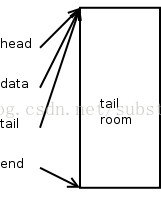
As you can see, the head, data, and tailpointers all point to the beginning of the data buffer. And the end pointerpoints to the end of it. Note that all of the data area is considered tailroom.
The length of this SKB is zero, it isn'tvery interesting since it doesn't contain any packet data at all. Let's reservesome space for protocol headers using skb_reserve()
skb_reserve(skb,header_len);
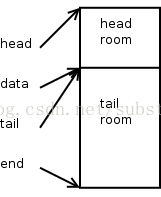
Typically, when building output packets,we reserve enough bytes for the maximum amount of header space we think we'llneed. Most IPV4 protocols can do this by using the socket value sk->sk_prot->max_header.
When setting up receive packets that anethernet device will DMA into, we typically call skb_reserve(skb, NET_IP_ALIGN). By default NET_IP_ALIGN is defined to '2'. This makes it so that, after theethernet header, the protocol header will be aligned on at least a 4-byteboundary. Nearly all of the IPV4 and IPV6 protocol processing assumes that theheaders are properly aligned.
Let's now add some user data to thepacket.
unsignedchar *data = skb_put(skb, user_data_len);
interr = 0;
skb->csum= csum_and_copy_from_user(user_pointer, data,
user_data_len, 0, &err);
if(err)
gotouser_fault;
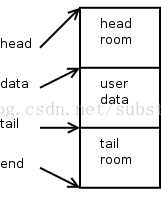
skb_put() advances 'skb->tail' by the specified number of bytes, it alsoincrements 'skb->len' by that number of bytes as well. This routine must notbe called on a SKB that has any paged data. You must also be sure that there isenough tail room in the SKB for the amount of bytes you are trying to put. Bothof these conditions are checked for by skb_put() and an assertion failure will trigger if either rule is violated.
The computed checksum is remembered in'skb->csum'. Now, it's time to build the protocol headers. We'll build a UDPheader, then one for IPV4.
structinet_sock *inet = inet_sk(sk);
structflowi *fl = &inet->cork.fl;
structudphdr *uh;
skb->h.raw= skb_push(skb, sizeof(struct udphdr));
uh= skb->h.uh
uh->source= fl->fl_ip_sport;
uh->dest= fl->fl_ip_dport;
uh->len= htons(user_data_len);
uh->check= 0;
skb->csum= csum_partial((char *)uh,
sizeof(struct udphdr), skb->csum);
uh->check= csum_tcpudp_magic(fl->fl4_src, fl->fl4_dst,
user_data_len, IPPROTO_UDP,skb->csum);
if(uh->check == 0)
uh->check= -1;
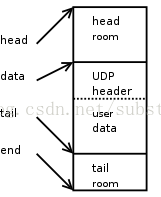
skb_push() will decrement the 'skb->data' pointer by the specified number ofbytes. It will also increment 'skb->len' by that number of bytes as well.The caller must make sure there is enough head room for the push beingperformed. This condition is checked for by skb_push() and an assertion failure will trigger if this rule is violated.
Now, it's time to tack on an IPV4 header.
structrtable *rt = inet->cork.rt;
structiphdr *iph;
skb->nh.raw= skb_push(skb, sizeof(struct iphdr));
iph= skb->nh.iph;
iph->version= 4;
iph->ihl= 5;
iph->tos= inet->tos;
iph->tot_len= htons(skb->len);
iph->frag_off= 0;
iph->id= htons(inet->id++);
iph->ttl= ip_select_ttl(inet, &rt->u.dst);
iph->protocol= sk->sk_protocol; /* IPPROTO_UDP in this case */
iph->saddr= rt->rt_src;
iph->daddr= rt->rt_dst;
ip_send_check(iph);
skb->priority= sk->sk_priority;
skb->dst= dst_clone(&rt->u.dst);
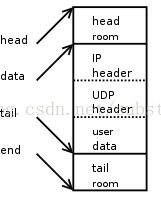
Just as above for UDP, skb_push() decrements 'skb->data' andincrements 'skb->len'. We update the 'skb->nh.raw' pointer to the beginningof the new space, and build the IPv4 header.
This packet is basically ready to bepushed out to the device once we have the necessary information to build theethernet header (from the generic neighbour layer and ARP).
Things start to get a little bit morecomplicated once paged data begins to be used. For the most part the ability touse [page, offset, len] tuples for SKB data came about sothat file system file contents could be directly sent over a socket. But, as itturns out, it is sometimes beneficial to use this for nomal buffering ofprocess sendmsg() data.
It must be understood that once paged datastarts to be used on an SKB, this puts a specific restriction on all future SKBdata area operations. In particular, it is no longer possible to do skb_put() operations.
We will now mention that there areactually two length variables assosciated with an SKB, len and data_len. The latter onlycomes into play when there is paged data in the SKB. skb->data_len tells how many bytes of paged datathere are in the SKB. From this we can derive a few more things:
- The existence of paged data in an SKB is indicated by skb->data_len being non-zero. This is codified in the helper routine skb_is_nonlinear() so that it the function you should use to test this.
- The amount of non-paged data at skb->data can be calculated as skb->len - skb->data_len. Again, there is a helper routine already defined for this called skb_headlen() so please use that.
The main abstraction isthat, when there is paged data, the packet begins at skb->data for skb_headlen(skb) bytes, thencontinues on into the paged data area for skb->data_len bytes. That is why it is illogicalto try and do an skb_put(skb) when there is pageddata. You have to add data onto the end of the paged data area instead.
Each chunk of paged data in an SKB isdescribed by the following structure:
struct skb_frag_struct {
structpage *page;
__u16page_offset;
__u16size;
};
There is a pointer to thepage (which you must hold a proper reference to), the offset within the pagewhere this chunk of paged data starts, and how many bytes are there.
The paged frags are organized into anarray in the shared SKB area, defined by this structure:
#define MAX_SKB_FRAGS (65536/PAGE_SIZE + 2)
struct skb_shared_info {
atomic_tdataref;
unsignedint nr_frags;
unsignedshort tso_size;
unsignedshort tso_segs;
structsk_buff *frag_list;
skb_frag_t frags[MAX_SKB_FRAGS];
};
The nr_frags member states howmany frags there are active in the frags[] array. The tso_size and tso_segs is used to convey information to the devicedriver for TCP segmentation offload. The frag_list is used to maintain a chain of SKBs organizedfor fragmentation purposes, it is _not_ used for maintaining paged data. Andfinally the frags[] holds the frag descriptorsthemselves.
A helper routine is available to help youfill in page descriptors.
void skb_fill_page_desc(struct sk_buff *skb,int i,
structpage *page,
intoff, int size)
This fills the i'th page vector to point to page at offset off of size size. It also updates the nr_frags member to be onepast i.
If you wish to simply extend an existingfrag entry by some number of bytes, increment the size member by that amount.
With all of the complications imposed bynon-linear SKBs, it may seem difficult to inspect areas of a packet in astraightforward way, or to copy data out from a packet into another buffer.This is not the case. There are two helper routines available which make thispretty easy.
First, we have:
void*skb_header_pointer(const struct sk_buff *skb, int offset, int len, void *buffer)
You give it the SKB, theoffset (in bytes) to the piece of data you are interested in, the number ofbytes you want, and a local buffer which is to be used _only_ if the data youare interested in resides in the non-linear data area.
You are returned a pointer to the dataitem, or NULL if you asked for an invalid offset and len parameter. Thispointer could be one of two things. First, if what you asked for is directly inthe skb->data linear data area, you are given a directpointer into there. Else, you are given the buffer pointer you passed in.
Code inspecting packet headers on theoutput path, especially, should use this routine to read and interpret protocolheaders. The netfilter layer uses this function heavily.
For larger pieces of data other thanprotocol headers, it may be more appropriate to use the following helperroutine instead.
int skb_copy_bits(const struct sk_buff *skb,int offset,
void *to, int len);
This will copy thespecified number of bytes, and the specified offset, of the given SKB into the 'to'buffer. This is used for copies of SKBdata into kernel buffers, and therefore it is not to be used for copying SKBdata into userspace. There is another helper routine for that:
int skb_copy_datagram_iovec(const structsk_buff *from,
int offset, struct iovec *to,
int size);
Here,the user's data area is described by the given IOVEC. The other parameters arenearly identical to those passed in to skb_copy_bits() above.
http://vger.kernel.org/~davem/skb_data.html
skb head/data/tail/end/介绍的更多相关文章
- JS魔法堂:Data URI Scheme介绍
一.前言 上周五公司内部的Any Topic Conf.上我和同事们分享了这个主题,有同事说这个有用,有同事说这个没啥用,后来还延伸到网站性能的话题上,大家讨论的激烈程度让我觉得这次选题还不错.本篇先 ...
- Python pandas 0.19.1 Intro to Data Structures 数据结构介绍 文档翻译
官方文档链接http://pandas.pydata.org/pandas-docs/stable/dsintro.html 数据结构介绍 我们将以一个快速的.非全面的pandas的基础数据结构概述来 ...
- 二维码Data Matrix简单介绍及在VS2010中的编译
Data Matrix 二维条码原名Datacode,由美国国际资料公司(International Data Matrix, 简称ID Matrix)于1989年发明.Data-Matrix二维条码 ...
- C++数据类型(data type)介绍
在编写程序时,数据类型(data type)定义了使用存储空间的(内存)的方式. 程序员通过定义数据类型(data type),告诉特定存储空间这里要存储的数据类型是什么,以及你即将操作他的方式.(注 ...
- Spring整合Hibernate实现Spring Data JPA (介绍和使用)
Spring Data JPA是Spring基于Hibernate开发的一个JPA框架.如果用过Hibernate或者MyBatis的话,就会知道对象关系映射(ORM)框架有多么方便. 但是Sprin ...
- UiPath数据抓取Data Scraping的介绍和使用
一.数据抓取(Data Scraping)的介绍 使用截据抓取使您可以将浏览器,应用程序或文档中的结构化数据提取到数据库,.csv文件甚至Excel电子表格中. 二.Data Scraping在UiP ...
- Spring Data Redis整体介绍 (一)
为什么使用Spring Data Redis 首先Spring Data Redis 是Spring 框架提供的用于操作Redis的客户端. Spring框架是一个全栈Java程序框架,通过DI.AO ...
- Landsat 现有 Analysis Ready Data (ARD) 数据介绍
Global Web-Enabled Landsat Data (GWELD)[1] NASA 原先的 Web-Enabled Landsat Data Conterminous U.S. Seaso ...
- 【转】 关于data factory的介绍——即如何快速生成大批量数据
上次在我的博客中讲述了quest公司的spotlight系列软件,这次来扯淡一下quest公司的另一测试辅助软件 datafactory(数据工厂),顾名思义,数据工厂是生产数据的,主要应用领域是性能 ...
随机推荐
- SQL Server系统函数:日期函数
原文:SQL Server系统函数:日期函数 1.返回当前日期和时间 select GETDATE() '当前日期-精确到33毫秒' select GETUTCDATE() 'UTC日期和时间-精确到 ...
- C# Winform 设置窗口打开的特效
https://www.cnblogs.com/mq0036/p/6421946.html using System.Runtime.InteropServices; public class Win ...
- 在.netcore webapi项目中使用后台任务工具Hangfire
安装Hangfire 在webapi项目中通过nuget安装Hangfire.Core,Hangfire.SqlServer,Hangfire.AspNetCore,截止到目前的最新版本是1.7.6. ...
- 初试Maven
1 [检查]确认已经安装jdk,已经环境变量中配置JAVA_HOME,已经修改Path 2 [下载]从http://maven.apache.org/download.cgi下载所需要的版本,笔者使用 ...
- 表空间 oracle
--create table create table table_name ( column1 varchar2(20) not null, column2 number(8) not null, ...
- MYSQL编码转换的问题latin1转utf8
1.先导出 mysqldump --default-character-set=latin1 --create-options=false --set-charset=false -u root - ...
- list通过lambda 表达式去重,筛选
List<User> distinctList = new ArrayList();User user1 = new User();user1.setId("111") ...
- Django路由及函数视图
路由系统 在django中,uri与逻辑函数的对应关系我们称之为路由系统 伪静态 伪静态是相对于静态文件来说的,例如https://www.cnblogs.com/hesujian/p/1116581 ...
- 2019年6月SAP发布的未来ABAP平台的发展方向
未来ABAP平台将始终是这些产品的技术平台: S/4HANA On-Premises和Cloud将基于一个统一的ABAP codeline: SAP云平台上的ABAP编程环境: 什么是SAP Clou ...
- 理解JVM之对象的生命周期
1.对象的创建 1) 当虚拟机遇到一条new的指令时,首先将去检查这个指令的参数是否能在常量池中定位到一个类的符号引用,并且检查这个符号引用代表的类是否已被加载,解析和初始化过. 2) 在类加载检查通 ...