
【转】Entity Systems

“Favour composition over inheritance”
If you haven’t already read my previous post on the problems of traditional game architecture and why entity systems are needed. I’m going to cover the basics of an entity system before we look at 3 different implantations and the pro’s and con’s of each.
What is an entity?
An entity (sometimes called game object) represents something in the game. For every tree,tank or ninja we have an entity. An entity is container to which we can add components (behaviours) that define what it is. e.g In this rather conceptual example a Ninja gets a Renderer, Physics, Health and Stealth components which together make up a Ninja.
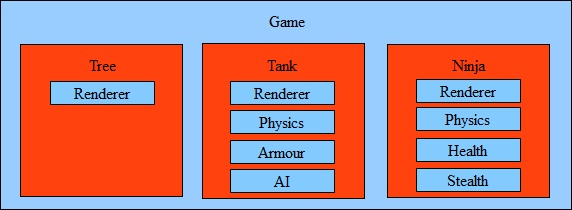
This is the basics of all Entity systems one of key feature is the ability to create entities and change there components at run time. So a Ninja could become a Tank! (that’s the hard sell done).
Spotter guide.
There are 3 main ways to implement an entity system I have seen and I’m going to quickly out line them all and take a critical look at the pro’s and con’s. I’m going to call them common, almost and true (yes I’m bias but I think they are appropriate names)
“Common”
Most common implantation you are going to come across. Its based on the strategy pattern and its the simplest to understand. The first time I built a entity system this is what I did. There are good example out there in flash like PushButton Engine.
How it works
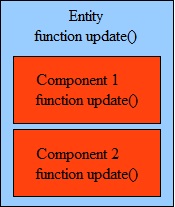
All components have a common interface normal with a function update(). Calling update() on entity causes update() to be called on all its components. Components then update there data for example a render component may copy its graphics to a view port.
Pros
Simple and fast. Better than inheritance.
Cons
Scalability and flexibility (how easy it is to make changes). To explain the issue lets take an example. We have an entity with both renderer and physics components. Both need to know about the location of the entity in the world. So we have two options
- push the data up into the entity its self. In complex games this can result inmore and more specialised data gets pushed up into the entity creating a god object.
- Allow components to access other components data. When one component depends on the data in another component we get a dependency. Component A can’t function unless component B exists. As a game grows so does the complexity of the dependencies.
There are work arounds to this issue for example automatically creating component B when A is added but then we need to give it the correct data. We start to lose the ability to mix and match components on the fly that makes an entity system so powerful. Entity to entity communication for example in collision detection is also difficult.
“Almost”
This was suggest to me by a friend I’m including it here as its hard to criticise and has a lot of positives points.
How it works
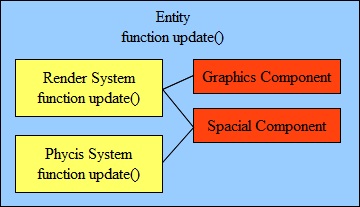
This gets the big leap correct it separates the data from the logic. In the common implementation both data and logic are combined in a component here they separated into
- Data – Components
- Logic – Systems(behaviours)
This is counter intuitive and contrary to what’s drilled into you about OOP. However it solves lots of issues.
A renderer system could require a spacial component (position in the world .etc) and a graphics component where as a physics system may require just the spacial component. Think of the components as the model and systems as the controller in MVC terms. Systems normally implement a common interface with a update() function
Pros
More scalable the systems have no dependencies on one another and can share data. Fast.
Cons
Systems are still dependent on an entity having specific components. This can be worked around to an extent by implementing it so that when we and a system to an entity any missing components are created automatically. This however means that we have to add a system before we can start setting the components data as they may not exist before that point. The main issue with this system come with entity to entity communication for example in collision detection. A collision system attached to an entity needs to check its self against all the others entities with collision systems this can be done with events but it also can be a lot simpler as we will see next.
“True”
“A game is just a real time database with a graphical front end”
- Dave Roderick
This is a blanket statment but its fundamentally true and this architecture is the closest fit to this statement I have found.
How it works
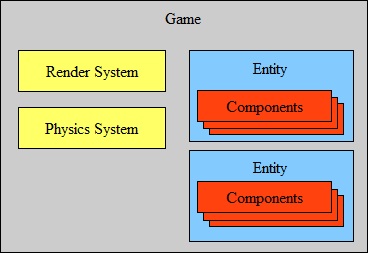
Again we separate out the logic and the data. However rather than adding systems to the individual entities we add the systems to the game its self. The systems can the do a real time look up and requests all entities that have the required components for processing. For instance a rendering system will ask every frame for all entities that have Spacial and Graphical components it will then run though the list drawing each one.
Pros
Scalable and easy to make change due to low dependences. Truly data driven. Simple. Collisions etc. are much easier to manage.
Cons
Slow(er) looking up the entities we need for each system every frame is going to effect performance. Counter-intuitive and requires you to rethink your approach to programming.
Conclusion
All these systems are better that a traditional inheritance hierarchy. I chose the “true” system for my frame work Ember as I think its pros out way its cons when it comes to the real issues of game development. It can also be implemented so that performance issues can become negligible. you can read how to get started using Ember here.
If you want to read more on entity systems its covered in some depth here by t-machine blogs.
Also check out Richard Lords post with a practical example here
http://www.richardlord.net/blog/what-is-an-entity-framework
Tagged with: architecture • components • entities • flash • game
【转】Entity Systems的更多相关文章
- 【转】What is an entity system framework for game development?
What is an entity system framework for game development? Posted on 19 January 2012 Last week I relea ...
- 为什么要在游戏开发中使用ECS模式
http://www.richardlord.net/blog/why-use-an-entity-framework Why use an entity system framework for g ...
- 组件-实体-系统 Entiy-Compoent-System ECS架构整理
继承体系的问题,为什么要用ECS 面向对象的问题 当一个新的类型需要多个老类型的不同功能的时候,不能很好的继承出来 游戏开发后期会有非常多的类,很难维护 游戏中子系统很多,它们对一个对象的关注点往往互 ...
- 《Entity Framework 6 Recipes》中文翻译系列 (15) -----第三章 查询之与列表值比较和过滤关联实体
翻译的初衷以及为什么选择<Entity Framework 6 Recipes>来学习,请看本系列开篇 3-8与列表值比较 问题 你想查询一个实体,条件是给定的列表中包含指定属性的值. 解 ...
- Protecting against XML Entity Expansion attacks
https://blogs.msdn.microsoft.com/tomholl/2009/05/21/protecting-against-xml-entity-expansion-attacks/ ...
- 【转】Fast Entity Component System
http://entity-systems.wikidot.com/fast-entity-component-system Summary Create a generic System class ...
- 如何使用 Java 测试 IBM Systems Director 的 REST API
转自: http://www.ibm.com/developerworks/cn/aix/library/au-aix-systemsdirector/section2.html 如何使用 Java ...
- ASP.NET MVC- Model- An Introduction to Entity Framework for Absolute Beginners
Introduction This article introduces Entity Framework to absolute beginners. The article is meant fo ...
- Professional C# 6 and .NET Core 1.0 - 38 Entity Framework Core
本文内容为转载,重新排版以供学习研究.如有侵权,请联系作者删除. 转载请注明本文出处:Professional C# 6 and .NET Core 1.0 - 38 Entity Framework ...
随机推荐
- maven搭建java ee项目
1.点击File->New->Other,选择maven project 2.选择maven project,点击Next,,而后再点击next,进入如下界面 如图选择最后一个,点击n ...
- 阮一峰:RSA算法原理(一)
今天看到一篇好文章,关于加密算法,收藏了觉得不过瘾,还是自己贴一遍,也能加深一下印象. 原文链接:http://www.ruanyifeng.com/blog/2013/06/rsa_algorith ...
- java入门第四步之应用服务器的安装(Tomcat)【转】
首先打开myeclipse,在myeclipse菜单栏下面有两个按钮: 左边的按钮是进行项目的部署的(即将项目部署到服务器上),右边的按钮是进行服务器的启动的,如果你安装了tomcat服务器,那你就可 ...
- linux copy
cp -ri 131115-6/* /web/www/attachment/ 把13这个文件夹下面所有的文件和文件夹复制到 /web/www/attachment cp -a a /web/ww ...
- 管理工具MongoVUE使用
连接数据库 管理数据库 查询 1,查询所有 2,查询命令窗口
- 注册并启动 Reporting Services SharePoint 服务
在安装 SharePoint 之前已安装 Reporting Services SharePoint 模式.所以Reporting Services SharePoint 是不能正常使用的. 安装完S ...
- Andriod——区别DVM与JVM
区别DVM与JVM 1.首要差别 Dalvik: 基于寄存器,编译和运行都会更快些 JVM: 基于栈, 编译和运行都会慢些 2.字节码的区别 Dalvik: 执行.dex格式的字节码,是对.class ...
- xml数据解析调研
XML数据解析http://www.tuicool.com/articles/Nraau2(必用) http://www.cnblogs.com/pengyingh/articles/2342699. ...
- ASP.NET MVC过滤器(一)
MVC过滤器是加在 Controller 或 Action 上的一种 Attribute,通过过滤器,MVC 网站在处理用户请求时,可以处理一些附加的操作,如:用户权限验证.系统日志.异常处理.缓存等 ...
- nbtstat -a <IP> 会显示主机名、所在工作组等信息
nbtstat -a <IP> 会显示主机名.所在工作组等信息