
Linux input子系统学习总结(二)----Input事件驱动
Input 事件驱动: (主要文件 :drivers/input/evdev.c 、 drivers/input/input.h)基于kernel 4.0
一、 关键函数调用顺序:
1、input_register_handler(&evdev_handler); ///注册 evdev_handler 这个input事件驱evdev.c
2、input_attach_handler(dev, handler);////input 设备和 input 事件进行匹配 input.h
3、handler->connect(handler, dev, id);///调用evdev_handler 的 connect 函数(.connect = evdev_connect)
4、evdev_connect(struct input_handler *handler, struct input_dev *dev,
const struct input_device_id *id)
5、cdev_init(&evdev->cdev, &evdev_fops);//// 初始化一个 cdev
6、device_add(&evdev->dev);///把初始化好的 evdev 添加到内核
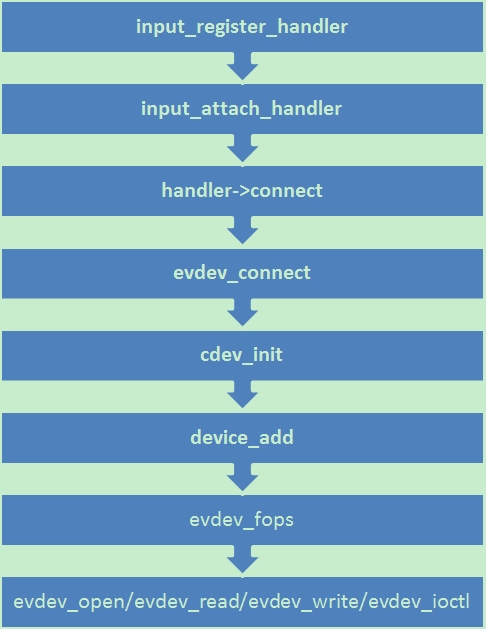
在系统启动时系统会注册input事件驱动 evdev_handler,通过遍历系统中已经存在input设备,并与之进行匹配,匹配成功即条用connect函数
创建evdev设备,即input设备节点,初始化完成之后,上层应用程序通过evdev_fops对输入设备节点进行open/write/read/ioctrl等一系列操作,
从而完成input输入子系统的整个功能实现;
二、关键代码段
 static struct input_handler evdev_handler = {

     .event        = evdev_event,

     .events        = evdev_events,

     .connect    = evdev_connect,

     .disconnect    = evdev_disconnect,

     .legacy_minors    = true,

     .minor        = EVDEV_MINOR_BASE,///次设备号从64开始

     .name        = "evdev",

     .id_table    = evdev_ids,

 };

 static int __init evdev_init(void)

 {

     return input_register_handler(&evdev_handler); ///注册 evdev_handler 这个input事件驱动

 }
 int input_register_handler(struct input_handler *handler)///把input 事件驱动注册到内核

 {

     struct input_dev *dev;

     int error;

     error = mutex_lock_interruptible(&input_mutex);

     if (error)

         return error;

     INIT_LIST_HEAD(&handler->h_list);///初始化链表头,把链表的前和后都指向它自己

     list_add_tail(&handler->node, &input_handler_list);///把 handler的 node 加到 input_handler_list这个双向链表,之后就可以通过这个链表访问所有的input_handler

     list_for_each_entry(dev, &input_dev_list, node)

         input_attach_handler(dev, handler);////inout 设备和 input 事件进行匹配

     input_wakeup_procfs_readers();

     mutex_unlock(&input_mutex);

     return ;

 }
 static int input_attach_handler(struct input_dev *dev, struct input_handler *handler)

 {

     const struct input_device_id *id;

     int error;

     id = input_match_device(handler, dev);///input_dev 和 input_handler 通过id_table进行匹配

     if (!id)

         return -ENODEV;

     error = handler->connect(handler, dev, id);///如果返回id不为空就执行handler 的 connect  ---> 调用 evdev.c 的 connect 函数

     if (error && error != -ENODEV)

         pr_err("failed to attach handler %s to device %s, error: %d\n",

                handler->name, kobject_name(&dev->dev.kobj), error);

     return error;

 }
 /*

  * Create new evdev device. Note that input core serializes calls

  * to connect and disconnect.

  */

 static int evdev_connect(struct input_handler *handler, struct input_dev *dev,

              const struct input_device_id *id)

 {

     struct evdev *evdev;

     int minor;

     int dev_no;

     int error;

     minor = input_get_new_minor(EVDEV_MINOR_BASE, EVDEV_MINORS, true);//动态分配一个新的设备号minor

     if (minor < ) {

         error = minor;

         pr_err("failed to reserve new minor: %d\n", error);

         return error;

     }

     evdev = kzalloc(sizeof(struct evdev), GFP_KERNEL);///初始化evdev ,为evdev分配空间

     if (!evdev) {

         error = -ENOMEM;

         goto err_free_minor;

     }

     INIT_LIST_HEAD(&evdev->client_list);///初始化队列

     spin_lock_init(&evdev->client_lock);

     mutex_init(&evdev->mutex);

     init_waitqueue_head(&evdev->wait);///初始化等待队列

     evdev->exist = true;

     dev_no = minor;

     /* Normalize device number if it falls into legacy range */

     if (dev_no < EVDEV_MINOR_BASE + EVDEV_MINORS)

         dev_no -= EVDEV_MINOR_BASE;

     dev_set_name(&evdev->dev, "event%d", dev_no);///给设备设置名字(event0、event1、...)

     evdev->handle.dev = input_get_device(dev);

     evdev->handle.name = dev_name(&evdev->dev);

     evdev->handle.handler = handler;

     evdev->handle.private = evdev;

     evdev->dev.devt = MKDEV(INPUT_MAJOR, minor);////根据主设备号(主设备号都是13)和次设备号生成一个设备号(次设备号从64开始)

     evdev->dev.class = &input_class;

     evdev->dev.parent = &dev->dev;

     evdev->dev.release = evdev_free;

     device_initialize(&evdev->dev);///对设备进行初始化

     error = input_register_handle(&evdev->handle);///注册 handle,handle 用来关联 input_dev 和 input_handler

     if (error)

         goto err_free_evdev;

     cdev_init(&evdev->cdev, &evdev_fops);//// 初始化一个 cdev

     evdev->cdev.kobj.parent = &evdev->dev.kobj;

     error = cdev_add(&evdev->cdev, evdev->dev.devt, );

     if (error)

         goto err_unregister_handle;

     error = device_add(&evdev->dev);///把初始化好的 evdev 添加到内核

     if (error)

         goto err_cleanup_evdev;

     return ;

  err_cleanup_evdev:

     evdev_cleanup(evdev);

  err_unregister_handle:

     input_unregister_handle(&evdev->handle);

  err_free_evdev:

     put_device(&evdev->dev);

  err_free_minor:

     input_free_minor(minor);

     return error;

 }
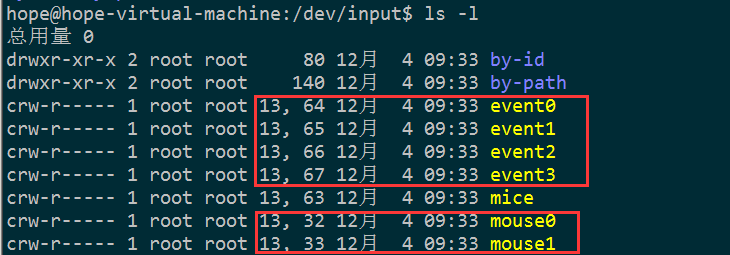
如下图 ,在linux 系统上 /dev/input这个路径下可以看到已经注册好的input设备节点,input设备的主设备号都是13,其中
按键设备的次设备号从64~95,鼠标设备的次设备号从32~63。
Linux input子系统学习总结(二)----Input事件驱动的更多相关文章
- input子系统学习笔记六 按键驱动实例分析下【转】
转自:http://blog.chinaunix.net/uid-20776117-id-3212095.html 本文接着input子系统学习笔记五 按键驱动实例分析上接续分析这个按键驱动实例! i ...
- input子系统分析之二:数据结构
内核版本:3.9.5 1. input_dev,用来标识输入设备 struct input_dev { const char *name; const char *phys; const char * ...
- Linux时间子系统之(二):软件架构
专题文档汇总目录 Notes:从框架上讲解了时间子系统,从底向上包括CPU Local TImer.Global Counter.Clock Souce/Clock Events模块管理.Tick D ...
- Linux Input子系统浅析(二)-- 模拟tp上报键值【转】
转自:https://blog.csdn.net/xiaopangzi313/article/details/52383226 版权声明:本文为博主原创文章,未经博主允许不得转载. https://b ...
- linux输入子系统(6)-input子系统介绍及结构图
注:本系列转自: http://www.ourunix.org/post/290.html input子系统介绍 输入设备(如按键,键盘,触摸屏,鼠标,蜂鸣器等)是典型的字符设备,其一 ...
- linux 输入子系统(4)---- input子系统的初始化
Input子系统的初始化函数为input_init(),如下: static int __init input_init(void) { int err; input_init_abs_bypass( ...
- Linux input子系统学习总结(三)----Input设备驱动
Input 设备驱动 ---操作硬件获取硬件寄存器中设备输入的数据,并把数据交给核心层: 一 .设备驱动的注册步骤: 1.分配一个struct input_dev : struct ...
- Linux input子系统学习总结(一)---- 三个重要的结构体
一 . 总体架构 图 上层是图形界面和应用程序,通过监听设备节点,获取用户相应的输入事件,根据输入事件来做出相应的反应:eventX (X从0开始)表示 按键事件,mice 表示鼠标事件 Input ...
- Linux System Programming 学习笔记(二) 文件I/O
1.每个Linux进程都有一个最大打开文件数,默认情况下,最大值是1024 文件描述符不仅可以引用普通文件,也可以引用套接字socket,目录,管道(everything is a file) 默认情 ...
随机推荐
- Redis在Windows环境下搭建
1. 下载Redis-Windows版本 Redis官网下载页面: http://redis.io/download Windows下Redis项目: https://github.com/MSOp ...
- Nginx实现内参:为什么架构很重要?
Nginx在web开发者眼中就是高并发高性能的代名词,其基于事件的架构也被众多开发者效仿.我从Nginx的网站找到一篇技术文章将Nginx是怎样实现的,文章是Nginx的产品老大Owen Garret ...
- 腾讯首度公开S级手游品质管理方法
weimjsam 引言 在最新的手游市场占有率统计中,腾讯游戏稳稳占据一半江山,目前仍以每月一到两款的速度推出新品,在如此复杂多变.响应要求极高的市场环境下,能持续推出高质量产品并保持高效迭代更新 ...
- 106. Construct Binary Tree from Inorder and Postorder Traversal
Given inorder and postorder traversal of a tree, construct the binary tree. Note:You may assume that ...
- opacity兼容写法
.opacity{ position: absolute; top: 0px;left: 0px; background: #000; filter:alpha(opacity=50); /* IE ...
- HBASE解析
Hbase是运行在Hadoop上的NoSQL数据库,它是一个分布式的和可扩展的大数据仓库,也就是说HBase能够利用HDFS的分布式处理模式,并从Hadoop的MapReduce程序模型中获益.这意味 ...
- SteamVR Unity工具包(VRTK)之激光和移动
简单激光指针(VRTK_ SimplePointer) 简单指针(Simple Pointer)脚本从控制器尾部发出一个有色光束来模拟激光束.这在场景中指向对象很有用,它能判断所指向的对象以及对象距控 ...
- H5与Native交互的实现
PDF文件下载:将后缀png改成PDF.
- BIO,NIO,AIO的理解
在高性能的IO体系设计中,有几个名词概念常常会使我们感到迷惑不解.具体如下: 序号 问题 1 什么是同步? 2 什么是异步? 3 什么是阻塞? 4 什么是非阻塞? 5 什么是同步阻塞? 6 什么是同步 ...
- OOP三个基本特征:封装、继承、多态
面向对象的三个基本特征是:封装.继承.多态. 封装 封装最好理解了.封装是面向对象的特征之一,是对象和类概念的主要特性. 封装,也就是把客观事物封装成抽象的类,并且类可以把自己的数据和方法只让可信的类 ...