
poj 1920 Towers of Hanoi
| Time Limit: 3000MS | Memory Limit: 16000K | |
| Total Submissions: 2213 | Accepted: 986 | |
| Case Time Limit: 1000MS | ||
Description
According to an old myth, the monks at an ancient Tibetian monastery have been trying to solve an especially large instance of this problem with 47 disks for thousands of years. Since this requires at least 247 - 1 moves and the monks started out without a strategy, they messed it all up while still following the rules. Now they would like to have the disks stacked up neatly on any arbitrary peg using the minimum number of moves. But they all took a vow which forbids them to move the disks contrary to the rules. They want to know on which peg they should best stack the disks, and the minimum number of moves needed.
Write a program that solves this problem for the monks. Your program should also be able to handle any number N (0 < N <= 100 000) of disks. The numbers involved in the computation can become quite large. Because of that, the monks are only interested in the number of moves modulo 1 000 000.
Example
The following example can be solved in four moves.
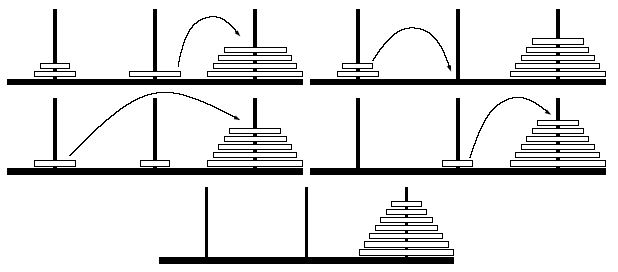
Input
The (i + 2)-th line of the input file consists of integer numbers mi,1 . . .mi,si with 1 <= mi,j <= N, the sizes of the disks on peg i. The disks are given from bottom to top, thus mi,1 > mi,2 > . . . > mi,si .
Note that an empty stack is given by an empty line. The set of N disks have different sizes. All numbers are separated by a single space.
Output
Sample Input
7

2 1 4

2 1

3

7 6 5 4
Sample Output
3

4
Source
第一行输出一个数字表示集中到哪个柱子上,第二行输出一个数字表示最小步数模1000000
附上代码:
 #include <iostream>

 #include <cstdio>

 #include <cstring>

 using namespace std;

 int main()

 {

     int T,i,j,n,m;

     int a[],b[],c[];

     while(~scanf("%d",&T))

     {

         for(i=; i<=; i++)

             scanf("%d",&a[i]);

         for(i=; i<=; i++)

         {

             for(j=; j<=a[i]; j++)

             {

                 scanf("%d",&n);

                 b[n]=i;             //记录每个盘子所在的柱子位置

             }

         }

         c[]=;

         for(i=; i<T; i++)

             c[i+]=(c[i]*)%;

         int s1=b[T],s2=b[T-],s=;   //s1为最大的盘子位置,s2为第二大的盘子位置

         for(i=T-; i>; i--,s2=b[i])

         {

             if(s1!=s2)   //假如盘子不在正确的位置上,将其移动

             {

                 s=(s+c[i-])%;

                 s1=-s1-s2;     //记录剩余盘子新的位置

             }

         }

         printf("%d\n%d\n",b[T],s);

     }

     return ;

 }
poj 1920 Towers of Hanoi的更多相关文章
- POJ 1958 Strange Towers of Hanoi 解题报告
Strange Towers of Hanoi 大体意思是要求\(n\)盘4的的hanoi tower问题. 总所周知,\(n\)盘3塔有递推公式\(d[i]=dp[i-1]*2+1\) 令\(f[i ...
- POJ 1958 Strange Towers of Hanoi
Strange Towers of Hanoi Time Limit: 1000MS Memory Limit: 30000K Total Submissions: 3784 Accepted: 23 ...
- The Towers of Hanoi Revisited---(多柱汉诺塔)
Description You all must know the puzzle named "The Towers of Hanoi". The puzzle has three ...
- [CareerCup] 3.4 Towers of Hanoi 汉诺塔
3.4 In the classic problem of the Towers of Hanoi, you have 3 towers and N disks of different sizes ...
- POJ-1958 Strange Towers of Hanoi(线性动规)
Strange Towers of Hanoi Time Limit: 1000MS Memory Limit: 30000K Total Submissions: 2677 Accepted: 17 ...
- ural 2029 Towers of Hanoi Strike Back (数学找规律)
ural 2029 Towers of Hanoi Strike Back 链接:http://acm.timus.ru/problem.aspx?space=1&num=2029 题意:汉诺 ...
- POJ1958 Strange Towers of Hanoi [递推]
题目传送门 Strange Towers of Hanoi Time Limit: 1000MS Memory Limit: 30000K Total Submissions: 3117 Ac ...
- zoj 2338 The Towers of Hanoi Revisited
The Towers of Hanoi Revisited Time Limit: 5 Seconds Memory Limit: 32768 KB Special Judge You all mus ...
- 【POJ 1958】 Strange Towers of Hanoi
[题目链接] http://poj.org/problem?id=1958 [算法] 先考虑三个塔的情况,g[i]表示在三塔情况下的移动步数,则g[i] = g[i-1] * 2 + 1 再考虑四个塔 ...
随机推荐
- ML面试1000题系列(71-80)
本文总结ML面试常见的问题集 转载来源:https://blog.csdn.net/v_july_v/article/details/78121924 71.看你是搞视觉的,熟悉哪些CV框架,顺带聊聊 ...
- HDU 3555 (递推&&记忆化)
#include<stdio.h> #include<string.h> #define max 25 typedef __int64 LL; LL dp[max][]; // ...
- 【水滴石穿】react-native-video-project
感觉这个是很有才华的博主,毕竟是可以在npm 包里面留后门的程序员 博主的gihtub关于这个项目的地址是:https://github.com/ikimiler/react-native-video ...
- 【Leetcode 滑动窗口】顺次数(1291)
题目 我们定义「顺次数」为:每一位上的数字都比前一位上的数字大 1 的整数. 请你返回由 [low, high] 范围内所有顺次数组成的 有序 列表(从小到大排序). 示例 1: 输出:low = ...
- django其他
聚合查询 聚合函数必须在分组之后使用 没有分组默认整体为一组 聚合函数 Max, Min, Sum, Avg, Count 从django.db.models 导入方法,然后使用关键字aggregat ...
- iOS viewDidLayoutSubviews,viewdidload
由于种种原因,最近才开始真正在新项目中使用autolayout,使用过程中虽说是比较顺畅,但是也遇到了一些麻烦,比如: 我使用的XIB默认是4寸屏幕,我再XIB中增加一个viewA,宽度为320,约束 ...
- C++ lambda表达式总结
一个lambda表达式用于创建闭包.lambda表达式与任何函数类似,具有返回类型.参数列表和函数体.与函数不同的是,lambda能定义在函数内部.lambda表达式具有如下形式 [ capture ...
- 全球首个百万IOPS云盘即将商业化 阿里云推出超高性能云盘ESSD
近日,在经过近半年的上线公测后,阿里云全球首个跨入IOPS百万时代的云盘——ESSD即将迎来商业化,单盘IOPS高达100万,这是阿里云迄今为止性能最强的企业级块存储服务. 搭配ECS云服务器使用, ...
- poj 2184 01背包变形【背包dp】
POJ 2184 Cow Exhibition Time Limit: 1000MS Memory Limit: 65536K Total Submissions: 14657 Accepte ...
- nodeJs学习-14 mysql数据库学习、Navicat管理工具
数据库: MySQL 免费.性能非常不错 缺点:集群.容灾稍微弱一点 Oracle 收费.大型应用.金融级.性能非常不错.集群.容灾非常强 缺点:贵 mySQL安装教程--nodeJsz智能社视频 ...