
poj 1920 Towers of Hanoi
| Time Limit: 3000MS | Memory Limit: 16000K | |
| Total Submissions: 2213 | Accepted: 986 | |
| Case Time Limit: 1000MS | ||
Description
According to an old myth, the monks at an ancient Tibetian monastery have been trying to solve an especially large instance of this problem with 47 disks for thousands of years. Since this requires at least 247 - 1 moves and the monks started out without a strategy, they messed it all up while still following the rules. Now they would like to have the disks stacked up neatly on any arbitrary peg using the minimum number of moves. But they all took a vow which forbids them to move the disks contrary to the rules. They want to know on which peg they should best stack the disks, and the minimum number of moves needed.
Write a program that solves this problem for the monks. Your program should also be able to handle any number N (0 < N <= 100 000) of disks. The numbers involved in the computation can become quite large. Because of that, the monks are only interested in the number of moves modulo 1 000 000.
Example
The following example can be solved in four moves.
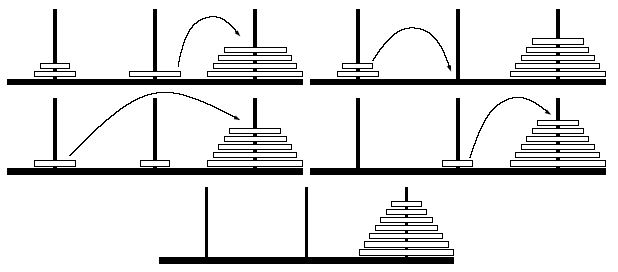
Input
The (i + 2)-th line of the input file consists of integer numbers mi,1 . . .mi,si with 1 <= mi,j <= N, the sizes of the disks on peg i. The disks are given from bottom to top, thus mi,1 > mi,2 > . . . > mi,si .
Note that an empty stack is given by an empty line. The set of N disks have different sizes. All numbers are separated by a single space.
Output
Sample Input
7

2 1 4

2 1

3

7 6 5 4
Sample Output
3

4
Source
第一行输出一个数字表示集中到哪个柱子上,第二行输出一个数字表示最小步数模1000000
附上代码:
 #include <iostream>

 #include <cstdio>

 #include <cstring>

 using namespace std;

 int main()

 {

     int T,i,j,n,m;

     int a[],b[],c[];

     while(~scanf("%d",&T))

     {

         for(i=; i<=; i++)

             scanf("%d",&a[i]);

         for(i=; i<=; i++)

         {

             for(j=; j<=a[i]; j++)

             {

                 scanf("%d",&n);

                 b[n]=i;             //记录每个盘子所在的柱子位置

             }

         }

         c[]=;

         for(i=; i<T; i++)

             c[i+]=(c[i]*)%;

         int s1=b[T],s2=b[T-],s=;   //s1为最大的盘子位置,s2为第二大的盘子位置

         for(i=T-; i>; i--,s2=b[i])

         {

             if(s1!=s2)   //假如盘子不在正确的位置上,将其移动

             {

                 s=(s+c[i-])%;

                 s1=-s1-s2;     //记录剩余盘子新的位置

             }

         }

         printf("%d\n%d\n",b[T],s);

     }

     return ;

 }
poj 1920 Towers of Hanoi的更多相关文章
- POJ 1958 Strange Towers of Hanoi 解题报告
Strange Towers of Hanoi 大体意思是要求\(n\)盘4的的hanoi tower问题. 总所周知,\(n\)盘3塔有递推公式\(d[i]=dp[i-1]*2+1\) 令\(f[i ...
- POJ 1958 Strange Towers of Hanoi
Strange Towers of Hanoi Time Limit: 1000MS Memory Limit: 30000K Total Submissions: 3784 Accepted: 23 ...
- The Towers of Hanoi Revisited---(多柱汉诺塔)
Description You all must know the puzzle named "The Towers of Hanoi". The puzzle has three ...
- [CareerCup] 3.4 Towers of Hanoi 汉诺塔
3.4 In the classic problem of the Towers of Hanoi, you have 3 towers and N disks of different sizes ...
- POJ-1958 Strange Towers of Hanoi(线性动规)
Strange Towers of Hanoi Time Limit: 1000MS Memory Limit: 30000K Total Submissions: 2677 Accepted: 17 ...
- ural 2029 Towers of Hanoi Strike Back (数学找规律)
ural 2029 Towers of Hanoi Strike Back 链接:http://acm.timus.ru/problem.aspx?space=1&num=2029 题意:汉诺 ...
- POJ1958 Strange Towers of Hanoi [递推]
题目传送门 Strange Towers of Hanoi Time Limit: 1000MS Memory Limit: 30000K Total Submissions: 3117 Ac ...
- zoj 2338 The Towers of Hanoi Revisited
The Towers of Hanoi Revisited Time Limit: 5 Seconds Memory Limit: 32768 KB Special Judge You all mus ...
- 【POJ 1958】 Strange Towers of Hanoi
[题目链接] http://poj.org/problem?id=1958 [算法] 先考虑三个塔的情况,g[i]表示在三塔情况下的移动步数,则g[i] = g[i-1] * 2 + 1 再考虑四个塔 ...
随机推荐
- laravel-- 在laravel操作redis数据库的数据类型(string、哈希、无序集合、list链表、有序集合)
安装redis和连接redis数据库 在controller头部引入 一.基本使用 public function RedisdDbOne() { // 清空Redis数据库 Redis::flush ...
- PHP配置环境中如何开启伪静态
1.在httpd.conf中引入httpd-vhosts.conf 2.在httpd.conf中开启mod_rewrite.so 3.在httpd-vhosts.conf中配置虚拟主机 AllowOv ...
- 用蒙特卡罗方法解非线性规划MATLAB
共需要三个M文件,主程序为randlp.m randlp.m: function [sol,r1,r2]=randlp(a,b,n) %随机模拟解非线性规划 debug=1; a=0; %试验点下界 ...
- 学习笔记(2)---Matlab 图像处理相关函数命令大全
Matlab 图像处理相关函数命令大全 一.通用函数: colorbar 显示彩色条 语法:colorbar \ colorbar('vert') \ colorbar('horiz') \ col ...
- day38 13-Spring的Bean的属性的注入:SpEL注入
Spring2.5提供了名称空间p注入属性的方式,Spring3.几提供了SpEL属性注入的方式. <?xml version="1.0" encoding="UT ...
- tyvjP1288 飘飘乎居士取能量块
P1288 飘飘乎居士取能量块 时间: 1000ms / 空间: 131072KiB / Java类名: Main 背景 9月21日,pink生日:9月22日,lina生日:9月23日,轮到到飘飘乎居 ...
- 阿里云linux服务器到期后续费,网站打不开解决方法之一
续费后打不开网站,可能会出现不同情况,这里只记录我遇到的问题 问题描述:服务器到期后续费,网站打不开. 解决尝试: 1.重启服务器nginx /etc/init.d/nginx restart ...
- PHPCMS快速建站系列之后台内容自定义修改
一.后台登录页面 背景图:\statics\images\admin_img 中的 login_bg.jpg 底部版权信息:\phpcms\languages\en 中的 system.lang.ph ...
- PHP进阶与redis锁限制并发访问功能示例
<?php /** * Redis锁操作类 * Date: 2017-06-30 * Author: fdipzone * Ver: 1.0 * * Func: * public lock 获取 ...
- 【C++】为什么INT_MIN不是直接写成-2147483648(转载)
最近在编程中遇到一个问题: #include <iostream> using namespace std; int main() { int n = -2147483648; //cou ...