
poj 1286 Necklace of Beads (polya(旋转+翻转)+模板)
Description
Beads of red, blue or green colors are connected together into a circular necklace of n beads ( n < ). If the repetitions that are produced by rotation around the center of the circular necklace or reflection to the axis of symmetry are all neglected, how many different forms of the necklace are there?
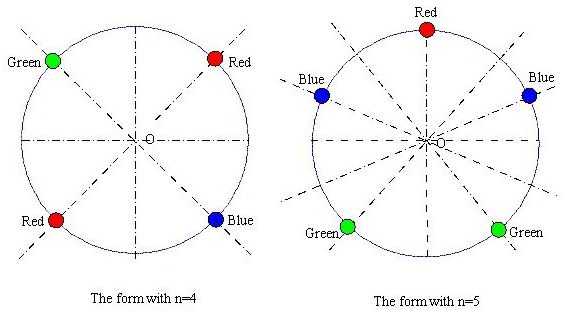
Input
The input has several lines, and each line contains the input data n.

- denotes the end of the input file.
Output
The output should contain the output data: Number of different forms, in each line correspondent to the input data.
Sample Input
-
Sample Output
Source
1、题目类型:Polya定理、组合数学、置换群。
2、解题思路:Polya定理:(1)设G是p个对象的一个置换群,用k种颜色突然这p个对象,若一种染色方案在群G的作用下变为另一种方案,则这两个方案当作是同一种方案,这样的不同染色方案数为: ;
;
(2)置换及循环节数的计算方法:对于有n个位置的手镯,有n种旋转置换和n种翻转置换.
对于旋转置换: c(fi) = gcd(n,i) i为一次转过i颗宝石( i = 0 时 c=n;);
对于翻转置换:如果n为偶数:c(f) = n/2 的置换有n/2个;
c(f) = n/2+1 的置换有n/2个;
如果n为奇数:c(f) = n/2+1.
3、注意事项:注意对于翻转置换过程中对于奇偶数情况的区分处理。
相同的gcd合并在一起计算:
 #include<iostream>

 #include<cstdio>

 #include<cstring>

 #include<map>

 #include<set>

 #include<vector>

 using namespace std;

 #define ll long long

 ll pow_mod(ll a,ll i){

     if(i==)

         return ;

     ll t=pow_mod(a,i/);

     ll ans=t*t;

     if(i&)

         ans=ans*a;

     return ans;

 }

 vector<ll> divisor(ll n){

     vector<ll> res;

     for(ll i=;i*i<=n;i++){

         if(n%i==){

             res.push_back(i);

             if(i*i!=n){

                 res.push_back(n/i);

             }

         }

     }

     return res;

 }

 ll eular(ll n){

     ll res=;

     for(ll i=;i*i<=n;i++){

         if(n%i==){

             n/=i,res*=i-;

             while(n%i==){

                 n/=i;

                 res*=i;

             }

         }

     }

     if(n>) res*=n-;

     return res;

 }

 ll polya(ll m,ll n){

     //map<ll,ll> primes = prime_factor(n);

     vector<ll> divs = divisor(n);

     ll res=;

     for(ll i=;i<divs.size();i++){

         ll euler=eular(divs[i]);

         res+=euler*pow_mod(m,n/divs[i]);

     }

     res/=n;

     return res;

 }

 int main()

 {

     ll n,m=;

     while(~scanf("%I64d",&n) && n!=-){

         if(n==){

             puts("");

             continue;

         }

         ll count=polya(m,n)*n;//旋转情况

         if(n&){//奇数

             count+=n*pow_mod(m,n/+);//翻转情况

         }

         else{//偶数

             count += (pow_mod(m, n /  + ) + pow_mod(m, n / )) * (n / );//翻转情况

         }

         count/=*n;

         printf("%I64d\n",count);

     }

     return ;

 }
附上大神代码:
相同的gcd合并在一起计算:
 #include <iostream>

 #include <map>

 #include <vector>

 using namespace std;

 #define LL long long

 inline LL power(LL p, LL n)

 {

     LL sum = ;

     while (n)

     {

         if (n & )

             sum *= p;

         p *= p;

         n /= ;

     }

     return sum;

 }

 //************************************

 // Method:    divisor

 // FullName:  divisor

 // Access:    public

 // Returns:   vector<int> 约数

 // Qualifier: 约数枚举

 // Parameter: const int & n 目标数n

 //************************************

 vector<int> divisor(const int& n)

 {

     vector<int> res;

     for (int i = ; i * i <= n; ++i)

     {

         if (n % i == )

         {

             res.push_back(i);

             if (i != n / i)

             {

                 res.push_back(n / i);

             }

         }

     }

     return res;

 }

 //************************************

 // Method:    prime_factor

 // FullName:  prime_factor

 // Access:    public

 // Returns:   map<int, int>

 // Qualifier: 整数分解

 // Parameter: int n

 //************************************

 map<int, int> prime_factor(int n)

 {

     map<int, int> res;

     for (int i = ; i * i <= n; ++i)

     {

         while (n % i == )

         {

             ++res[i];

             n /= i;

         }

     }

     if (n != )

     {

         res[n] = ;

     }

     return res;

 }

 LL polya(const int& m, const int& n)

 {

     map<int, int> primes = prime_factor(n);

     vector<int> divs = divisor(n);

     LL res = ;

     for (int i = ; i < divs.size(); ++i)

     {

         // 求divs[i]的欧拉函数值

         LL euler = divs[i];

         for (map<int, int>::iterator it = primes.begin(); it != primes.end(); ++it)

         {

             int p = it->first;

             if (divs[i] % p == ) euler = euler / p * (p - );

         }

         res += euler * power(m, n / divs[i]);

     }

     // 最后除以n

     res /= n;

     return res;

 }

 ///////////////////////////SubMain//////////////////////////////////

 int main(int argc, char *argv[])

 {

 #ifndef ONLINE_JUDGE

     freopen("in.txt", "r", stdin);

     freopen("out.txt", "w", stdout);

 #endif

     int n; const LL m = ;

     while (~scanf("%d", &n) && n != -)

     {

         if (n == )

         {

             puts("");

             continue;

         }

         LL count = polya(m, n) * n;

         if (n & )

             count += n * power(m, n /  + );

         else

             count += (power(m, n /  + ) + power(m, n / )) * (n / );

         count /=  * n;

         printf("%lld\n", count);

     }

 #ifndef ONLINE_JUDGE

     fclose(stdin);

     fclose(stdout);

     system("out.txt");

 #endif

     return ;

 }
还有一种暴力求法:
 #include <iostream>

 using namespace std;

 #define LL long long

 int gcd(int a, int b)

 {

     return b ==  ? a : gcd(b, a % b);

 }

 LL power(LL p, LL n)

 {

     LL sum = ;

     while (n)

     {

         if (n & )

             sum *= p;

         p *= p;

         n /= ;

     }

     return sum;

 }

 ///////////////////////////SubMain//////////////////////////////////

 int main(int argc, char *argv[])

 {

 #ifndef ONLINE_JUDGE

     freopen("in.txt", "r", stdin);

     freopen("out.txt", "w", stdout);

 #endif

     int n; const LL m = ;

     while (~scanf("%d", &n) && n != -)

     {

         if (n == )

         {

             puts("");

             continue;

         }

         LL count = ;

         for (int i = ; i <= n; ++i)

             count += power(m, gcd(i, n));

         if (n & )

             count += n * power(m, n /  + );

         else

             count += n /  * (power(m, n /  + ) + power(m, n / ));

         count /= n * ;

         printf("%lld\n", count);

     }

 #ifndef ONLINE_JUDGE

     fclose(stdin);

     fclose(stdout);

     system("out.txt");

 #endif

     return ;

 }
poj 1286 Necklace of Beads (polya(旋转+翻转)+模板)的更多相关文章
- poj 1286 Necklace of Beads & poj 2409 Let it Bead(初涉polya定理)
http://poj.org/problem?id=1286 题意:有红.绿.蓝三种颜色的n个珠子.要把它们构成一个项链,问有多少种不同的方法.旋转和翻转后同样的属于同一种方法. polya计数. 搜 ...
- POJ 1286 Necklace of Beads(Polya简单应用)
Necklace of Beads 大意:3种颜色的珠子,n个串在一起,旋转变换跟反转变换假设同样就算是同一种,问会有多少种不同的组合. 思路:正规学Polya的第一道题,在楠神的带领下,理解的还算挺 ...
- POJ 1286 Necklace of Beads(项链的珠子)
Necklace of Beads Time Limit: 1000MS Memory Limit: 10000K Total Submissions: 7874 Accepted: 3290 ...
- poj 1286 Necklace of Beads poj 2409 Let it Bead HDU 3923 Invoker <组合数学>
链接:http://poj.org/problem?id=1286 http://poj.org/problem?id=2409 #include <cstdio> #include &l ...
- 数学计数原理(Pólya):POJ 1286 Necklace of Beads
Necklace of Beads Time Limit: 1000MS Memory Limit: 10000K Total Submissions: 7763 Accepted: 3247 ...
- poj 2409 Let it Bead && poj 1286 Necklace of Beads(Polya定理)
题目:http://poj.org/problem?id=2409 题意:用k种不同的颜色给长度为n的项链染色 网上大神的题解: 1.旋转置换:一个有n个旋转置换,依次为旋转0,1,2,```n-1. ...
- POJ 1286 Necklace of Beads(Polya原理)
Description Beads of red, blue or green colors are connected together into a circular necklace of n ...
- POJ 1286 Necklace of Beads(Polya定理)
点我看题目 题意 :给你3个颜色的n个珠子,能组成多少不同形式的项链. 思路 :这个题分类就是polya定理,这个定理看起来真的是很麻烦啊T_T.......看了有个人写的不错: Polya定理: ( ...
- poj 1286 Necklace of Beads【polya定理+burnside引理】
和poj 2409差不多,就是k变成3了,详见 还有不一样的地方是记得特判n==0的情况不然会RE #include<iostream> #include<cstdio> us ...
随机推荐
- 你需要知道的九大排序算法【Python实现】之堆排序
六.堆排序 堆排序是一种树形选择排序,是对直接选择排序的有效改进. 堆的定义下:具有n个元素的序列 (h1,h2,...,hn),当且仅当满足(hi>=h2i,hi>=2i+1)或(h ...
- [RxJS] Creation operator: of()
RxJS is a lot about the so-called "operators". We will learn most of the important operato ...
- android SlidingTabLayout实现ViewPager页卡滑动效果
先来张效果图(能够滑动切换页卡) watermark/2/text/aHR0cDovL2Jsb2cuY3Nkbi5uZXQvcGVuZ2t2/font/5a6L5L2T/fontsize/400/fi ...
- struts2讲义----二
Struts的namespace 示例工程Struts2_0200_Namespace Struts.xml <struts> <constant name="struts ...
- NS2仿真:使用NS仿真软件模拟简单网络模型
NS2仿真实验报告1 实验名称:使用NS仿真软件模拟简单网络模型 实验日期:2015年3月2日~2015年3月7日 实验报告日期:2015年3月8日 一.实验环境(网络平台,操作系统,网络拓扑图) 运 ...
- Slider( 滑动条) 组件
本节课重点了解 EasyUI 中 Slider(滑动条)组件的使用方法,这个组件依赖于Draggable(拖动)组件. 一. 加载方式//class 加载方式<input class=" ...
- Visual Studio 2015 RC Downloads
https://www.visualstudio.com/en-us/downloads/visual-studio-2015-downloads-vs
- x++ and ++x
http://blog.sina.com.cn/s/blog_6c762bb30101ar1w.html 看到个东西,搞不清的时候可以看看 =.=
- android 自定义view之 TypeArray
在定义view的时候,我们可以使用系统提供的属性,也可以自定义些额外的属性来设置自定义view的样式,这个时候,我们就需要TypeArray,字面意思就是Type 数组. 今天我们就讲讲如何自定义Vi ...
- oc 多线程UI更新
1.在子线程中是不能进行UI 更新的,而可以更新的结果只是一个幻像:因为子线程代码执行完毕了,又自动进入到了主线程,执行了子线程中的UI更新的函数栈,这中间的时间非常的短,就让大家误以为分线程可以更新 ...