
Matlab矢量图图例函数quiverkey
Matlab自带函数中不包含构造 quiver 函数注释过程,本文参照 matplotlib 中 quiverkey 函数,构造类似函数为 Matlab 中 quiver 矢量场进行标注。
quiverkey函数
首先看 matplotlib 中 quiverkey 如何定义的
quiverkey(*args, **kw)

Add a key to a quiver plot.

Call signature::

  quiverkey(Q, X, Y, U, label, **kw)

Arguments:

  *Q*:

    The Quiver instance returned by a call to quiver.

  *X*, *Y*:

    The location of the key; additional explanation follows.

  *U*:

    The length of the key

  *label*:

    A string with the length and units of the key

Keyword arguments:

  *coordinates* = [ 'axes' | 'figure' | 'data' | 'inches' ]

    Coordinate system and units for *X*, *Y*: 'axes' and 'figure' are

    normalized coordinate systems with 0,0 in the lower left and 1,1

    in the upper right; 'data' are the axes data coordinates (used for

    the locations of the vectors in the quiver plot itself); 'inches'

    is position in the figure in inches, with 0,0 at the lower left

    corner.

  *color*:

    overrides face and edge colors from *Q*.

  *labelpos* = [ 'N' | 'S' | 'E' | 'W' ]

    Position the label above, below, to the right, to the left of the

    arrow, respectively.

  *labelsep*:

    Distance in inches between the arrow and the label.  Default is

    0.1

  *labelcolor*:

    defaults to default :class:`~matplotlib.text.Text` color.

  *fontproperties*:

    A dictionary with keyword arguments accepted by the

    :class:`~matplotlib.font_manager.FontProperties` initializer:

    *family*, *style*, *variant*, *size*, *weight*

Any additional keyword arguments are used to override vector

properties taken from *Q*.

The positioning of the key depends on *X*, *Y*, *coordinates*, and

*labelpos*.  If *labelpos* is 'N' or 'S', *X*, *Y* give the position

of the middle of the key arrow.  If *labelpos* is 'E', *X*, *Y*

positions the head, and if *labelpos* is 'W', *X*, *Y* positions the

tail; in either of these two cases, *X*, *Y* is somewhere in the

middle of the arrow+label key object.

Additional kwargs: hold = [True|False] overrides default hold state
可以看到主要参数有这么些个
- quiver绘图指针
- 图例位置
X, Y - 标注大小
U - 标注单位字符
- 其他参数
1). 输入坐标X, Y单位
2). (文字)标注在图例哪个位置
3). 标注与图例相对距离
4). 标注字体颜色
使用方法:
对应Matlab函数也应该使用这么个流程
- 使用quiver绘图
- 将quiver返回指针与图例位置坐标和大小等作为参数传入
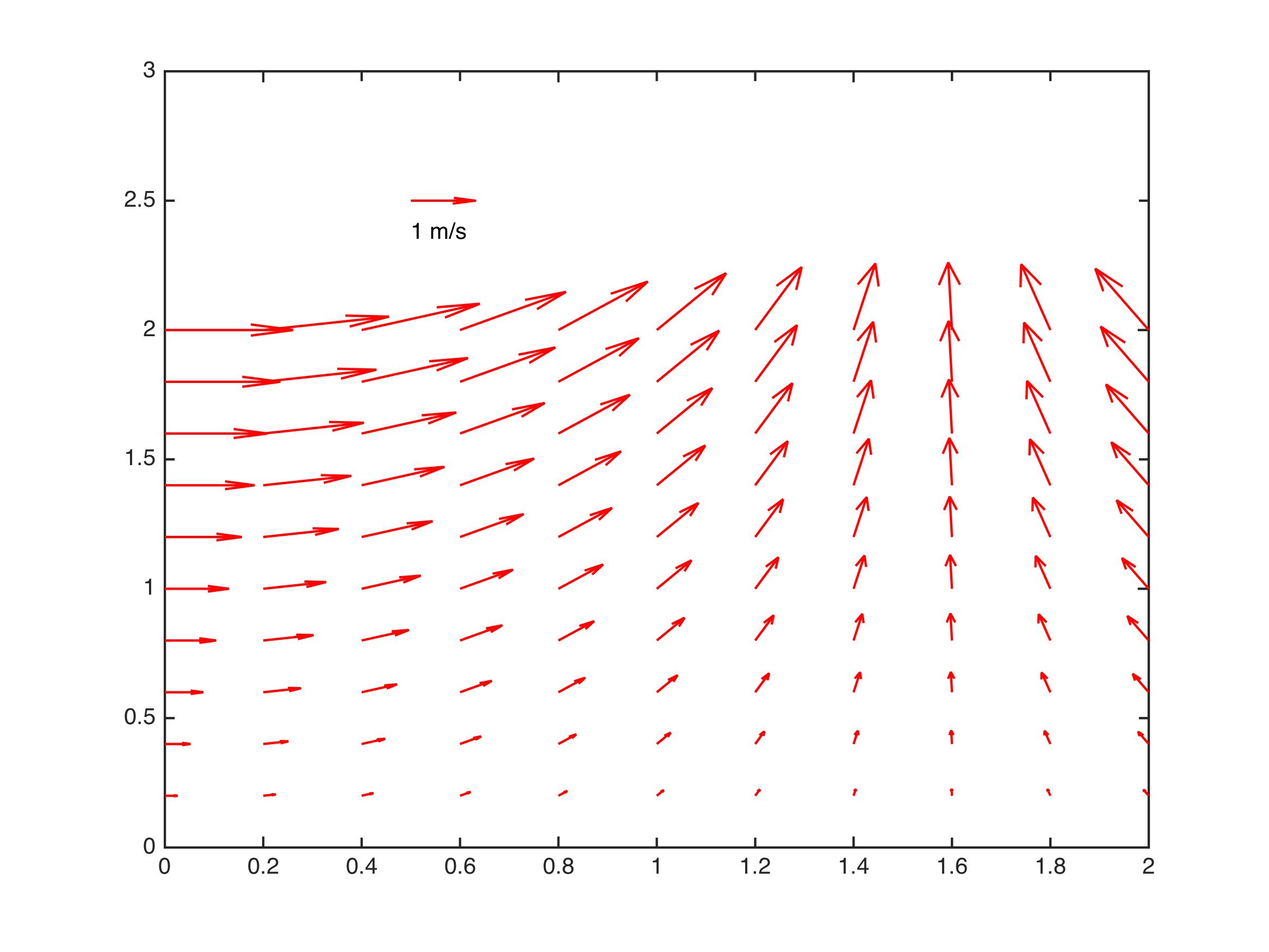
示例
[x,y] = meshgrid(0:0.2:2,0:0.2:2);

u = cos(x).*y;

v = sin(x).*y;

figure;

Qh = quiver(x,y,u,v);

quiverkey(Qh, 0.5, 2.5, 1, 'm/s', 'Color', 'r', 'Coordinates', 'data')
最终效果图
代码
function Q = quiverkey(Q, X, Y, U, label, varargin)

%QUIVERKEY legend for quiver

%

%   QUIVERKEY(Q, X, Y, U, label)

%

%   Arguments:

%       Q :      The quiver handle returned by a call to quiver

%       X,Y :    The location of the legend

%       U :      The unit length. If U<0, the arrow will be reversed

%       label :  The string with the length and units of the key

%

%   Addition arguments:

%       Coordinates = [ 'axes' | 'data'(default) ]

%

%           'axes' & 'figure' : 'axes' and 'figure' are normalized

%                       coordinate systems with 0,0 in the lower left

%                       and 1,1 in the upper right;

%           'data' :    use the axes data coordinates

%

%       LabelDistance : Distance in 'coordinates' between the arrow and the

%                   label. Deauft is 0.1 (units 'axes').

%

%       Color : overrides face and edge colors from Q.

%

%       LabelPosition = [ 'N' | 'S'(default) | 'E' | 'W' ]

%

%               Position the label above, below, to the right,

%               to the left of the arrow, respectively.

%

%       LabelColor : defaults to black

%

%   Examples:

%

%   [x,y] = meshgrid(0:0.2:2,0:0.2:2);

%   u = cos(x).*y;

%   v = sin(x).*y;

%   figure; Qh = quiver(x,y,u,v);

%   quiverkey(Qh, 0.5, 2.5, 1, 'm/s', 'Color', 'r', 'Coordinates', 'data')

%

% Author:

%   li12242 - Department of Civil Engineering in Tianjin University

% Email:

%   li12242@tju.edu.cn

%

%% get input argument

if nargin < 5

    error('Input arguments" Number incorrect!')

end

if isempty(varargin) && mod(length(varargin), 2) ~= 0

    error('Input arguments donot pairs!')

else

    [CoorUnit, LabelDist, Color, LabelPosition, LabelColor] = getInput(varargin);

end

%% add legend arrow

% get original data

xData = get(Q, 'XData'); yData = get(Q, 'YData');

uData = get(Q, 'UData'); vData = get(Q, 'VData');

% get axes properties

haxes = get(Q, 'Parent');

xLim = get(haxes, 'XLim'); yLim = get(haxes, 'YLim');

NextPlot = get(haxes, 'NextPlot');

% set axes properties

set(haxes, 'NextPlot', 'add')

if strcmp(CoorUnit, 'axes')

    % position of legend arrow

    xa = xLim(1) + X*(xLim(2) - xLim(1));

    ya = yLim(1) + Y*(yLim(2) - yLim(1));

else

    xa = X; ya = Y;

end

% add legend arrow into data vector

xData = [xData(:); xa]; yData = [yData(:); ya];

uData = [uData(:); U];  vData = [vData(:); 0];

% reset data

set(Q, 'XData', xData, 'YData', yData, 'UData', uData, 'VData', vData);

set(Q, 'Color', Color)

%% add text

dx = LabelDist*(xLim(2) - xLim(1));

dy = LabelDist*(yLim(2) - yLim(1));

% set position of label

switch LabelPosition

    case 'N'

        xl = xa; yl = ya + dy;

    case 'S'

        xl = xa; yl = ya - dy;

    case 'E'

        xl = xa + dx; yl = ya;

    case 'W'

        xl = xa - dx; yl = ya;

end% switch

th = text(xl, yl, [num2str(U), ' ', label]);

set(th, 'Color', LabelColor);

% turn axes properties to original

set(haxes, 'NextPlot', NextPlot)

end% func

%% sub function

function [CoorUnit, LabelDist, Color, LabelPosition, LabelColor] = getInput(varcell)

% Input:

%   varcell - cell variable

% Output:

%

nargin = numel(varcell);

%% set default arguments

CoorUnit = 'data';

LabelDist = 0.05; % units 'axes'

Color = 'k';

LabelPosition = 'S';

LabelColor = 'k';

%% get input arguments

contour = 1;

while contour < nargin

    switch varcell{contour}

        case 'Coordinates'

            CoorUnit = varcell{contour+ 1};

        case 'LabelDistance'

            LabelDist = varcell{contour+ 1};

        case 'Color'

            Color = varcell{contour+ 1};

        case 'LabelPosition'

            LabelPosition = varcell{contour+ 1};

        case 'LabelColor'

            LabelColor = varcell{contour+ 1};

        otherwise

            error('Unknown input argument.')

    end% switch

    contour = contour + 2;

end% while

end% fun
Matlab矢量图图例函数quiverkey的更多相关文章
- matlab 矢量化编程(四)—— 标量函数转化为能够处理矢量的函数
1. 组合的矢量实现 nchoosek(n, k) 的第二个参数在 matlab 下是不支持矢量化的,必须是标量形式.但 matlab 下的 gamma 函数,却可支持,矢量形式,又因为,gamma ...
- matlab中help所有函数功能的英文翻译
doc funname 在帮助浏览器中打开帮助文档 help funname 在命令窗口打开帮助文档 helpbrowser 直接打开帮助浏览器 lookfor funname 搜索某个关键字相关函数 ...
- C# 导出一个控件的矢量图
调用Control.DrawToBitmap(Bitmap) 方法是很容易得到控件的图形的. 但是bitmap是栅格化图形.栅格化图形有很多缺点,比如文件体积比较大. 放大后失真. 不易编辑等等. 这 ...
- matlab 全部的随机数函数
matlab 全部的随机数函数 (一)Matlab内部函数 a. 基本随机数 Matlab中有两个最基本生成随机数的函数. 1.rand() 生成(0,1)区间上均匀分布的随机变量.基本语法: ran ...
- Android 开发 VectorDrawable 矢量图 (三)矢量图动画
VectorDrawable 矢量图 三部曲: Android 开发 VectorDrawable 矢量图 (一)了解Android矢量图与获取矢量图 Android 开发 VectorDrawabl ...
- D3.js (v3)+react框架 基础部分之认识选择集和如何绘制一个矢量图
首先需要下载安装d3.js : yarn add d3 然后在组建中引入 : import * as d3 from 'd3' 然后定义一个方法,在componentDidMount()这个钩子 ...
- 矢量图和Word:EPS,PDF,EMF和SVG
1.EMF和Word 在学校的时候,我思考过一个问题,论文中的插图如何保证清晰度.关键之一就是使用矢量图.参考知乎问题:如何在论文中画出漂亮的插图?.常见的矢量图包括:EPS,EMF和SVG.SVG适 ...
- Matlab随笔之画图函数总结
原文:Matlab随笔之画图函数总结 MATLAB函数画图 MATLAB不但擅长於矩阵相关的数值运算,也适合用在各种科学目视表示(Scientific visualization).本节将介绍MATL ...
- Matlab中的eig函数和Opecv中eigen()函数的区别
奇异值分解的理论参见下面的链接 http://www.cnblogs.com/pinard/p/6251584.html https://blog.csdn.net/shenziheng1/artic ...
随机推荐
- 改善深层神经网络-week1编程题(Regularization)
Regularization Deep Learning models have so much flexibility and capacity that overfitting can be a ...
- ScatterLayout:分散布局在py中的引用
""" ScatterLayout:分散布局 """ from kivy.app import App from kivy.uix.scat ...
- 机器学习:SVM
SVM 前言:支持向量机(Support Vector Machine, SVM),作为最富盛名的机器学习算法之一,其本身是一个二元分类算法,为了更好的了解SVM,首先需要一些前提知识,例如:梯度下降 ...
- 利用Microsoft Graph开发微软的Exchange Calendar会议、Team
Microsoft Graph是什么? Microsoft Graph 是 Microsoft 365 中通往数据和智能的网关. 它提供统一的可编程模型,可用于访问 Microsoft 365.Win ...
- IdentityServer4 负载均衡配置
在不用到负载之前,一切都很好,但是部署多个实例之后,问题挺多的:session问题.令牌签发后的校验问题. 在此之前,先自查官方文档:Deployment - IdentityServer4 1.0. ...
- arm开发板上找不到/dev/i2c-*设备
最近在调试arm与外设iic通讯是,想来个投机取巧,先不写单独的驱动,直接通过iic bus设备是否可以连接到外设,然后发现在板子上找不到"/dev/i2c-n"的设备,标准的系统 ...
- Relocations in generic ELF (EM: 40)
最近在搞机器上的wifi热点,需要移植一大堆东西,如hostapd\wpa_suppliant.dhcp等,这些玩意又依赖其他的一大堆库的移植,比如libnl,openssl等,今天在移植编译libn ...
- 数值的整数次方 牛客网 剑指Offer
数值的整数次方 牛客网 剑指Offer 题目描述 给定一个double类型的浮点数base和int类型的整数exponent.求base的exponent次方 class Solution: #run ...
- Java 在PPT中创建散点图
本文将以Java代码示例展示如何在PPT幻灯片中创建散点图表. 创建图表前 需要在Java程序中导入用于操作PPT的jar包 Free Spire.Presentation for Java.可参考如 ...
- SpringBoot热部署(7)
1.引入热部署依赖包 <dependency> <groupId>org.springframework.boot</groupId> <artifactId ...