
POJ 1330 LCA裸题~
Description
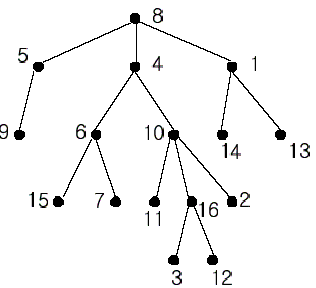
In the figure, each node is labeled with an integer from {1, 2,...,16}. Node 8 is the root of the tree. Node x is an ancestor of node y if node x is in the path between the root and node y. For example, node 4 is an ancestor of node 16. Node 10 is also an ancestor of node 16. As a matter of fact, nodes 8, 4, 10, and 16 are the ancestors of node 16. Remember that a node is an ancestor of itself. Nodes 8, 4, 6, and 7 are the ancestors of node 7. A node x is called a common ancestor of two different nodes y and z if node x is an ancestor of node y and an ancestor of node z. Thus, nodes 8 and 4 are the common ancestors of nodes 16 and 7. A node x is called the nearest common ancestor of nodes y and z if x is a common ancestor of y and z and nearest to y and z among their common ancestors. Hence, the nearest common ancestor of nodes 16 and 7 is node 4. Node 4 is nearer to nodes 16 and 7 than node 8 is.
For other examples, the nearest common ancestor of nodes 2 and 3 is node 10, the nearest common ancestor of nodes 6 and 13 is node 8, and the nearest common ancestor of nodes 4 and 12 is node 4. In the last example, if y is an ancestor of z, then the nearest common ancestor of y and z is y.
Write a program that finds the nearest common ancestor of two distinct nodes in a tree.
Input
Output
Sample Input
2

16

1 14

8 5

10 16

5 9

4 6

8 4

4 10

1 13

6 15

10 11

6 7

10 2

16 3

8 1

16 12

16 7

5

2 3

3 4

3 1

1 5

3 5
Sample Output
4

3
最近在复习一些暑假集训时候学到的一些数据结构,这次的主题是LCA(最近公共祖先),找出一棵树里边任意两个节点的最近公共祖先节点(这个称呼不太科学?),这是一道全裸的LCA的题目,有两种解决思路
方法一:对于每次查询的两个节点,先让两个节点上升到同一个深度的地方,然后两个节点在同时上升,直到两个节点相遇为止,相遇的点即为最近公共祖先。
方法二:先让某个节点一直往上走一直走到根节点,并开一个数组记录这个路径,让后再让另一个节点往上走,直到与前一个节点产生的路径相交为止,那么这个交点也是两个节点的最近公共祖先啦~

方法1的AC代码:
 /*********************************

 Author: jusonalien

 Email : jusonalien@qq.com

 school: South China Normal University

 Origin:

 *********************************/

 #include <cstdio>

 #include <vector>

 #include <cstring>

 using namespace std;

 const int maxn = ;

 vector<int>G[maxn];

 int depth[maxn],father[maxn];

 int root,n;

 void dfs(int v,int p,int d){//通过dfs构造出一棵树,并且记录每个节点的深度,这个很重要!

     depth[v] = d;

     for(int i = ;i < G[v].size();++i){

         if(G[v][i] != p) dfs(G[v][i],v,d+);

     }

     return ;

 }

 int lca(int u,int v){

     while(depth[u] > depth[v]) u = father[u];

     while(depth[v] > depth[u]) v = father[v];

     while(u != v){

         u = father[u];

         v = father[v];

     }

     return u;

 }

 void init(){

     memset(depth,,sizeof(depth));

     memset(father,-,sizeof(father));

     for(int i = ;i <= n;++i) G[i].clear();

 }

 void print(){//调试代码

     for(int i = ;i <= n;++i) printf("%02d ",father[i]);

     puts("");

     for(int i = ;i <= n;++i) printf("%02d ",depth[i]);

     puts("");

 }

 int main(){

     int cas;

     int a,b;

     scanf("%d",&cas);

     while(cas--){

         scanf("%d",&n);

         init();

         for(int i = ;i < n;++i){

             scanf("%d%d",&a,&b);

             father[b] = a;

             G[a].push_back(b);

         }

         for(int i = ;i <= n;++i)

             if(father[i] == -){

                 root = i;break;

             }

         dfs(root,-,);

         //print();

         scanf("%d%d",&a,&b);

         printf("%d\n",lca(a,b));

     }

     return ;

 }
方法2的AC代码:
 #include <cstdio>

 #include <cstring>

 using namespace std;

 int const maxn = +;

 int fa[maxn];

 bool vis[maxn];

 int n;

 int main()

 {

     int T;

     scanf("%d",&T);

     while(T--)

     {

         int u,v;

         scanf("%d",&n);

         memset(vis,,sizeof(vis));

         memset(fa,,sizeof(fa));

         for(int i=;i<n;++i)

         {

             scanf("%d%d",&u,&v);

             fa[v]=u;

         }

         scanf("%d%d",&u,&v);

         do

         {

             vis[u]=true;

             u=fa[u];

         }while(u!=);

         do

         {

             if(vis[v])

             {

                 printf("%d\n",v);

                 break;

             }

             v=fa[v];

         }while(v!=);

     }

     return ;

 }
个人觉得,方法1对于同一棵树上的大规模查询的效率要比方法2要高,并且当查询的节点大都在树的底层的时候,方法2会产生很多不必要的查询,也会产生较多的浪费(并且个人觉得方法1的代码更加优美?
Ps:这里有一份很不错的关于RMQ和LCA的学习资料介绍,请猛戳此处 选自农夫三拳。
POJ 1330 LCA裸题~的更多相关文章
- JZOJ5883【NOIP2018模拟A组9.25】到不了——动态LCA裸题
题目描述 Description wy 和 wjk 是好朋友. 今天他们在一起聊天,突然聊到了以前一起唱过的<到不了>. "说到到不了,我给你讲一个故事吧." &quo ...
- poj 1330 LCA
#include<cstdio> #include<iostream> #include<algorithm> #include<cstring> #i ...
- poj 1330 LCA (倍增+离线Tarjan)
/* 先来个倍增 */ #include<iostream> #include<cstring> #include<cstdio> #define maxn 100 ...
- POJ 3264 RMQ裸题
POJ 3264 题意:n个数,问a[i]与a[j]间最大值与最小值之差. 总结:看了博客,记下了模板,但有些地方还是不太理解. #include<iostream> #include&l ...
- poj 1330 LCA最近公共祖先
今天学LCA,先照一个模板学习代码,给一个离线算法,主要方法是并查集加上递归思想. 再搞,第一个离线算法是比较常用了,基本离线都用这种方法了,复杂度O(n+q).通过递归思想和并查集来寻找最近公共祖先 ...
- POJ 1330 LCA最近公共祖先 离线tarjan算法
题意要求一棵树上,两个点的最近公共祖先 即LCA 现学了一下LCA-Tarjan算法,还挺好理解的,这是个离线的算法,先把询问存贮起来,在一遍dfs过程中,找到了对应的询问点,即可输出 原理用了并查集 ...
- POJ.1330 Nearest Common Ancestors (LCA 倍增)
POJ.1330 Nearest Common Ancestors (LCA 倍增) 题意分析 给出一棵树,树上有n个点(n-1)条边,n-1个父子的边的关系a-b.接下来给出xy,求出xy的lca节 ...
- POJ 1330 Nearest Common Ancestors 倍增算法的LCA
POJ 1330 Nearest Common Ancestors 题意:最近公共祖先的裸题 思路:LCA和ST我们已经很熟悉了,但是这里的f[i][j]却有相似却又不同的含义.f[i][j]表示i节 ...
- POJ - 1330 Nearest Common Ancestors(dfs+ST在线算法|LCA倍增法)
1.输入树中的节点数N,输入树中的N-1条边.最后输入2个点,输出它们的最近公共祖先. 2.裸的最近公共祖先. 3. dfs+ST在线算法: /* LCA(POJ 1330) 在线算法 DFS+ST ...
随机推荐
- HDU - 2612 Find a way(BFS搜索)
题目: 链接 思路: 用BFS分别以‘Y’和‘M’的位置为起点进行两次搜索,并把这两次的搜索结果在一个二维数组中保存下来,在对地图遍历遇到‘@’更行最小值. PS: 如果用‘Y’和‘M’点分别去搜每个 ...
- 树莓派 -- oled 续(2) python
上文中的代码通过wiringPi的API调用devfs API来显示图片. 这里分析的Python代码也通过类似的方法来显示图片. 主要用到了两个Library. import spidev impo ...
- Django之模板引擎(母版)
Django之模板引擎(母版) 母版:存放所有页面的基本信息,基本样式 子班:继承母版 自定义当前页面私有的样式信息 母版的样式: {% block xxx(名称) %} xxxxxxx(数据) {% ...
- maven项目运行tomcat7-maven-plugin:run时出现Caused by: java.lang.ClassNotFoundException: org.codehaus.plexus.util.Scanner(xjl456852原创)
使用tomcat7-maven-plugin插件运行web项目时, 出现下面错误: [WARNING] Error injecting: org.sonatype.plexus.build.incre ...
- 全文搜索(A-2)-推荐算法
一般来说推荐算法分为两类. 基于内容过滤的推荐: 基于协同过滤的推荐: 基于内容过滤的推荐,基于特征码描述项目. 协同过滤算法的设计基于一个假设,“和目标用户相似度高的用户,其感兴趣的物品目标用户也会 ...
- DFS template and summary
最近一直在学习Deep Frist Search,也在leetcode上练习了不少题目.从最开始的懵懂,到现在遇到问题基本有了思路.依然清晰的记得今年2月份刚开始刷题的时做subsets的那个吃力劲, ...
- UVA 140_Bandwidth
题意: 定义一个结点的带宽是其距离所有相连结点的最远距离,一个图的带宽是图中所有结点带宽的最小值.给出一个图中各个结点的相邻情况,要求写出一个结点的排列,使得其所构成的图带宽最小. 分析: 枚举全排列 ...
- [bzoj1430]小猴打架_prufer序列
小猴打架 bzoj-1430 题目大意:题目链接. 注释:略. 想法: 我们发现打架的情况就是一棵树. 我们只需要把确定树的形态然后乘以$(n-1)!$表示生成这棵树时边的顺序. 一共$n$个节点我们 ...
- [bzoj2058][Usaco2010 Nov]Cow Photographs_树状数组_动态规划
Cow Photographs bzoj-2058 Usaco-2010 Nov 题目大意:给定一个n的排列.每次操作可以交换相邻两个数.问将序列变成一个:$i,i+1,i+2,...,n,1,2,. ...
- HDU——1068 Girls and Boys
Girls and Boys Time Limit: 20000/10000 MS (Java/Others) Memory Limit: 65536/32768 K (Java/Others) ...