
【转帖】You can now run a GPT-3-level AI model on your laptop, phone, and Raspberry Pi
https://arstechnica.com/information-technology/2023/03/you-can-now-run-a-gpt-3-level-ai-model-on-your-laptop-phone-and-raspberry-pi/
Things are moving at lightning speed in AI Land. On Friday, a software developer named Georgi Gerganov created a tool called "llama.cpp" that can run Meta's new GPT-3-class AI large language model, LLaMA, locally on a Mac laptop. Soon thereafter, people worked out how to run LLaMA on Windows as well. Then someone showed it running on a Pixel 6 phone, and next came a Raspberry Pi (albeit running very slowly).
If this keeps up, we may be looking at a pocket-sized ChatGPT competitor before we know it.

But let's back up a minute, because we're not quite there yet. (At least not today—as in literally today, March 13, 2023.) But what will arrive next week, no one knows.
Since ChatGPT launched, some people have been frustrated by the AI model's built-in limits that prevent it from discussing topics that OpenAI has deemed sensitive. Thus began the dream—in some quarters—of an open source large language model (LLM) that anyone could run locally without censorship and without paying API fees to OpenAI.
Open source solutions do exist (such as GPT-J), but they require a lot of GPU RAM and storage space. Other open source alternatives could not boast GPT-3-level performance on readily available consumer-level hardware.
Enter LLaMA, an LLM available in parameter sizes ranging from 7B to 65B (that's "B" as in "billion parameters," which are floating point numbers stored in matrices that represent what the model "knows"). LLaMA made a heady claim: that its smaller-sized models could match OpenAI's GPT-3, the foundational model that powers ChatGPT, in the quality and speed of its output. There was just one problem—Meta released the LLaMA code open source, but it held back the "weights" (the trained "knowledge" stored in a neural network) for qualified researchers only.
Advertisement
Flying at the speed of LLaMA
Meta's restrictions on LLaMA didn't last long, because on March 2, someone leaked the LLaMA weights on BitTorrent. Since then, there has been an explosion of development surrounding LLaMA. Independent AI researcher Simon Willison has compared this situation to the release of Stable Diffusion, an open source image synthesis model that launched last August. Here's what he wrote in a post on his blog:
It feels to me like that Stable Diffusion moment back in August kick-started the entire new wave of interest in generative AI—which was then pushed into over-drive by the release of ChatGPT at the end of November.
That Stable Diffusion moment is happening again right now, for large language models—the technology behind ChatGPT itself. This morning I ran a GPT-3 class language model on my own personal laptop for the first time!
AI stuff was weird already. It’s about to get a whole lot weirder.
Typically, running GPT-3 requires several datacenter-class A100 GPUs (also, the weights for GPT-3 are not public), but LLaMA made waves because it could run on a single beefy consumer GPU. And now, with optimizations that reduce the model size using a technique called quantization, LLaMA can run on an M1 Mac or a lesser Nvidia consumer GPU (although "llama.cpp" only runs on CPU at the moment—which is impressive and surprising in its own way).
Things are moving so quickly that it's sometimes difficult to keep up with the latest developments. (Regarding AI's rate of progress, a fellow AI reporter told Ars, "It's like those videos of dogs where you upend a crate of tennis balls on them. [They] don't know where to chase first and get lost in the confusion.")
For example, here's a list of notable LLaMA-related events based on a timeline Willison laid out in a Hacker News comment:
- February 24, 2023: Meta AI announces LLaMA.
- March 2, 2023: Someone leaks the LLaMA models via BitTorrent.
- March 10, 2023: Georgi Gerganov creates llama.cpp, which can run on an M1 Mac.
- March 11, 2023: Artem Andreenko runs LLaMA 7B (slowly) on a Raspberry Pi 4, 4GB RAM, 10 sec/token.
- March 12, 2023: LLaMA 7B running on NPX, a node.js execution tool.
- March 13, 2023: Someone gets llama.cpp running on a Pixel 6 phone, also very slowly.
- March 13, 2023, 2023: Stanford releases Alpaca 7B, an instruction-tuned version of LLaMA 7B that "behaves similarly to OpenAI's "text-davinci-003" but runs on much less powerful hardware.
Advertisement
After obtaining the LLaMA weights ourselves, we followed Willison's instructions and got the 7B parameter version running on an M1 Macbook Air, and it runs at a reasonable rate of speed. You call it as a script on the command line with a prompt, and LLaMA does its best to complete it in a reasonable way.
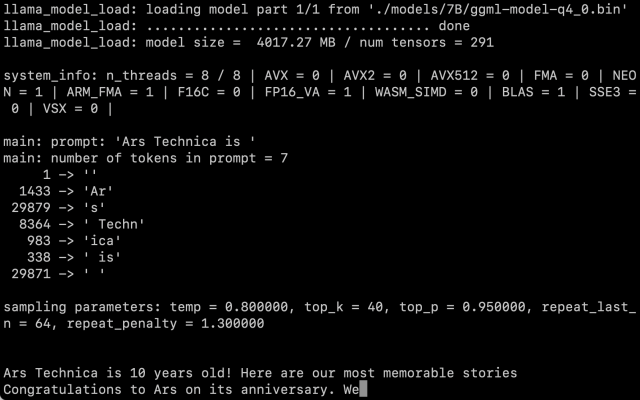
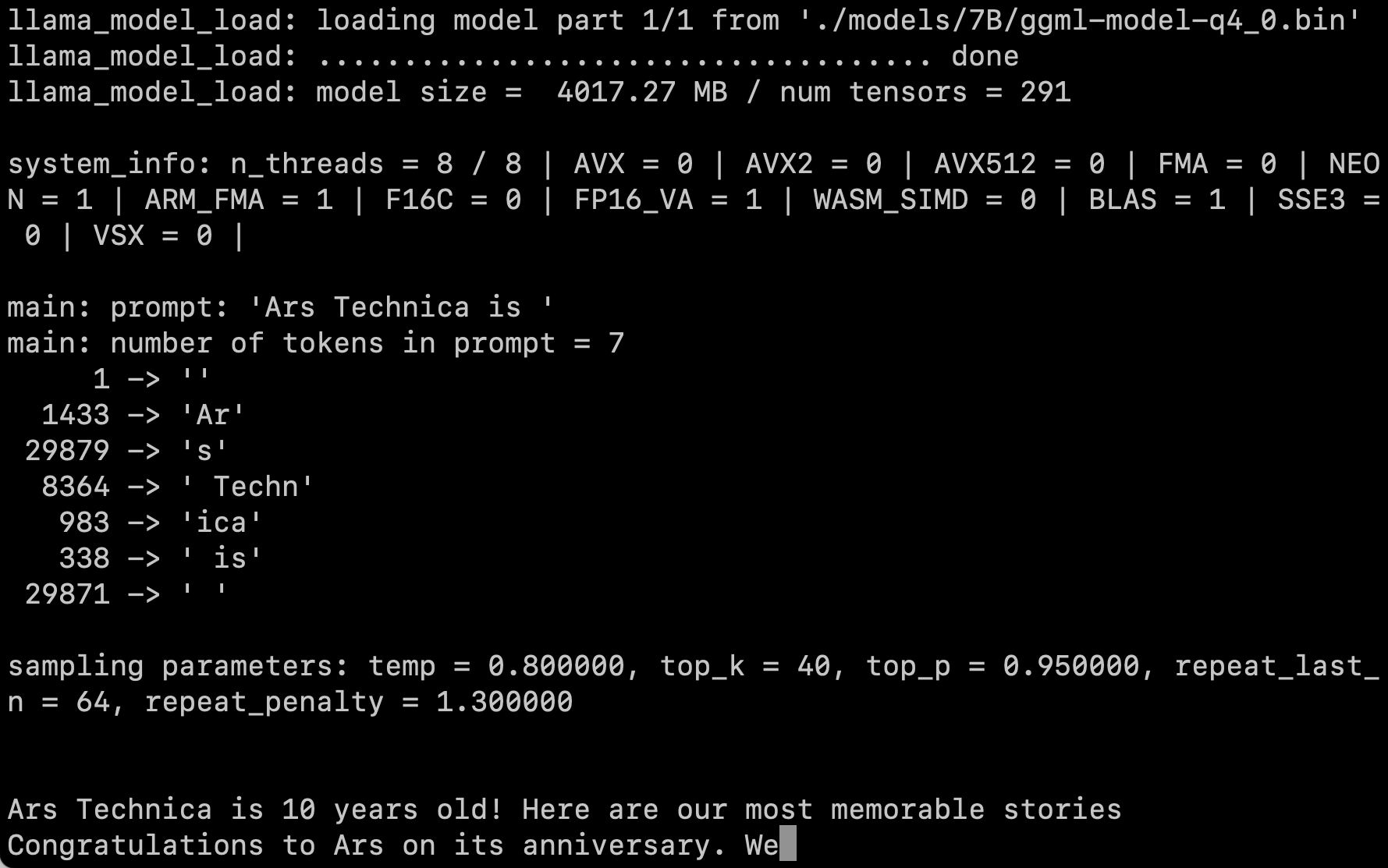
There's still the question of how much the quantization affects the quality of the output. In our tests, LLaMA 7B trimmed down to 4-bit quantization was very impressive for running on a MacBook Air—but still not on par with what you might expect from ChatGPT. It's entirely possible that better prompting techniques might generate better results.
Also, optimizations and fine-tunings come quickly when everyone has their hands on the code and the weights—even though LLaMA is still saddled with some fairly restrictive terms of use. The release of Alpaca today by Stanford proves that fine tuning (additional training with a specific goal in mind) can improve performance, and it's still early days after LLaMA's release.
FURTHER READING
As of this writing, running LLaMA on a Mac remains a fairly technical exercise. You have to install Python and Xcode and be familiar with working on the command line. Willison has good step-by-step instructions for anyone who would like to attempt it. But that may soon change as developers continue to code away.
As for the implications of having this tech out in the wild—no one knows yet. While some worry about AI's impact as a tool for spam and misinformation, Willison says, "It’s not going to be un-invented, so I think our priority should be figuring out the most constructive possible ways to use it."
Right now, our only guarantee is that things will change rapidly.
【转帖】You can now run a GPT-3-level AI model on your laptop, phone, and Raspberry Pi的更多相关文章
- Raspberry Pi 3 --- Kernel Building and Run in A New Version Kernal
ABSTRACT There are two main methods for building the kernel. You can build locally on a Raspberry Pi ...
- OSMC Vs. OpenELEC Vs. LibreELEC – Kodi Operating System Comparison
Kodi's two slim-and-trim kid brothers LibreELEC and OpenELEC were once great solutions for getting t ...
- Jenkins报错Caused: java.io.IOException: Cannot run program "sh" (in directory "D:\Jenkins\Jenkins_home\workspace\jmeter_test"): CreateProcess error=2, 系统找不到指定的文件。
想在本地执行我的python文件,我本地搭建了一个Jenkins,使用了execute shell来运行我的脚本,发现报错 [jmeter_test] $ sh -xe D:\tomcat\apach ...
- FAT-fs (mmcblk0p1): Volume was not properly unmounted. Some data may be corrupt. Please run fsck.
/******************************************************************************** * FAT-fs (mmcblk0p ...
- (转载)如何创建一个以管理员权限运行exe 的快捷方式? How To Create a Shortcut That Lets a Standard User Run An Application as Administrator
How To Create a Shortcut That Lets a Standard User Run An Application as Administrator by Chris Hoff ...
- java.io.IOException: Cannot run program "/opt/jdk1.8.0_191/bin/java" (in directory "/var/lib/jenkins/workspace/xinguan"): error=2, No such file or directory
测试jenkins构建,报错如下 Parsing POMs Established TCP socket on 44463 [xinguan] $ /opt/jdk1.8.0_191/bin/java ...
- 【协作式原创】自己动手写docker之run代码解析
linux预备知识 urfave cli预备知识 准备工作 阿里云抢占式实例:centos7.4 每次实例释放后都要重新安装go wget https://dl.google.com/go/go1.1 ...
- FreeBSD 10 发布
发行注记:http://www.freebsd.org/releases/10.0R/relnotes.html 下文翻译中... 主要有安全问题修复.新的驱动与硬件支持.新的命名/选项.主要bug修 ...
- 【Xamarin挖墙脚系列:Mono项目的图标为啥叫Mono】
因为发起人大Boss :Miguel de lcaza 是西班牙人,喜欢猴子.................就跟Hadoop的创始人的闺女喜欢大象一样...................... 历 ...
- Win8.1重装win7或win10中途无法安装
一.有的是usb识别不了,因为新的机器可能都是USB3.0的,安装盘是Usb2.0的. F12更改系统BIOS设置,我改了三个地方: 1.设置启动顺序为U盘启动 2.关闭了USB3.0 control ...
随机推荐
- 冠军斩获10万奖金!首届“域见杯”医检AI开发者大赛精彩落幕
摘要:首届"域见杯"医检AI开发者大赛精彩落幕. 8月24日,由广州市科学技术局指导,金域医学和华为云共同打造的中国第三方医检行业首个开发者大赛--"域见杯"医 ...
- U2Net基于ModelArts Notbook的仿真实验
摘要:U2Net是一个优秀的显著性目标检测算法,由Qin Xuebin等人发表在Pattern Recognition 2020期刊[Arxiv].U2Net名称的来源在于其网络结构由两层嵌套的Une ...
- 想从单体架构演进到分布式架构,SBA 会是一个不错的选择
摘要:SBA 可以看成是单体架构和微服务架构之间的一个折中方案,它也是按照业务领域进行服务划分,但服务划分的粒度相比微服务要更粗.从单体架构演进到 SBA,会比直接演进到微服务架构更加容易. 本文分享 ...
- gis经纬度坐标转换多格式兼容:支持字符串/数组/GeoJSON
格式 let coordinatesStrReg = /((-*[1][0-9]{0,2}|0)(\.[0-9]{1,6})*),\s{0,2}((-*[1-9][0-9]{0,1}|0)(\.[0- ...
- C# 跳过值班时间代码逻辑
/// <summary> /// 当前时间是否是值班时间 /// </summary> private bool IsDutyTime { get { var dutyTim ...
- windows使用rclone挂载alist为本地磁盘,设置开机自启
前言 实现在windows下将alist挂载为本地磁盘,并设置开机自启,使得重启后依然生效. 教程 下载软件 Rclone: Rclone downloads WinFsp: https://winf ...
- ME2N增强
一.ME2N增加字段 二.结构中添加扩展字段 附加结构中添加同名这些字段时会报错,原因是MEREP_OUTTAB_DOWNPAY等结构已存在该字段,导致冲突 三.添加逻辑代码 包含文件LMEREPI0 ...
- 【Boost】boost.log 要点笔记
常用简写: namespace logging = boost::log; namespace src = boost::log::sources; namespace expr = boost::l ...
- Educational Round 95 (Div. 2) A - B题题解(A题数据连错3次,搞人心态中)
1418A. Buying Torches 这次A题,真心fo了(导致wa了我两次) 样例出错两次,数据出错一次. 讲一下我的思路吧. 首先先明确至少需要多少个棍.\(k\) 个火炬,至少需要$k ∗ ...
- vivo 商城前端架构升级-总览篇
本文首发于 vivo互联网技术 微信公众号链接: https://mp.weixin.qq.com/s/vD9yvYNaxTQBLABik6aqNg作者:官网商城前端团队 [背景] 一年前 vivo ...