
Handler 消息传递机制
1,Handler 的概念
Handler 是用来干什么的?
1)执行计划任务,可以在预定的时间执行某些任务,可以模拟定时器
2)线程间通信。在Android的应用启动时,会创建一个主线程,主线程会创建一个
消息队列来处理各种消息。当你创建子线程时,你可以在你的子线程中拿到父线程中
创建的Handler 对象,就可以通过该对象向父线程的消息队列发送消息了。由于Android
要求在UI线程中更新界面,因此,可以通过该方法在其它线程中更新界面。
角色描述:
1) Looper: 一个线程可以产生一个Looper对象,由它来管理此线程里的Message Queue
2) Handler: 你可以构造Handler对象来与Looper沟通,以便push 新消息到 Message Queue里,或者
接收Looper从Message Queue 里所送来的消息。
3)Message Queue(消息队列):是用来存放线程放入的消息。
4)线程:UI thread 通常就是 main thread,而Android 启动程序时会替它建立一个Message Queue。
每一个线程里可含有一个 Looper 对象以及一个 Message Queue 数据结构。在你的应用程序里,
可以定义 Handler 的子类别来接收 Looper 所送出的消息。
2,Handler 的执行过程
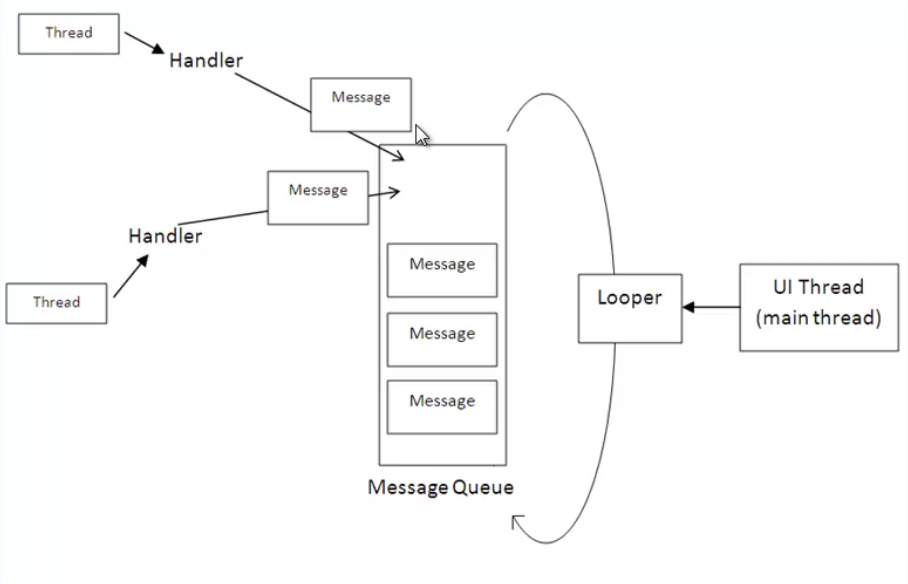
每个handler 对应一个线程 thread , 在子线程中 handler 发送的消息会进入到 Message Queue当中去,由 looper 再来分发给 Handler 处理。
3,Handler 异步实现方法
见实例
http://download.csdn.net/detail/fulinwsuafcie/4437306
4,Handler 与线程的关系
Handler 一般运行于主线程内
问题:
1,使用Handler 是异步的,它会建立新的线程么? 不会
2,Handler 是在主线程内么? 一般都会在主线程内,但也可以在子线程中创建Handler
3,Handler 的 post 和 sendMessage 方法,使用的是一个队列不安是两个? 一个
4,子线程中建立一个 handler, 然后sendMessage 会怎么样? 会崩溃
5,子线程建立 handler ,构造的时候舒心入主线程的 Looper ? yes
如果有兴趣的话,可以看下原始的android 注释,摘自 Handler.java 代码的头部注释。
/**
* A Handler allows you to send and process {@link Message} and Runnable
* objects associated with a thread's {@link MessageQueue}. Each Handler
* instance is associated with a single thread and that thread's message
* queue. When you create a new Handler, it is bound to the thread /
* message queue of the thread that is creating it -- from that point on,
* it will deliver messages and runnables to that message queue and execute
* them as they come out of the message queue.
*
* <p>There are two main uses for a Handler: (1) to schedule messages and
* runnables to be executed as some point in the future; and (2) to enqueue
* an action to be performed on a different thread than your own.
*
* <p>Scheduling messages is accomplished with the
* {@link #post}, {@link #postAtTime(Runnable, long)},
* {@link #postDelayed}, {@link #sendEmptyMessage},
* {@link #sendMessage}, {@link #sendMessageAtTime}, and
* {@link #sendMessageDelayed} methods. The <em>post</em> versions allow
* you to enqueue Runnable objects to be called by the message queue when
* they are received; the <em>sendMessage</em> versions allow you to enqueue
* a {@link Message} object containing a bundle of data that will be
* processed by the Handler's {@link #handleMessage} method (requiring that
* you implement a subclass of Handler).
*
* <p>When posting or sending to a Handler, you can either
* allow the item to be processed as soon as the message queue is ready
* to do so, or specify a delay before it gets processed or absolute time for
* it to be processed. The latter two allow you to implement timeouts,
* ticks, and other timing-based behavior.
*
* <p>When a
* process is created for your application, its main thread is dedicated to
* running a message queue that takes care of managing the top-level
* application objects (activities, broadcast receivers, etc) and any windows
* they create. You can create your own threads, and communicate back with
* the main application thread through a Handler. This is done by calling
* the same <em>post</em> or <em>sendMessage</em> methods as before, but from
* your new thread. The given Runnable or Message will then be scheduled
* in the Handler's message queue and processed when appropriate.
*/
转自:http://blog.csdn.net/fulinwsuafcie/article/details/7760041
Handler 消息传递机制的更多相关文章
- 安卓开发_深入理解Handler消息传递机制
一.概述 因为子线程的run()方法无法修改UI线程(主线程)的UI界面,所以Android引入了Handler消息传递机制,实现在新创建的线程中操作UI界面 二.消息类(Message) 消息类是存 ...
- Android学习笔记-事件处理之Handler消息传递机制
内容摘要:Android Handler消息传递机制的学习总结.问题记录 Handler消息传递机制的目的: 1.实现线程间通信(如:Android平台只允许主线程(UI线程)修改Activity里的 ...
- 事件处理机制与Handler消息传递机制
一.基于监听的事件处理机制 基于监听的时间处理机制模型: 事件监听机制中由事件源,事件,事件监听器三类对象组成 处理流程如下: Step 1:为某个事件源(组件)设置一个监听器,用于监听用户操作 St ...
- Handler消息传递机制
引言: 出于性能优化考虑,Android的UI操作并不是线程安全的,这意味着如果有多个线程并发操作UI组件,可能导致线程安全问题. 为了解决这个问题,Android制定了一条简单的规则:只允许UI线程 ...
- Android学习之Handler消息传递机制
Android只允许UI线程修改Activity里的UI组件.当Android程序第一次启动时,Android会同时启动一条主线程(Main Thread),主线程主要负责处理与UI相关的事件,如用户 ...
- Handler消息传递机制——Handler类简洁
Handler类的主要作用有两个: 在新启动的线程中发送消息. 在主线程中获取.处理消息. 上面的说法很简单,只要分成两步即可:在新启动的线程中发送消息:然后在主线程上获取.并处理消息.但这个过程涉及 ...
- Android Handler消息传递机制
在Android系统中,类Handler主要有如下两个作用. 在新启动的线程中发送消息. 在主线程中获取.处理消息. 类Handler在实现上述作用时,首先在新启动的线程中发送消息,然后在主线程中获取 ...
- Android中的消息机制:Handler消息传递机制
参考<疯狂android讲义>第2版3.5 P214 一.背景 出于性能优化考虑,Android的UI操作并不是线程安全的,这意味着如果有多个线程并发操作UI组件,可能导致线程安全问题.为 ...
- Handler消息传递机制——Handler、Loop、MessageQueue的工作原理
为了更好地理解Handler的工作原理,先介绍一下与Handler一起工作的几个组件. Message:Handler接收和处理的消息对象. Looper:每个线程只能拥有一个Looper.它的loo ...
随机推荐
- .NET读写Excel工具Spire.XlS使用(DataExport )
Introduction E-ICEBLUE is developing office.net component, the main products include Spire.Doc, Spir ...
- .NET(C#):await返回Task的async方法
众所周知,async方法只可以返回void,Task和Task<T>. 对于返回void的async方法,它并不是awaitable,所以其他方法不能用await方法来调用它,而返回Tas ...
- fillStyle线性渐变
废话小说,沾待马 <!DOCTYPE HTML> <head> <meta charset = "utf-8"> <title>ca ...
- SQL Server(五)——常用函数
1.数学函数:操作一个数据,返回一个结果 --取上限ceiling select code,name,ceiling(price) from car ; --取下限 floor select floo ...
- Tomcat:bio nio 的设计
BIO 由Acceptor接收Socket,将其转交给Worker来处理. NIO 由Acceptor接收Socket,将其转交给Poller来轮询处理.Poller再将可处理的Socket交给Wo ...
- SQL优化技巧--远程连接对象引起的CTE性能问题
背景 最近SSIS的开发过程中遇到几个问题.其中使用CTE时,遇到一个远程连接对象,结果导致严重的性能问题,为了应急我就修改了代码. 之前我写了一篇介绍CTE的随笔包含了CTE的用法等: http:/ ...
- SQL Server 2000 sp2 及更低版本不受此版本的 Windows 支持
SQL Server 2000 sp2 及更低版本不受此版本的 Windows 支持.在安装了 SQL Server 2000 之后请应用 sp3. 出现这种现象的原因在于:Windows Serve ...
- itextpd f生成 pdf 文件
一.简介 itextpdf 是一个开源的允许你去创建和操作PDF文档的库.它使的开发者可以提高web和其他应用来动态地生成或操作PDF文档.通过iText 中的Document和PdfWriter类, ...
- IO系统性能之一:衡量性能的几个指标
作为一个数据库管理员,关注系统的性能是日常最重要的工作之一,而在所关注的各方面的性能只能IO性能却是最令人头痛的一块,面对着各种生涩的参数和令人眼花缭乱的新奇的术语,再加上存储厂商的忽悠,总是让我们有 ...
- MySQL-procedure(cursor,loop)
现有一张表spam_keyword,共629条记录,每条记录的word字段的字符数量不等. CREATE TABLE `spam_keyword` ( `kid` ) NOT NULL, `word` ...