
大batch任务对structured streaming任务影响
信念,你拿它没办法,但是没有它你什么也做不成。—— 撒姆尔巴特勒
前言
对于spark streaming而言,大的batch任务会导致后续batch任务积压,对于structured streaming任务影响如何,本篇文章主要来做一下简单的说明。
本篇文章的全称为设置trigger后,运行时间长的 query 对后续 query 的submit time的影响
Trigger类型
首先trigger有三种类型,分别为 OneTimeTrigger ,ProcessingTime 以及 ContinuousTrigger 三种。这三种解释可以参照 spark 集群优化 中对 trigger的解释说明。
设置OneTimeTrigger后,运行时间长的 query 对后续 query 的submit time的影响
OneTimeTrigger只执行一次query就结束了,不存在对后续batch影响。
设置ProcessingTimeTrigger后,运行时间长的 query 对后续 query 的submit time的影响
设置超过 trigger inverval的sleep时间
代码截图如下,即在每一个partition上的task中添加一个sleep逻辑:

运行效果
运行效果截图如下:
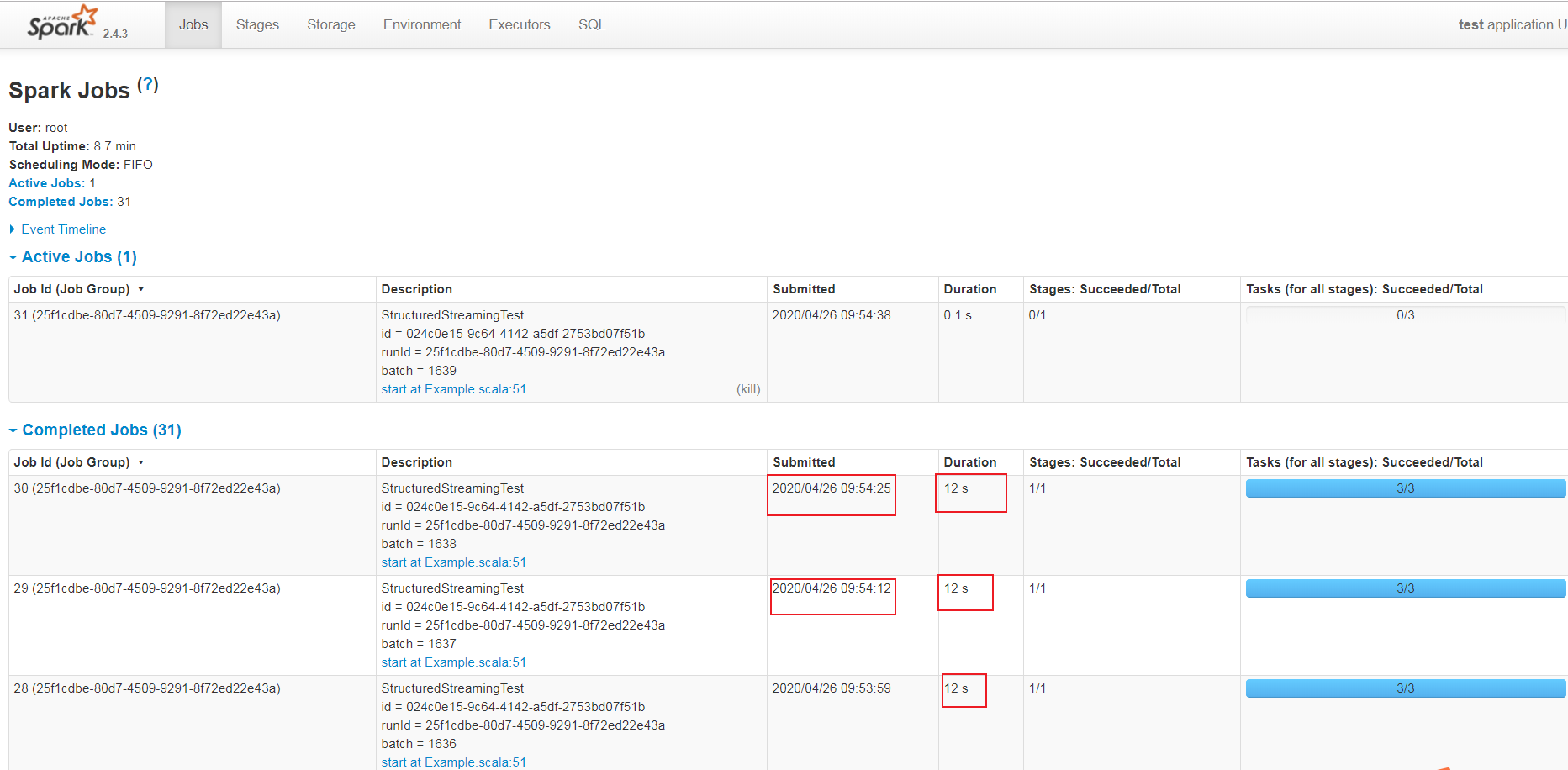
UI的Jobs面板截图如下:
UI的SQL面板截图如下:
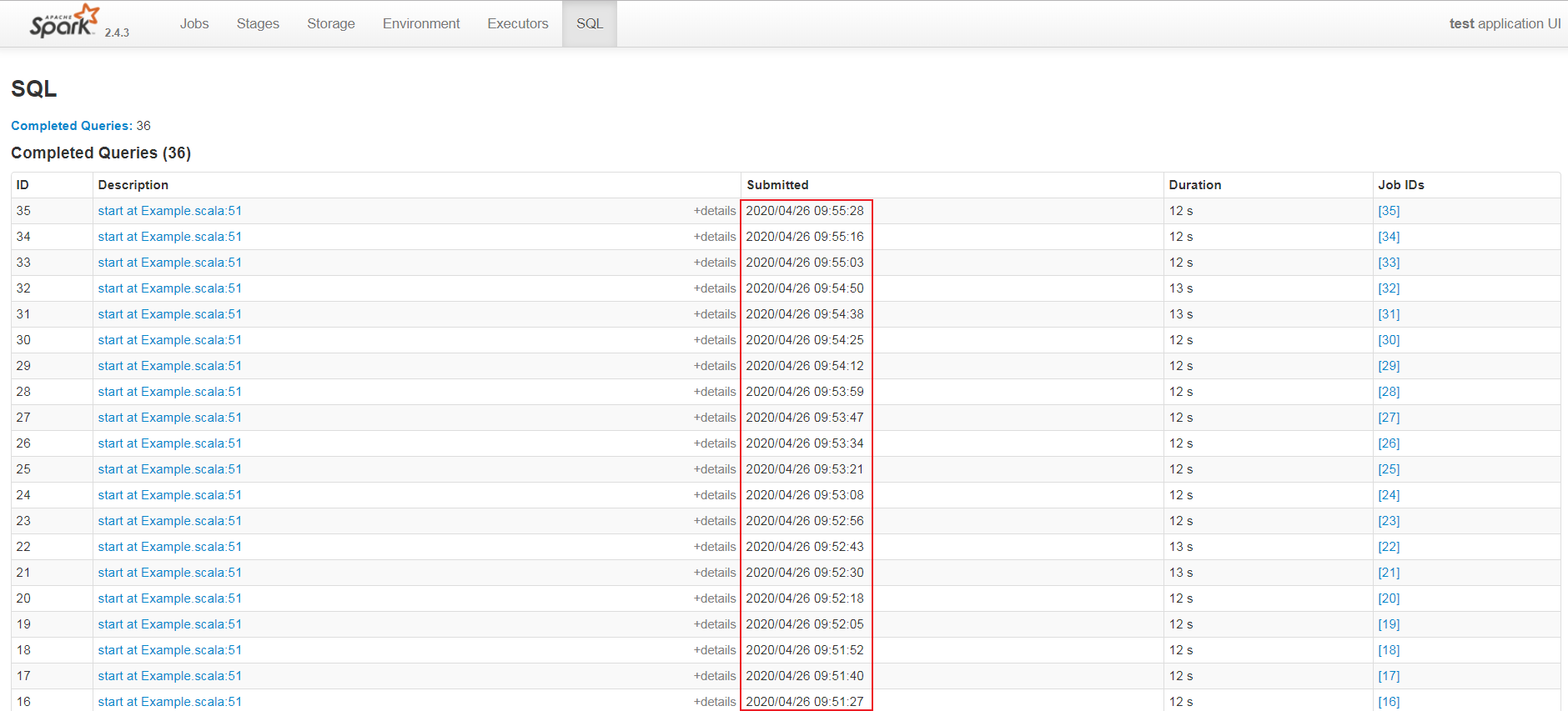
通过上面两个面板截图中的submitted列可以看出,此时每一个batch的query 提交时间是根据前驱query的结束时间来确定的。
设置 ContinuousTrigger 后,运行时间长的 query 对后续 query 的submit time的影响
源码分析
下面从源码角度来分析一下。
StreamExecution的职责
它是当新数据到达时在后台连续执行的查询的句柄。管理在单独线程中发生的流式Spark SQL查询的执行。 与标准查询不同,每次新数据到达查询计划中存在的任何 Source 时,流式查询都会重复执行。每当新数据到达时,都会创建一个 QueryExecution,并将结果以事务方式提交给给定的 Sink 。
它有两个子类,截图如下:

Tigger和StreamExecution的对应关系
在org.apache.spark.sql.streaming.StreamingQueryManager#createQuery方法中有如下代码片段:
 (sink, trigger) match {

       case (v2Sink: StreamWriteSupport, trigger: ContinuousTrigger) =>

         if (sparkSession.sessionState.conf.isUnsupportedOperationCheckEnabled) {

           UnsupportedOperationChecker.checkForContinuous(analyzedPlan, outputMode)

         }

         // 使用 ContinuousTrigger 则为 ContinuousExecution

         new StreamingQueryWrapper(new ContinuousExecution(

           sparkSession,

           userSpecifiedName.orNull,

           checkpointLocation,

           analyzedPlan,

           v2Sink,

           trigger,

           triggerClock,

           outputMode,

           extraOptions,

           deleteCheckpointOnStop))

       case _ =>

         // 使用 ProcessingTrigger 则为 MicroBatchExecution

         new StreamingQueryWrapper(new MicroBatchExecution(

           sparkSession,

           userSpecifiedName.orNull,

           checkpointLocation,

           analyzedPlan,

           sink,

           trigger,

           triggerClock,

           outputMode,

           extraOptions,

           deleteCheckpointOnStop))

     }
可以看出,Tigger和对应的StreamExecution的关系如下:
|
Trigger
|
StreamExecution
|
|---|---|
| OneTimeTrigger | MicroBatchExecution |
| ProcessingTrigger | MicroBatchExecution |
| ContinuousTrigger | ContinuousExecution |
另外,StreamExecution构造参数中的analyzedPlan是指LogicalPlan,也就是说在第一个query启动之前,LogicalPlan已经生成,此时的LogicalPlan是 UnResolved LogicalPlan,因为此时每一个AST依赖的数据节点的source信息还未知,还无法优化LogicalPlan。
注意
ContinuousExecution支持的source类型目前有限,主要为StreamWriteSupport子类,即:
|
source
|
class full name
|
|---|---|
| console | org.apache.spark.sql.execution.streaming.ConsoleSinkProvider |
| kafka | org.apache.spark.sql.kafka010.KafkaSourceProvider |
| ForeachSink | org.apache.spark.sql.execution.streaming.sources.ForeachWriterProvider |
| MemorySinkV2 | org.apache.spark.sql.execution.streaming.sources.MemorySinkV2 |
否则会匹配到 MicroBatchExecution, 但是在初始化 triggerExecution成员变量时,只支持ProcessingTrigger,不支持 ContinuousTrigger,会抛出如下异常:

StreamExecution的执行
org.apache.spark.sql.streaming.StreamingQueryManager#startQuery有如下代码片段:
 try {

       // When starting a query, it will call `StreamingQueryListener.onQueryStarted` synchronously.

       // As it's provided by the user and can run arbitrary codes, we must not hold any lock here.

       // Otherwise, it's easy to cause dead-lock, or block too long if the user codes take a long

       // time to finish.

       query.streamingQuery.start()

     } catch {

       case e: Throwable =>

         activeQueriesLock.synchronized {

           activeQueries -= query.id

         }

         throw e

     }
这里的query.streamingQuery就是StreamExecution,即为MicroBatchExecution 或 ContinuousExecution。
StreamExecution的start 方法如下:
 /**

    * Starts the execution. This returns only after the thread has started and [[QueryStartedEvent]]

    * has been posted to all the listeners.

    */

   def start(): Unit = {

     logInfo(s"Starting $prettyIdString. Use $resolvedCheckpointRoot to store the query checkpoint.")

     queryExecutionThread.setDaemon(true)

     queryExecutionThread.start()

     startLatch.await()  // Wait until thread started and QueryStart event has been posted

   }
queryExecutionThread成员变量声明如下:
 /**

    * The thread that runs the micro-batches of this stream. Note that this thread must be

    * [[org.apache.spark.util.UninterruptibleThread]] to workaround KAFKA-1894: interrupting a

    * running `KafkaConsumer` may cause endless loop.

    */

   val queryExecutionThread: QueryExecutionThread =

     new QueryExecutionThread(s"stream execution thread for $prettyIdString") {

       override def run(): Unit = {

         // To fix call site like "run at <unknown>:0", we bridge the call site from the caller

         // thread to this micro batch thread

         sparkSession.sparkContext.setCallSite(callSite)

         runStream()

       }

     }
其中,QueryExecutionThread 是 UninterruptibleThread 的子类,UninterruptibleThread 是 Thread的子类,即QueryExecutionThread 是一个线程类。他会运行runStream方法,runStream关键代码如下:
try {

// 运行Stream query的准备工作,send QueryStartedEvent event, countDown latch,streaming configure等操作

runActivatedStream(sparkSessionForStream) // 运行 stream

} catch {

// 异常处理

} finally {

 // 运行完Stream query的收尾工作,stop source,send stream stop event,删除checkpoint(如果启用deleteCheckpointOnStop)等等操作

}
runActivatedStream 说明:Run the activated stream until stopped. :它是抽象方法,由子类实现。
MicroBatchExecution的runActivatedStream的实现
MicroBatchExecution 的 runActivatedStream的方法逻辑描述如下:
 triggerExecutor.execute(() =>{

     提交执行每一个query的操作

 })
triggerExecution 的定义如下:
private val triggerExecutor = trigger match {

    case t: ProcessingTime => ProcessingTimeExecutor(t, triggerClock)

    case OneTimeTrigger => OneTimeExecutor()

    case _ => throw new IllegalStateException(s"Unknown type of trigger: $trigger")

}
即使用 ProcessingTime 会使用 ProcessingTimeExecutor 来周期性生成 batch query,其 execution 方法代码如下:
 override def execute(triggerHandler: () => Boolean): Unit = {

     while (true) {

       val triggerTimeMs = clock.getTimeMillis

       val nextTriggerTimeMs = nextBatchTime(triggerTimeMs)

       val terminated = !triggerHandler()

       if (intervalMs > 0) {

         val batchElapsedTimeMs = clock.getTimeMillis - triggerTimeMs

         if (batchElapsedTimeMs > intervalMs) {

           notifyBatchFallingBehind(batchElapsedTimeMs)

         }

         if (terminated) {

           return

         }

         clock.waitTillTime(nextTriggerTimeMs)

       } else {

         if (terminated) {

           return

         }

       }

     }

   }
伪代码如下:
def execute(triggerHandler: () => Boolean): Unit = {

 while(true) {

    获取current_time

    根据current_time和interval获取下一个批次start_time

    执行query任务获取并获取是否结束stream的标志位

    if(interval > 0) {

       query使用时间 = 新获取的current_time - 旧的current_time

       if(query使用时间 > interval) {

          notifyBatchFallingBehind // 目前只是打印warn日志

       }

       if(stream终止标志位为true){

          return // 结束这个while循环退出方法

       }

        // Clock.waitTillTime SystemClock子类通过while + sleep(ms)实现,其余子类通过while + wait(ms) 来实现,使用while是为了防止外部中断导致wait时间不够

    } else {

       if(stream终止标志位为true){

          return // 结束这个while循环退出方法

       }

    }

 }

}
即stream没有停止情况下,下一个batch的提交时间为 = 当前batch使用时间 > interval ? 当前batch结束时间:本批次开始时间 / interval * interval + interval
ContinuousExecution的runActivatedStream的实现
源码如下:
 override protected def runActivatedStream(sparkSessionForStream: SparkSession): Unit = {

     val stateUpdate = new UnaryOperator[State] {

       override def apply(s: State) = s match {

         // If we ended the query to reconfigure, reset the state to active.

         case RECONFIGURING => ACTIVE

         case _ => s

       }

     }

     do {

       runContinuous(sparkSessionForStream)

     } while (state.updateAndGet(stateUpdate) == ACTIVE)

   }
其中,runContinuous 源码如下:
  /**

   * Do a continuous run.

   * @param sparkSessionForQuery Isolated [[SparkSession]] to run the continuous query with.

   */

  private def runContinuous(sparkSessionForQuery: SparkSession): Unit = {

    // A list of attributes that will need to be updated.

    val replacements = new ArrayBuffer[(Attribute, Attribute)]

    // Translate from continuous relation to the underlying data source.

    var nextSourceId = 0

    continuousSources = logicalPlan.collect {

      case ContinuousExecutionRelation(dataSource, extraReaderOptions, output) =>

        val metadataPath = s"$resolvedCheckpointRoot/sources/$nextSourceId"

        nextSourceId += 1

        dataSource.createContinuousReader(

          java.util.Optional.empty[StructType](),

          metadataPath,

          new DataSourceOptions(extraReaderOptions.asJava))

    }

    uniqueSources = continuousSources.distinct

    val offsets = getStartOffsets(sparkSessionForQuery)

    var insertedSourceId = 0

    val withNewSources = logicalPlan transform {

      case ContinuousExecutionRelation(source, options, output) =>

        val reader = continuousSources(insertedSourceId)

        insertedSourceId += 1

        val newOutput = reader.readSchema().toAttributes

        assert(output.size == newOutput.size,

          s"Invalid reader: ${Utils.truncatedString(output, ",")} != " +

            s"${Utils.truncatedString(newOutput, ",")}")

        replacements ++= output.zip(newOutput)

        val loggedOffset = offsets.offsets(0)

        val realOffset = loggedOffset.map(off => reader.deserializeOffset(off.json))

        reader.setStartOffset(java.util.Optional.ofNullable(realOffset.orNull))

        StreamingDataSourceV2Relation(newOutput, source, options, reader)

    }

    // Rewire the plan to use the new attributes that were returned by the source.

    val replacementMap = AttributeMap(replacements)

    val triggerLogicalPlan = withNewSources transformAllExpressions {

      case a: Attribute if replacementMap.contains(a) =>

        replacementMap(a).withMetadata(a.metadata)

      case (_: CurrentTimestamp | _: CurrentDate) =>

        throw new IllegalStateException(

          "CurrentTimestamp and CurrentDate not yet supported for continuous processing")

    }

    val writer = sink.createStreamWriter(

      s"$runId",

      triggerLogicalPlan.schema,

      outputMode,

      new DataSourceOptions(extraOptions.asJava))

    val withSink = WriteToContinuousDataSource(writer, triggerLogicalPlan)

    val reader = withSink.collect {

      case StreamingDataSourceV2Relation(_, _, _, r: ContinuousReader) => r

    }.head

    reportTimeTaken("queryPlanning") {

      lastExecution = new IncrementalExecution(

        sparkSessionForQuery,

        withSink,

        outputMode,

        checkpointFile("state"),

        runId,

        currentBatchId,

        offsetSeqMetadata)

      lastExecution.executedPlan // Force the lazy generation of execution plan

    }

    sparkSessionForQuery.sparkContext.setLocalProperty(

      StreamExecution.IS_CONTINUOUS_PROCESSING, true.toString)

    sparkSessionForQuery.sparkContext.setLocalProperty(

      ContinuousExecution.START_EPOCH_KEY, currentBatchId.toString)

    // Add another random ID on top of the run ID, to distinguish epoch coordinators across

    // reconfigurations.

    val epochCoordinatorId = s"$runId--${UUID.randomUUID}"

    currentEpochCoordinatorId = epochCoordinatorId

    sparkSessionForQuery.sparkContext.setLocalProperty(

      ContinuousExecution.EPOCH_COORDINATOR_ID_KEY, epochCoordinatorId)

    sparkSessionForQuery.sparkContext.setLocalProperty(

      ContinuousExecution.EPOCH_INTERVAL_KEY,

      trigger.asInstanceOf[ContinuousTrigger].intervalMs.toString)

    // Use the parent Spark session for the endpoint since it's where this query ID is registered.

    val epochEndpoint =

      EpochCoordinatorRef.create(

        writer, reader, this, epochCoordinatorId, currentBatchId, sparkSession, SparkEnv.get)

    val epochUpdateThread = new Thread(new Runnable {

      override def run: Unit = {

        try {

          triggerExecutor.execute(() => {

            startTrigger()

            if (reader.needsReconfiguration() && state.compareAndSet(ACTIVE, RECONFIGURING)) {

              if (queryExecutionThread.isAlive) {

                queryExecutionThread.interrupt()

              }

              false

            } else if (isActive) {

              currentBatchId = epochEndpoint.askSync[Long](IncrementAndGetEpoch)

              logInfo(s"New epoch $currentBatchId is starting.")

              true

            } else {

              false

            }

          })

        } catch {

          case _: InterruptedException =>

            // Cleanly stop the query.

            return

        }

      }

    }, s"epoch update thread for $prettyIdString")

    try {

      epochUpdateThread.setDaemon(true)

      epochUpdateThread.start()

      reportTimeTaken("runContinuous") {

        SQLExecution.withNewExecutionId(sparkSessionForQuery, lastExecution) {

          lastExecution.executedPlan.execute()

        }

      }

    } catch {

      case t: Throwable

          if StreamExecution.isInterruptionException(t) && state.get() == RECONFIGURING =>

        logInfo(s"Query $id ignoring exception from reconfiguring: $t")

        // interrupted by reconfiguration - swallow exception so we can restart the query

    } finally {

      // The above execution may finish before getting interrupted, for example, a Spark job having

      // 0 partitions will complete immediately. Then the interrupted status will sneak here.

      //

      // To handle this case, we do the two things here:

      //

      // 1. Clean up the resources in `queryExecutionThread.runUninterruptibly`. This may increase

      //    the waiting time of `stop` but should be minor because the operations here are very fast

      //    (just sending an RPC message in the same process and stopping a very simple thread).

      // 2. Clear the interrupted status at the end so that it won't impact the `runContinuous`

      //    call. We may clear the interrupted status set by `stop`, but it doesn't affect the query

      //    termination because `runActivatedStream` will check `state` and exit accordingly.

      queryExecutionThread.runUninterruptibly {

        try {

          epochEndpoint.askSync[Unit](StopContinuousExecutionWrites)

        } finally {

          SparkEnv.get.rpcEnv.stop(epochEndpoint)

          epochUpdateThread.interrupt()

          epochUpdateThread.join()

          stopSources()

          // The following line must be the last line because it may fail if SparkContext is stopped

          sparkSession.sparkContext.cancelJobGroup(runId.toString)

        }

      }

      Thread.interrupted()

    }

  }
// TODO 伪代码,后续整理
总结
总而言之,structured streaming设置 trigger后,不会造成后续任务的挤压,但会影响后续任务的提交时间
大batch任务对structured streaming任务影响的更多相关文章
- DataFlow编程模型与Spark Structured streaming
流式(streaming)和批量( batch):流式数据,实际上更准确的说法应该是unbounded data(processing),也就是无边界的连续的数据的处理:对应的批量计算,更准确的说法是 ...
- Spark之Structured Streaming
目录 Part V. Streaming Stream Processing Fundamentals Structured Streaming Basics Event-Time and State ...
- Spark Streaming揭秘 Day29 深入理解Spark2.x中的Structured Streaming
Spark Streaming揭秘 Day29 深入理解Spark2.x中的Structured Streaming 在Spark2.x中,Spark Streaming获得了比较全面的升级,称为St ...
- Structured Streaming教程(1) —— 基本概念与使用
近年来,大数据的计算引擎越来越受到关注,spark作为最受欢迎的大数据计算框架,也在不断的学习和完善中.在Spark2.x中,新开放了一个基于DataFrame的无下限的流式处理组件--Structu ...
- Structured Streaming编程向导
简介 Structured Streaming is a scalable and fault-tolerant stream processing engine built on the Spark ...
- 学习Spark2.0中的Structured Streaming(一)
转载自:http://lxw1234.com/archives/2016/10/772.htm Spark2.0新增了Structured Streaming,它是基于SparkSQL构建的可扩展和容 ...
- Apache Spark 2.2.0 中文文档 - Structured Streaming 编程指南 | ApacheCN
Structured Streaming 编程指南 概述 快速示例 Programming Model (编程模型) 基本概念 处理 Event-time 和延迟数据 容错语义 API 使用 Data ...
- Spark Streaming vs. Structured Streaming
简介 Spark Streaming Spark Streaming是spark最初的流处理框架,使用了微批的形式来进行流处理. 提供了基于RDDs的Dstream API,每个时间间隔内的数据为一个 ...
- Structured Streaming编程 Programming Guide
Structured Streaming编程 Programming Guide Overview Quick Example Programming Model Basic Concepts Han ...
随机推荐
- 三、ARP协议和ICMP协议
一.ARP协议 网络设备有数据要发送到另一台网络设备时,必须要知道对方的网络层地址(IP).IP地址由网络层来提供,但是仅有IP地址是不够的,IP数据报文必须封装成帧才能通过数据链路进行发送.数据帧必 ...
- leetcode c++做题思路和题解(3)——栈的例题和总结
栈的例题和总结 0. 目录 有效的括号 栈实现队列(这个参见队列) 1. 有效的括号 static int top = 0; static char* buf = NULL; void stack(i ...
- AJ学IOS 之微博项目实战(11)发送微博自定义TextView实现带占位文字
AJ分享,必须精品 一:效果 二:代码: 由于系统自带的UITextField:和UITextView:不能满足我们的需求,所以我们需要自己设计一个. UITextField: 1.文字永远是一行,不 ...
- Map使用foreach遍历方式,Map获取第一个键值
List<Map<String, Object>> mapList = new ArrayList<>(); for (Map.Entry<String,O ...
- Python openpyxl使用操作和openpyxl操作
前言 本文的文字及图片来源于网络,仅供学习.交流使用,不具有任何商业用途,版权归原作者所有,如有问题请及时联系我们以作处理. PS:如有需要Python学习资料的小伙伴可以加点击下方链接自行获取htt ...
- 068.Python框架Django之DRF视图集使用
一 视图集与路由的使用 使用视图集ViewSet,可以将一系列逻辑相关的动作放到一个类中: list() 提供一组数据 retrieve() 提供单个数据 create() 创建数据 update() ...
- Linux 平台 安装 Composer
1.检查是否安装 composer --version 2.下载安装 php -r "copy('https://install.phpcomposer.com/installer', 'c ...
- idea 激活方法
转载自: https://www.jianshu.com/p/7d60ea5e51e9
- [GO] linux 下安装GO
yum install mercurial安装 mercurial包 安装git包 yum install git 安装gcc yum install gcc 然后就可以下载golang的压缩包了 对 ...
- 如何在非 sudo 用户下运行 docker 命令?
当我们在一台 Linux 系统中安装了 Docker 后, 有时候会遇到下面这样的错误, 我们在运行 docker 的命令时必须加上 sudo, 例如: sudo docker ps, 但是我们其实更 ...