
ML_R Kmeans
Kmeans作为机器学习中入门级算法,涉及到计算距离算法的选择,聚类中心个数的选择。下面就简单介绍一下在R语言中是怎么解决这两个问题的。
参考Unsupervised Learning with R
> Iris<-iris

> #K mean

> set.seed(123)

> KM.Iris<-kmeans(Iris[1:4],3,iter.max=1000,algorithm = c("Forgy"))

> KM.Iris$size

[1] 50 39 61

> KM.Iris$centers  #聚类的3个中心

  Sepal.Length Sepal.Width Petal.Length Petal.Width

1     5.006000    3.428000     1.462000    0.246000

2     6.853846    3.076923     5.715385    2.053846

3     5.883607    2.740984     4.388525    1.434426

> str(KM.Iris)

List of 9

 $ cluster     : int [1:150] 1 1 1 1 1 1 1 1 1 1 ...

 $ centers     : num [1:3, 1:4] 5.01 6.85 5.88 3.43 3.08 ...

  ..- attr(*, "dimnames")=List of 2

  .. ..$ : chr [1:3] "1" "2" "3"

  .. ..$ : chr [1:4] "Sepal.Length" "Sepal.Width" "Petal.Length" "Petal.Width"

 $ totss       : num 681

 $ withinss    : num [1:3] 15.2 25.4 38.3

 $ tot.withinss: num 78.9

 $ betweenss   : num 603

 $ size        : int [1:3] 50 39 61

 $ iter        : int 2

 $ ifault      : NULL

 - attr(*, "class")= chr "kmeans"
> table(Iris$Species,KM.Iris$cluster)

              1  2  3

  setosa     50  0  0

  versicolor  0  3 47

  virginica   0 36 14

> Iris.dist<-dist(Iris[1:4])

> Iris.mds<-cmdscale(Iris.dist)
关于cmdscale,classical multidimensional scaling of a data matrix,也被成为是principal coordinates analysis
> par(mfrow=c(1,2))

> #3D

> library("scatterplot3d")

> chars<-c("1","2","3")[as.integer(iris$Species)]

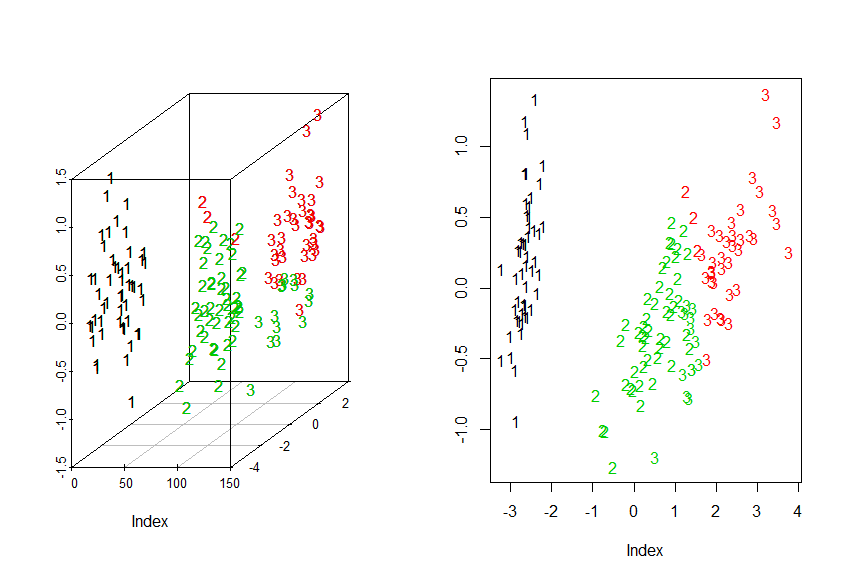
> g3d<-scatterplot3d(Iris.mds,pch=chars)

> g3d$points3d(iris.mds,col=KM.Iris$cluster,pch=chars)

> #2D

> plot(Iris.mds,col=KM.Iris$cluster,pch=chars,xlab="Index",ylab= "Y")
> KM.Iris[1]

$cluster

  [1] 1 1 1 1 1 1 1 1 1 1 1 1 1 1 1 1 1 1 1 1 1 1 1 1 1 1 1 1 1 1 1 1 1 1 1 1 1 1 1 1 1 1 1 1 1 1 1 1 1 1 2 3 2 3 3 3 3 3

 [59] 3 3 3 3 3 3 3 3 3 3 3 3 3 3 3 3 3 3 3 2 3 3 3 3 3 3 3 3 3 3 3 3 3 3 3 3 3 3 3 3 3 3 2 3 2 2 2 2 3 2 2 2 2 2 2 3 3 2

[117] 2 2 2 3 2 3 2 3 2 2 3 3 2 2 2 2 2 3 2 2 2 2 3 2 2 2 3 2 2 2 3 2 2 3

> Iris.cluster<-cbind(Iris,KM.Iris$cluster)

> head(Iris.cluster)

  Sepal.Length Sepal.Width Petal.Length Petal.Width Species KM.Iris$cluster

1          5.1         3.5          1.4         0.2  setosa               1

2          4.9         3.0          1.4         0.2  setosa               1

3          4.7         3.2          1.3         0.2  setosa               1

4          4.6         3.1          1.5         0.2  setosa               1

5          5.0         3.6          1.4         0.2  setosa               1

6          5.4         3.9          1.7         0.4  setosa               1

> # 下面寻找最佳簇数目

> # 30 Kmeans loop

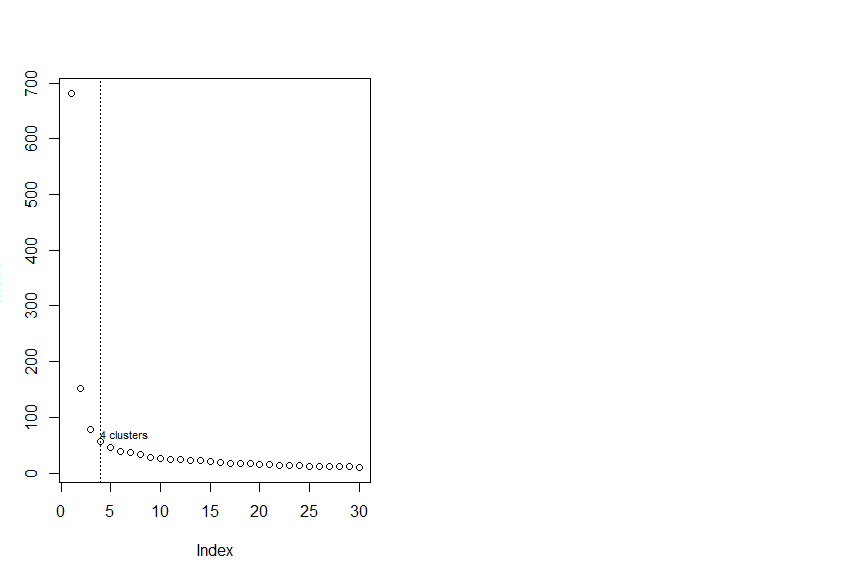
> InerIC<-rep(0,30);InerIC

 [1] 0 0 0 0 0 0 0 0 0 0 0 0 0 0 0 0 0 0 0 0 0 0 0 0 0 0 0 0 0 0

> for (k in 1:30){

+ set.seed(123)

+ groups=kmeans(Iris[1:4],k)

+ InerIC[k]<-groups$tot.withinss

+ }

> InerIC

 [1] 681.37060 152.34795  78.85144  57.26562  46.46117  39.05498  37.34900  32.58266  28.46897  26.32133  24.92591

[12]  23.52298  23.33464  21.83167  20.04231  19.21720  17.82750  17.35801  16.69589  15.74660  14.53898  13.61800

[23]  13.38004  12.81350  12.37310  12.02532  11.72245  11.55765  11.04824  10.56507

> groups

K-means clustering with 30 clusters of sizes 5, 4, 1, 5, 7, 5, 9, 3, 4, 2, 3, 4, 3, 7, 4, 5, 8, 5, 4, 3, 9, 1, 6, 4, 4, 8, 1, 3, 10, 13

Cluster means:

   Sepal.Length Sepal.Width Petal.Length Petal.Width

1      4.940000    3.400000     1.680000   0.3800000

2      7.675000    2.850000     6.575000   2.1750000

3      5.000000    2.000000     3.500000   1.0000000

4      7.240000    2.980000     6.020000   1.8400000

5      6.442857    2.828571     5.557143   1.9142857

6      4.580000    3.320000     1.280000   0.2200000

7      6.722222    3.000000     4.677778   1.4555556

8      6.233333    3.300000     4.566667   1.5666667

9      6.150000    2.900000     4.200000   1.3500000

10     5.400000    2.800000     3.750000   1.3500000

11     6.133333    2.700000     5.266667   1.5000000

12     6.075000    2.900000     4.625000   1.3750000

13     5.000000    2.400000     3.200000   1.0333333

14     6.671429    3.085714     5.257143   2.1571429

15     4.400000    2.800000     1.275000   0.2000000

16     5.740000    2.700000     5.040000   2.0400000

17     5.212500    3.812500     1.587500   0.2750000

18     5.620000    4.060000     1.420000   0.3000000

19     5.975000    3.050000     4.900000   1.8000000

20     7.600000    3.733333     6.400000   2.2333333

21     6.566667    3.244444     5.711111   2.3333333

22     4.900000    2.500000     4.500000   1.7000000

23     5.550000    2.450000     3.816667   1.1333333

24     6.275000    2.625000     4.900000   1.7500000

25     5.775000    2.700000     4.025000   1.1750000

26     5.600000    2.875000     4.325000   1.3250000

27     6.000000    2.200000     4.000000   1.0000000

28     6.166667    2.233333     4.633333   1.4333333

29     4.840000    3.080000     1.470000   0.1900000

30     5.146154    3.461538     1.438462   0.2230769

Clustering vector:

  [1] 30 29  6 29 30 17  6 30 15 29 17  1 29 15 18 18 18 30 18 17 30 17  6  1  1 29  1 30 30 29 29 30 17 18 29 29 30 30 15

 [40] 30 30 15  6  1 17 29 17  6 17 30  7  8  7 23  7 26  8 13  7 10  3  9 27 12 10  7 26 25 28 23 19  9 24 12  9  7  7  7

 [79] 12 23 23 23 25 11 26  8  7 28 26 23 26 12 25 13 26 26 26  9 13 25 21 16  4  5 21  2 22  4  5 20 14  5 14 16 16 14  5

[118] 20  2 28 21 16  2 24 21  4 24 19  5  4  4 20  5 11 11  2 21  5 19 14 21 14 16 21 21 14 24 14 21 19

Within cluster sum of squares by cluster:

 [1] 0.2880000 0.5325000 0.0000000 0.4200000 0.6371429 0.2920000 0.7933333 0.1400000 0.2400000 0.1500000 0.2533333

[12] 0.1025000 0.1066667 0.5571429 0.4275000 0.2960000 0.5012500 0.5280000 0.1175000 0.5933333 1.0311111 0.0000000

[23] 0.3716667 0.1850000 0.1025000 0.5450000 0.0000000 0.2866667 0.3700000 0.6969231

 (between_SS / total_SS =  98.4 %)

Available components:

[1] "cluster"      "centers"      "totss"        "withinss"     "tot.withinss" "betweenss"    "size"

[8] "iter"         "ifault"

> plot(InerIC,col = "black",lty =3)

There were 18 warnings (use warnings() to see them)

> abline(v=4,col="black",lty=3)

> text (4,60,"4 clusters",col="black",adj = c(0,-0.1),cex=0.7)
> library(NbClust)

> data<-Iris[,-5]

> head(data)

  Sepal.Length Sepal.Width Petal.Length Petal.Width

1          5.1         3.5          1.4         0.2

2          4.9         3.0          1.4         0.2

3          4.7         3.2          1.3         0.2

4          4.6         3.1          1.5         0.2

5          5.0         3.6          1.4         0.2

6          5.4         3.9          1.7         0.4

> best<-NbClust(data,diss=NULL,distance ="euclidean",min.nc=2, max.nc=15, method = "complete",index = "alllong")
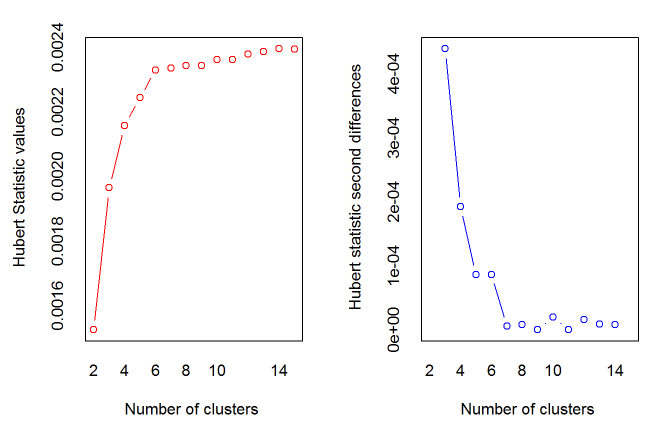
*** : The Hubert index is a graphical method of determining the number of clusters.

                In the plot of Hubert index, we seek a significant knee that corresponds to a

                significant increase of the value of the measure i.e the significant peak in Hubert

                index second differences plot.
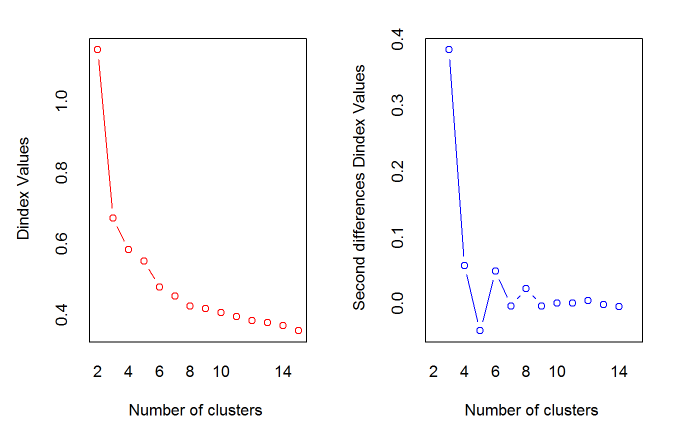
*** : The D index is a graphical method of determining the number of clusters.

                In the plot of D index, we seek a significant knee (the significant peak in Dindex

                second differences plot) that corresponds to a significant increase of the value of

                the measure.

*******************************************************************

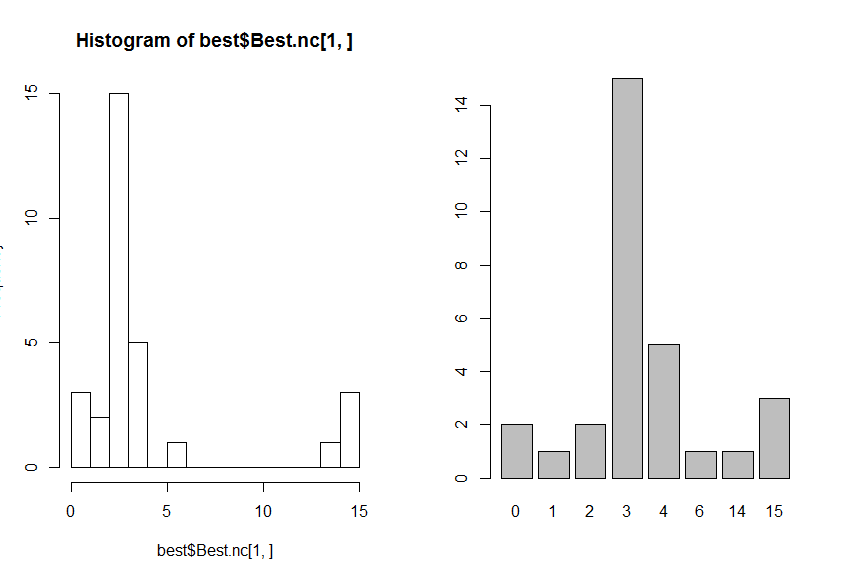
* Among all indices:

* 2 proposed 2 as the best number of clusters

* 15 proposed 3 as the best number of clusters

* 5 proposed 4 as the best number of clusters

* 1 proposed 6 as the best number of clusters

* 1 proposed 14 as the best number of clusters

* 3 proposed 15 as the best number of clusters

                   ***** Conclusion *****

* According to the majority rule, the best number of clusters is  3

*******************************************************************

> table(names(best$Best.nc[1,]),best$Best.nc[1,])

             0 1 2 3 4 6 14 15

  Ball       0 0 0 1 0 0  0  0

  Beale      0 0 0 1 0 0  0  0

  CCC        0 0 0 1 0 0  0  0

  CH         0 0 0 0 1 0  0  0

  Cindex     0 0 0 1 0 0  0  0

  DB         0 0 0 1 0 0  0  0

  Dindex     1 0 0 0 0 0  0  0

  Duda       0 0 0 0 1 0  0  0

  Dunn       0 0 0 0 0 0  0  1

  Frey       0 1 0 0 0 0  0  0

  Friedman   0 0 0 0 1 0  0  0

  Gamma      0 0 0 0 0 0  1  0

  Gap        0 0 0 1 0 0  0  0

  Gplus      0 0 0 0 0 0  0  1

  Hartigan   0 0 0 1 0 0  0  0

  Hubert     1 0 0 0 0 0  0  0

  KL         0 0 0 0 1 0  0  0

  Marriot    0 0 0 1 0 0  0  0

  McClain    0 0 1 0 0 0  0  0

  PseudoT2   0 0 0 0 1 0  0  0

  PtBiserial 0 0 0 1 0 0  0  0

  Ratkowsky  0 0 0 1 0 0  0  0

  Rubin      0 0 0 0 0 1  0  0

  Scott      0 0 0 1 0 0  0  0

  SDbw       0 0 0 0 0 0  0  1

  SDindex    0 0 0 1 0 0  0  0

  Silhouette 0 0 1 0 0 0  0  0

  Tau        0 0 0 1 0 0  0  0

  TraceW     0 0 0 1 0 0  0  0

  TrCovW     0 0 0 1 0 0  0  0

> hist(best$Best.nc[1,],breaks = max(na.omit(best$Best.nc[1,])))

> barplot(table(best$Best.nc[1,]))
> # 选择最佳聚类算法algorithm

> Hartigan <-0

> Lloyd <- 0

> Forgy <- 0

> MacQueen <- 0

> set.seed(123)

> # 做500次Kmeans计算,3个聚类中心,每次计算,每种算法迭代最多1000次

> for (i in 1:500){

+ KM<-kmeans(Iris[1:4],3,iter.max = 1000,algorithm = "Hartigan-Wong")

+ Hartigan <- Hartigan + KM$betweenss

+ KM<-kmeans(Iris[1:4],3,iter.max = 1000,algorithm = "Lloyd")

+ Lloyd <- Lloyd + KM$betweenss

+ KM<-kmeans(Iris[1:4],3,iter.max = 1000,algorithm = "Forgy")

+ Forgy <- Forgy + KM$betweenss

+ KM<-kmeans(Iris[1:4],3,iter.max = 1000,algorithm = "MacQueen")

+ MacQueen <- MacQueen + KM$betweenss

+ }

> # 输出结果

> Methods <- c("Hartigan","Lloyd","Forgy","MacQueen")

> Results <- as.data.frame(round(c(Hartigan,Lloyd,Forgy,MacQueen)/500,2))

> Results <- cbind(Methods,Results)

> names(Results) <- c("Method","Betweenss")

> Results

    Method Betweenss

1 Hartigan    590.76

2    Lloyd    589.38

3    Forgy    590.63

4 MacQueen    590.05

> #作图

> par(mfrow =c(1,1))

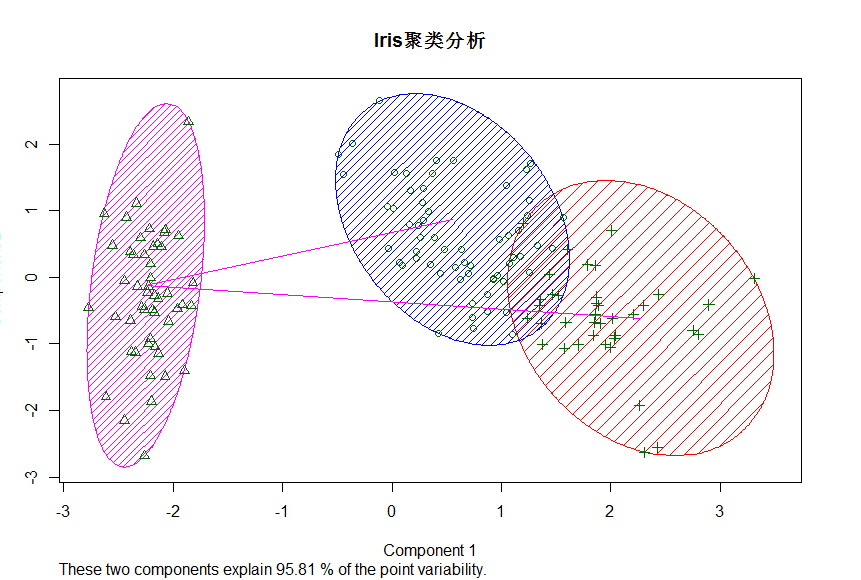
> KM<-kmeans(Iris[1:4],3,iter.max = 1000,algorithm = "Hartigan-Wong")

> library(cluster)

> clusplot(Iris[1:4],KM$cluster,color = T,shade = T,lables=2,lines = 1,main = "Iris聚类分析")

There were 50 or more warnings (use warnings() to see the first 50)
> library(HSAUR)

There were 50 or more warnings (use warnings() to see the first 50)

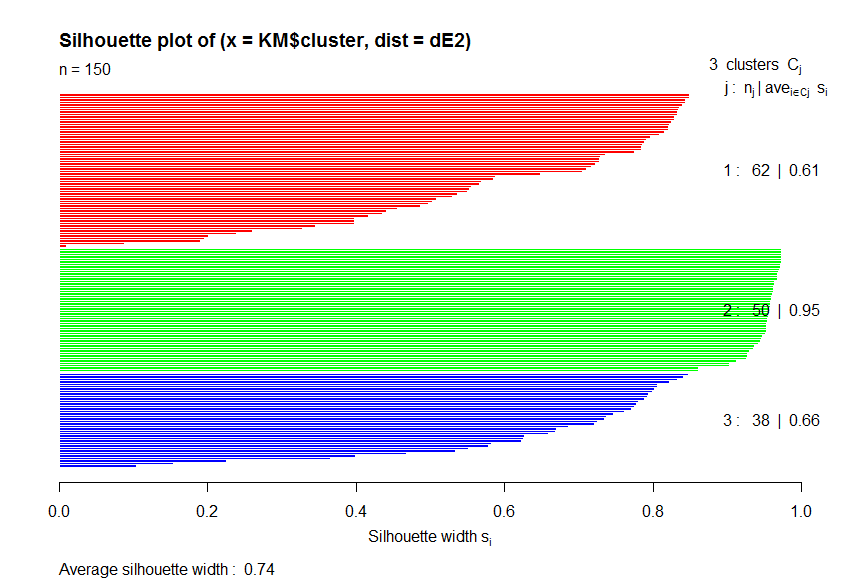
> diss <- daisy(Iris[1:4])

> dE2 <- diss^2

> obj <-silhouette(KM$cluster,dE2)

> plot(obj,col=c("red","green","blue"))
ML_R Kmeans的更多相关文章
- 当我们在谈论kmeans(1)
本稿为初稿,后续可能还会修改:如果转载,请务必保留源地址,非常感谢! 博客园:http://www.cnblogs.com/data-miner/ 简书:建设中... 知乎:建设中... 当我们在谈论 ...
- K-Means 聚类算法
K-Means 概念定义: K-Means 是一种基于距离的排他的聚类划分方法. 上面的 K-Means 描述中包含了几个概念: 聚类(Clustering):K-Means 是一种聚类分析(Clus ...
- 用scikit-learn学习K-Means聚类
在K-Means聚类算法原理中,我们对K-Means的原理做了总结,本文我们就来讨论用scikit-learn来学习K-Means聚类.重点讲述如何选择合适的k值. 1. K-Means类概述 在sc ...
- K-Means聚类算法原理
K-Means算法是无监督的聚类算法,它实现起来比较简单,聚类效果也不错,因此应用很广泛.K-Means算法有大量的变体,本文就从最传统的K-Means算法讲起,在其基础上讲述K-Means的优化变体 ...
- kmeans算法并行化的mpi程序
用c语言写了kmeans算法的串行程序,再用mpi来写并行版的,貌似参照着串行版来写并行版,效果不是很赏心悦目~ 并行化思路: 使用主从模式.由一个节点充当主节点负责数据的划分与分配,其他节点完成本地 ...
- 当我们在谈论kmeans(2)
本稿为初稿,后续可能还会修改:如果转载,请务必保留源地址,非常感谢! 博客园:http://www.cnblogs.com/data-miner/ 其他:建设中- 当我们在谈论kmeans(2 ...
- K-Means clusternig example with Python and Scikit-learn(推荐)
https://www.pythonprogramming.net/flat-clustering-machine-learning-python-scikit-learn/ Unsupervised ...
- K-Means聚类和EM算法复习总结
摘要: 1.算法概述 2.算法推导 3.算法特性及优缺点 4.注意事项 5.实现和具体例子 6.适用场合 内容: 1.算法概述 k-means算法是一种得到最广泛使用的聚类算法. 它是将各个聚类子集内 ...
- 【原创】数据挖掘案例——ReliefF和K-means算法的医学应用
数据挖掘方法的提出,让人们有能力最终认识数据的真正价值,即蕴藏在数据中的信息和知识.数据挖掘 (DataMiriing),指的是从大型数据库或数据仓库中提取人们感兴趣的知识,这些知识是隐含的.事先未知 ...
随机推荐
- Linux Process Management && Process Scheduling Principle
目录 . 引言 . 进程优先级 . 进程的生命周 . 进程表示 . 进程管理相关的系统调用 . 进程调度 . 完全公平调度类 . 实时调度类 . 调度器增强 . 小结 1. 引言 在多处理器系统中,可 ...
- shutil模块
shutil模块 提供了大量的文件的高级操作,特别针对文件拷贝和删除,主要功能为目录和文件操作以及压缩操作 常用方法 shutil.copyfile(src, dst) 复制文件内容(不包含元数据)从 ...
- 通过Minimal版的iso安装CentOS7之后升级Desktop
重新安装了CentOS7,但是使用的是Minimal的iso镜像安装的,所以安装之后只有文本界面,这里记录一下重新安装图形界面的过程. 连接网络 通过文本界面登陆后是没有连接网络的,所以需要修改配置连 ...
- 大家是怎么做Code Review的?
先说说我们公司现在的做法,一个团队被人为地分为两个阵营:Senior Developers和Junior Developers,比例差不多是1:1,Senior Developers就担负着对Juni ...
- bootstrap学习总结-04 常用标签2
1 表格 Bootstrap为表格设计了漂亮的样式. 1)表格基本实例 任意 <table> 标签添加 .table. <table class="table"& ...
- angular state和stateParams
angular ui-route通过路由传递参数 发送ctrl var model = { data: positionid }; $state.go('app.position.publish', ...
- Nginx个人简单理解
首先我们来补充下一些基本知识: 什么是代理服务器? 先举个简单的例子,现在我们在百度访问谷歌的网站,发现现在进不去,这个时候我们可以FQ(关于FQ,可以借鉴下这个博文:http://zhangge.n ...
- MYSQL 常用函数(数学、字符串、日期时间、系统信息、加密)
一.数学函数 数学函数主要用于处理数字,包括整型.浮点数等. ABS(x) 返回x的绝对值 SELECT ABS(-1) -- 返回1 CEIL(x),CEILING(x) 返回大于或等于x的最小整数 ...
- notification的使用
示例: NotificationManager nm = (NotificationManager)getSystemService(Context.NOTIFICATION_SERVICE); No ...
- dedecms标签的sql语句
{dede:sql sql='Select content from dede_arctype where id=1' titlelen='40′} [field:content/] {/dede:s ...