
自然语言15_Part of Speech Tagging with NLTK
sklearn实战-乳腺癌细胞数据挖掘(博主亲自录制视频教程)
https://study.163.com/course/introduction.htm?courseId=1005269003&utm_campaign=commission&utm_source=cp-400000000398149&utm_medium=share
https://www.pythonprogramming.net/part-of-speech-tagging-nltk-tutorial/?completed=/stemming-nltk-tutorial/
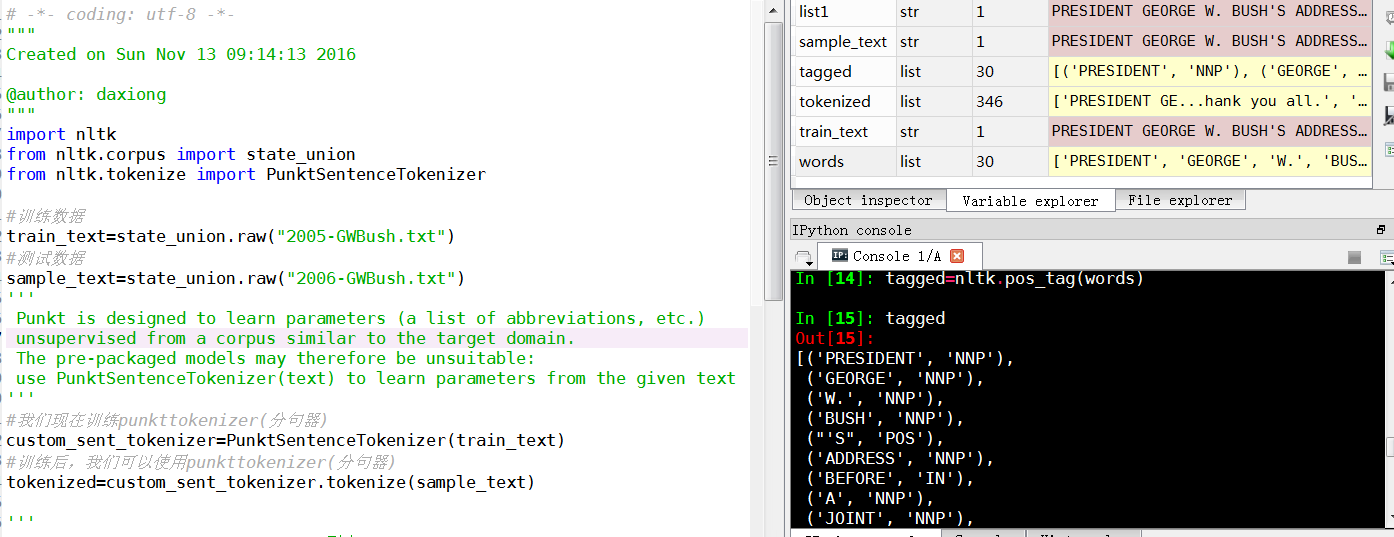
# -*- coding: utf-8 -*-

"""

Created on Sun Nov 13 09:14:13 2016

@author: daxiong

"""

import nltk

from nltk.corpus import state_union

from nltk.tokenize import PunktSentenceTokenizer

#训练数据

train_text=state_union.raw("2005-GWBush.txt")

#测试数据

sample_text=state_union.raw("2006-GWBush.txt")

'''

 Punkt is designed to learn parameters (a list of abbreviations, etc.)

 unsupervised from a corpus similar to the target domain.

 The pre-packaged models may therefore be unsuitable:

 use PunktSentenceTokenizer(text) to learn parameters from the given text

'''

#我们现在训练punkttokenizer(分句器)

custom_sent_tokenizer=PunktSentenceTokenizer(train_text)

#训练后,我们可以使用punkttokenizer(分句器)

tokenized=custom_sent_tokenizer.tokenize(sample_text)

'''

nltk.pos_tag(["fire"]) #pos_tag(列表)

Out[19]: [('fire', 'NN')]

'''

#文本词性标记函数

def process_content():

    try:

        for i in tokenized[0:5]:

            words=nltk.word_tokenize(i)

            tagged=nltk.pos_tag(words)

            print(tagged)

    except Exception as e:

        print(str(e))

process_content()
One of the more powerful aspects of the NLTK module is the Part of Speech tagging that it can do for you. This means labeling words in a sentence as nouns, adjectives, verbs...etc. Even more impressive, it also labels by tense, and more. Here's a list of the tags, what they mean, and some examples:
POS tag list:

CC	coordinating conjunction

CD	cardinal digit

DT	determiner

EX	existential there (like: "there is" ... think of it like "there exists")

FW	foreign word

IN	preposition/subordinating conjunction

JJ	adjective	'big'

JJR	adjective, comparative	'bigger'

JJS	adjective, superlative	'biggest'

LS	list marker	1)

MD	modal	could, will

NN	noun, singular 'desk'

NNS	noun plural	'desks'

NNP	proper noun, singular	'Harrison'

NNPS	proper noun, plural	'Americans'

PDT	predeterminer	'all the kids'

POS	possessive ending	parent's

PRP	personal pronoun	I, he, she

PRP$	possessive pronoun	my, his, hers

RB	adverb	very, silently,

RBR	adverb, comparative	better

RBS	adverb, superlative	best

RP	particle	give up

TO	to	go 'to' the store.

UH	interjection	errrrrrrrm

VB	verb, base form	take

VBD	verb, past tense	took

VBG	verb, gerund/present participle	taking

VBN	verb, past participle	taken

VBP	verb, sing. present, non-3d	take

VBZ	verb, 3rd person sing. present	takes

WDT	wh-determiner	which

WP	wh-pronoun	who, what

WP$	possessive wh-pronoun	whose

WRB	wh-abverb	where, when
How might we use this? While we're at it, we're going to cover a new sentence tokenizer, called the PunktSentenceTokenizer. This tokenizer is capable of unsupervised machine learning, so you can actually train it on any body of text that you use. First, let's get some imports out of the way that we're going to use:
import nltk

from nltk.corpus import state_union

from nltk.tokenize import PunktSentenceTokenizer
Now, let's create our training and testing data:
train_text = state_union.raw("2005-GWBush.txt")

sample_text = state_union.raw("2006-GWBush.txt")
One is a State of the Union address from 2005, and the other is from 2006 from past President George W. Bush.
Next, we can train the Punkt tokenizer like:
custom_sent_tokenizer = PunktSentenceTokenizer(train_text)
Then we can actually tokenize, using:
tokenized = custom_sent_tokenizer.tokenize(sample_text)
Now we can finish up this part of speech tagging script by creating a function that will run through and tag all of the parts of speech per sentence like so:
def process_content():

    try:

        for i in tokenized[:5]:

            words = nltk.word_tokenize(i)

            tagged = nltk.pos_tag(words)

            print(tagged)

    except Exception as e:

        print(str(e))

process_content()
The output should be a list of tuples, where the first element in the tuple is the word, and the second is the part of speech tag. It should look like:
[('PRESIDENT', 'NNP'), ('GEORGE', 'NNP'), ('W.', 'NNP'), ('BUSH', 'NNP'), ("'S", 'POS'), ('ADDRESS', 'NNP'), ('BEFORE', 'NNP'), ('A', 'NNP'), ('JOINT', 'NNP'), ('SESSION', 'NNP'), ('OF', 'NNP'), ('THE', 'NNP'), ('CONGRESS', 'NNP'), ('ON', 'NNP'), ('THE', 'NNP'), ('STATE', 'NNP'), ('OF', 'NNP'), ('THE', 'NNP'), ('UNION', 'NNP'), ('January', 'NNP'), ('31', 'CD'), (',', ','), ('2006', 'CD'), ('THE', 'DT'), ('PRESIDENT', 'NNP'), (':', ':'), ('Thank', 'NNP'), ('you', 'PRP'), ('all', 'DT'), ('.', '.')] [('Mr.', 'NNP'), ('Speaker', 'NNP'), (',', ','), ('Vice', 'NNP'), ('President', 'NNP'), ('Cheney', 'NNP'), (',', ','), ('members', 'NNS'), ('of', 'IN'), ('Congress', 'NNP'), (',', ','), ('members', 'NNS'), ('of', 'IN'), ('the', 'DT'), ('Supreme', 'NNP'), ('Court', 'NNP'), ('and', 'CC'), ('diplomatic', 'JJ'), ('corps', 'NNS'), (',', ','), ('distinguished', 'VBD'), ('guests', 'NNS'), (',', ','), ('and', 'CC'), ('fellow', 'JJ'), ('citizens', 'NNS'), (':', ':'), ('Today', 'NN'), ('our', 'PRP$'), ('nation', 'NN'), ('lost', 'VBD'), ('a', 'DT'), ('beloved', 'VBN'), (',', ','), ('graceful', 'JJ'), (',', ','), ('courageous', 'JJ'), ('woman', 'NN'), ('who', 'WP'), ('called', 'VBN'), ('America', 'NNP'), ('to', 'TO'), ('its', 'PRP$'), ('founding', 'NN'), ('ideals', 'NNS'), ('and', 'CC'), ('carried', 'VBD'), ('on', 'IN'), ('a', 'DT'), ('noble', 'JJ'), ('dream', 'NN'), ('.', '.')] [('Tonight', 'NNP'), ('we', 'PRP'), ('are', 'VBP'), ('comforted', 'VBN'), ('by', 'IN'), ('the', 'DT'), ('hope', 'NN'), ('of', 'IN'), ('a', 'DT'), ('glad', 'NN'), ('reunion', 'NN'), ('with', 'IN'), ('the', 'DT'), ('husband', 'NN'), ('who', 'WP'), ('was', 'VBD'), ('taken', 'VBN'), ('so', 'RB'), ('long', 'RB'), ('ago', 'RB'), (',', ','), ('and', 'CC'), ('we', 'PRP'), ('are', 'VBP'), ('grateful', 'JJ'), ('for', 'IN'), ('the', 'DT'), ('good', 'NN'), ('life', 'NN'), ('of', 'IN'), ('Coretta', 'NNP'), ('Scott', 'NNP'), ('King', 'NNP'), ('.', '.')] [('(', 'NN'), ('Applause', 'NNP'), ('.', '.'), (')', ':')] [('President', 'NNP'), ('George', 'NNP'), ('W.', 'NNP'), ('Bush', 'NNP'), ('reacts', 'VBZ'), ('to', 'TO'), ('applause', 'VB'), ('during', 'IN'), ('his', 'PRP$'), ('State', 'NNP'), ('of', 'IN'), ('the', 'DT'), ('Union', 'NNP'), ('Address', 'NNP'), ('at', 'IN'), ('the', 'DT'), ('Capitol', 'NNP'), (',', ','), ('Tuesday', 'NNP'), (',', ','), ('Jan', 'NNP'), ('.', '.')]
At this point, we can begin to derive meaning, but there is still some work to do. The next topic that we're going to cover is chunking, which is where we group words, based on their parts of speech, into hopefully meaningful groups.
自然语言15_Part of Speech Tagging with NLTK的更多相关文章
- 自然语言15.1_Part of Speech Tagging 词性标注
QQ:231469242 欢迎喜欢nltk朋友交流 https://en.wikipedia.org/wiki/Part-of-speech_tagging In corpus linguistics ...
- 自然语言12_Tokenizing Words and Sentences with NLTK
https://www.pythonprogramming.net/tokenizing-words-sentences-nltk-tutorial/ # -*- coding: utf-8 -*- ...
- 词性标注 parts of speech tagging
In corpus linguistics, part-of-speech tagging (POS tagging or POST), also called grammatical tagging ...
- 自然语言处理NLP程序包(NLTK/spaCy)使用总结
NLTK和SpaCy是NLP的Python应用,提供了一些现成的处理工具和数据接口.下面介绍它们的一些常用功能和特性,便于对NLP研究的组成形式有一个基本的了解. NLTK Natural Langu ...
- 自然语言27_Converting words to Features with NLTK
https://www.pythonprogramming.net/words-as-features-nltk-tutorial/ Converting words to Features with ...
- 自然语言18.1_Named Entity Recognition with NLTK
QQ:231469242 欢迎nltk爱好者交流 https://www.pythonprogramming.net/named-entity-recognition-nltk-tutorial/?c ...
- Part of Speech Tagging
Natural Language Processing with Python Charpter 6.1 suffix_fdist处代码稍微改动. import nltk from nltk.corp ...
- 自然语言14_Stemming words with NLTK
https://www.pythonprogramming.net/stemming-nltk-tutorial/?completed=/stop-words-nltk-tutorial/ # -*- ...
- python and 我爱自然语言处理
曾经因为NLTK的 缘故开始学习Python,之后渐渐成为我工作中的第一辅助脚本语言,虽然开发语言是C/C++,但平时的很多文本数据处理任务都交给了Python.离 开腾讯创业后,第一个作品课程图谱也 ...
随机推荐
- 个人阅读作业——M1/M2总结
~ http://www.cnblogs.com/wx1306/p/4831950.html 在这篇博客中,我提出来一些关于软件工程的问题,但随着这一个学期的即将结束,以及我对软件开发的了解的深入,我 ...
- 【BZOJ 2440】【中山市选 2011】完全平方数 莫比乌斯函数+容斥原理
网上PoPoQQQ的课件: •题目大意:求第k个无平方因子数 •无平方因子数(Square-Free Number),即分解之后所有质因数的次数都为1的数 •首先二分答案 问题转化为求[1,x]之间有 ...
- jquery-遍历each
使用案例一 $.ajax({ url : webPath + "/clickCount", type : "POST", dataType : "js ...
- Js-加密
1.base64加密 在页面中引入base64.js文件,调用方法为: <!DOCTYPE HTML> <html> <head> <meta charset ...
- Java产生随机数
前言: 每一门程序设计语言基本都具有一个随机函数,而Java当中产生随机数的方式不拘一格.而且其中的Random工具类还有着更深入的应用,但本文仅对比3种产生随机数的方式,就不深入扩展分析其内部工具类 ...
- R语言快速入门上手
导言: 较早之前就听说R是一门便捷的数据分析工具,但由于课程设计的原因,一直没有空出足够时间来进行学习.最近自从决定本科毕业出来找工作之后,渐渐开始接触大数据行业的技术,现在觉得是时候把R拿下 ...
- [vijos1982][NOIP2015]子串
Description 有两个仅包含小写英文字母的字符串和.现在要从字符串中取出个互不重叠的非空子串,然后把这个子串按照其在字符串中出现的顺序依次连接起来得到一个新的字符串,请问有多少种方案可以使得这 ...
- 【poj3237】 Tree
http://poj.org/problem?id=3237 (题目链接) 树链剖分模板题,然而这150+行的程序我调了一天,历经艰辛,终于ac.. 题意 给出一个n个节点的带权树,要求维护操作:1. ...
- web api Post 接收不到参数的问题
前端: 注意两个点: 1. contentType: "application/json" 请求的格式是Json 2. 要用JSON.stringify(customer)序列化对 ...
- vijos2001 xor-sigma
本文版权归ljh2000和博客园共有,欢迎转载,但须保留此声明,并给出原文链接,谢谢合作. 本文作者:ljh2000作者博客:http://www.cnblogs.com/ljh2000-jump/转 ...