
vtkTestHull将多个平面围成一个凸面体
1、vtkHull
produce an n-sided convex hull
vtkHull is a filter which will produce an n-sided convex hull given a set of n planes. (The convex hull bounds the input polygonal data.) The hull is generated by squeezing the planes towards the input vtkPolyData, until the planes just touch the vtkPolyData. Then, the resulting planes are used to generate a polyhedron (i.e., hull) that is represented by triangles.
The n planes can be defined in a number of ways including 1) manually specifying each plane; 2) choosing the six face planes of the input's bounding box; 3) choosing the eight vertex planes of the input's bounding box; 4) choosing the twelve edge planes of the input's bounding box; and/or 5) using a recursively subdivided octahedron. Note that when specifying planes, the plane normals should point outside of the convex region.
The output of this filter can be used in combination with vtkLODActor to represent a levels-of-detail in the LOD hierarchy. Another use of this class is to manually specify the planes, and then generate the polyhedron from the planes (without squeezing the planes towards the input). The method GenerateHull() is used to do this.
- Tests:
- vtkHull (Tests)
下面分别是有50个和150个随机面围裹成的两个凸多面体
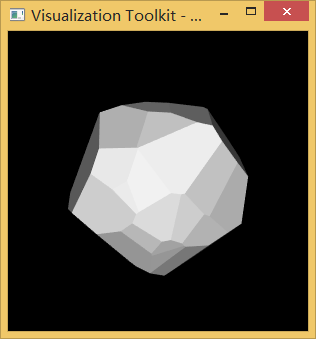
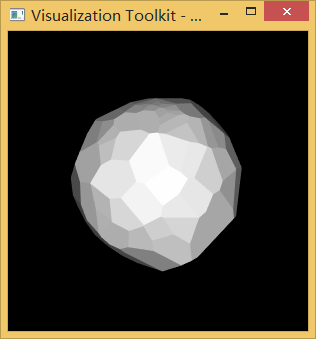
示例代码:
#ifndef INITIAL_OPENGL

#define INITIAL_OPENGL

#include <vtkAutoInit.h>

VTK_MODULE_INIT(vtkRenderingOpenGL)

VTK_MODULE_INIT(vtkInteractionStyle)

#endif

#include <iostream>

using namespace std;

#include <vtkVersion.h>

#include <vtkActor.h>

#include <vtkLine.h>

#include <vtkPointData.h>

#include <vtkPoints.h>

#include <vtkPolyData.h>

#include <vtkPolyDataMapper.h>

#include <vtkRenderer.h>

#include <vtkRenderWindow.h>

#include <vtkRenderWindowInteractor.h>

#include <vtkSmartPointer.h>

#include <vtkFloatArray.h>

#include <vtkMath.h>

#include <vtkPlanes.h>

#include <vtkHull.h>

int main()

{

    vtkSmartPointer<vtkMath> mathObj=vtkSmartPointer<vtkMath>::New();

    vtkSmartPointer<vtkPoints> points=vtkSmartPointer<vtkPoints>::New();

    vtkSmartPointer<vtkFloatArray> normals=vtkSmartPointer<vtkFloatArray>::New();

    normals->SetNumberOfComponents();

    float radius,theta,phi,x,y,z;

    int numberOfPlanes=;

///创建numberOfPlanes个随机平面,每个平面中心点坐标为(x,y,z),其法向量为(x,y,z),

///无论怎样随机,这些平面都是与半径为radius的球面相切,并包裹着该球面

    for(int i=;i<numberOfPlanes;i++)

    {

         radius=;

        theta=mathObj->Random(,mathObj->Pi()*);

        phi=mathObj->Random(,mathObj->Pi());

        x=radius*sin(phi)*cos(theta);

        y=radius*sin(phi)*sin(theta);

        z=radius*cos(phi);

        points->InsertPoint(i,x,y,z);

        normals->InsertTuple3(i,x,y,z);

    }

    vtkSmartPointer<vtkPlanes>planes=vtkSmartPointer<vtkPlanes>::New();

    planes->SetPoints(points);

    planes->SetNormals(normals);

std::cout<<planes->GetNumberOfPlanes()<<std::endl;

    vtkSmartPointer<vtkHull>hull=vtkSmartPointer<vtkHull>::New();

    hull->SetPlanes(planes);

   vtkSmartPointer<vtkPolyData> pd=vtkSmartPointer<vtkPolyData>::New();

    hull->GenerateHull(pd,-,,-,,-,);

    vtkSmartPointer<vtkPolyDataMapper>hullMapper=vtkSmartPointer<vtkPolyDataMapper>::New();

    hullMapper->SetInputData(pd);

    vtkSmartPointer<vtkActor>hullActor=vtkSmartPointer<vtkActor>::New();

    hullActor->SetMapper(hullMapper);

    //创建图形对象

    //创建显示窗口

    vtkSmartPointer<vtkRenderer> ren1=vtkSmartPointer<vtkRenderer>::New();

    vtkSmartPointer<vtkRenderWindow> renWin=vtkSmartPointer<vtkRenderWindow>::New();

    vtkSmartPointer<vtkRenderWindowInteractor> iren=vtkSmartPointer<vtkRenderWindowInteractor>::New();

    ren1->AddActor(hullActor);

    renWin->AddRenderer(ren1);

    iren->SetRenderWindow(renWin);

    ren1->ResetCamera();

    iren->Initialize();

    iren->Start();

    return ;

}
vtkTestHull将多个平面围成一个凸面体的更多相关文章
- C语言——N个人围成一圈报数淘汰问题
<一>问题描述: 有17个人围成一圈(编号为0-16),从第 0号的人开始从 1报数, 凡报到 3的倍数的人离开圈子,然后再数下去,直到最后只剩下一个人为止. 问此人原来的位置是多少号? ...
- C++经典题目:有n个人围成一圈,顺序排号,然后数数进行淘汰的解法和一些思考
问题描述: 有n个人围成一圈,顺序排号.从第一个人开始报数(1~3报数),凡报到3的人退出圈子,问最后留下的人原来排在第几号. 分析: 首先由用户输入人数n,然后对这n个人进行编号[因为如果不编号的话 ...
- n人围成一圈报数
题目:有n个人围成一圈,顺序排号.从第一个人开始报数(从1到3报数),凡报到3的人退出圈子,问最后留下的是原来的第几号的那位 思路:用一个数组存这n个人,里面的初始状态全设为1,表示都还在圈子里面. ...
- java解答:有17个人围成一圈(编号0~16),从第0号的人开始从1报数,凡报到3的倍数的人离开圈子,然后再数下去,直到最后只剩下一个人为止,问此人原来的位置是多少号?
package ttt; import java.util.HashMap; import java.util.Map.Entry; /** * 有17个人围成一圈(编号0~16),从第0号的人开始从 ...
- hdu 3951 硬币围成一圈(博弈)
n个硬币围成一个环 每次只能取1-K个硬币 最后取完者胜 假如5个硬币 每次取1-2个情况1 先手取1个 后手取剩下4个中间2个 破坏了连续 虽然最后剩2个,但先手只能取一个 然后后再取一个 后手胜 ...
- 37 有n个人围成一圈,顺序排号,从第一个人开始报数(从1到3报数),凡报到3的人退出圈子,问最后留下的是原来第几号那位.
题目:有n个人围成一圈,顺序排号,从第一个人开始报数(从1到3报数),凡报到3的人退出圈子,问最后留下的是原来第几号那位. public class _037NumberOff { public st ...
- 20190121-n个人围成一圈,凡报到3的人退出圈子,最后留下的是原来第几号的那位
1. 报数问题:有n个人围成一圈,顺序排号.从第一个人开始报数(从1到3报数),凡报到3的人退出圈子,问最后留下的是原来第几号的那位 思路:此题主要问题在于但凡报到3的人退出圈子,而报数的号码与圈子的 ...
- 约瑟夫环问题:有n个人围成一圈,顺序排号。从第一个人开始报数(从1到3报数),凡报到3的人退出圈子,问最后留下的是原来第几号的那位。
首先,我最大的学习来源不是百度而是我群友~~在这里表白一波我热爱学习的群友们!然后今天群里突然有人提出了题目的这个问题:有n个人围成一圈,顺序排号.从第一个人开始报数(从1到3报数),凡报到3的人退出 ...
- 代码实现:有n个人围成一圈,顺序排号。从第一个人开始报数(从1到3报数),凡报到3的人退出圈子,问最后留下的是原来第几号的那位。
import java.util.ArrayList; import java.util.List; import java.util.Scanner; //有n个人围成一圈,顺序排号.从第一个人开始 ...
随机推荐
- Hive 常用命令
1.hive模糊搜索表 show tables like '*name*'; 2.查看表结构信息 desc formatted table_name; desc table_name; 3.查看分 ...
- 背包 || NOIP 2018 D1 T2 || Luogu P5020 货币系统
题面:P5020 货币系统 题解: 显然要求的货币系统是当前货币系统的子集时答案会更优,于是考虑从当前货币系统中删数 一个大数如果能被其他小数表示出来,它就可以去掉 把数据排个序去个重,然后直接背包 ...
- Linux 内核源代码的几个C语言技巧
1.#define中使用do{statement}while(0)保证statement无论在何处都能正确执行一次2.将链表操作抽象出来,与宿主结果相互独立.所有的链表操作都作用与list_head, ...
- html中表单提交
表单提交代码 1.源代码分析 <!DOCTYPE html> <html lang="en"> <head> <meta charset= ...
- Python CGI编程Ⅴ
通过CGI程序传递 Textarea 数据 Textarea 向服务器传递多行数据,HTML代码如下: textarea.py 脚本代https://www.xuanhe.net/码如下: 修改 te ...
- 接口headers
接口headers from-data header: { 'Content-Type':'application/json'}, header: { 'Content-Type':'appl ...
- 【转载】多网卡的7种bond模式原理
多网卡的7种bond模式原理 Linux 多网卡绑定 网卡绑定mode共有七种(0~6) bond0.bond1.bond2.bond3.bond4.bond5.bond6 常用的有三种 mode=0 ...
- 「WC 2007」剪刀石头布
题目链接 戳我 \(Solution\) 直接求很明显不太好求,于是考虑不构成剪刀石头布的情况. 我们现在假设一个人\(i\)赢了\(x\)场,那么就会有\(\frac{x*(x-1)}{2}\) 我 ...
- 分布式-网络通信-IO-基础(2)
IS 与 OS1. 基本 IO 操作1.1. InputStream 与 OutputStream1.1.1. 输入与输出我们编写的程序除了自身会定义一些数据信息外,经常还会引用外界的数据,或是将自身 ...
- C++入门经典-例5.18-通过引用交换数值
1:在C++中,函数参数的传递方式主要有两种,即值传递和引用传递.值传递是指在函数调用时,将实际参数的值赋值一份传递到调用函数中,这样如果在调用函数中修改了参数的值,其改变将不会影响到实际参数的值.而 ...