
吴裕雄 python 机器学习——半监督学习标准迭代式标记传播算法LabelPropagation模型
import numpy as np

import matplotlib.pyplot as plt

from sklearn import  metrics

from sklearn import datasets

from sklearn.semi_supervised import LabelPropagation

def load_data():

    '''

    加载数据集

    '''

    digits = datasets.load_digits()

    ######   混洗样本 ########

    rng = np.random.RandomState(0)

    indices = np.arange(len(digits.data)) # 样本下标集合

    rng.shuffle(indices) # 混洗样本下标集合

    X = digits.data[indices]

    y = digits.target[indices]

    ###### 生成未标记样本的下标集合 ####

    # 只有 10% 的样本有标记

    n_labeled_points = int(len(y)/10)

    # 后面 90% 的样本未标记

    unlabeled_indices = np.arange(len(y))[n_labeled_points:]

    return X,y,unlabeled_indices

#半监督学习标准迭代式标记传播算法LabelPropagation模型

def test_LabelPropagation(*data):

    '''

    测试 LabelPropagation 的用法

    '''

    X,y,unlabeled_indices=data

    # 必须拷贝,后面要用到 y

    y_train=np.copy(y)

    # 未标记样本的标记设定为 -1

    y_train[unlabeled_indices]=-1

    clf=LabelPropagation(max_iter=100,kernel='rbf',gamma=0.1)

    clf.fit(X,y_train)

    ### 获取预测准确率

    # 预测标记

    predicted_labels = clf.transduction_[unlabeled_indices]

    # 真实标记

    true_labels = y[unlabeled_indices]

    print("Accuracy:%f"%metrics.accuracy_score(true_labels,predicted_labels))

    # 或者 print("Accuracy:%f"%clf.score(X[unlabeled_indices],true_labels))

# 获取半监督分类数据集

data=load_data()

# 调用 test_LabelPropagation

test_LabelPropagation(*data)

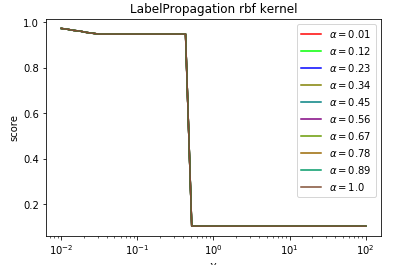
def test_LabelPropagation_rbf(*data):

    '''

    测试 LabelPropagation 的 rbf 核时,预测性能随 alpha 和 gamma 的变化

    '''

    X,y,unlabeled_indices=data

    # 必须拷贝,后面要用到 y

    y_train=np.copy(y)

    # 未标记样本的标记设定为 -1

    y_train[unlabeled_indices]=-1

    fig=plt.figure()

    ax=fig.add_subplot(1,1,1)

    alphas=np.linspace(0.01,1,num=10,endpoint=True)

    gammas=np.logspace(-2,2,num=50)

     # 颜色集合,不同曲线用不同颜色

    colors=((1,0,0),(0,1,0),(0,0,1),(0.5,0.5,0),(0,0.5,0.5),(0.5,0,0.5),(0.4,0.6,0),(0.6,0.4,0),(0,0.6,0.4),(0.5,0.3,0.2))

    ## 训练并绘图

    for alpha,color in zip(alphas,colors):

        scores=[]

        for gamma in gammas:

            clf=LabelPropagation(max_iter=100,gamma=gamma,alpha=alpha,kernel='rbf')

            clf.fit(X,y_train)

            scores.append(clf.score(X[unlabeled_indices],y[unlabeled_indices]))

        ax.plot(gammas,scores,label=r"$\alpha=%s$"%alpha,color=color)

    ### 设置图形

    ax.set_xlabel(r"$\gamma$")

    ax.set_ylabel("score")

    ax.set_xscale("log")

    ax.legend(loc="best")

    ax.set_title("LabelPropagation rbf kernel")

    plt.show()

# 调用 test_LabelPropagation_rbf

test_LabelPropagation_rbf(*data)
def test_LabelPropagation_knn(*data):

    '''

   测试 LabelPropagation 的 knn 核时,预测性能随 alpha 和 n_neighbors 的变化

    '''

    X,y,unlabeled_indices=data

    y_train=np.copy(y) # 必须拷贝,后面要用到 y

    y_train[unlabeled_indices]=-1 # 未标记样本的标记设定为 -1

    fig=plt.figure()

    ax=fig.add_subplot(1,1,1)

    alphas=np.linspace(0.01,1,num=10,endpoint=True)

    Ks=[1,2,3,4,5,8,10,15,20,25,30,35,40,50]

    # 颜色集合,不同曲线用不同颜色

    colors=((1,0,0),(0,1,0),(0,0,1),(0.5,0.5,0),(0,0.5,0.5),(0.5,0,0.5),(0.4,0.6,0),(0.6,0.4,0),(0,0.6,0.4),(0.5,0.3,0.2))

    ## 训练并绘图

    for alpha,color in zip(alphas,colors):

        scores=[]

        for K in Ks:

            clf=LabelPropagation(max_iter=100,n_neighbors=K,alpha=alpha,kernel='knn')

            clf.fit(X,y_train)

            scores.append(clf.score(X[unlabeled_indices],y[unlabeled_indices]))

        ax.plot(Ks,scores,label=r"$\alpha=%s$"%alpha,color=color)

    ### 设置图形

    ax.set_xlabel(r"$k$")

    ax.set_ylabel("score")

    ax.legend(loc="best")

    ax.set_title("LabelPropagation knn kernel")

    plt.show()

# 调用 test_LabelPropagation_knn

test_LabelPropagation_knn(*data)

吴裕雄 python 机器学习——半监督学习标准迭代式标记传播算法LabelPropagation模型的更多相关文章
- 吴裕雄 python 机器学习——半监督学习LabelSpreading模型
import numpy as np import matplotlib.pyplot as plt from sklearn import metrics from sklearn import d ...
- 吴裕雄 python 机器学习——人工神经网络与原始感知机模型
import numpy as np from matplotlib import pyplot as plt from mpl_toolkits.mplot3d import Axes3D from ...
- 吴裕雄 python 机器学习——分类决策树模型
import numpy as np import matplotlib.pyplot as plt from sklearn import datasets from sklearn.model_s ...
- 吴裕雄 python 机器学习——回归决策树模型
import numpy as np import matplotlib.pyplot as plt from sklearn import datasets from sklearn.model_s ...
- 吴裕雄 python 机器学习——线性判断分析LinearDiscriminantAnalysis
import numpy as np import matplotlib.pyplot as plt from matplotlib import cm from mpl_toolkits.mplot ...
- 吴裕雄 python 机器学习——逻辑回归
import numpy as np import matplotlib.pyplot as plt from matplotlib import cm from mpl_toolkits.mplot ...
- 吴裕雄 python 机器学习——ElasticNet回归
import numpy as np import matplotlib.pyplot as plt from matplotlib import cm from mpl_toolkits.mplot ...
- 吴裕雄 python 机器学习——Lasso回归
import numpy as np import matplotlib.pyplot as plt from sklearn import datasets, linear_model from s ...
- 吴裕雄 python 机器学习——岭回归
import numpy as np import matplotlib.pyplot as plt from sklearn import datasets, linear_model from s ...
随机推荐
- [Python]python已经安装了jieba库,Pycharm无法使用的问题
这个问题是Pycharm解释器的问题, 打开file--->setting---> 在如图所示界面点击add 在弹出的页面中选择python3的安装路径,可以用win10的搜索打开文件位置 ...
- java面试记录三:hashmap、hashtable、concurrentHashmap、ArrayList、linkedList、linkedHashmap、Object类的12个成员方法、消息队列MQ的种类
口述题 1.HashMap的原理?(数组+单向链表.put.get.size方法) 非线程安全:(1)hash冲突:多线程某一时刻同时操作hashmap并执行put操作时,可能会产两个key的hash ...
- WSO2 ESB XML定义语法(3)
6.Property Mediator 通过Synapse调解的每条消息都可以具有一组关联的属性.Synapse引擎和底层传输在处理的每条消息上设置了许多属性,用户可以操纵这些属性来修改消息流的运行时 ...
- PP: Think globally, act locally: A deep neural network approach to high-dimensional time series forecasting
Problem: high-dimensional time series forecasting ?? what is "high-dimensional" time serie ...
- C编译过程
system()调用系统命令 C语言源代码——> 预编译(1.去掉注释:2.包含文件)——> gcc -o a.o a.c 编译(编译成二进制质量)——> 链接系统库函数——> ...
- @Html.DropDownList()的四种用法及自定义DropDownList扩展
https://blog.csdn.net/xiaouncle/article/details/82856982
- opencv-python常用接口
最直接的是参考官网:https://docs.opencv.org/4.2.0/d6/d00/tutorial_py_root.html
- shiro认证和授权
一.shiro基础概念 Authentication:身份认证 / 登录,验证用户是不是拥有相应的身份: Authorization:授权,即权限验证,验证某个已认证的用户是否拥有某个权限:即判断用户 ...
- ORA-04089: cannot create triggers on objects owned by SYS
04089 问题原因 因为你在以sys用户创建触发器,但oracle却不建议在sys用户下创建触发器.
- Android 开发 微信分享,登陆,获取信息
1 获取appid和appsecret. https://open.weixin.qq.com/cgi-bin/index?t=home/index&lang=zh_CN ...