
spring的基于XML方式的属性注入
1.掌握spring的属性注入的方法:
1.1构造方法注入普通值---------<constructor-arg>标签的使用
首先新建一个类
package spring.day1.demo3;

public class car {

    private String name;

    private double price;

    public car(String name, Double price) {

        this.name = name;

        this.price = price;

    }

    @Override

    public String toString() {

        return "car [name=" + name + ", price=" + price + "]";

    }

}
在编写applicationContext2.xml
<?xml version="1.0" encoding="UTF-8"?>

<!-- =======================引入spring的关于bean的约束 ========================= -->

<beans xmlns="http://www.springframework.org/schema/beans"

    xmlns:p="http://www.springframework.org/schema/p"

    xmlns:xsi="http://www.w3.org/2001/XMLSchema-instance"

    xsi:schemaLocation="

        http://www.springframework.org/schema/beans

        http://www.springframework.org/schema/beans/spring-beans.xsd">

    <!-- ================spring属性注入=============================== -->

    <!-- 构造方法注入 -->

    <bean id="car" class="spring.day1.demo3.car">

        <constructor-arg name="name" value="宝马"></constructor-arg>

        <constructor-arg name="price" value="500000"></constructor-arg>

    </bean>

</beans>
在编写测试类SpringDemo3
package spring.day1.demo3;

import org.junit.Test;

import org.springframework.context.ApplicationContext;

import org.springframework.context.support.ClassPathXmlApplicationContext;

public class springDemo3 {

    @Test

    public void demo1() {

        ApplicationContext applicationContext = new ClassPathXmlApplicationContext("applicationContext2.xml");

        car bean = (car) applicationContext.getBean("car");

        System.out.println(bean);

    }

}
运行结果如下

1.2set方法注入普通值和对象属性(ref的使用)------<property>标签的使用
新建一个类car2
package spring.day1.demo3;

public class car2 {

    private String name;

    private double price;

    public void setName(String name) {

        this.name = name;

    }

    public void setPrice(double price) {

        this.price = price;

    }

    @Override

    public String toString() {

        return "car2 [name=" + name + ", price=" + price + "]";

    }

}
新建一个Employee类
package spring.day1.demo3;

public class employee {

    private String name;

    private car2 car;

    public void setName(String name) {

        this.name = name;

    }

    public void setCar(car2 car) {

        this.car = car;

    }

    @Override

    public String toString() {

        return "Employee [name=" + name + ", car=" + car + "]";

    }

}
在applicationContext2.xml中加入以下
<!-- set方法对car2注入普通值 -->

    <bean id="car2" class="spring.day1.demo3.car2">

        <property name="name" value="奔驰"></property>

        <property name="price" value="600000"></property>

    </bean>

    <!-- set方法注入对象 -->

    <bean id="employee" class="spring.day1.demo3.employee">

        <property name="name" value="张三"></property>

        <property name="car" ref="car2"></property>

    </bean>
在测试类SpringDemo3加入以下
@Test

    public void demo2() {

        ApplicationContext applicationContext = new ClassPathXmlApplicationContext("applicationContext2.xml");

        employee bean = (employee) applicationContext.getBean("employee");

        System.out.println(bean);

    }
运行截图如下

1.3SPEL方式注入普通值和对象值(Spring3.0以后)
SpEL:Spring Expression Language,Spring的表达式语言。
语法格式:#{SPEL}
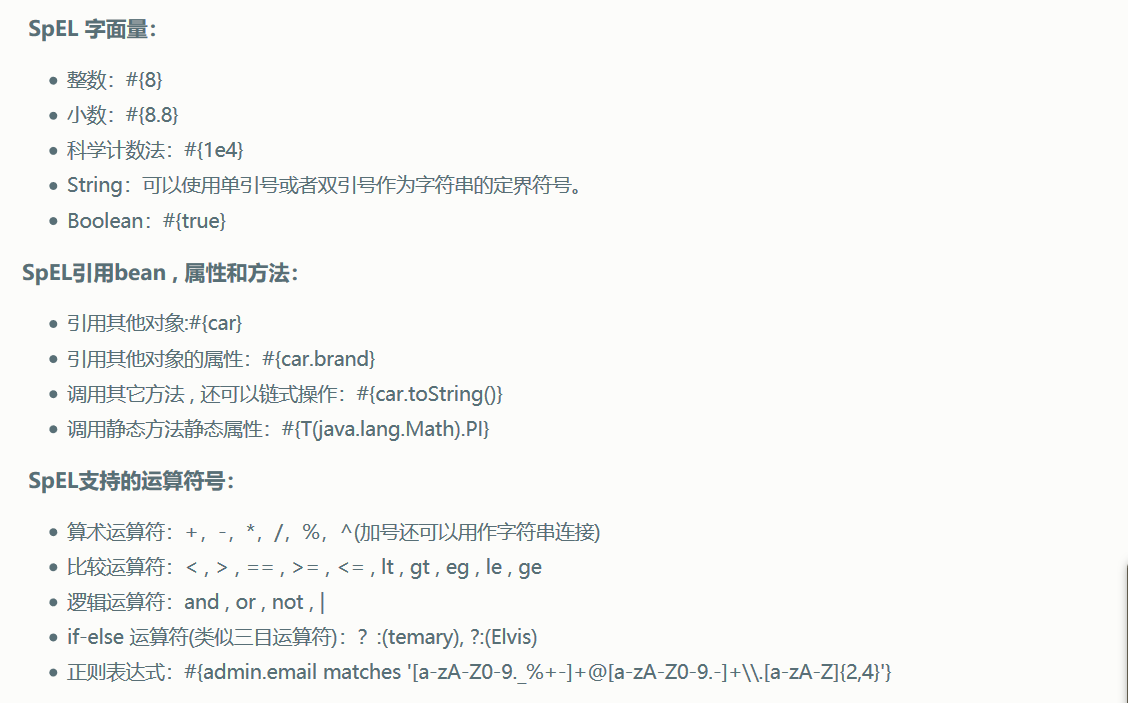
新建一个类carInfo
package spring.day1.demo3;

public class carInfo {

    private String name;

    private double price;

    public String getName() {

        return "小三轮儿";

    }

    public double getPrice() {

        return Math.random()*1000;

    }

}
修改applicationContext2.xml为如下
<?xml version="1.0" encoding="UTF-8"?>

<!-- =======================引入spring的关于bean的约束 ========================= -->

<beans xmlns="http://www.springframework.org/schema/beans"

    xmlns:p="http://www.springframework.org/schema/p"

    xmlns:xsi="http://www.w3.org/2001/XMLSchema-instance"

    xsi:schemaLocation="

        http://www.springframework.org/schema/beans

        http://www.springframework.org/schema/beans/spring-beans.xsd">

    <!-- ================spring属性注入=============================== -->

    <!-- 构造方法注入 -->

    <bean id="car" class="spring.day1.demo3.car">

        <constructor-arg name="name" value="宝马"></constructor-arg>

        <constructor-arg name="price" value="500000"></constructor-arg>

    </bean>

    <!-- set方法对car2注入普通值 -->

    <!-- <bean id="car2" class="spring.day1.demo3.car2">

        <property name="name" value="奔驰"></property>

        <property name="price" value="600000"></property>

    </bean> -->

    <!-- set方法注入对象 -->

    <!-- <bean id="employee" class="spring.day1.demo3.employee">

        <property name="name" value="张三"></property>

        <property name="car" ref="car2"></property>

    </bean> -->

    <!-- SPEL方式 -->

    <bean id="carInfo" class="spring.day1.demo3.carInfo"></bean>

    <bean id="car2" class="spring.day1.demo3.car2">

        <property name="name" value="#{carInfo.name}"></property>

        <property name="price" value="#{carInfo.getPrice()}"></property>

    </bean>

</beans>
在测试类SpringDemo3加入以下
@Test

    public void demo3() {

        ApplicationContext applicationContext = new ClassPathXmlApplicationContext("applicationContext2.xml");

        car2 bean = (car2) applicationContext.getBean("car2");

        System.out.println(bean);

    }
运行截图如下

1.4P名称空间方式注入普通值和对象(Spring2.5以后)了解

2.集合属性注入(了解)
1.新建CollectionBean类
2.在applicationContext2.xml中加入如下代码
3.新建测试类测试
<!-- =======================spring集合属性的注入============================ -->

    <bean id="collectionBean" class="zcc.spring.demo5.CollectionBean">

        <!-- 数组类型 -->

        <property name="arrs">

            <list>

                <value>张三</value>

                <value>李四</value>

                <value>王麻子</value>

            </list>

        </property>

        <!-- List集合类型 -->

        <property name="list">

            <list>

                <value>一号</value>

                <value>二号</value>

                <value>三号</value>

            </list>

        </property>

        <!-- Set集合类型 -->

        <property name="set">

            <set>

                <value>a</value>

                <value>b</value>

                <value>c</value>

            </set>

        </property>

        <!-- Map集合类型 -->

        <property name="map">

            <map>

                <entry key="数字" value="1"></entry>

                <entry key="性别" value="男"></entry>

            </map>

        </property>

    </bean>
package zcc.spring.demo5;

import java.util.Arrays;

import java.util.List;

import java.util.Map;

import java.util.Set;

/*

 * 集合属性的注入

 */

public class CollectionBean {

    private String []arrs;

    private List<String> list;

    private Set<String> set;

    private Map<String,String> map;

    public void setArrs(String[] arrs) {

        this.arrs = arrs;

    }

    public void setList(List<String> list) {

        this.list = list;

    }

    public void setSet(Set<String> set) {

        this.set = set;

    }

    public void setMap(Map<String, String> map) {

        this.map = map;

    }

    @Override

    public String toString() {

        return "CollectionBean [arrs=" + Arrays.toString(arrs) + ", list=" + list + ", set=" + set + ", map=" + map

                + "]";

    }

}
package zcc.spring.demo5;

import org.junit.Test;

import org.springframework.context.ApplicationContext;

import org.springframework.context.support.ClassPathXmlApplicationContext;

/*

 * 集合类型的属性注入

 */

public class SpringDemo5 {

    @Test

    public void demo1() {

        //创建spring的工厂来实例化xml中所有的bean对象

        ApplicationContext applicationContext = new ClassPathXmlApplicationContext("applicationContext.xml");

        CollectionBean bean = (CollectionBean) applicationContext.getBean("collectionBean");

        System.out.println(bean);

    }

}

spring的基于XML方式的属性注入的更多相关文章
- Spring声明式事务管理(基于XML方式实现)
--------------------siwuxie095 Spring 声明式事务管理(基于 XML 方式实现) 以转账为例 ...
- Spring 中IOC(控制反转)&& 通过SET方式为属性注入值 && Spring表达式
### 1. Spring IoC IoC:Inversion of control:控制反转:在传统开发模式下,对象的创建过程和管理过程都是由开发者通过Java程序来实现的,操作权在开发者的Java ...
- Spring boot 基于注解方式配置datasource
Spring boot 基于注解方式配置datasource 编辑 Xml配置 我们先来回顾下,使用xml配置数据源. 步骤: 先加载数据库相关配置文件; 配置数据源; 配置sqlSessionF ...
- Spring-注入方式(基于xml方式)
1.基于xml方式创建对象 <!--配置User类对象的创建 --> <bean id="user" class="com.at.spring5.Use ...
- 跟着刚哥学习Spring框架--通过XML方式配置Bean(三)
Spring配置Bean有两种形式(XML和注解) 今天我们学习通过XML方式配置Bean 1. Bean的配置方式 通过全类名(反射)的方式 √ id:标识容器中的bean.id唯一. √ cl ...
- 表达式SpEL方式的属性注入
-----------------------siwuxie095 表达式 SpEL 方式的属性注入 表达式 SpEL 方式的属性注入是 Spring 3.x 版本后提供的方式 1.编写一个普通类 B ...
- 命名空间p方式的属性注入
---------------------siwuxie095 命名空间 p 方式的属性注入 命名空间 p 方式的属性注入是 Spring 2.x 版本后提供的方式 1.编写一个普通类 Book.ja ...
- Spring 框架的概述以及Spring中基于XML的IOC配置
Spring 框架的概述以及Spring中基于XML的IOC配置 一.简介 Spring的两大核心:IOC(DI)与AOP,IOC是反转控制,DI依赖注入 特点:轻量级.依赖注入.面向切面编程.容器. ...
- Spring中基于xml的AOP
1.Aop 全程是Aspect Oriented Programming 即面向切面编程,通过预编译方式和运行期动态代理实现程序功能的同一维护的一种技术.Aop是oop的延续,是软件开发中的 一个热点 ...
随机推荐
- FMDB源码解析
上一篇博客讲述SQLite的使用,本篇将讲述FMDB源码,后面也会讲解SQLite在使用与FMDB的区别.本篇读下来大约20-30分钟,建议大家先收藏一下. FMDB是以OC方式封装SQLite中C语 ...
- Python爬虫之使用Fiddler+Postman+Python的requests模块爬取各国国旗
介绍 本篇博客将会介绍一个Python爬虫,用来爬取各个国家的国旗,主要的目标是为了展示如何在Python的requests模块中使用POST方法来爬取网页内容. 为了知道POST方法所需要传 ...
- Webapi--Webapi 跨域链接
1]创建 WebAPIWebAPI WebAPI,新建 ,新建 ->项目 ->ASP.NET Web >ASP.NET Web >ASP.NET Web >ASP.NET ...
- git中的忽略配置文件中没有忽略该文件,却提交不到服务器上。
解决方法:在被忽略项目上单击右键
- openssl基本原理 + 生成证书 + 使用实例
前期准备 : 安装xampp:打开文件E:\xampp\apache\bin\openssl.exe 右键 以管理员身份运行 ------转载自 https://blog.csdn.net/oldm ...
- Jmter接口网站压力测试工具使用记录
1.首先下载Jmeter 官方地址:http://jmeter.apache.org/ 2.安装Jmeter 把下载的文件进行解压,产生如下目录: 打开bin文件夹下的jmeter.bat文件及进入程 ...
- Hibernate入门(六)---------HQL语句
Query: 代表面向对象的一个Hibernate查询操作.在Hibernate中,通常使用session.createQuery()方法接收一个HQL语句,然后调用Query的 list()或uni ...
- 2018年,JavaScript都经历了什么?
摘要: 对JSer来说,这是很有意思的1年. 本文灵感来自JavaScript Weekly周报,欢迎大家订阅. The State of JavaScript 2018 The State of J ...
- 【mysql】2003-Can't connect to MySQL server (10060)
使用navicat或者其他数据库管理工具连接mysql时出现2003-Can’t connect to MySQL server (10060)错误 可能造成出现的原因: 1.网络不通畅 2.mysq ...
- 6;XHTML 超链接
1.超链接的基本格式 2.超链接的种类 3.相对链接和绝对链接 4.书签的链接 5.基准参考点 6.超链接事件 7.为链接创建键盘快捷键 8.为链接设置制表符次序 超链接也叫 URL 中文翻译为资源定 ...