
TIJ——Chapter Eleven:Holding Your Objects
Java Provides a number of ways to hold objects:
- An array associates numerical indexes to objects. It holds objects of a known type so that you don't have to cast the result when you're looking up an object. It can be multidimensional, and it can hold primitives. However, its size cannot be changed once you create it.
- A Collection holds signle elements, and a Map holds associated pairs. With Java generics, you specify the type of objec to be held in the containers, so you can't put the wrong type into a container and you don't have to cast elements when you fetch them out of a container. Both Collections and Maps automatically resize themselves as you add more elements. A container won't hold primitives, but autoboxing takes care of translating primitives back and forth to the wrapper types held in the container.
- Like an array, a List also associates numerical indexed to objects—thus, arrays and Lists are ordered containers.
- Use an ArrayList if you're doing a lot of random accesses, but a LinkedList if you will be doing a lot of insertions and removals in the middle of the list.
- The behavior of Queue and Stack is provided via the LinkedList.
- A Map is a way to associate not integral values, but objects with other objects. HashMap are designed for rapid access, whereas a TreeMap keeps its keys in sorted order, and thus is not as fast as a HashMap. A LinkedHashMap keeps its elements in insertion order, but provides rapid access with hashing.
- A set only accepts one of each type of object. HashSet provide maximally fast lookups, whereas TreeSet keep the elements in sorted order. LinkedHashSet keep elements in insertion order.
- There's no need to use the legacy classes Vector, Hashtable, and Stack in new code.
It's helpful to look at a simplified diagram of the Java containers(without the abstract classes or legacy components). This only includes the interfaces and classes that you will encounter on a regular basis.
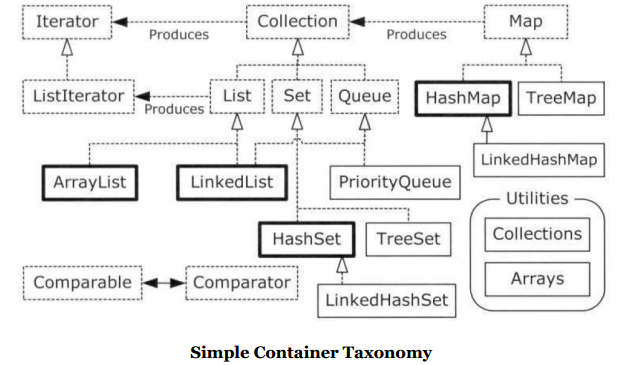
图中,用粗黑线框包围的容器(HashMap、ArrayList、LinkedList、HashSet)是我们在开发过程中要频繁使用的;虚线框表示接口,实线框表示具体的实现类;空心箭头表示某一个类实现了所指向的接口,实心箭头表示一个类(或实现某个接口的类)能生成一个指向类的对象。
- 对于容器而言,使用泛型与不使用泛型的几个重要的区别是:当往容器中放元素的时候,如果使用泛型,那么对于类型不兼容的对象,会在编译期报错;而且从容器中取出元素的时候,使用泛型则不需要类型转换,而不使用泛型则必须进行类型转换。可以看出,使用泛型可以使我们的代码更精简、健壮,同时不必记忆放入容器中元素的类型。
- The Java container library takes the idea of "holding your object" and divides it into two distinct concepts, expressed as the basic interfaces of the library:Lists promise to maintain elements in a particular sequence. The List interface adds a number of methods to Collection that allow insertion and removal of elements in the middle of a List. There are two types of List:
- Collection: a sequence of individual elements with one or more rules applied to them. A List must hold the elements in the way that they were inserted, a Set cannot have duplicate elements.
- Map: a group of key-value object pairs, allowing you to look up a value using a key. An ArrayList allows you to look up an object using a number, so in a sense it associates number to objects. A map allows you to look up an object using another object. It's also called an associative array, because it associates objects with another objects, or a dictionary, because you look up a value object using a key object just like you look up a definition using a word. Maps are powerful programming tools.
- Lists promise to maintain elements in a particular sequence. The List Interface adds a number of methods to Collection that allow insertion and removal of elements in the middle of a List. There are two types of List:
- The basic ArrayList, which excels at randomly accessing elements, but is slower when inserting and removing elements in the middle of a List.
- The LinkedList, which provides optimal sequential access, with inexpensive insertions and deletions from the middle of the List. A LinkedList is relatively slow for random access, but it has a larger feature set than the ArrayList.
- The Java Iterator can move in only one direction, There's not much you can do with an Iterator except(With an Iterator, you don't need to worry about the number of elements in the container. That's taken care of for you by hasNext() and next()):
- Ask a Collection to hand you an Iterator using a method called iterator(). That Iterator will be ready to return the first element in the sequence.
- Get the next object in the sequence with next().
- See if there are more object in the sequence with hasNext().
- Remove the last element returned by the iterator with remove().
- HashSet uses hashing for speed. The Order maintained by a HashSet is different from a TreeSet or a LinkedHashSet, since each implementation has a different way of storing elements. TreeSet keeps elements sorted into a red-black tree data structure, whereas HashSet uses the hashing fuction. LinkedHashSet also uses hashing for lookup speed, but appears to maintain elements in insertion order using a linked list.
- A foreach statement works with an array or anything Iterable, but that doesn't mean that an array is automatically an Iterable, nor is there any autoboxing that takes place:
public class ArrayIsNotIterable

{

	static <T> void test(Iterable<T> ib)

	{

		for(T t : ib)

		{

			System.out.print(t + " ");

		}

	}

	public static void main(String[] args)

	{

		test(Arrays.asList(1, 2, 3));

		String[] strings = {"A", "B", "C"};

		// An array works in foreach, but it's not Iterable:

		// !test(strings);

		// You must explicitly convert it to Iterable:

		test(Arrays.asList(strings));

	}

}

/*

 Output:

 1 2 3 A B C

*/
TIJ——Chapter Eleven:Holding Your Objects的更多相关文章
- TIJ——Chapter One:Introduction to Objects
///:~容我对这个系列美其名曰"读书笔记",其实shi在练习英文哈:-) Introduction to Objects Object-oriented programming( ...
- TIJ——Chapter Two:Everything Is an Object
If we spoke a different language, we would perceive a somewhat different world. Ludwig Wittgenstein( ...
- TIJ——Chapter Twelve:Error Handling with Exception
Exception guidelines Use exceptions to: Handle problems at the appropriate level.(Avoid catching exc ...
- TIJ——Chapter Eight:Polymorphism
The twist |_Method-call binding Connecting a method call to a method body is called binding. When bi ...
- TIJ——Chapter Seven:Reusing Classes
Reusing Classes 有两种常用方式实现类的重用,组件(在新类中创建存在类的对象)和继承. Composition syntax Every non-primitive object has ...
- TIJ——Chapter Five:Initialization & Cleanup
Method overloading |_Distinguishing overloaded methods If the methods hava the same name, how can Ja ...
- Think Python - Chapter 15 - Classes and objects
15.1 User-defined typesWe have used many of Python’s built-in types; now we are going to define a ne ...
- Chapter 3 Introduction to Objects and Input/Output
与声明一个primitive variable不同,声明一个对象的时候,并不创建用来存储一个对象的内存空间,而是创建了一个存储该对象所在内存空间的地址. 在java里,new是一个操作符,它让系统分配 ...
- TIJ——Chapter Thirteen:Strings
String 对象是不可修改的,对于被String 重载的'+' 和'+=' 运算符来说,当你用它们来连接两个String 对象的时候,它在底层并不会对于每一次连接均生成一个String 对象,取而代 ...
随机推荐
- ChannelPipeline
Netty的ChannelPipeline和ChannelHandler机制类似于Servlet和Filter过滤器,这类拦截器实际上是职责链模式的一种变形,主要是为了方便事件的拦截和用户业务逻辑的定 ...
- C#写入和读出文本文件
C#写入和读出文本文件 写入文本文件 class WriteTextFile { static void Main() { //如果文件不存在,则创建:存在则覆盖 //该方法写入字符数组换行显示 st ...
- ViewPager打造轮播图(Banner)\引导页(Guide)
今年7月时,在Github发布了一个开源的Banner库,虽然Star不多,但还是有少部分人使用. Banner效果: 昨天,有使用此库的同学提出需求,想在引导页的时候用这个库并且最后一页有进入按钮 ...
- XVI Open Cup named after E.V. Pankratiev. GP of Eurasia
A. Nanoassembly 首先用叉积判断是否在指定向量右侧,然后解出法线与给定直线的交点,再关于交点对称即可. #include<bits/stdc++.h> using names ...
- Activiti工作流学习(三)Activiti工作流与spring集成
一.前言 前面Activiti工作流的学习,说明了Activiti的基本应用,在我们开发中可以根据实际的业务参考Activiti的API去更好的理解以及巩固.我们实际的开发中我们基本上都使用sprin ...
- Django URL name详解
我们基于上一节的代码来开始这一节的内容. 上节源代码:zqxt_views(django 1.4 - django 1.10).zip [更新于 2016-09-06 00:13:23] 1. 打开 ...
- 2016huasacm暑假集训训练四 递推_C
题目链接:http://acm.hust.edu.cn/vjudge/contest/125308#problem/C 题意:给你一个高为n ,宽为m列的网格,计算出这个网格中有多少个矩形 这个题只 ...
- 玩转 H5 下拉上滑动效
按照上面的技术方案实施,具体过程为: 禁用页面顶部下拉事件 ------> 将页面的主体内容用一个DIV容器包含起来,同时复制需要放大处理的内容节点至主体内容之外 ------> 绑 ...
- 浮点数 (IEEE-754)
浮点数又称"实数",一个浮点数包含三个部分 符号位(S) 阶码 有效数字 S:阶码:有效数字 浮点数是由科学二级制来表示的. 三种类型的浮点数: 短浮点数(32bit): S(b ...
- 百度网盘生成二维码api
分享出自精神,灵感来自大脑,在百度云网盘分享每一个文件,都会在页面生成一个二维码扫描的图片: 我就进一步看了该图片的地址: 发现没有,圈圈内是不是有点眼熟,就跟其他二维码api接口一样,只要盗用这段东 ...