
Chromium Graphics: Video Playback and Compositor
Video Playback and Compositor
|
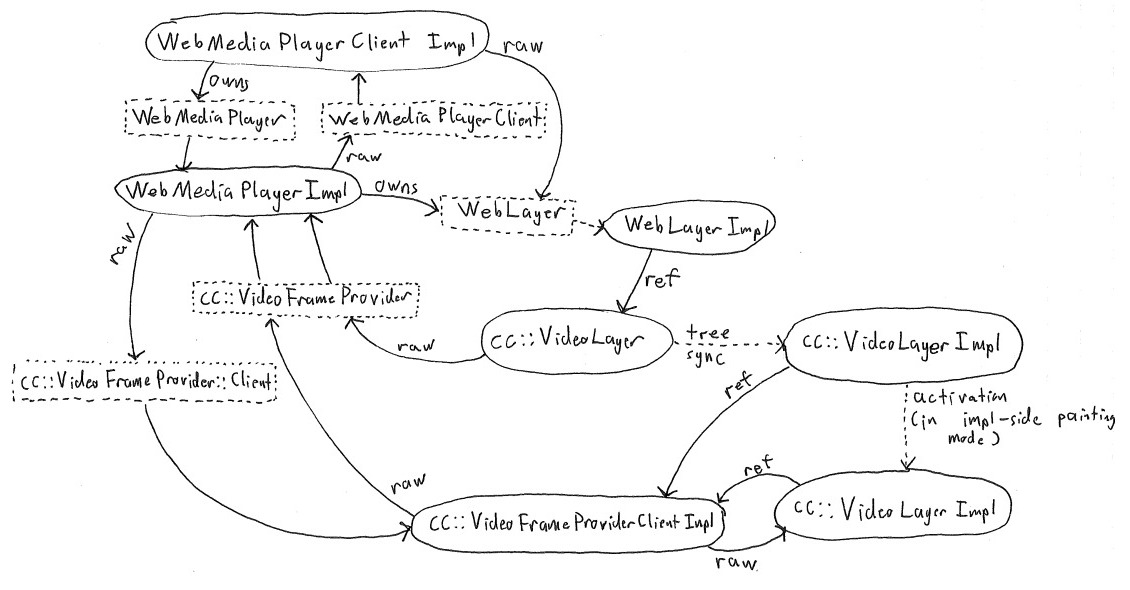
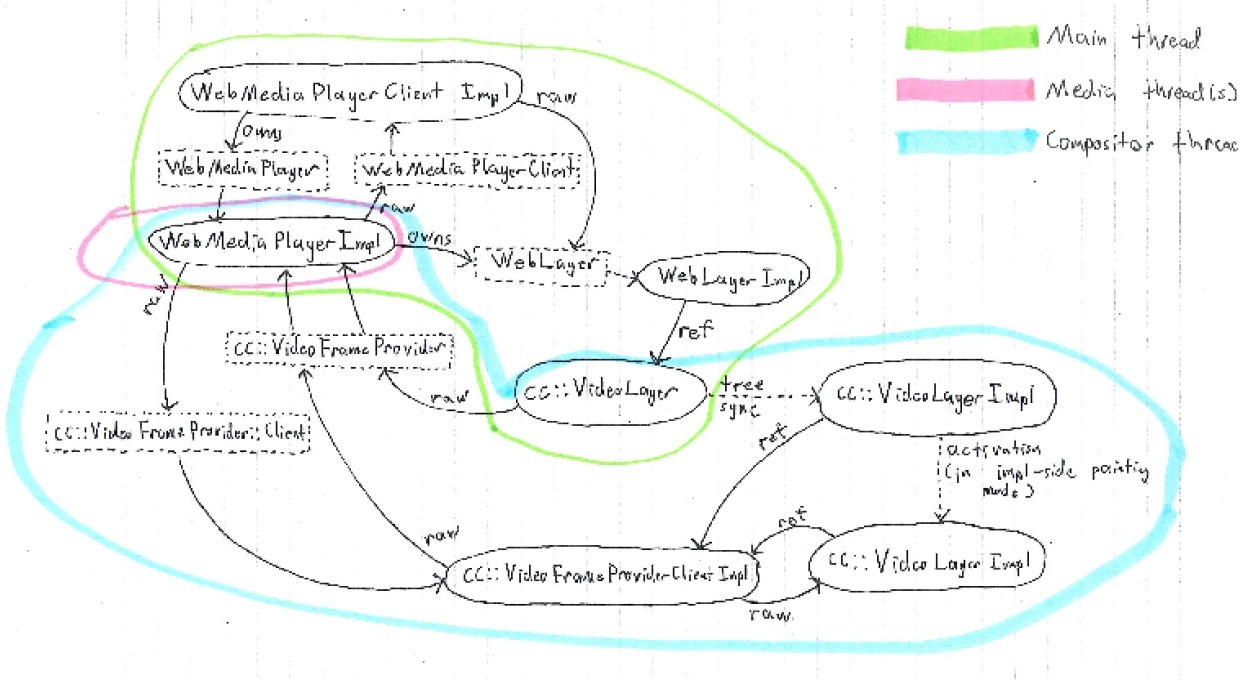
Authors: jamesr@chromium.org, danakj@chromium.org The Chromium compositor has support for video playback to support offloading work to the GPU and displaying video frames while the main thread is blocked. There are a few different media engine implementations in Chromium, but they interact with the compositor in similar ways. Here’s a diagram of the different classes and how they interact: Things in dotted square boxes are interfaces, things in ovals are concrete classes. Arrows represent pointers between objects. Objects by thread (note that a few span multiple threads): Before video playback: 1.) WebMediaPlayerClientImpl constructed by WebCore At start of video load: 2.) WebMediaPlayerClientImpl constructs WebMediaPlayer In SetReadyState, if the video has loaded enough to know we want composited playback: 3.) WebMediaPlayerImpl constructs a WebLayerImpl wrapping a cc::VideoLayer with the provider pointer set to the WebMediaPlayerImpl 4.) WebMediaPlayerImpl provides WebLayer* to WebMediaPlayerClientImpl to register in WebCore’s compositing tree On the next compositor commit during tree sync (on compositor thread with main thread blocked): 5.) cc::VideoLayer creates a cc::VideoLayerImpl and passes the cc::VideoFrameProvider* 6.) cc::VideoLayerImpl creates a cc::VideoFrameProviderClientImpl with the provider pointer 7.) cc::VideoFrameProviderClientImpl calls SetVideoFrameProviderClient(this) on the cc::VideoFrameProvider*, which is the WebMediaPlayerImpl On tree activation (immediately after tree sync when not in impl-side painting, at some point later on in impl-side painting) 8.) Active tree cc::VideoLayerImpl sets itself as the cc::VideoFrameProviderClientImpl’s active layer If we fully initialize without anything shutting down, then the pathway for the video layer to grab a new frame is: On the compositor thread when preparing to draw a frame: 1.) cc::VideoLayerImpl::WillDraw calls VideoFrameProviderClientImpl::AcquireLockAndCurrentFrame() 2.) VFPCI::ALACF takes its provider_lock_ and calls GetCurrentFrame() on its provider 3.) WebMediaPlayerImpl takes its internal lock_ and returns its current_frame_ 4.) cc::VideoLayerImpl uploads data into textures (if needed) On the compositor thread when drawing a frame: 5.) cc::VideoLayerImpl::AppendQuads adds quads into the draw list referencing the video texture(s) On the compositor thread after drawing a frame: 6.) cc::VideoLayerImpl::DidDraw calls VideoFrameProviderClientImpl::PutCurrentFrame 7.) VFPCI::PCF calls PutCurrentFrame() on its provider 8.) cc::VideoLayerImpl::DidDraw calls VFPCI::ReleaseLock which releases provider_lock_ The way the media system can notify the compositor of new video frames on the compositor thread is (currently implemented only on android): On the compositor thread when the media system has a new frame available 1.) Something in the media playback system (content::StreamTextureProxyImpl for android) calls cc::VideoFrameProvider::DidReceiveFrame() 2.) cc::VideoFrameProviderClientImpl checks if it has an active cc::VideoLayerImpl and calls SetNeedsRedraw() on it if so 3.) cc::VideoLayerImpl::SetNeedsRedraw tells the compositor to schedule a new frame Shutdown There are a few ways this system can shut down. All shutdown paths start on the main thread, but they can propagate out to other threads in different ways depending on the type of shutdown. Video layer removed from compositing tree while playing This can happen if a <video> element is detached from the DOM tree or display:none is set on an ancestor of the element. There are two cases to consider here - impl-side painting off and impl-side painting on. With impl-side painting off, there is only one cc::VideoLayerImpl associated with a given cc::VideoLayer. The cc::VideoLayerImpl is always created or destroyed during the tree sync part of commit which happens on the compositor thread with the main thread blocked. With impl-side painting on, there are potentially two cc::VideoLayerImpls associated with a given cc::VideoLayer. One is in the pending/recycle tree and is always created/destroyed during the commit tree sync on the compositor thread with the main thread blocked. The other is in the active tree and is created/destroyed during tree activation, which happens on the compositor thread while the main thread is not blocked. In impl-side painting mode both cc::VideoLayerImpls hold a reference to the same cc::VideoFrameProviderClientImpl. Preconditions: 1.) WebMediaPlayerClientImpl owns a WebMediaPlayer (which is a WebMediaPlayerImpl) 2.) WebMediaPlayerImpl owns a WebLayerImpl, which has a ref to a cc::VideoLayer 3.) cc::VideoLayer has an associated cc::VideoLayerImpl (two in impl-side painting mode) which reference a cc::VideoFrameProviderClientImpl 4.) WebMediaPlayerImpl’s provider_client_ pointer points to the cc::VideoFrameProviderClientImpl 5.) cc::VideoFrameProviderClientImpl’s provider_ pointer points to the WebMediaPlayerImpl Sequence: On the main thread at any point in time 1.) cc::VideoLayer removed from the compositing tree and/or destroyed In the next compositor commit on the compositor thread with the main thread blocked: 2.) Tree sync starts destruction of the cc::VideoLayerImpl (only cc::VideoLayerImpl when not in impl-side painting, pending/recycle layer in impl-side painting) 3.) ~cc::VideoLayerImpl() calls cc::VideoFrameProviderClientImpl::Stop() 4.) cc::VFPCI::Stop() calls SetVideoFrameProviderClientImpl(NULL) on its cc::VideoFrameProvider*, which is a WebMediaPlayerImpl 5.) cc::VFPCI::StopUsingProvider() takes its provider_lock_ and nulls out its provider_ 6.) WebMediaPlayerImpl nulls out its provider_client_ pointer 7.) cc::VFPCI::Stop() nulls out its provider_ pointer (again) If in impl-side painting mode, on tree activation in the compositor thread: 8.) cc::VideoLayerImpl in active tree destroyed, dropping last reference to cc::VideoFrameProviderClientImpl Ordering: Steps 2-7 happen on the compositor thread with the main thread blocked. This means that the compositor cannot be in a frame for any of these steps and nothing on the main thread can advance (i.e. we can’t start shutting down the WebMediaPlayerImpl). Postconditions: 1.) WebMediaPlayerImpl’s provider_client_ pointer is NULL (as of step 7) 2.) cc::VideoFrameProviderClientImpl’s provider_ pointer is NULL (as of step 6) When impl-side painting is not enabled, then 3.) cc::VideoLayerImpl and cc::VideoFrameProviderClientImpl destroyed (as of step 9) Media engine shut down while video layer is in compositing tree Preconditions: 1.) WebMediaPlayerClientImpl owns a WebMediaPlayer (which is a WebMediaPlayerImpl) 2.) WebMediaPlayerImpl owns a WebLayerImpl, which has a ref to a cc::VideoLayer 3.) cc::VideoLayer has an associated cc::VideoLayerImpl (two in impl-side painting mode) which reference a cc::VideoFrameProviderClientImpl 4.) WebMediaPlayerImpl’s provider_client_ pointer points to the cc::VideoFrameProviderClientImpl 5.) cc::VideoFrameProviderClientImpl’s provider_ pointer points to the WebMediaPlayerImpl 6.) We’re outside a compositor commit on the main thread 7.) The compositor thread may be in any state, including activation or drawing a frame. Sequence: On the main thread at any point in time: 1.) WebMediaPlayerClientImpl destroys its WebMediaPlayer (which is a WebMediaPlayerImpl) 2.) ~WebMediaPlayerImpl() calls SetVideoFrameProviderClient(NULL) on its provider_client_, which is a cc::VideoFrameProvierClientImpl 3.) cc::VideoFrameProviderClientImpl::SetVideoFrameProviderClient() takes its provider_lock_ 4.) cc::VideoFrameProviderClientImpl::SetVideoFrameProviderClient() nulls out its provider_ pointer, which pointed to the WebMediaPlayerImpl 5.) cc:VFPCI::SetVideoFrameProviderClient() releases its provider_lock_ 6.) ~WebMediaPlayerImpl() completes and the object is destroyed Ordering: 1.) In step (3) the cc::VFPCI takes its provider_lock_. If the compositor thread is in the middle of drawing a frame (specifically between WillDraw() and DidDraw()), this call will block until the frame is complete Postconditions: 1.) WebMediaPlayerImpl’s provider_client_ pointer is NULL (as of step 4) 2.) cc::VideoFrameProviderClientImpl’s provider_ pointer is NULL (as of step 5) |
Chromium Graphics: Video Playback and Compositor的更多相关文章
- Audio / Video Playback
For Developers > Design Documents > Audio / Video Playback Interested in helping out? Ch ...
- Chrome/Chromium HTML5 video 视频播放硬件加速
Chromium站点上有个大致的框图.描写叙述了Chromium的video在各个平台 - 包含Android - 上是怎样使用硬件资源来做视频编解码加速的: 而依据Android Kitkat上的C ...
- stagefright框架(一)Video Playback的流程
在Android上,預設的多媒體框架(multimedia framework)是OpenCORE. OpenCORE的優點是兼顧了跨平台的移植性,而且已經過多方驗證,所以相對來說較為穩定:但是其缺點 ...
- Chromium Graphics: Compositor Thread Architecture
Compositor Thread Architecture <jamesr, enne, vangelis, nduca> @chromium.org Goals The main re ...
- Chromium Graphics: HW Video Acceleration in Chrom{e,ium}{,OS}
HW Video Acceleration in Chrom{e,ium}{,OS} Ami Fischman <fischman@chromium.org> Status as of 2 ...
- Chromium Graphics : GPU Accelerated Compositing in Chrome
GPU Accelerated Compositing in Chrome Tom Wiltzius, Vangelis Kokkevis & the Chrome Graphics team ...
- HW Video Acceleration in Chrome/Chromium HTML5 video 视频播放硬件加速
Introduction Video decode (e.g. YouTube playback) and encode (e.g. video chat applications) are some ...
- Chromium Graphics: Android L平台上WebView的变化及其对浏览器厂商的影响分析
原创文章.转载请以链接形式注明原始出处为http://blog.csdn.net/hongbomin/article/details/40799167. 摘要:Google近期公布的Android L ...
- Chromium Graphics: GPUclient的原理和实现分析之间的同步机制-Part I
摘要:Chromium于GPU多个流程架构的同意GPUclient这将是这次访问的同时GPU维修,和GPUclient这之间可能存在数据依赖性.因此必须提供一个同步机制,以确保GPU订购业务.本文讨论 ...
随机推荐
- zookeeper的选举机制
1)半数机制:集群中半数以上机器存活,集群可用.所以zookeeper适合装在奇数台机器上. 2)Zookeeper虽然在配置文件中并没有指定master和slave.但是,zookeeper工作时, ...
- oracle锁表进行关闭
--查询被锁表 select 'alter system kill session '''||sess.sid||','||sess.serial#||''';', sess.sid, sess.se ...
- (转载)android 一些工具类汇总
android 一些工具类汇总 作者:曾田生z 字体:[增加 减小] 类型:转载 时间:2016-08-14我要评论 本文给大家汇总介绍了一些常用的Android工具类,非常的简单实用,有需要的小伙伴 ...
- ZBrush中常用笔刷综合简介
单击左托盘的笔刷图标,弹出一个笔刷库,其中有许多常用笔刷,这也是许多初学者所头疼的问题,ZBrush的笔刷非常多,而且功能很强大,好多朋友不知道该选择哪一个笔刷进行雕刻.其实,在ZBrush的学习中我 ...
- 搭健MyBatis开发环境
相关文献资料地址:http://www.mybatis.org/mybatis-3/zh/getting-started.html 关于如何创建一个项目,添加Tomcat运行环境和生成`web.xml ...
- CSS常用样式--font
CSS font 属性 参考:W3school- CSS font 所有浏览器都支持 font 属性,可在一个声明中设置所有字体属性,各属性需按顺序,语法如下: selector{ font:styl ...
- bzoj4551 [HEOI2016]树
题目描述 在2016年,佳媛姐姐刚刚学习了树,非常开心.现在他想解决这样一个问题:给定一颗有根树(根为1),有以下 两种操作:1. 标记操作:对某个结点打上标记(在最开始,只有结点1有标记,其他结点均 ...
- luogu P3414 SAC#1 - 组合数(组合数学)
题意 求sigma(C(n,i))其中C是组合数(即C(n,i)表示n个物品无顺序选取i个的方案数),i取从0到n所有偶数. 由于答案可能很大,请输出答案对6662333的余数. (n<=101 ...
- 2015 Multi-University Training Contest 1 hdu 5290 Bombing plan
Bombing plan Time Limit: 8000/4000 MS (Java/Others) Memory Limit: 262144/262144 K (Java/Others)To ...
- BZOJ 4236~4247 题解
BZOJ 4236 JOIOJI f[i][0..2]表示前i个字符中′J′/′O′/′I′的个数 将二元组<f[i][0]−f[i][1],f[i][1]−f[i][2]>扔进map,记 ...