
第十六节,使用函数封装库tf.contrib.layers
这一节,介绍TensorFlow中的一个封装好的高级库,里面有前面讲过的很多函数的高级封装,使用这个高级库来开发程序将会提高效率。
我们改写第十三节的程序,卷积函数我们使用tf.contrib.layers.conv2d(),池化函数使用tf.contrib.layers.max_pool2d()和tf.contrib.layers.avg_pool2d(),全连接函数使用tf.contrib.layers.fully_connected()。
一 tf.contrib.layers中的具体函数介绍
1.tf.contrib.layers.conv2d()函数的定义如下:
def convolution(inputs,

                num_outputs,

                kernel_size,

                stride=1,

                padding='SAME',

                data_format=None,

                rate=1,

                activation_fn=nn.relu,

                normalizer_fn=None,

                normalizer_params=None,

                weights_initializer=initializers.xavier_initializer(),

                weights_regularizer=None,

                biases_initializer=init_ops.zeros_initializer(),

                biases_regularizer=None,

                reuse=None,

                variables_collections=None,

                outputs_collections=None,

                trainable=True,

                scope=None):
常用的参数说明如下:
- inputs:形状为[batch_size, height, width, channels]的输入。
- num_outputs:代表输出几个channel。这里不需要再指定输入的channel了,因为函数会自动根据inpus的shpe去判断。
- kernel_size:卷积核大小,不需要带上batch和channel,只需要输入尺寸即可。[5,5]就代表5x5的卷积核,如果长和宽都一样,也可以只写一个数5.
- stride:步长,默认是长宽都相等的步长。卷积时,一般都用1,所以默认值也是1.如果长和宽都不相等,也可以用一个数组[1,2]。
- padding:填充方式,'SAME'或者'VALID'。
- activation_fn:激活函数。默认是ReLU。也可以设置为None
- weights_initializer:权重的初始化,默认为initializers.xavier_initializer()函数。
- weights_regularizer:权重正则化项,可以加入正则函数。biases_initializer:偏置的初始化,默认为init_ops.zeros_initializer()函数。
- biases_regularizer:偏置正则化项,可以加入正则函数。
- trainable:是否可训练,如作为训练节点,必须设置为True,默认即可。如果我们是微调网络,有时候需要冻结某一层的参数,则设置为False。
2.tf.contrib.layers.max_pool2d()函数的定义如下:
def max_pool2d(inputs,

               kernel_size,

               stride=2,

               padding='VALID',

               data_format=DATA_FORMAT_NHWC,

               outputs_collections=None,

               scope=None):
参数说明如下:
- inputs: A 4-D tensor of shape `[batch_size, height, width, channels]` if`data_format` is `NHWC`, and `[batch_size, channels, height, width]` if `data_format` is `NCHW`.
- kernel_size: A list of length 2: [kernel_height, kernel_width] of the pooling kernel over which the op is computed. Can be an int if both values are the same.
- stride: A list of length 2: [stride_height, stride_width].Can be an int if both strides are the same. Note that presently both strides must have the same value.
- padding: The padding method, either 'VALID' or 'SAME'.
- data_format: A string. `NHWC` (default) and `NCHW` are supported.
- outputs_collections: The collections to which the outputs are added.
- scope: Optional scope for name_scope.
3.tf.contrib.layers.avg_pool2d()函数定义
def avg_pool2d(inputs,

               kernel_size,

               stride=2,

               padding='VALID',

               data_format=DATA_FORMAT_NHWC,

               outputs_collections=None,

               scope=None):
参数说明如下:
- inputs: A 4-D tensor of shape `[batch_size, height, width, channels]` if`data_format` is `NHWC`, and `[batch_size, channels, height, width]` if `data_format` is `NCHW`.
- kernel_size: A list of length 2: [kernel_height, kernel_width] of the pooling kernel over which the op is computed. Can be an int if both values are the same.
- stride: A list of length 2: [stride_height, stride_width].Can be an int if both strides are the same. Note that presently both strides must have the same value.
- padding: The padding method, either 'VALID' or 'SAME'.
- data_format: A string. `NHWC` (default) and `NCHW` are supported.
- outputs_collections: The collections to which the outputs are added.
- scope: Optional scope for name_scope.
4.tf.contrib.layers.fully_connected()函数的定义如下:
def fully_connected(inputs,

                    num_outputs,

                    activation_fn=nn.relu,

                    normalizer_fn=None,

                    normalizer_params=None,

                    weights_initializer=initializers.xavier_initializer(),

                    weights_regularizer=None,

                    biases_initializer=init_ops.zeros_initializer(),

                    biases_regularizer=None,

                    reuse=None,

                    variables_collections=None,

                    outputs_collections=None,

                    trainable=True,

                    scope=None):
参数说明如下:
- inputs: A tensor of at least rank 2 and static value for the last dimension; i.e. `[batch_size, depth]`, `[None, None, None, channels]`.
- num_outputs: Integer or long, the number of output units in the layer.
- activation_fn: Activation function. The default value is a ReLU function.Explicitly set it to None to skip it and maintain a linear activation.
- normalizer_fn: Normalization function to use instead of `biases`. If `normalizer_fn` is provided then `biases_initializer` and
- `biases_regularizer` are ignored and `biases` are not created nor added.default set to None for no normalizer function
- normalizer_params: Normalization function parameters.
- weights_initializer: An initializer for the weights.
- weights_regularizer: Optional regularizer for the weights.
- biases_initializer: An initializer for the biases. If None skip biases.
- biases_regularizer: Optional regularizer for the biases.
- reuse: Whether or not the layer and its variables should be reused. To be able to reuse the layer scope must be given.
- variables_collections: Optional list of collections for all the variables or a dictionary containing a different list of collections per variable.
- outputs_collections: Collection to add the outputs.
- trainable: If `True` also add variables to the graph collection `GraphKeys.TRAINABLE_VARIABLES` (see tf.Variable).如果我们是微调网络,有时候需要冻结某一层的参数,则设置为False。
- scope: Optional scope for variable_scope.
二 改写cifar10分类
代码如下:
# -*- coding: utf-8 -*-

"""

Created on Thu May  3 12:29:16 2018

@author: zy

"""

'''

建立一个带有全连接层的卷积神经网络  并对CIFAR-10数据集进行分类

1.使用2个卷积层的同卷积操作,滤波器大小为5x5,每个卷积层后面都会跟一个步长为2x2的池化层,滤波器大小为2x2

2.对输出的64个feature map进行全局平均池化,得到64个特征

3.加入一个全连接层,使用softmax激活函数,得到分类

'''

import cifar10_input

import tensorflow as tf

import numpy as np

def print_op_shape(t):

    '''

    输出一个操作op节点的形状

    '''

    print(t.op.name,'',t.get_shape().as_list())

'''

一 引入数据集

'''

batch_size = 128

learning_rate = 1e-4

training_step = 15000

display_step = 200

#数据集目录

data_dir = './cifar10_data/cifar-10-batches-bin'

print('begin')

#获取训练集数据

images_train,labels_train = cifar10_input.inputs(eval_data=False,data_dir = data_dir,batch_size=batch_size)

print('begin data')

'''

二 定义网络结构

'''

#定义占位符

input_x = tf.placeholder(dtype=tf.float32,shape=[None,24,24,3])   #图像大小24x24x

input_y = tf.placeholder(dtype=tf.float32,shape=[None,10])        #0-9类别

x_image = tf.reshape(input_x,[batch_size,24,24,3])

#1.卷积层 ->池化层

h_conv1 = tf.contrib.layers.conv2d(inputs=x_image,num_outputs=64,kernel_size=5,stride=1,padding='SAME', activation_fn=tf.nn.relu)    #输出为[-1,24,24,64]

print_op_shape(h_conv1)

h_pool1 = tf.contrib.layers.max_pool2d(inputs=h_conv1,kernel_size=2,stride=2,padding='SAME')         #输出为[-1,12,12,64]

print_op_shape(h_pool1)

#2.卷积层 ->池化层

h_conv2 =tf.contrib.layers.conv2d(inputs=h_pool1,num_outputs=64,kernel_size=[5,5],stride=[1,1],padding='SAME', activation_fn=tf.nn.relu)    #输出为[-1,12,12,64]

print_op_shape(h_conv2)

h_pool2 =  tf.contrib.layers.max_pool2d(inputs=h_conv2,kernel_size=[2,2],stride=[2,2],padding='SAME')   #输出为[-1,6,6,64]

print_op_shape(h_pool2)

#3全连接层

nt_hpool2 = tf.contrib.layers.avg_pool2d(inputs=h_pool2,kernel_size=6,stride=6,padding='SAME')          #输出为[-1,1,1,64]

print_op_shape(nt_hpool2)

nt_hpool2_flat = tf.reshape(nt_hpool2,[-1,64])

y_conv = tf.contrib.layers.fully_connected(inputs=nt_hpool2_flat,num_outputs=10,activation_fn=tf.nn.softmax)

print_op_shape(y_conv)

'''

三 定义求解器

'''

#softmax交叉熵代价函数

cost = tf.reduce_mean(-tf.reduce_sum(input_y * tf.log(y_conv),axis=1))

#求解器

train = tf.train.AdamOptimizer(learning_rate).minimize(cost)

#返回一个准确度的数据

correct_prediction = tf.equal(tf.arg_max(y_conv,1),tf.arg_max(input_y,1))

#准确率

accuracy = tf.reduce_mean(tf.cast(correct_prediction,dtype=tf.float32))

'''

四 开始训练

'''

sess = tf.Session();

sess.run(tf.global_variables_initializer())

# 启动计算图中所有的队列线程 调用tf.train.start_queue_runners来将文件名填充到队列,否则read操作会被阻塞到文件名队列中有值为止。

tf.train.start_queue_runners(sess=sess)

for step in range(training_step):

    #获取batch_size大小数据集

    image_batch,label_batch = sess.run([images_train,labels_train])

    #one hot编码

    label_b = np.eye(10,dtype=np.float32)[label_batch]

    #开始训练

    train.run(feed_dict={input_x:image_batch,input_y:label_b},session=sess)

    if step % display_step == 0:

        train_accuracy = accuracy.eval(feed_dict={input_x:image_batch,input_y:label_b},session=sess)

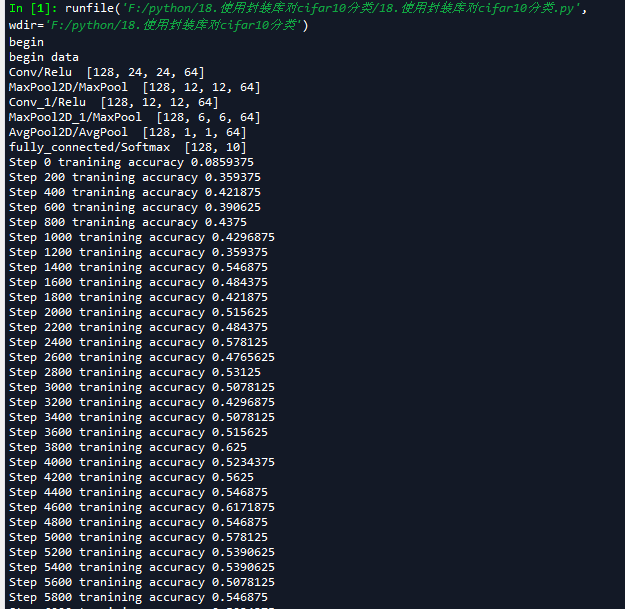
        print('Step {0} tranining accuracy {1}'.format(step,train_accuracy))

第十六节,使用函数封装库tf.contrib.layers的更多相关文章
- 第三百三十六节,web爬虫讲解2—urllib库中使用xpath表达式—BeautifulSoup基础
第三百三十六节,web爬虫讲解2—urllib库中使用xpath表达式—BeautifulSoup基础 在urllib中,我们一样可以使用xpath表达式进行信息提取,此时,你需要首先安装lxml模块 ...
- centos shell脚本编程2 if 判断 case判断 shell脚本中的循环 for while shell中的函数 break continue test 命令 第三十六节课
centos shell脚本编程2 if 判断 case判断 shell脚本中的循环 for while shell中的函数 break continue test 命令 ...
- ASP.NET MVC深入浅出系列(持续更新) ORM系列之Entity FrameWork详解(持续更新) 第十六节:语法总结(3)(C#6.0和C#7.0新语法) 第三节:深度剖析各类数据结构(Array、List、Queue、Stack)及线程安全问题和yeild关键字 各种通讯连接方式 设计模式篇 第十二节: 总结Quartz.Net几种部署模式(IIS、Exe、服务部署【借
ASP.NET MVC深入浅出系列(持续更新) 一. ASP.NET体系 从事.Net开发以来,最先接触的Web开发框架是Asp.Net WebForm,该框架高度封装,为了隐藏Http的无状态模 ...
- 第一百二十六节,JavaScript,XPath操作xml节点
第一百二十六节,JavaScript,XPath操作xml节点 学习要点: 1.IE中的XPath 2.W3C中的XPath 3.XPath跨浏览器兼容 XPath是一种节点查找手段,对比之前使用标准 ...
- 第四百一十六节,Tensorflow简介与安装
第四百一十六节,Tensorflow简介与安装 TensorFlow是什么 Tensorflow是一个Google开发的第二代机器学习系统,克服了第一代系统DistBelief仅能开发神经网络算法.难 ...
- 第三百四十六节,Python分布式爬虫打造搜索引擎Scrapy精讲—Requests请求和Response响应介绍
第三百四十六节,Python分布式爬虫打造搜索引擎Scrapy精讲—Requests请求和Response响应介绍 Requests请求 Requests请求就是我们在爬虫文件写的Requests() ...
- 第三百二十六节,web爬虫,scrapy模块,解决重复ur——自动递归url
第三百二十六节,web爬虫,scrapy模块,解决重复url——自动递归url 一般抓取过的url不重复抓取,那么就需要记录url,判断当前URL如果在记录里说明已经抓取过了,如果不存在说明没抓取过 ...
- 大白话5分钟带你走进人工智能-第二十六节决策树系列之Cart回归树及其参数(5)
第二十六节决策树系列之Cart回归树及其参数(5) 上一节我们讲了不同的决策树对应的计算纯度的计算方法, ...
- m_Orchestrate learning system---二十六、动态给封装好的控件添加属性
m_Orchestrate learning system---二十六.动态给封装好的控件添加属性 一.总结 一句话总结:比如我现在封装好了ueditor控件,我外部调用这个控件,因为要写数据到数据库 ...
随机推荐
- flask 下载本地文件
下载本地文件就是找到文件路径 调用flask自带的send_file(路径)下载, 并返回 flask: # 下载文件 from flask import send_file@task_mgm.ro ...
- Python——Flask框架——数据库
一.数据库框架 Flask-SQLAlchemy (1)安装: pip install flask-sqlalchemy (2)Flask-SQLAlchemy数据库URL 数据库引擎 URL MyS ...
- Rest模式get,put,post,delete含义与区别
POST /uri 创建 DELETE /uri/xxx 删除 PUT /uri/xxx 更新或创建 GET /uri/xxx 查看 GET操作是安全的.所谓 ...
- java Builder模式创建不可变类
package com.geostar.gfstack.operationcenter.logger.manager.common; /** * Created by Nihaorz on 2017/ ...
- js自动运行
叹号后面跟函数!function 和加号后面跟函数+function 都是跟(function(){})();这个函数是一个意思,都是告诉浏览器自动运行这个匿名函数的
- kubernetes 创建系统用户来支持访问 dashboard
Dashboard: 1.部署: 下载yaml文件 可以直接运行也可以下载下来kubectl apply -f https://raw.githubusercontent.com/kubernete ...
- King of Destruction HDU - 3002 && HDU - 3691(全局最小割)
求无向图的最小割 有没有源点都一样,不影响 #include <iostream> #include <cstdio> #include <sstream> #in ...
- Java归并排序的递归与非递归实现
该命题已有无数解释,备份修改后的代码 平均时间复杂度: O(NLogN) 以2为底 最好情况时间复杂度: O(NLogN) 最差情况时间复杂度: O(NLogN) 所需要额外空间: 递归:O(N + ...
- github Permission denied (publickey). fatal: Could not read from remote repository.
github Permission denied (publickey).fatal: Could not read from remote repository. ----------------- ...
- 使用树莓派 Raspberry Pi 播放豆瓣 FM
安装 mplayersudo apt-get install mplayer 安装 Python-pipsudo apt-get install python-pip 通过 python-pip 安装 ...