
poj1696 Space Ant【计算几何】
| Time Limit: 1000MS | Memory Limit: 10000K | |
| Total Submissions: 5334 | Accepted: 3312 |
Description
- It can not turn right due to its special body structure.
- It leaves a red path while walking.
- It hates to pass over a previously red colored path, and never does that.
The pictures transmitted by the Discovery space ship depicts that plants in the Y1999 grow in special points on the planet. Analysis of several thousands of the pictures have resulted in discovering a magic coordinate system governing the grow points of the plants. In this coordinate system with x and y axes, no two plants share the same x or y.
An M11 needs to eat exactly one plant in each day to stay alive. When it eats one plant, it remains there for the rest of the day with no move. Next day, it looks for another plant to go there and eat it. If it can not reach any other plant it dies by the end of the day. Notice that it can reach a plant in any distance.
The problem is to find a path for an M11 to let it live longest.
Input is a set of (x, y) coordinates of plants. Suppose A with the coordinates (xA, yA) is the plant with the least y-coordinate. M11 starts from point (0,yA) heading towards plant A. Notice that the solution path should not cross itself and all of the turns should be counter-clockwise. Also note that the solution may visit more than two plants located on a same straight line. 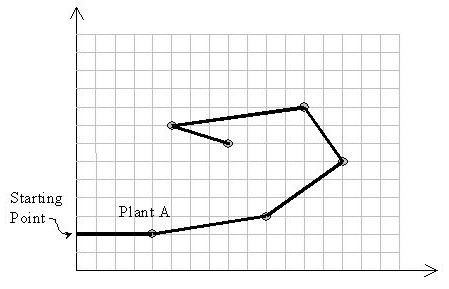
Input
Output
Sample Input
2

10

1 4 5

2 9 8

3 5 9

4 1 7

5 3 2

6 6 3

7 10 10

8 8 1

9 2 4

10 7 6

14

1 6 11

2 11 9

3 8 7

4 12 8

5 9 20

6 3 2

7 1 6

8 2 13

9 15 1

10 14 17

11 13 19

12 5 18

13 7 3

14 10 16
Sample Output
10 8 7 3 4 9 5 6 2 1 10

14 9 10 11 5 12 8 7 6 13 4 14 1 3 2
Source
题意:
给定n个点,一只蚂蚁只能按逆时针方向走。问最多走多少点,已经走的顺序。
思路:
很显然每次选的都是极角序最小的。
所以每走一个点就按极角序排个序,选最近的。排序的时候前面走过的就不用走了。
第一次要swap,之后就不用了,因为一定程度已经有序了。每次正好选的都是下一个。
很多地方说的凸包,好吧我没想出来怎么就凸包了.....【太菜了】
 #include <iostream>

 #include <set>

 #include <cmath>

 #include <stdio.h>

 #include <cstring>

 #include <algorithm>

 #include <vector>

 #include <queue>

 #include <map>

 //#include <bits/stdc++.h>

 using namespace std;

 typedef long long LL;

 #define inf 0x7f7f7f7f

 int n, m, now;

 const int maxn = ;

 struct node{

     int x, y, id;

 }point[maxn];

 int xmult(int x1, int y1, int x2, int y2, int x3, int y3)

 {

     return (x2 - x1) * (y3 - y1) - (x3 - x1) * (y2 - y1);

 }

 int distance(node p1, node p2)

 {

     return (p2.x - p1.x) * (p2.x - p1.x) + (p2.y - p1.y) * (p2.y - p1.y);

 }

 void swap(node &a, node &b)

 {

     node t = a;

     a = b;

     b = t;

 }

 bool cmp (const node& a, const node& b)

 {

     int k = xmult(point[now].x, point[now].y, a.x, a.y, b.x, b.y);

     if(k > ){

         return ;

     }

     else if(k == ){

         if( abs(point[now].x-a.x)<abs(point[now].x-b.x) )

             return ;

         if( abs(point[now].y-a.y)<abs(point[now].y-b.y) )

             return ;

     }

     return ;

 }

 int order[maxn];

 bool vis[maxn];

 int main()

 {

     scanf("%d", &m);

     while(m--){

         scanf("%d", &n);

         now = ;

         memset(vis, , sizeof(vis));

         for(int i = ; i <= n; i++){

             scanf("%d%d%d", &point[i].id, &point[i].x, &point[i].y);

             //point[i].id = i;

             if(point[i].y < point[now].y){

                 swap(point[now], point[i]);

             }

         }

         int cnt = ;

         order[cnt] = point[now].id;

         //vis[mid] = true;

         while(cnt < n){

             //node now = point[order[cnt]];

             //swap(point[order[cnt]], point[1]);

             //point[0] = point[order[cnt]];

             sort(point + now + , point + n + , cmp);

             order[++cnt] = point[++now].id;

         }

         printf("%d", n);

         for(int i = ; i <= cnt; i++){

             printf(" %d", order[i]);

         }

         printf("\n");

     }

     return ;

 }
poj1696 Space Ant【计算几何】的更多相关文章
- poj1696 Space Ant
地址: 题目: Space Ant Time Limit: 1000MS Memory Limit: 10000K Total Submissions: 4295 Accepted: 2697 ...
- POJ-1696 Space Ant 凸包版花式水过!
Space Ant 明天早上最后一科毛概了,竟然毫无复习之意,沉迷刷题无法自拔~~ 题意:说实 ...
- poj 1696:Space Ant(计算几何,凸包变种,极角排序)
Space Ant Time Limit: 1000MS Memory Limit: 10000K Total Submissions: 2876 Accepted: 1839 Descrip ...
- poj 1696 Space Ant (极角排序)
链接:http://poj.org/problem?id=1696 Space Ant Time Limit: 1000MS Memory Limit: 10000K Total Submissi ...
- POJ 1696 Space Ant(极角排序)
Space Ant Time Limit: 1000MS Memory Limit: 10000K Total Submissions: 2489 Accepted: 1567 Descrip ...
- poj 1696 Space Ant(模拟+叉积)
Space Ant Time Limit: 1000MS Memory Limit: 10000K Total Submissions: 3840 Accepted: 2397 Descrip ...
- POJ 1696 Space Ant 卷包裹法
Space Ant Time Limit: 1000MS Memory Limit: 10000K Total Submissions: 3316 Accepted: 2118 Descrip ...
- POJ 1696 Space Ant(点积的应用)
Space Ant 大意:有一仅仅蚂蚁,每次都仅仅向当前方向的左边走,问蚂蚁走遍全部的点的顺序输出.開始的点是纵坐标最小的那个点,開始的方向是開始点的x轴正方向. 思路:从開始点開始,每次找剩下的点中 ...
- Space Ant
Space Ant The most exciting space discovery occurred at the end of the 20th century. In 1999, scient ...
随机推荐
- 转:Hibernate query.list()之卡住问题
某个函数里面有调用Query的list()方法,然后它有时会出现这种症状: 忽然停住不动,但是也没报异常,就是界面死了. 我的查询差不多是这样: Query q=sessionFactory.open ...
- linq to xml 初学 -- 查询语法
初学linq to xml,很方便 string path = ch.GetConfigFile("")+ "SpeedDial.xml"; var sdDo ...
- SPOJ QTREE5 lct
题目链接 对于每一个节点,记录这个节点所在链的信息: ls:(链的上端点)距离链内部近期的白点距离 rs:(链的下端点)距离链内部近期的白点距离 注意以上都是实边 虚边的信息用一个set维护. set ...
- RESTful api架构设计
阮老师的这两篇文章足够了 理解 RESTful 架构 RESTful API 设计指南
- mysql强制使用索引
在公司后台某模块功能记录日志中有一个搜索功能,通过前段时间的产品使用时间区间进行搜索反馈有些卡顿,我发现这个搜索功能比较慢,要3秒左右才能出来,就决定对这里做一下优化. 通过分析代码和SQL发现最核心 ...
- C++ mysql 乱码
C++读mysql数据库中的中文显示出来的是乱码 在连接到数据库后加上这么一句 mysql_query(pMYSQL, "SET NAMES GB2312"); 或者 mysql_ ...
- 【Android】录音-amr音频录制
http://www.cnblogs.com/fengzhblog/archive/2013/08/01/3231500.html http://blog.csdn.net/fan7983377/ar ...
- 【代码审计】EasySNS_V1.6 前台任意文件下载漏洞分析
0x00 环境准备 EasySNS官网:http://www.imzaker.com/ 网站源码版本:EasySNS极简社区V1.60 程序源码下载:http://es.imzaker.com/i ...
- Tiny6410 关于制作ubifs文件系统映像
Tiny6410的superboot设计使得我不能用yaffs2文件系统,不过也罢,费点事就费点事吧 在这之前要安装mktools系列工具哦~~ 进入工作目录/opt/FriendlyARM/mini ...
- Java中获取资源文件的方法总结
这里总结3中方法获取资源文件的 ServletContext Class ClassLoader 文件的位置 1. ServletContext public void doGet(HttpServl ...