
Inheritance with EF Code First: Part 3 – Table per Concrete Type (TPC)
Inheritance with EF Code First: Part 3 – Table per Concrete Type (TPC)
| This is the third (and last) post in a series that explains different approaches to map an inheritance hierarchy with EF Code First. I've described these strategies in previous posts:
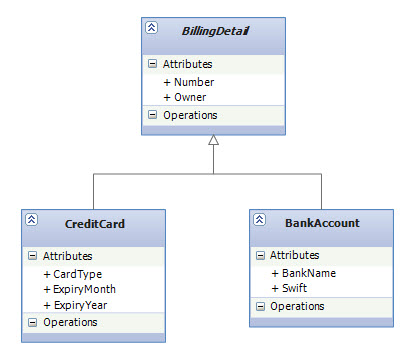
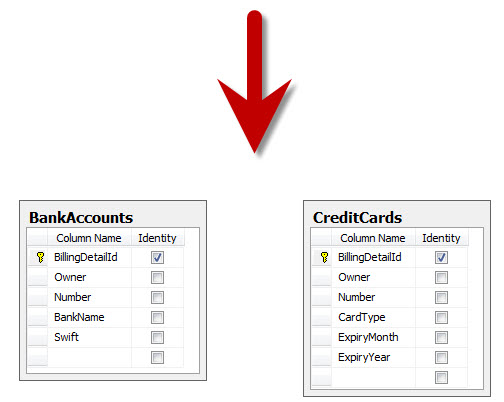
In today’s blog post I am going to discuss Table per Concrete Type (TPC) which completes the inheritance mapping strategies supported by EF Code First. At the end of this post I will provide some guidelines to choose an inheritance strategy mainly based on what we've learned in this series. TPC and Entity Framework in the PastTable per Concrete type is somehow the simplest approach suggested, yet using TPC with EF is one of those concepts that has not been covered very well so far and I've seen in some resources that it was even discouraged. The reason for that is just because Entity Data Model Designer in VS2010 doesn't support TPC (even though the EF runtime does). That basically means if you are following EF's Database-First or Model-First approaches then configuring TPC requires manually writing XML in the EDMX file which is not considered to be a fun practice. Well, no more. You'll see that with Code First, creating TPC is perfectly possible with fluent API just like other strategies and you don't need to avoid TPC due to the lack of designer support as you would probably do in other EF approaches. Table per Concrete Type (TPC)In Table per Concrete type (aka Table per Concrete class) we use exactly one table for each (nonabstract) class. All properties of a class, including inherited properties, can be mapped to columns of this table, as shown in the following figure: |
||||
 |
||||
 |
||||
As you can see, the SQL schema is not aware of the inheritance; effectively, we’ve mapped two unrelated tables to a more expressive class structure. If the base class was concrete, then anadditional table would be needed to hold instances of that class. I have to emphasize that there is no relationship between the database tables, except for the fact that they share some similar columns.
TPC Implementation in Code FirstJust like the TPT implementation, we need to specify a separate table for each of the subclasses. We also need to tell Code First that we want all of the inherited properties to be mapped as part of this table. In CTP5, there is a new helper method on EntityMappingConfiguration class called MapInheritedProperties that exactly does this for us. Here is the complete object model as well as the fluent API to create a TPC mapping: |
||||
public abstract class BillingDetail |
||||
|
||||
TPC Configuration is Not Done Yet!We are not quite done with our TPC configuration and there is more into this story even though the fluent API we saw perfectly created a TPC mapping for us in the database. To see why, let's start working with our object model. For example, the following code creates two new objects of BankAccount and CreditCard types and tries to add them to the database: |
||||
using (var context = new InheritanceMappingContext()) |
||||
| Running this code throws an InvalidOperationException with this message: | ||||
|
The changes to the database were committed successfully, but an error occurred while updating the object context. The ObjectContext might be in an inconsistent state. Inner exception message: AcceptChanges cannot continue because the object's key values conflict with another object in the ObjectStateManager. Make sure that the key values are unique before calling AcceptChanges.
|
||||
The reason we got this exception is because DbContext.SaveChanges() internally invokes SaveChanges method of its internal ObjectContext. ObjectContext's SaveChanges method on its turn by default calls AcceptAllChanges after it has performed the database modifications. AcceptAllChanges method merely iterates over all entries in ObjectStateManager and invokesAcceptChanges on each of them. Since the entities are in Added state, AcceptChanges method replaces their temporary EntityKey with a regular EntityKey based on the primary key values (i.e. BillingDetailId) that come back from the database and that's where the problem occurs since both the entities have been assigned the same value for their primary key by the database (i.e. on both BillingDetailId = 1) and the problem is that ObjectStateManager cannot track objects of the same type (i.e. BillingDetail) with the same EntityKey value hence it throws. If you take a closer look at the TPC's SQL schema above, you'll see why the database generated the same values for the primary keys: the BillingDetailId column in both BankAccounts and CreditCards table has been marked as identity.
How to Solve The Identity Problem in TPCAs you saw, using SQL Server’s int identity columns doesn't work very well together with TPC since there will be duplicate entity keys when inserting in subclasses tables with all having the same identity seed. Therefore, to solve this, either a spread seed (where each table has its own initial seed value) will be needed, or a mechanism other than SQL Server’s int identity should be used. Some other RDBMSes have other mechanisms allowing a sequence (identity) to be shared by multiple tables, and something similar can be achieved with GUID keys in SQL Server. While using GUID keys, or int identity keys with different starting seeds will solve the problem but yet another solution would be to completely switch off identity on the primary key property. As a result, we need to take the responsibility of providing unique keys when inserting records to the database. We will go with this solution since it works regardless of which database engine is used. Switching Off Identity in Code FirstWe can switch off identity simply by placing DatabaseGenerated attribute on the primary key property and pass DatabaseGenerationOption.None to its constructor. DatabaseGeneratedattribute is a new data annotation which has been added to System.ComponentModel.DataAnnotations namespace in CTP5: |
||||
public abstract class BillingDetail |
||||
| As always, we can achieve the same result by using fluent API, if you prefer that: | ||||
modelBuilder.Entity<BillingDetail>() |
||||
Working With The Object ModelOur TPC mapping is ready and we can try adding new records to the database. But, like I said, now we need to take care of providing unique keys when creating new objects: |
||||
using (var context = new InheritanceMappingContext()) |
||||
Polymorphic Associations with TPC is ProblematicThe main problem with this approach is that it doesn’t support Polymorphic Associations very well. After all, in the database, associations are represented as foreign key relationships and in TPC, the subclasses are all mapped to different tables so a polymorphic association to their base class (abstract BillingDetail in our example) cannot be represented as a simple foreign key relationship. For example, consider the domain model we introduced here where User has a polymorphic association with BillingDetail. This would be problematic in our TPC Schema, because if User has a many-to-one relationship with BillingDetail, the Users table would need a single foreign key column, which would have to refer both concrete subclass tables. This isn’t possible with regular foreign key constraints. Schema Evolution with TPC is ComplexA further conceptual problem with this mapping strategy is that several different columns, of different tables, share exactly the same semantics. This makes schema evolution more complex. For example, a change to a base class property results in changes to multiple columns. It also makes it much more difficult to implement database integrity constraints that apply to all subclasses. |
||||
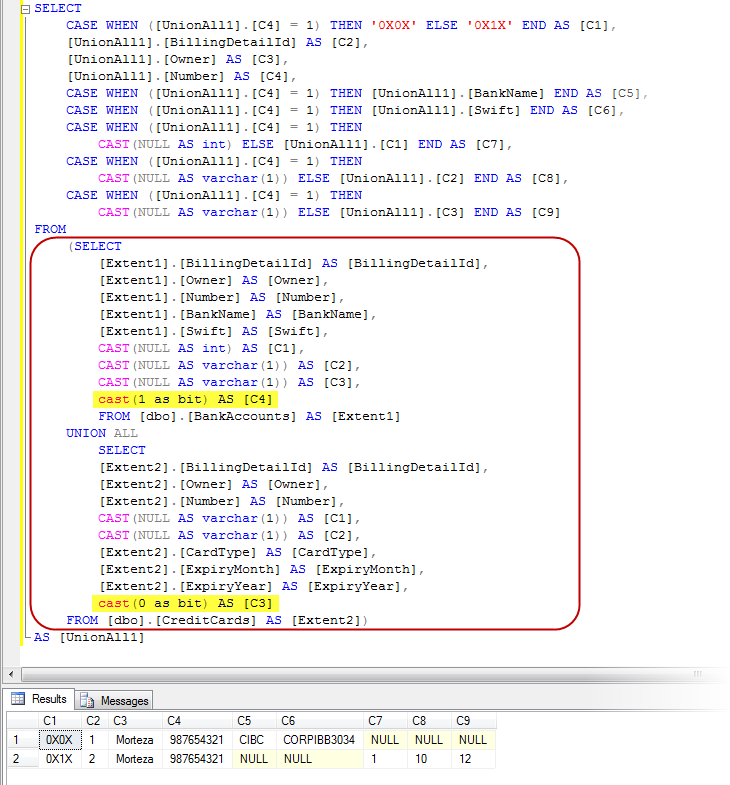
Generated SQLLet's examine SQL output for polymorphic queries in TPC mapping. For example, consider this polymorphic query for all BillingDetails and the resulting SQL statements that being executed in the database: |
||||
var query = from b in context.BillingDetails select b; |
||||
 |
||||
Just like the SQL query generatedby TPT mapping, the CASE statements that you see in the beginning of the query is merely to ensure columns that are irrelevant for a particular row have NULL values in the returning flattened table. (e.g. BankName for a row that represents a CreditCard type).
TPC's SQL Queries are Union BasedAs you can see in the above screenshot, the first SELECT uses a FROM-clause subquery (which is selected with a red rectangle) to retrieve all instances of BillingDetails from all concrete class tables. The tables are combined with a UNION operator, and a literal (in this case, 0 and 1) is inserted into the intermediate result; (look at the lines highlighted in yellow.) EF reads this to instantiate the correct class given the data from a particular row. A union requires that the queries that are combined, project over the same columns; hence, EF has to pad and fill up nonexistent columns with NULL. This query will really perform well since here we can let the database optimizer find the best execution plan to combine rows from several tables. There is also no Joins involved so it has a better performance than the SQL queries generated by TPT where a Join is required between the base and subclasses tables. Choosing Strategy GuidelinesBefore we get into this discussion, I want to emphasize that there is no one single "best strategy fits all scenarios" exists. As you saw, each of the approaches have their own advantages and drawbacks. Here are some rules of thumb to identify the best strategy in a particular scenario:
By default, choose TPH only for simple problems. For more complex cases (or when you’re overruled by a data modeler insisting on the importance of nullability constraints and normalization), you should consider the TPT strategy. But at that point, ask yourself whether it may not be better to remodel inheritance as delegation in the object model (delegation is a way of making composition as powerful for reuse as inheritance). Complex inheritance is often best avoided for all sorts of reasons unrelated to persistence or ORM. EF acts as a buffer between the domain and relational models, but that doesn’t mean you can ignore persistence concerns when designing your classes. |
||||
SummaryIn this series, we focused on one of the main structural aspect of the object/relational paradigm mismatch which is inheritance and discussed how EF solve this problem as an ORM solution. We learned about the three well-known inheritance mapping strategies and their implementations in EF Code First. Hopefully it gives you a better insight about the mapping of inheritance hierarchies as well as choosing the best strategy for your particular scenario. |
原文地址:http://weblogs.asp.net/manavi/inheritance-mapping-strategies-with-entity-framework-code-first-ctp5-part-3-table-per-concrete-type-tpc-and-choosing-strategy-guidelines
Inheritance with EF Code First: Part 3 – Table per Concrete Type (TPC)的更多相关文章
- Inheritance with EF Code First: Part 2 – Table per Type (TPT)
In the previous blog post you saw that there are three different approaches to representing an inher ...
- Inheritance with EF Code First: Part 1 – Table per Hierarchy (TPH)
以下三篇文章是Entity Framework Code-First系列中第七回:Entity Framework Code-First(7):Inheritance Strategy 提到的三篇.这 ...
- EF Code First 学习笔记:表映射
多个实体映射到一张表 Code First允许将多个实体映射到同一张表上,实体必须遵循如下规则: 实体必须是一对一关系 实体必须共享一个公共键 观察下面两个实体: public class Perso ...
- EF Code First 学习笔记:表映射 多个Entity到一张表和一个Entity到多张表
多个实体映射到一张表 Code First允许将多个实体映射到同一张表上,实体必须遵循如下规则: 实体必须是一对一关系 实体必须共享一个公共键 观察下面两个实体: public class Per ...
- EF Code First 学习笔记:表映射(转)
多个实体映射到一张表 Code First允许将多个实体映射到同一张表上,实体必须遵循如下规则: 实体必须是一对一关系 实体必须共享一个公共键 观察下面两个实体: public class Per ...
- EF Code First学习系列
EF Model First在实际工作中基本用不到,前段时间学了一下,大概的了解一下.现在开始学习Code First这种方式.这也是在实际工作中用到最多的方式. 下面先给出一些目录: 1.什么是Co ...
- 1.什么是Code First(EF Code First 系列)
EF4.1中开始支持Code First .这种方式在领域设计模式中非常有用.使用Code First模式,你可以专注于领域设计,根据需要,为你一个领域的对象创建类集合,而不是首先来设计数据库,然后来 ...
- 从零开始,搭建博客系统MVC5+EF6搭建框架(1),EF Code frist、实现泛型数据仓储以及业务逻辑
前言 从上篇30岁找份程序员的工作(伪程序员的独白),文章开始,我说过我要用我自学的技术,来搭建一个博客系统,也希望大家给点意见,另外我很感谢博客园的各位朋友们,对我那篇算是自我阶段总结文章 ...
- IoC容器Autofac - Autofac + Asp.net MVC + EF Code First(转载)
转载地址:http://www.cnblogs.com/JustRun1983/archive/2013/03/28/2981645.html 有修改 Autofac通过Controller默认构造 ...
随机推荐
- Codeforces Round #279 (Div. 2)B. Queue(构造法,数组下标的巧用)
这道题不错,思维上不难想到规律,但是如何写出优雅的代码比较考功力. 首先第一个人的序号可以确定,那么接下来所有奇数位的序号就可以一个连一个的确定了.然后a[i].first==0时的a[i].seco ...
- UVA - 11754 Code Feat (分块+中国剩余定理)
对于一个正整数N,给出C组限制条件,每组限制条件为N%X[i]∈{Y1,Y2,Y3,...,Yk[i]},求满足条件的前S小的N. 这道题很容易想到用中国剩余定理,然后用求第k小集合的方法输出答案.但 ...
- SQL Server 索引中include
SQL Server 索引中include的魅力(具有包含性列的索引) http://www.cnblogs.com/gaizai/archive/2010/01/11/1644358.html 开文 ...
- Storm的并行度、Grouping策略以及消息可靠处理机制简介
转自:https://my.oschina.net/zc741520/blog/409949 概念: Workers (JVMs): 在一个节点上可以运行一个或多个独立的JVM 进程.一个Topolo ...
- 幸运数字(数位dp)
个人心得:数位dp处理起来是真的麻烦,本来动态规划就够头疼的了,菜的一批. 来看这个题目吧,题目在下面. 把题目变成可以求得就是求前n个数中1-n*9的情况的总和,所以用dp[i][j],表示前i个数 ...
- 洛谷 P3052 [USACO12MAR]摩天大楼里的奶牛Cows in a Skyscraper
题目描述 A little known fact about Bessie and friends is that they love stair climbing races. A better k ...
- 【LeetCode】007. Reverse Integer
Given a 32-bit signed integer, reverse digits of an integer. Example 1: Input: 123 Output: 321 Examp ...
- bzoj 4591 [Shoi2015]超能粒子炮·改——组合数前缀和
题目:https://www.lydsy.com/JudgeOnline/problem.php?id=4591 先说说自己的想法: 从组合意义的角度考虑,从n个里选<=k个,就添加k个空位置, ...
- 异常:idea一直刷新索引:updating index
解决方案:File ->Invalidate Caches/restart -> Invalidate and Restart 即重新构建索引
- DATAX动态参数数据传递
实例:ORACLE到ORACLE的数据传递 编写job.xml文件,添加变量参数 执行datax.py文件时记得带参数 格式:./datax.py –p"-Ddbname=*** -Di ...