
k8s client-go源码分析 informer源码分析(6)-Indexer源码分析
client-go之Indexer源码分析
1.Indexer概述
Indexer中有informer维护的指定资源对象的相对于etcd数据的一份本地内存缓存,可通过该缓存获取资源对象,以减少对apiserver、对etcd的请求压力。
// staging/src/k8s.io/client-go/tools/cache/thread_safe_store.go

type threadSafeMap struct {

	items map[string]interface{}

	indexers Indexers

	indices Indices

	...

}
informer所维护的缓存依赖于threadSafeMap结构体中的items属性,其本质上是一个用map构建的键值对,资源对象都存在items这个map中,key为资源对象的namespace/name组成,value为资源对象本身,这些构成了informer的本地缓存。
Indexer除了维护了一份本地内存缓存外,还有一个很重要的功能,便是索引功能了。索引的目的就是为了快速查找,比如我们需要查找某个node节点上的所有pod、查找某个命名空间下的所有pod等,利用到索引,可以实现快速查找。关于索引功能,则依赖于threadSafeMap结构体中的indexers与indices属性。
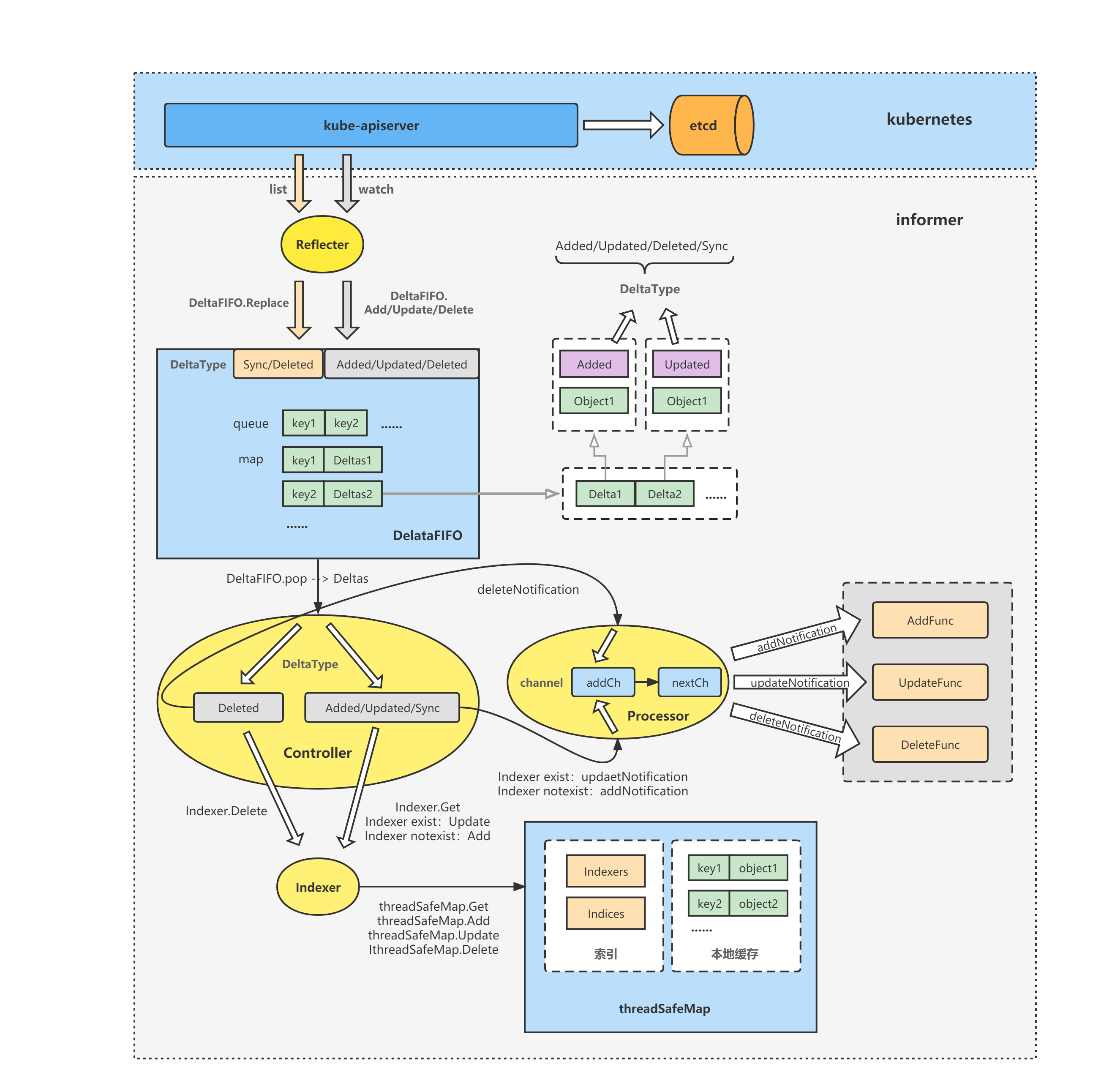
先通过一张informer概要架构图看一下Indexer所处位置与其概要功能。

2.Indexer的结构定义分析
2.1 Indexer interface
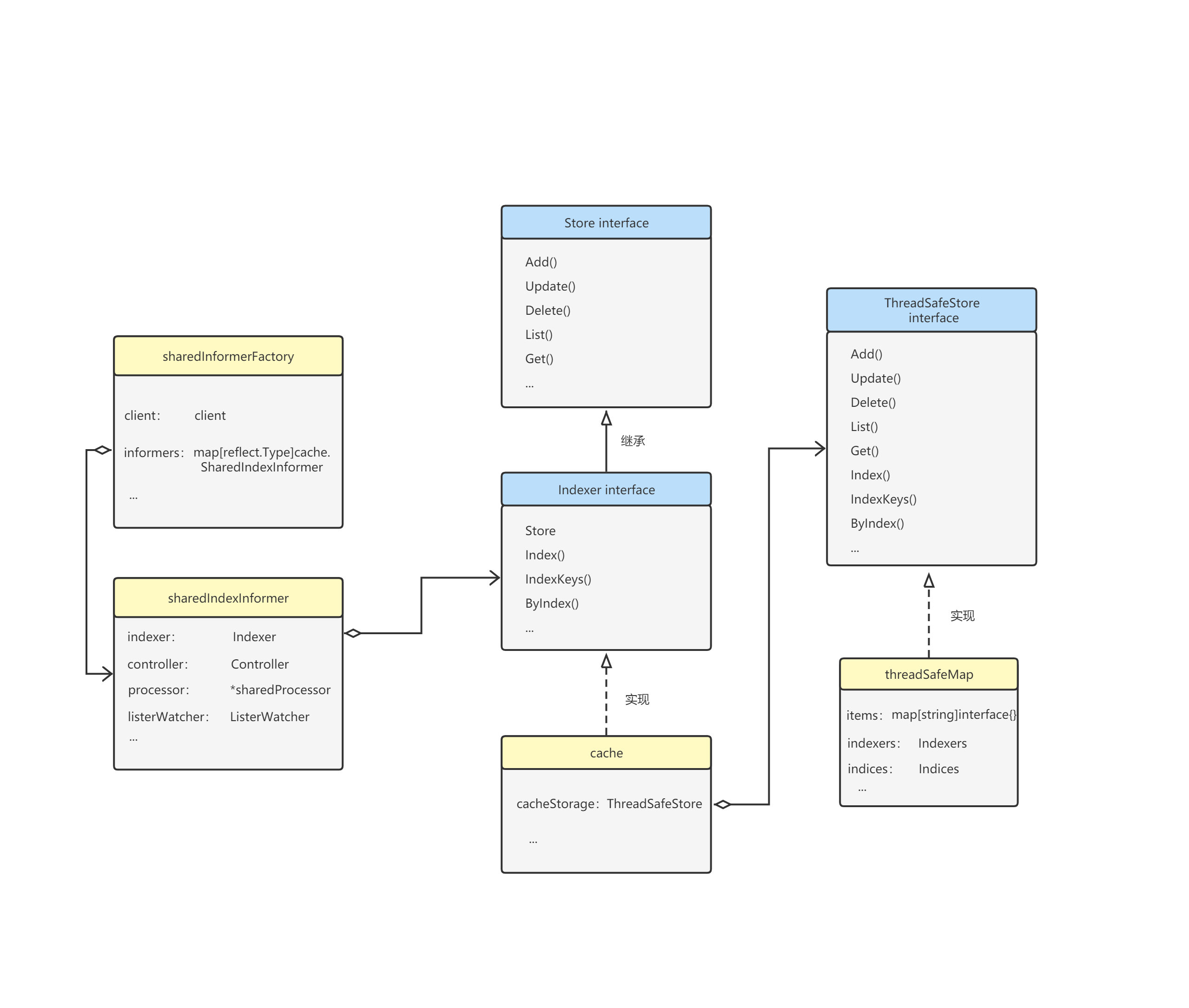
Indexer接口继承了一个Store接口(实现本地缓存),以及包含几个index索引相关的方法声明(实现索引功能)。
// staging/src/k8s.io/client-go/tools/cache/index.go

type Indexer interface {

	Store

	Index(indexName string, obj interface{}) ([]interface{}, error)

	IndexKeys(indexName, indexedValue string) ([]string, error)

	ListIndexFuncValues(indexName string) []string

	ByIndex(indexName, indexedValue string) ([]interface{}, error)

	GetIndexers() Indexers

	AddIndexers(newIndexers Indexers) error

}
2.2 Store interface
Store接口本身,定义了Add、Update、Delete、List、Get等一些对象增删改查的方法声明,用于操作informer的本地缓存。
// staging/src/k8s.io/client-go/tools/cache/store.go

type Store interface {

	Add(obj interface{}) error

	Update(obj interface{}) error

	Delete(obj interface{}) error

	List() []interface{}

	ListKeys() []string

	Get(obj interface{}) (item interface{}, exists bool, err error)

	GetByKey(key string) (item interface{}, exists bool, err error)

	Replace([]interface{}, string) error

	Resync() error

}
2.3 cache struct
结合代码,可以看到cache struct是Indexer接口的一个实现,所以自然也是Store接口的一个实现,cache struct包含一个ThreadSafeStore接口的实现,以及一个计算object key的函数KeyFunc。
cache struct会根据keyFunc生成某个obj对象对应的一个唯一key, 然后调用ThreadSafeStore接口中的方法来操作本地缓存中的对象。
// staging/src/k8s.io/client-go/tools/cache/store.go

type cache struct {

	cacheStorage ThreadSafeStore

	keyFunc KeyFunc

}
2.4 ThreadSafeStore interface
ThreadSafeStore接口包含了操作本地缓存的增删改查方法以及索引功能的相关方法,其方法名称与Indexer接口的类似,最大区别是ThreadSafeStore接口的增删改查方法入参基本都有key,由cache struct中的KeyFunc函数计算得出object key。
// staging/src/k8s.io/client-go/tools/cache/thread_safe_store.go

type ThreadSafeStore interface {

	Add(key string, obj interface{})

	Update(key string, obj interface{})

	Delete(key string)

	Get(key string) (item interface{}, exists bool)

	List() []interface{}

	ListKeys() []string

	Replace(map[string]interface{}, string)

	Index(indexName string, obj interface{}) ([]interface{}, error)

	IndexKeys(indexName, indexKey string) ([]string, error)

	ListIndexFuncValues(name string) []string

	ByIndex(indexName, indexKey string) ([]interface{}, error)

	GetIndexers() Indexers

	AddIndexers(newIndexers Indexers) error

	Resync() error

}
2.5 threadSafeMap struct
threadSafeMap struct是ThreadSafeStore接口的一个实现,其最重要的一个属性便是items了,items是用map构建的键值对,资源对象都存在items这个map中,key根据资源对象来算出,value为资源对象本身,这里的items即为informer的本地缓存了,而indexers与indices属性则与索引功能有关。
// staging/src/k8s.io/client-go/tools/cache/thread_safe_store.go

type threadSafeMap struct {

	lock  sync.RWMutex

	items map[string]interface{}

	// indexers maps a name to an IndexFunc

	indexers Indexers

	// indices maps a name to an Index

	indices Indices

}
2.6 Indexer结构定义小结
下面对上面介绍的Indexer的相关struct与interface做个小结:
(1)Store interface: 定义了Add、Update、Delete、List、Get等一些对象增删改查的方法声明,用于操作informer的本地缓存;
(2)Indexer interface: 继承了一个Store接口(实现本地缓存),以及包含几个index索引相关的方法声明(实现索引功能);
(3)cache struct: Indexer接口的一个实现,所以自然也是Store接口的一个实现,cache struct包含一个ThreadSafeStore接口的实现,以及一个计算object key的函数KeyFunc;
(4)ThreadSafeStore interface: 包含了操作本地缓存的增删改查方法以及索引功能的相关方法,其方法名称与Indexer接口的类似,最大区别是ThreadSafeStore接口的增删改查方法入参基本都有key,由cache struct中的KeyFunc函数计算得出object key;
(5)threadSafeMap struct: ThreadSafeStore接口的一个实现,其最重要的一个属性便是items了,items是用map构建的键值对,资源对象都存在items这个map中,key根据资源对象来算出,value为资源对象本身,这里的items即为informer的本地缓存了,而indexers与indices属性则与索引功能有关;
3.Indexer的索引功能
在threadSafeMap struct中,与索引功能有关的是indexers与indices属性;
// staging/src/k8s.io/client-go/tools/cache/thread_safe_store.go

type threadSafeMap struct {

	lock  sync.RWMutex

	items map[string]interface{}

	// indexers maps a name to an IndexFunc

	indexers Indexers

	// indices maps a name to an Index

	indices Indices

}

type Indexers map[string]IndexFunc

type IndexFunc func(obj interface{}) ([]string, error)

type Indices map[string]Index

type Index map[string]sets.String
3.1 type Indexers map[string]IndexFunc / type IndexFunc func(obj interface{}) ([]string, error)
Indexers包含了所有索引器(索引分类)及其索引器函数IndexFunc,IndexFunc为计算某个索引键下的所有对象键列表的方法;
Indexers: {

  "索引器1": 索引函数1,

  "索引器2": 索引函数2,

}
数据示例:
Indexers: {

  "namespace": MetaNamespaceIndexFunc,

  "nodeName": NodeNameIndexFunc,

}
func MetaNamespaceIndexFunc(obj interface{}) ([]string, error) {

	meta, err := meta.Accessor(obj)

	if err != nil {

		return []string{""}, fmt.Errorf("object has no meta: %v", err)

	}

	return []string{meta.GetNamespace()}, nil

}

func NodeNameIndexFunc(obj interface{}) ([]string, error) {

	pod, ok := obj.(*v1.Pod)

	if !ok {

		return []string{""}, fmt.Errorf("object is not a pod)

	}

	return []string{pod.Spec.NodeName}, nil

}
3.2 type Indices map[string]Index / type Index map[string]sets.String
Indices包含了所有索引器(索引分类)及其所有的索引数据Index;而Index则包含了索引键以及索引键下的所有对象键的列表;
Indices: {

 "索引器1": {

  "索引键1": ["对象键1", "对象键2"],

  "索引键2": ["对象键3"],

 },

 "索引器2": {

  "索引键3": ["对象键1"],

  "索引键4": ["对象键2", "对象键3"],

 }

}
数据示例:
pod1 := &v1.Pod {

    ObjectMeta: metav1.ObjectMeta {

        Name: "pod-1",

        Namespace: "default",

    },

    Spec: v1.PodSpec{

        NodeName: "node1",

    }

}

pod2 := &v1.Pod {

    ObjectMeta: metav1.ObjectMeta {

        Name: "pod-2",

        Namespace: "default",

    },

    Spec: v1.PodSpec{

        NodeName: "node2",

    }

}

pod3 := &v1.Pod {

    ObjectMeta: metav1.ObjectMeta {

        Name: "pod-3",

        Namespace: "kube-system",

    },

    Spec: v1.PodSpec{

        NodeName: "node2",

    }

}
Indices: {

 "namespace": {

  "default": ["pod-1", "pod-2"],

  "kube-system": ["pod-3"],

 },

 "nodeName": {

  "node1": ["pod-1"],

  "node2": ["pod-2", "pod-3"],

 }

}
3.3 索引结构小结
Indexers: {

  "索引器1": 索引函数1,

  "索引器2": 索引函数2,

}

Indices: {

 "索引器1": {

  "索引键1": ["对象键1", "对象键2"],

  "索引键2": ["对象键3"],

 },

 "索引器2": {

  "索引键3": ["对象键1"],

  "索引键4": ["对象键2", "对象键3"],

 }

}
3.4 索引功能方法分析
看到Indexer interface,除了继承的Store外,其他的几个方法声明均与索引功能相关,下面对几个常用方法进行介绍。
// staging/src/k8s.io/client-go/tools/cache/index.go

type Indexer interface {

	Store

	Index(indexName string, obj interface{}) ([]interface{}, error)

	IndexKeys(indexName, indexedValue string) ([]string, error)

	ListIndexFuncValues(indexName string) []string

	ByIndex(indexName, indexedValue string) ([]interface{}, error)

	GetIndexers() Indexers

	AddIndexers(newIndexers Indexers) error

}
下面的方法介绍基于以下数据:
Indexers: {

  "namespace": MetaNamespaceIndexFunc,

  "nodeName": NodeNameIndexFunc,

}
Indices: {

 "namespace": {

  "default": ["pod-1", "pod-2"],

  "kube-system": ["pod-3"],

 },

 "nodeName": {

  "node1": ["pod-1"],

  "node2": ["pod-2", "pod-3"],

 }

}
3.4.1 ByIndex(indexName, indexedValue string) ([]interface{}, error)
调用ByIndex方法,传入索引器名称indexName,以及索引键名称indexedValue,方法寻找该索引器下,索引键对应的对象键列表,然后根据对象键列表,到Indexer缓存(即threadSafeMap中的items属性)中获取出相应的对象列表。
// staging/src/k8s.io/client-go/tools/cache/store.go

func (c *cache) ByIndex(indexName, indexKey string) ([]interface{}, error) {

	return c.cacheStorage.ByIndex(indexName, indexKey)

}
// staging/src/k8s.io/client-go/tools/cache/thread_safe_store.go

func (c *threadSafeMap) ByIndex(indexName, indexKey string) ([]interface{}, error) {

	c.lock.RLock()

	defer c.lock.RUnlock()

	indexFunc := c.indexers[indexName]

	if indexFunc == nil {

		return nil, fmt.Errorf("Index with name %s does not exist", indexName)

	}

	index := c.indices[indexName]

	set := index[indexKey]

	list := make([]interface{}, 0, set.Len())

	for key := range set {

		list = append(list, c.items[key])

	}

	return list, nil

}
使用示例:
pods, err := index.ByIndex("namespace", "default")

if err != nil {

    panic(err)

}

for _, pod := range pods {

    fmt.Println(pod.(*v1.Pod).Name)

}

fmt.Println("=====")

pods, err := index.ByIndex("nodename", "node1")

if err != nil {

    panic(err)

}

for _, pod := range pods {

    fmt.Println(pod.(*v1.Pod).Name)

}
输出:
pod-1

pod-2

=====

pod-1
3.4.2 IndexKeys(indexName, indexedValue string) ([]string, error)
IndexKeys方法与ByIndex方法类似,只不过只返回对象键列表,不会根据对象键列表,到Indexer缓存(即threadSafeMap中的items属性)中获取出相应的对象列表。
// staging/src/k8s.io/client-go/tools/cache/store.go

func (c *cache) IndexKeys(indexName, indexKey string) ([]string, error) {

	return c.cacheStorage.IndexKeys(indexName, indexKey)

}
// staging/src/k8s.io/client-go/tools/cache/thread_safe_store.go

func (c *threadSafeMap) IndexKeys(indexName, indexKey string) ([]string, error) {

	c.lock.RLock()

	defer c.lock.RUnlock()

	indexFunc := c.indexers[indexName]

	if indexFunc == nil {

		return nil, fmt.Errorf("Index with name %s does not exist", indexName)

	}

	index := c.indices[indexName]

	set := index[indexKey]

	return set.List(), nil

}
4.Indexer本地缓存
从前面的分析可以知道,informer中的本地缓存实际上指的是Indexer中的threadSafeMap,具体到属性,则是threadSafeMap中的items属性;
threadSafeMap struct
threadSafeMap struct中的items属性即为informer的本地缓存;
// staging/src/k8s.io/client-go/tools/cache/thread_safe_store.go

type threadSafeMap struct {

	lock  sync.RWMutex

	items map[string]interface{}

	// indexers maps a name to an IndexFunc

	indexers Indexers

	// indices maps a name to an Index

	indices Indices

}
接下来分析下threadSafeMap的几个核心方法,主要都是操作items属性的;
前面对informer-Controller的分析中(代码如下),提到的s.indexer.Add、s.indexer.Update、s.indexer.Delete、s.indexer.Get等方法其实最终就是调用的threadSafeMap.Add、threadSafeMap.Update、threadSafeMap.Delete、threadSafeMap.Get等;
// staging/src/k8s.io/client-go/tools/cache/shared_informer.go

func (s *sharedIndexInformer) HandleDeltas(obj interface{}) error {

	s.blockDeltas.Lock()

	defer s.blockDeltas.Unlock()

	// from oldest to newest

	for _, d := range obj.(Deltas) {

		switch d.Type {

		case Sync, Added, Updated:

			isSync := d.Type == Sync

			s.cacheMutationDetector.AddObject(d.Object)

			if old, exists, err := s.indexer.Get(d.Object); err == nil && exists {

				if err := s.indexer.Update(d.Object); err != nil {

					return err

				}

				s.processor.distribute(updateNotification{oldObj: old, newObj: d.Object}, isSync)

			} else {

				if err := s.indexer.Add(d.Object); err != nil {

					return err

				}

				s.processor.distribute(addNotification{newObj: d.Object}, isSync)

			}

		case Deleted:

			if err := s.indexer.Delete(d.Object); err != nil {

				return err

			}

			s.processor.distribute(deleteNotification{oldObj: d.Object}, false)

		}

	}

	return nil

}
4.1 threadSafeMap.Add
调用链:s.indexer.Add --> cache.Add --> threadSafeMap.Add
threadSafeMap.Add方法将key:object存入items中,并调用updateIndices方法更新索引(updateIndices方法这里不展开分析,可以自行查看源码);
// staging/src/k8s.io/client-go/tools/cache/thread_safe_store.go

func (c *threadSafeMap) Add(key string, obj interface{}) {

	c.lock.Lock()

	defer c.lock.Unlock()

	oldObject := c.items[key]

	c.items[key] = obj

	c.updateIndices(oldObject, obj, key)

}
也可以看到对threadSafeMap进行操作的方法,基本都会先获取锁,然后方法执行完毕释放锁,所以是并发安全的。
4.2 threadSafeMap.Update
调用链:s.indexer.Update --> cache.Update --> threadSafeMap.Update
threadSafeMap.Update方法逻辑与threadSafeMap.Add方法相同;
// staging/src/k8s.io/client-go/tools/cache/thread_safe_store.go

func (c *threadSafeMap) Update(key string, obj interface{}) {

	c.lock.Lock()

	defer c.lock.Unlock()

	oldObject := c.items[key]

	c.items[key] = obj

	c.updateIndices(oldObject, obj, key)

}
4.3 threadSafeMap.Delete
调用链:s.indexer.Delete --> cache.Delete --> threadSafeMap.Delete
threadSafeMap.Delete方法中,先判断本地缓存items中是否存在该key,存在则调用deleteFromIndices删除相关索引,然后删除items中的key及其对应object;
// staging/src/k8s.io/client-go/tools/cache/thread_safe_store.go

func (c *threadSafeMap) Delete(key string) {

	c.lock.Lock()

	defer c.lock.Unlock()

	if obj, exists := c.items[key]; exists {

		c.deleteFromIndices(obj, key)

		delete(c.items, key)

	}

}
4.4 threadSafeMap.Get
调用链:s.indexer.Get --> cache.Get --> threadSafeMap.Get
threadSafeMap.Get方法逻辑相对简单,没有索引的相关操作,而是直接从items中通过key获取对应的object并返回;
// staging/src/k8s.io/client-go/tools/cache/thread_safe_store.go

func (c *threadSafeMap) Get(key string) (item interface{}, exists bool) {

	c.lock.RLock()

	defer c.lock.RUnlock()

	item, exists = c.items[key]

	return item, exists

}
总结
Indexer中有informer维护的指定资源对象的相对于etcd数据的一份本地内存缓存,可通过该缓存获取资源对象,以减少对apiserver、对etcd的请求压力。
informer所维护的缓存依赖于threadSafeMap结构体中的items属性,其本质上是一个用map构建的键值对,资源对象都存在items这个map中,key为资源对象的namespace/name组成,value为资源对象本身,这些构成了informer的本地缓存。
Indexer除了维护了一份本地内存缓存外,还有一个很重要的功能,便是索引功能了。索引的目的就是为了快速查找,比如我们需要查找某个node节点上的所有pod、查找某个命名空间下的所有pod等,利用到索引,可以实现快速查找。关于索引功能,则依赖于threadSafeMap结构体中的indexers与indices属性。
最后以一张图来回顾总结一下Indexer在informer中所处位置与其概要功能。
k8s client-go源码分析 informer源码分析(6)-Indexer源码分析的更多相关文章
- k8s client-go源码分析 informer源码分析(1)-概要分析
k8s informer概述 我们都知道可以使用k8s的Clientset来获取所有的原生资源对象,那么怎么能持续的获取集群的所有资源对象,或监听集群的资源对象数据的变化呢?这里不需要轮询去不断执行L ...
- k8s client-go源码分析 informer源码分析(2)-初始化与启动分析
k8s client-go源码分析 informer源码分析(2)-初始化与启动分析 前面一篇文章对k8s informer做了概要分析,本篇文章将对informer的初始化与启动进行分析. info ...
- k8s client-go源码分析 informer源码分析(3)-Reflector源码分析
k8s client-go源码分析 informer源码分析(3)-Reflector源码分析 1.Reflector概述 Reflector从kube-apiserver中list&watc ...
- k8s client-go源码分析 informer源码分析(4)-DeltaFIFO源码分析
client-go之DeltaFIFO源码分析 1.DeltaFIFO概述 先从名字上来看,DeltaFIFO,首先它是一个FIFO,也就是一个先进先出的队列,而Delta代表变化的资源对象,其包含资 ...
- k8s client-go源码分析 informer源码分析(5)-Controller&Processor源码分析
client-go之Controller&Processor源码分析 1.controller与Processor概述 Controller Controller从DeltaFIFO中pop ...
- external-provisioner源码分析(2)-main方法与Leader选举分析
更多ceph-csi其他源码分析,请查看下面这篇博文:kubernetes ceph-csi分析目录导航 external-provisioner源码分析(2)-main方法与Leader选举分析 本 ...
- dubbo源码解析五 --- 集群容错架构设计与原理分析
欢迎来我的 Star Followers 后期后继续更新Dubbo别的文章 Dubbo 源码分析系列之一环境搭建 博客园 Dubbo 入门之二 --- 项目结构解析 博客园 Dubbo 源码分析系列之 ...
- ceph-csi组件源码分析(1)-组件介绍与部署yaml分析
更多ceph-csi其他源码分析,请查看下面这篇博文:kubernetes ceph-csi分析目录导航 ceph-csi组件源码分析(1)-组件介绍与部署yaml分析 基于tag v3.0.0 ht ...
- Java并发包源码学习系列:阻塞队列BlockingQueue及实现原理分析
目录 本篇要点 什么是阻塞队列 阻塞队列提供的方法 阻塞队列的七种实现 TransferQueue和BlockingQueue的区别 1.ArrayBlockingQueue 2.LinkedBloc ...
随机推荐
- DRF 过滤排序分页异常处理
DRF 中如何使用过滤,排序,分页,以及报错了如何处理?10分钟get了~
- ADO访问Excel
需要安装驱动:Microsoft Access Database Engine,可搜索下载,有64位和32位之分. 随便新建一个后缀名为udl的文件,双击打开.注意,现如今一般都是64位系统,双击打开 ...
- 4.Java开发环境的搭建
Java开发环境搭建 一.JDK下载与安装 JDK8下载地址 选择目录,点击下一步 二.配置环境变量 变量名:JAVA_HOME 变量值:JDK安装路径 变量值:CLASSPATH 变量值:.;%JA ...
- Java学习day20
一个简单的鼠标点击在窗口画点的程序 今天学习了键盘监听和Swing窗口 Swing可以理解为是AWT的升级版本,方法名字等大都相似,例如Frame和JFrame AWT如果要关闭窗口,需要使用窗口监听 ...
- css 实现图片专场
<template> <div> </div> </template> <style lang="scss"> html ...
- 解构华为云HE2E项目中的容器技术应用
摘要:本文从容器技术应用的角度解构了HE2E项目的代码仓库配置.镜像构建.及docker-compose的部署方式.希望通过本篇文章分享可以使更多的开发者了解容器技术和华为云. 本文分享自华为云社区& ...
- Java语言学习day01--6月28日
Java语言学习day01一:Java概述 1.Java语言发展史 任职于太阳微系统的 詹姆斯·高斯林 等人于1990年代初开发Java语言的雏形,最初被命名为 Oak ,目标设置在 家用电器等小型系 ...
- python基础练习题(题目 模仿静态变量的用法)
day27 --------------------------------------------------------------- 实例041:类的方法与变量 题目 模仿静态变量的用法. 程序 ...
- Linux下安装并使用jumpserver跳板机
堡垒机介绍: 官方网站:https://www.jumpserver.org/ 在一个特定网络环境下,为了保障网络和数据不受外界入侵和破坏,而运用各种技术手段实时收集和监控网络环境中每一个组成部分的系 ...
- 半导体行业如何保持高效远程办公?因果集群(Causal Clustering)了解一下!
什么是因果集群?因果集群是下一代多站点复制技术.它支持数据中心的分布式系统集群模型.借助于因果集群技术,可以让远程工作团队成员体验到更卓越的性能和更健壮的复制功能,确保您的团队始终以高效状态工作. 因 ...