
cluster KMeans need preprocessing scale????
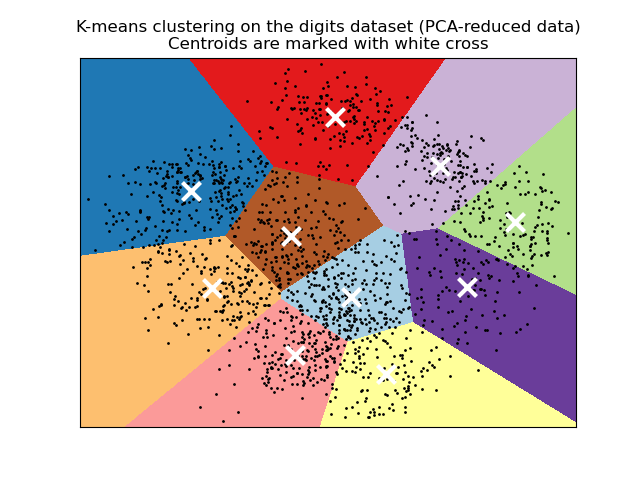
Out:
n_digits: 10,    n_samples 1797,         n_features 64

__________________________________________________________________________________

init            time    inertia homo    compl   v-meas  ARI     AMI     silhouette

k-means++       0.30s   69432   0.602   0.650   0.625   0.465   0.598   0.146

random          0.23s   69694   0.669   0.710   0.689   0.553   0.666   0.147

PCA-based       0.04s   70804   0.671   0.698   0.684   0.561   0.668   0.118

__________________________________________________________________________________
print(__doc__)

from time import time

import numpy as np

import matplotlib.pyplot as plt

from sklearn import metrics

from sklearn.cluster import KMeans

from sklearn.datasets import load_digits

from sklearn.decomposition import PCA

from sklearn.preprocessing import scale

np.random.seed(42)

digits = load_digits()

data = scale(digits.data)

n_samples, n_features = data.shape

n_digits = len(np.unique(digits.target))

labels = digits.target

sample_size = 300

print("n_digits: %d, \t n_samples %d, \t n_features %d"

      % (n_digits, n_samples, n_features))

print(82 * '_')

print('init\t\ttime\tinertia\thomo\tcompl\tv-meas\tARI\tAMI\tsilhouette')

def bench_k_means(estimator, name, data):

    t0 = time()

    estimator.fit(data)

    print('%-9s\t%.2fs\t%i\t%.3f\t%.3f\t%.3f\t%.3f\t%.3f\t%.3f'

          % (name, (time() - t0), estimator.inertia_,

             metrics.homogeneity_score(labels, estimator.labels_),

             metrics.completeness_score(labels, estimator.labels_),

             metrics.v_measure_score(labels, estimator.labels_),

             metrics.adjusted_rand_score(labels, estimator.labels_),

             metrics.adjusted_mutual_info_score(labels,  estimator.labels_),

             metrics.silhouette_score(data, estimator.labels_,

                                      metric='euclidean',

                                      sample_size=sample_size)))

bench_k_means(KMeans(init='k-means++', n_clusters=n_digits, n_init=10),

              name="k-means++", data=data)

bench_k_means(KMeans(init='random', n_clusters=n_digits, n_init=10),

              name="random", data=data)

# in this case the seeding of the centers is deterministic, hence we run the

# kmeans algorithm only once with n_init=1

pca = PCA(n_components=n_digits).fit(data)

bench_k_means(KMeans(init=pca.components_, n_clusters=n_digits, n_init=1),

              name="PCA-based",

              data=data)

print(82 * '_')

# #############################################################################

# Visualize the results on PCA-reduced data

reduced_data = PCA(n_components=2).fit_transform(data)

kmeans = KMeans(init='k-means++', n_clusters=n_digits, n_init=10)

kmeans.fit(reduced_data)

# Step size of the mesh. Decrease to increase the quality of the VQ.

h = .02     # point in the mesh [x_min, x_max]x[y_min, y_max].

# Plot the decision boundary. For that, we will assign a color to each

x_min, x_max = reduced_data[:, 0].min() - 1, reduced_data[:, 0].max() + 1

y_min, y_max = reduced_data[:, 1].min() - 1, reduced_data[:, 1].max() + 1

xx, yy = np.meshgrid(np.arange(x_min, x_max, h), np.arange(y_min, y_max, h))

# Obtain labels for each point in mesh. Use last trained model.

Z = kmeans.predict(np.c_[xx.ravel(), yy.ravel()])

# Put the result into a color plot

Z = Z.reshape(xx.shape)

plt.figure(1)

plt.clf()

plt.imshow(Z, interpolation='nearest',

           extent=(xx.min(), xx.max(), yy.min(), yy.max()),

           cmap=plt.cm.Paired,

           aspect='auto', origin='lower')

plt.plot(reduced_data[:, 0], reduced_data[:, 1], 'k.', markersize=2)

# Plot the centroids as a white X

centroids = kmeans.cluster_centers_

plt.scatter(centroids[:, 0], centroids[:, 1],

            marker='x', s=169, linewidths=3,

            color='w', zorder=10)

plt.title('K-means clustering on the digits dataset (PCA-reduced data)\n'

          'Centroids are marked with white cross')

plt.xlim(x_min, x_max)

plt.ylim(y_min, y_max)

plt.xticks(())

plt.yticks(())

plt.show()
It depends on your data.
If you have attributes with a well-defined meaning. Say, latitude and longitude, then you should not scale your data, because this will cause distortion. (K-means might be a bad choice, too - you need something that can handle lat/lon naturally)
If you have mixed numerical data, where each attribute is something entirely different (say, shoe size and weight), has different units attached (lb, tons, m, kg ...) then these values aren't really comparable anyway; z-standardizing them is a best-practise to give equal weight to them.
If you have binary values, discrete attributes or categorial attributes, stay away from k-means. K-means needs to compute means, and the mean value is not meaningful on this kind of data.
from:https://stats.stackexchange.com/questions/89809/is-it-important-to-scale-data-before-clustering
Importance of Feature Scaling
Feature scaling though standardization (or Z-score normalization) can be an important preprocessing step for many machine learning algorithms. Standardization involves rescaling the features such that they have the properties of a standard normal distribution with a mean of zero and a standard deviation of one.
While many algorithms (such as SVM, K-nearest neighbors, and logistic regression) require features to be normalized, intuitively we can think of Principle Component Analysis (PCA) as being a prime example of when normalization is important. In PCA we are interested in the components that maximize the variance. If one component (e.g. human height) varies less than another (e.g. weight) because of their respective scales (meters vs. kilos), PCA might determine that the direction of maximal variance more closely corresponds with the ‘weight’ axis, if those features are not scaled. As a change in height of one meter can be considered much more important than the change in weight of one kilogram, this is clearly incorrect.
To illustrate this, PCA is performed comparing the use of data with StandardScaler applied, to unscaled data. The results are visualized and a clear difference noted. The 1st principal component in the unscaled set can be seen. It can be seen that feature #13 dominates the direction, being a whole two orders of magnitude above the other features. This is contrasted when observing the principal component for the scaled version of the data. In the scaled version, the orders of magnitude are roughly the same across all the features.
The dataset used is the Wine Dataset available at UCI. This dataset has continuous features that are heterogeneous in scale due to differing properties that they measure (i.e alcohol content, and malic acid).
The transformed data is then used to train a naive Bayes classifier, and a clear difference in prediction accuracies is observed wherein the dataset which is scaled before PCA vastly outperforms the unscaled version.
from:http://scikit-learn.org/stable/auto_examples/preprocessing/plot_scaling_importance.html
cluster KMeans need preprocessing scale????的更多相关文章
- 聚类--K均值算法:自主实现与sklearn.cluster.KMeans调用
1.用python实现K均值算法 import numpy as np x = np.random.randint(1,100,20)#产生的20个一到一百的随机整数 y = np.zeros(20) ...
- 第八次作业:聚类--K均值算法:自主实现与sklearn.cluster.KMeans调用
import numpy as np x = np.random.randint(1,100,[20,1]) y = np.zeros(20) k = 3 def initcenter(x,k): r ...
- 【原】KMeans与深度学习模型结合提高聚类效果
这几天在做用户画像,特征是用户的消费商品的消费金额,原始数据(部分)是这样的: id goods_name goods_amount 男士手袋 1882.0 淑女装 2491.0 女士手袋 345.0 ...
- 【原】KMeans与深度学习自编码AutoEncoder结合提高聚类效果
这几天在做用户画像,特征是用户的消费商品的消费金额,原始数据(部分)是这样的: id goods_name goods_amount 男士手袋 1882.0 淑女装 2491.0 女士手袋 345.0 ...
- RFM模型的变形LRFMC模型与K-means算法的有机结合
应用场景: 可以应用在不同行业的客户分类管理上,比如航空公司,传统的RFM模型不再适用,通过RFM模型的变形LRFMC模型实现客户价值分析:基于消费者数据的精细化营销 应用价值: LRFMC模型构建之 ...
- 吴裕雄 数据挖掘与分析案例实战(14)——Kmeans聚类分析
# 导入第三方包import pandas as pdimport numpy as np import matplotlib.pyplot as pltfrom sklearn.cluster im ...
- 131.005 Unsupervised Learning - Cluster | 非监督学习 - 聚类
@(131 - Machine Learning | 机器学习) 零. Goal How Unsupervised Learning fills in that model gap from the ...
- Kmeans应用
1.思路 应用Kmeans聚类时,需要首先确定k值,如果k是未知的,需要先确定簇的数量.其方法可以使用拐点法.轮廓系数法(k>=2).间隔统计量法.若k是已知的,可以直接调用sklearn子模块 ...
- Scikit-Learn模块学习笔记——数据预处理模块preprocessing
preprocessing 模块提供了数据预处理函数和预处理类,预处理类主要是为了方便添加到 pipeline 过程中. 数据标准化 标准化预处理函数: preprocessing.scale(X, ...
随机推荐
- DFS应用——找出无向图的割点
[0]README 0.1) 本文总结于 数据结构与算法分析, 源代码均为原创, 旨在 理解 "DFS应用于找割点" 的idea 并用源代码加以实现: 0.2) 必须要事先 做个s ...
- VS使用WEB DEPLOY发布
背景是这样的,公司有两台服务器,平时一台备用,另一台做为主生产机器.当有大量补丁或者安装什么东西需要重启的时候,交其中一台直接关掉IIS,然后重启即可,此时另一台负责处理用户请求. 之前一台服务器一个 ...
- html5小趣味知识点系列(一)contentEditable
在这里纠正一下某些书籍说 这个修改后的文字内容是无法保存的 的错误必须发送到服务器进行保存才可以(因为我可以保存到内容)看代码吧 也许我理解的不对 <!DOCTYPE html> < ...
- 用javascript简单写的判断电话号码
在很多网站注册的时候,需要我们填写电话号码,本来想糊弄一下,但是还不行,一直提示不正确,我去网上搜了很多,正则表达式,发现有很多不对的, 最后写了一个简单的,但是比较实用的 首先是html部分的内容 ...
- IM测试功能点
测试前的总结: 1. 对象 对象就是聊天的联系人,包括个人账号,公共号,机构号,群组等. 2. 对象的属性 就是这些联系人的各个特征. 个人主页(头像,昵称,签名,管理的群,管理的轻应用,2维码... ...
- Bag of mice(概率DP)
Bag of mice CodeForces - 148D The dragon and the princess are arguing about what to do on the New Y ...
- jQuery.callbacks 注释
(function( jQuery ) { // String to Object flags format cache var flagsCache = {}; // Convert String- ...
- 九度OJ 1204:农夫、羊、菜和狼的故事 (遍历、BFS)
时间限制:1 秒 内存限制:32 兆 特殊判题:是 提交:744 解决:502 题目描述: 有一个农夫带一只羊.一筐菜和一只狼过河. 果没有农夫看管,则狼要吃羊,羊要吃菜. 但是船很小,只够农夫带一样 ...
- 基于 django 自带的用户认证进行用户认证
django admin 默认已经存在了一个用户认证,这个时候可以偷个小懒,直接用 django 自带的,就不需要自己写用户认证了 1.目录结构: 2.代码 在 settings.py 中添加一行 # ...
- Linux c编程:I/O多路复用之select
一般我们在写socet程序的时候调用的accept,recv等操作都是阻塞型的.意思就是如果我们一直收不到数据那么则会被阻塞.所谓阻塞方式block,顾名思义,就是进程或是线程执行到这些函数时必须等待 ...