
论文阅读:Learning Visual Question Answering by Bootstrapping Hard Attention
Learning Visual Question Answering by Bootstrapping Hard Attention
Google DeepMind ECCV-2018
2018-08-05 19:24:44
Paper:https://arxiv.org/abs/1808.00300
Introduction:
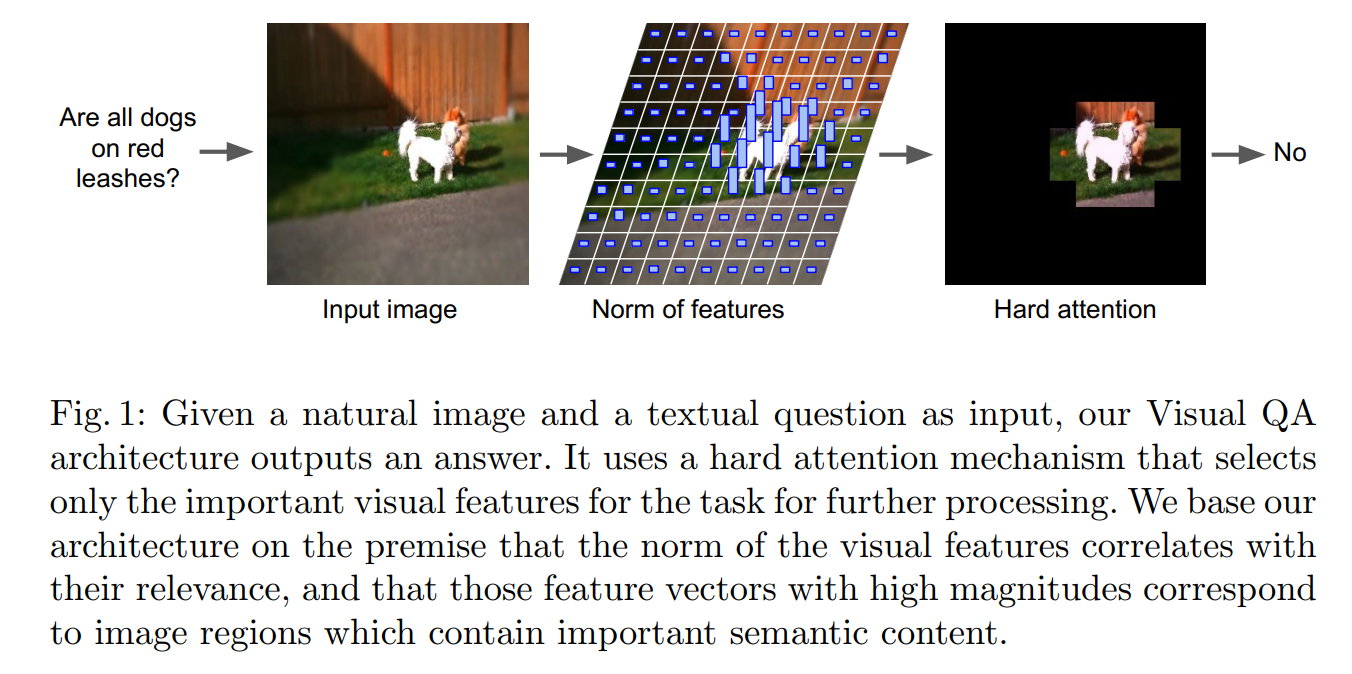
本文尝试仅仅用 hard attention 的方法来抠出最有用的 feature,进行 VQA 任务的学习。
Soft Attention:
Existing attention models are predominantly based on soft attention, in which all information is adaptively re-weighted before being aggregated. This can improve accuracy by isolating important information and avoiding interference from unimportant information.
Hard Attention:
It has the potential to improve accuracy and learning efficiency by focusing computation on the important parts of an image. But beyond this, it offers better computational efficiency because it only fully processes the information deemed most relevant.
但是,hard attention 有一个很致命的缺陷:由于图像中信息的选择是离散的,这导致基于梯度的学习方法,如 deep learning based methods,不可求导。然后,就无法利用 back-propagation 的方法进行区域的选择,来支持基于梯度的优化(because the choice of which information to process is discrete and thus non-differentiable, gradients cannot be backpropagated into the selection mechanism to support gradient-based optimization.)。当然有一些基于 Policy Gradient 的方法可以通过采样的方法,来处理梯度不可导的问题,但是这方面的研究,也仍然是非常的火热。
Approach Details:
待更新 、、、
--
论文阅读:Learning Visual Question Answering by Bootstrapping Hard Attention的更多相关文章
- 论文笔记:Visual Question Answering as a Meta Learning Task
Visual Question Answering as a Meta Learning Task ECCV 2018 2018-09-13 19:58:08 Paper: http://openac ...
- Learning Conditioned Graph Structures for Interpretable Visual Question Answering
Learning Conditioned Graph Structures for Interpretable Visual Question Answering 2019-05-29 00:29:4 ...
- Hierarchical Question-Image Co-Attention for Visual Question Answering
Hierarchical Question-Image Co-Attention for Visual Question Answering NIPS 2016 Paper: https://arxi ...
- Visual Question Answering with Memory-Augmented Networks
Visual Question Answering with Memory-Augmented Networks 2018-05-15 20:15:03 Motivation: 虽然 VQA 已经取得 ...
- 【自然语言处理】--视觉问答(Visual Question Answering,VQA)从初始到应用
一.前述 视觉问答(Visual Question Answering,VQA),是一种涉及计算机视觉和自然语言处理的学习任务.这一任务的定义如下: A VQA system takes as inp ...
- 论文:Bottom-Up and Top-Down Attention for Image Captioning and Visual Question Answering-阅读总结
Bottom-Up and Top-Down Attention for Image Captioning and Visual Question Answering-阅读总结 笔记不能简单的抄写文中 ...
- 论文阅读笔记二十二:End-to-End Instance Segmentation with Recurrent Attention(CVPR2017)
论文源址:https://arxiv.org/abs/1605.09410 tensorflow 代码:https://github.com/renmengye/rec-attend-public 摘 ...
- 第八讲_图像问答Image Question Answering
第八讲_图像问答Image Question Answering 课程结构 图像问答的描述 具备一系列AI能力:细分识别,物体检测,动作识别,常识推理,知识库推理..... 先要根据问题,判断什么任务 ...
- Deep Reinforcement Learning for Dialogue Generation 论文阅读
本文来自李纪为博士的论文 Deep Reinforcement Learning for Dialogue Generation. 1,概述 当前在闲聊机器人中的主要技术框架都是seq2seq模型.但 ...
随机推荐
- Yii2 nginx配置伪静态
Yii2 配置 Nginx 伪静态 主要检查以下代码: location / { # Redirect everything that isn't a real file to index.php t ...
- C# & ASP.NET Core 入门官方资料汇总
借助给公司实习生培训事宜,整理了一些微软官方的适合新同学入门的资料,这里分享一下: 工具: Visual Studio 2017 Community 版本下载地址:https://www.visual ...
- hdu2295DLX重复覆盖+二分
题目是说 给了n个城市 m个雷达 你只能选择其中的k个雷达进行使用 你可以设置每个雷达的半径,最后使得所有城市都被覆盖,要求雷达的半径尽可能的小(所有雷达的半径是一样的) 二分最小半径,然后每次重新建 ...
- jQuery选择器--selector1,selector2,selectorN和ancestor descendant
selector1,selector2,selectorN 概述 将每一个选择器匹配到的元素合并后一起返回.你可以指定任意多个选择器,并将匹配到的元素合并到一个结果内 参数 selector1 ...
- CS229 - MachineLearning - 12 强化学习笔记
Ng的机器学习课,课程资源:cs229-课件 网易公开课-视频 问题数学模型: 马尔科夫过程五元组{S.a.Psa.γ.R},分别对应 {状态.行为.状态s下做出a行为的概率.常数.回报}. 一 ...
- TensorFire:WEB端的高性能神经网络框架
TensorFire:WEB端的高性能神经网络框架 摘要: 近日,一种专门用于在网页内执行神经网络算法的JavaScript库——TensorFire引起了人们的关注,这种JavaScript库在浏览 ...
- 51Nod 1433 0和5
小K手中有n张牌,每张牌上有一个一位数的数,这个字数不是0就是5.小K从这些牌在抽出任意张(不能抽0张),排成一行这样就组成了一个数.使得这个数尽可能大,而且可以被90整除. 注意: 1.这个数没有前 ...
- RHEL7 CentOS7 的 firewall命令简单介绍
firewall 服务介绍 firewall 服务是 redhat7 和 centos7 系统默认安装好的防火墙服务,一个信任级别的概念来管理与之相关联的连接与接口.它支持 ipv4 与 ipv6,并 ...
- linux grep 正则表达式
grep正则表达式元字符集: ^ 锚定行的开始 如:'^grep'匹配所有以grep开头的行. $ 锚定行的结束 如:'grep$'匹配所有以grep结尾的行. . 匹配一个非换行符的字符 如:'gr ...
- jquery easyui datagrid 空白条处理 自适应宽高 格式化函数formmater 初始化时会报错 cannot read property 'width'||'length' of null|undefined
1---表格定义好之后右侧可能会有一个空白条 这个空白条是留给滚动条的,当表格中的一页的数据在页面中不能全显示时会自动出现滚动条,网上有很多事要改源码才可以修改这个,但是当项目中多处用到时,有的需要滚 ...