
Seaborn分布数据可视化---箱型分布图
箱型分布图
boxplot()
sns.boxplot(

    x=None,

    y=None,

    hue=None,

    data=None,

    order=None,

    hue_order=None,

    orient=None,

    color=None,

    palette=None,

    saturation=0.75,

    width=0.8,

    dodge=True,

    fliersize=5,

    linewidth=None,

    whis=1.5,

    notch=False,

    ax=None,

    **kwargs,

)

Docstring:

Draw a box plot to show distributions with respect to categories.

A box plot (or box-and-whisker plot) shows the distribution of quantitative

data in a way that facilitates comparisons between variables or across

levels of a categorical variable. The box shows the quartiles of the

dataset while the whiskers extend to show the rest of the distribution,

except for points that are determined to be "outliers" using a method

that is a function of the inter-quartile range.

Input data can be passed in a variety of formats, including:

- Vectors of data represented as lists, numpy arrays, or pandas Series

  objects passed directly to the ``x``, ``y``, and/or ``hue`` parameters.

- A "long-form" DataFrame, in which case the ``x``, ``y``, and ``hue``

  variables will determine how the data are plotted.

- A "wide-form" DataFrame, such that each numeric column will be plotted.

- An array or list of vectors.

In most cases, it is possible to use numpy or Python objects, but pandas

objects are preferable because the associated names will be used to

annotate the axes. Additionally, you can use Categorical types for the

grouping variables to control the order of plot elements.

This function always treats one of the variables as categorical and

draws data at ordinal positions (0, 1, ... n) on the relevant axis, even

when the data has a numeric or date type.

See the :ref:`tutorial <categorical_tutorial>` for more information.

Parameters

----------

x, y, hue : names of variables in ``data`` or vector data, optional

    Inputs for plotting long-form data. See examples for interpretation.

data : DataFrame, array, or list of arrays, optional

    Dataset for plotting. If ``x`` and ``y`` are absent, this is

    interpreted as wide-form. Otherwise it is expected to be long-form.

order, hue_order : lists of strings, optional

    Order to plot the categorical levels in, otherwise the levels are

    inferred from the data objects.

orient : "v" | "h", optional

    Orientation of the plot (vertical or horizontal). This is usually

    inferred from the dtype of the input variables, but can be used to

    specify when the "categorical" variable is a numeric or when plotting

    wide-form data.

color : matplotlib color, optional

    Color for all of the elements, or seed for a gradient palette.

palette : palette name, list, or dict, optional

    Colors to use for the different levels of the ``hue`` variable. Should

    be something that can be interpreted by :func:`color_palette`, or a

    dictionary mapping hue levels to matplotlib colors.

saturation : float, optional

    Proportion of the original saturation to draw colors at. Large patches

    often look better with slightly desaturated colors, but set this to

    ``1`` if you want the plot colors to perfectly match the input color

    spec.

width : float, optional

    Width of a full element when not using hue nesting, or width of all the

    elements for one level of the major grouping variable.

dodge : bool, optional

    When hue nesting is used, whether elements should be shifted along the

    categorical axis.

fliersize : float, optional

    Size of the markers used to indicate outlier observations.

linewidth : float, optional

    Width of the gray lines that frame the plot elements.

whis : float, optional

    Proportion of the IQR past the low and high quartiles to extend the

    plot whiskers. Points outside this range will be identified as

    outliers.

notch : boolean, optional

    Whether to "notch" the box to indicate a confidence interval for the

    median. There are several other parameters that can control how the

    notches are drawn; see the ``plt.boxplot`` help for more information

    on them.

ax : matplotlib Axes, optional

    Axes object to draw the plot onto, otherwise uses the current Axes.

kwargs : key, value mappings

    Other keyword arguments are passed through to ``plt.boxplot`` at draw

    time.

Returns

-------

ax : matplotlib Axes

    Returns the Axes object with the plot drawn onto it.

See Also

--------

violinplot : A combination of boxplot and kernel density estimation.

stripplot : A scatterplot where one variable is categorical. Can be used

            in conjunction with other plots to show each observation.

swarmplot : A categorical scatterplot where the points do not overlap. Can

            be used with other plots to show each observation.
#设置风格

sns.set_style('white')

#导入数据

tip_datas = sns.load_dataset('tips', data_home='seaborn-data')

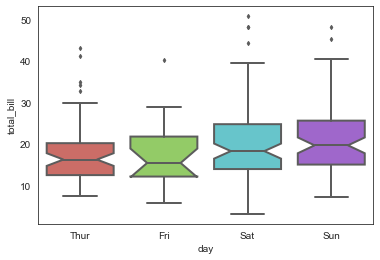
# 绘制传统的箱型图

sns.boxplot(x='day', y='total_bill', data=tip_datas,

            linewidth=2,               #线宽

            width=0.8,                 #箱之间的间隔比例

            fliersize=3,               #异常点大小

            palette='hls',             #设置调色板

            whis=1.5,                  #设置IQR

            notch=True,               #设置中位值凹陷

            order=['Thur','Fri','Sat','Sun'],   #选择类型并排序

            )
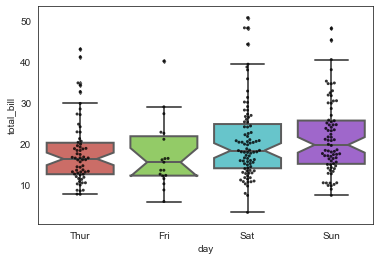
# 绘制箱型图

sns.boxplot(x='day', y='total_bill', data=tip_datas,

            linewidth=2,

            width=0.8,

            fliersize=3,

            palette='hls',

            whis=1.5,

            notch=True,

            order=['Thur','Fri','Sat','Sun'],

            )

#添加散点图

sns.swarmplot(x='day', y='total_bill', data=tip_datas, color='k', size=3, alpha=0.8)
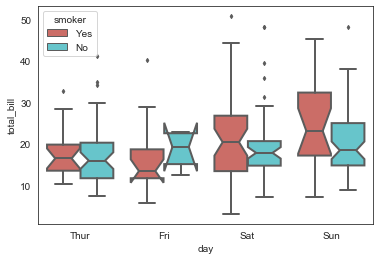
# 绘制箱型图,hue参数设置再分类

sns.boxplot(x='day', y='total_bill', data=tip_datas,

            linewidth=2,

            width=0.8,

            fliersize=3,

            palette='hls',

            whis=1.5,

            notch=True,

            order=['Thur','Fri','Sat','Sun'],

            hue='smoker',

            )
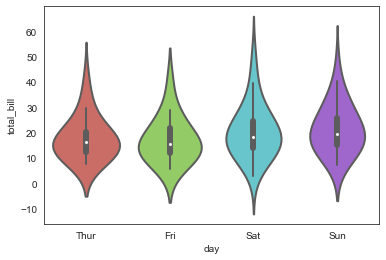
violinplot()
sns.violinplot(x='day', y='total_bill', data=tip_datas,

               linewidth=2,

               width=0.8,

               palette='hls',

               order=['Thur','Fri','Sat','Sun'],

               scale='area',                    #设置提琴宽度:area-面积相同,count-按照样本数量决定宽度,width-宽度一样

               gridsize=50,                     #设置提琴图的边线平滑度,越高越平滑

               inner='box',                     #设置内部显示类型--"box","quartile","point","stick",None

               bw=0.8                           #控制拟合程度,一般可以不设置

              )
sns.violinplot(x='day', y='total_bill', data=tip_datas,

               linewidth=2,

               width=0.8,

               palette='hls',

               order=['Thur','Fri','Sat','Sun'],

               scale='width',

               gridsize=50,

               inner='quartile',                   #内部标记分位线

               bw=0.8

              )
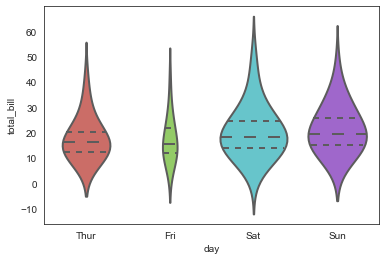
sns.violinplot(x='day', y='total_bill', data=tip_datas,

               linewidth=2,

               width=0.8,

               palette='hls',

               order=['Thur','Fri','Sat','Sun'],

               scale='width',

               gridsize=50,

               inner='point',                 #内部添加散点

               bw=0.8

              )
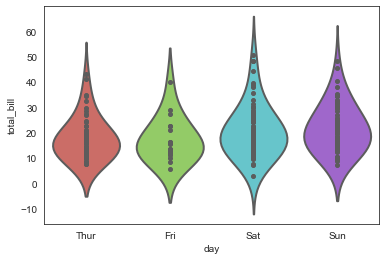
sns.violinplot(x='day', y='total_bill', data=tip_datas,

               linewidth=2,

               width=0.8,

               palette='hls',

               order=['Thur','Fri','Sat','Sun'],

               scale='width',

               gridsize=50,

               inner='stick',              #内部添加细横线

               bw=0.8

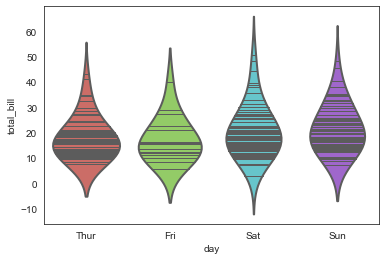
              )
boxenplot()
sns.boxenplot(

    x=None,

    y=None,

    hue=None,

    data=None,

    order=None,

    hue_order=None,

    orient=None,

    color=None,

    palette=None,

    saturation=0.75,

    width=0.8,

    dodge=True,

    k_depth='proportion',

    linewidth=None,

    scale='exponential',

    outlier_prop=None,

    ax=None,

    **kwargs,

)

Docstring:

Draw an enhanced box plot for larger datasets.

This style of plot was originally named a "letter value" plot because it

shows a large number of quantiles that are defined as "letter values".  It

is similar to a box plot in plotting a nonparametric representation of a

distribution in which all features correspond to actual observations. By

plotting more quantiles, it provides more information about the shape of

the distribution, particularly in the tails. For a more extensive

explanation, you can read the paper that introduced the plot:

https://vita.had.co.nz/papers/letter-value-plot.html

Input data can be passed in a variety of formats, including:

- Vectors of data represented as lists, numpy arrays, or pandas Series

  objects passed directly to the ``x``, ``y``, and/or ``hue`` parameters.

- A "long-form" DataFrame, in which case the ``x``, ``y``, and ``hue``

  variables will determine how the data are plotted.

- A "wide-form" DataFrame, such that each numeric column will be plotted.

- An array or list of vectors.

In most cases, it is possible to use numpy or Python objects, but pandas

objects are preferable because the associated names will be used to

annotate the axes. Additionally, you can use Categorical types for the

grouping variables to control the order of plot elements.

This function always treats one of the variables as categorical and

draws data at ordinal positions (0, 1, ... n) on the relevant axis, even

when the data has a numeric or date type.

See the :ref:`tutorial <categorical_tutorial>` for more information.

Parameters

----------

x, y, hue : names of variables in ``data`` or vector data, optional

    Inputs for plotting long-form data. See examples for interpretation.

data : DataFrame, array, or list of arrays, optional

    Dataset for plotting. If ``x`` and ``y`` are absent, this is

    interpreted as wide-form. Otherwise it is expected to be long-form.

order, hue_order : lists of strings, optional

    Order to plot the categorical levels in, otherwise the levels are

    inferred from the data objects.

orient : "v" | "h", optional

    Orientation of the plot (vertical or horizontal). This is usually

    inferred from the dtype of the input variables, but can be used to

    specify when the "categorical" variable is a numeric or when plotting

    wide-form data.

color : matplotlib color, optional

    Color for all of the elements, or seed for a gradient palette.

palette : palette name, list, or dict, optional

    Colors to use for the different levels of the ``hue`` variable. Should

    be something that can be interpreted by :func:`color_palette`, or a

    dictionary mapping hue levels to matplotlib colors.

saturation : float, optional

    Proportion of the original saturation to draw colors at. Large patches

    often look better with slightly desaturated colors, but set this to

    ``1`` if you want the plot colors to perfectly match the input color

    spec.

width : float, optional

    Width of a full element when not using hue nesting, or width of all the

    elements for one level of the major grouping variable.

dodge : bool, optional

    When hue nesting is used, whether elements should be shifted along the

    categorical axis.

k_depth : "proportion" | "tukey" | "trustworthy", optional

    The number of boxes, and by extension number of percentiles, to draw.

    All methods are detailed in Wickham's paper. Each makes different

    assumptions about the number of outliers and leverages different

    statistical properties.

linewidth : float, optional

    Width of the gray lines that frame the plot elements.

scale : "linear" | "exponential" | "area"

    Method to use for the width of the letter value boxes. All give similar

    results visually. "linear" reduces the width by a constant linear

    factor, "exponential" uses the proportion of data not covered, "area"

    is proportional to the percentage of data covered.

outlier_prop : float, optional

    Proportion of data believed to be outliers. Used in conjunction with

    k_depth to determine the number of percentiles to draw. Defaults to

    0.007 as a proportion of outliers. Should be in range [0, 1].

ax : matplotlib Axes, optional

    Axes object to draw the plot onto, otherwise uses the current Axes.

kwargs : key, value mappings

    Other keyword arguments are passed through to ``plt.plot`` and

    ``plt.scatter`` at draw time.

Returns

-------

ax : matplotlib Axes

    Returns the Axes object with the plot drawn onto it.

See Also

--------

violinplot : A combination of boxplot and kernel density estimation.

boxplot : A traditional box-and-whisker plot with a similar API.
#单变量简易图

ax = sns.boxenplot(x=tip_datas['total_bill'])
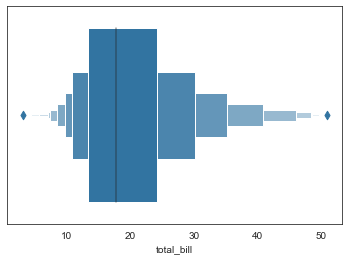
#多变量箱型图

ax = sns.boxenplot(x='day', y='total_bill', data=tip_datas)

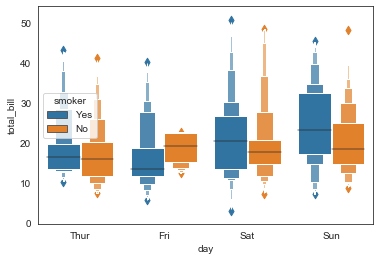
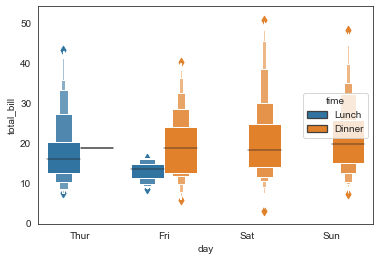
#多变量分类箱型图,hue

ax = sns.boxenplot(x='day', y='total_bill',

                   data=tip_datas,hue='smoker'

                   )
#多变量分类箱型图,hue

ax = sns.boxenplot(x='day', y='total_bill',

                   data=tip_datas,hue='time',

                   linewidth=2.5)
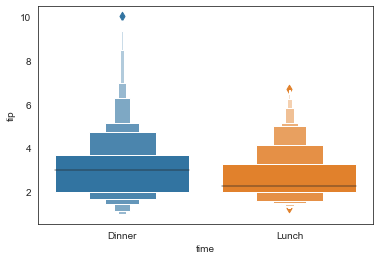
#多变量排序箱型图,order

ax = sns.boxenplot(x='time', y='tip',

                   data=tip_datas,order=['Dinner','Lunch']

                  )
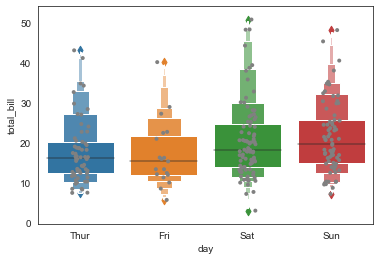
ax = sns.boxenplot(x='day', y='total_bill',

                   data=tip_datas)

#添加散点图

ax = sns.stripplot(x='day', y='total_bill', data=tip_datas,

                   size=4,jitter=True, color="gray"

                  )
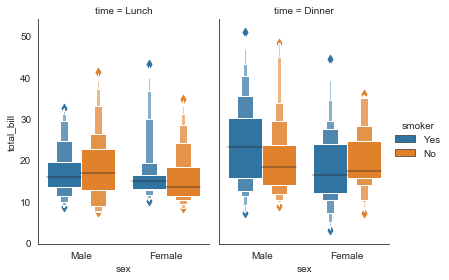
#分栏箱型图

g = sns.catplot(x="sex", y="total_bill",

                hue="smoker", col="time",

                data=tip_datas, kind="boxen",

                height=4, aspect=.7)
#其他参数,scale\k_depth

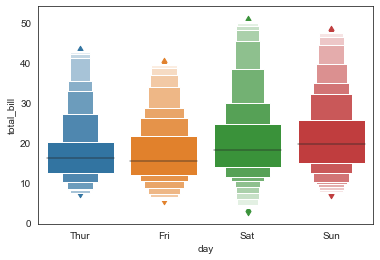
sns.boxenplot(x='day', y='total_bill', data=tip_datas,

           width=0.8,

           linewidth=12,

           scale='area',          #设置框大小:"linear"、"exponential"、"area"

           k_depth='proportion',  #设置框的数量: "proportion"、"tukey"、"trustworthy"

          )
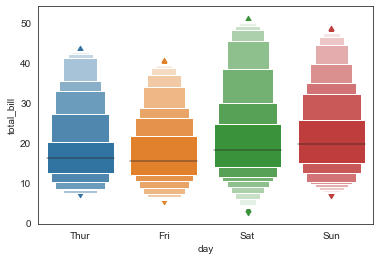
sns.boxenplot(x='day', y='total_bill', data=tip_datas,

           width=0.8,

           linewidth=12,

           scale='linear',          #设置框大小:"linear"、"exponential"、"area"

           k_depth='proportion',  #设置框的数量: "proportion"、"tukey"、"trustworthy"

          )
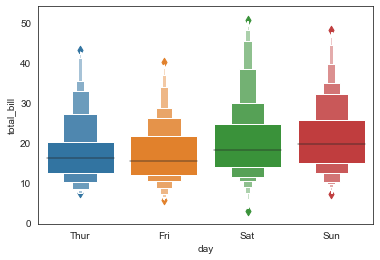
sns.boxenplot(x='day', y='total_bill', data=tip_datas,

           width=0.8,

           linewidth=12,

           scale='exponential',          #设置框大小:"linear"、"exponential"、"area"

           k_depth='proportion',       #设置框的数量: "proportion"、"tukey"、"trustworthy"

          )
#多变量横向箱型图,orient

iris_datas = sns.load_dataset('iris', data_home='seaborn-data')

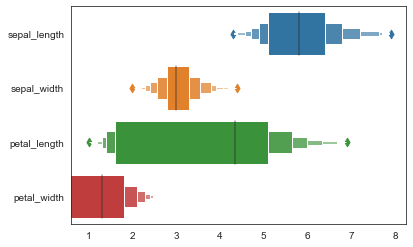
ax = sns.boxenplot(data=iris_datas, orient='h')
Seaborn分布数据可视化---箱型分布图的更多相关文章
- seaborn分布数据可视化:直方图|密度图|散点图
系统自带的数据表格(存放在github上https://github.com/mwaskom/seaborn-data),使用时通过sns.load_dataset('表名称')即可,结果为一个Dat ...
- Python图表数据可视化Seaborn:1. 风格| 分布数据可视化-直方图| 密度图| 散点图
conda install seaborn 是安装到jupyter那个环境的 1. 整体风格设置 对图表整体颜色.比例等进行风格设置,包括颜色色板等调用系统风格进行数据可视化 set() / se ...
- Python图表数据可视化Seaborn:2. 分类数据可视化-分类散点图|分布图(箱型图|小提琴图|LV图表)|统计图(柱状图|折线图)
1. 分类数据可视化 - 分类散点图 stripplot( ) / swarmplot( ) sns.stripplot(x="day",y="total_bill&qu ...
- seaborn分类数据可视化:散点图|箱型图|小提琴图|lv图|柱状图|折线图
一.散点图stripplot( ) 与swarmplot() 1.分类散点图stripplot( ) 用法stripplot(x=None, y=None, hue=None, data=None, ...
- seaborn分类数据可视化
转载:https://cloud.tencent.com/developer/article/1178368 seaborn针对分类型的数据有专门的可视化函数,这些函数可大致分为三种: 分类数据散点图 ...
- seaborn线性关系数据可视化:时间线图|热图|结构化图表可视化
一.线性关系数据可视化lmplot( ) 表示对所统计的数据做散点图,并拟合一个一元线性回归关系. lmplot(x, y, data, hue=None, col=None, row=None, p ...
- 用seaborn对数据可视化
以下用sns作为seaborn的别名 1.seaborn整体布局设置 sns.set_syle()函数设置图的风格,传入的参数可以是"darkgrid", "whiteg ...
- Python Seaborn综合指南,成为数据可视化专家
概述 Seaborn是Python流行的数据可视化库 Seaborn结合了美学和技术,这是数据科学项目中的两个关键要素 了解其Seaborn作原理以及使用它生成的不同的图表 介绍 一个精心设计的可视化 ...
- Seaborn数据可视化入门
在本节学习中,我们使用Seaborn作为数据可视化的入门工具 Seaborn的官方网址如下:http://seaborn.pydata.org 一:definition Seaborn is a Py ...
- 第六篇:R语言数据可视化之数据分布图(直方图、密度曲线、箱线图、等高线、2D密度图)
数据分布图简介 中医上讲看病四诊法为:望闻问切.而数据分析师分析数据的过程也有点相似,我们需要望:看看数据长什么样:闻:仔细分析数据是否合理:问:针对前两步工作搜集到的问题与业务方交流:切:结合业务方 ...
随机推荐
- Windows配置R语言、RStudio开发环境
本文介绍R语言及其集成开发环境RStudio的下载.安装方法. R语言是一个属于GNU操作系统的开源软件,在数据统计与分析.可视化等方面具有优秀的表现:而RStudio则是R语言的集成开发环境 ...
- [QT] 记录一些使用技巧
目录 概述 打开窗口 弹出消息框 判断文件存在 获取时间 获取子控件 TableWidget设置不可编辑 QT QString判断纯数字 Qt 保存文件选择器 读写ini 概述 最近花了好几天的时间编 ...
- Redis项目常见解决方案
## 1. 缓存预热 在项目启动,或者服务器重启后, 因为请求量较大, 此时对关系型数据库的访问量就有可能超标,导致服务卡顿,宕机, 所以在启动前应该对缓存进行预热: 前置准备工作: 日常例行统计数据 ...
- 提升地理空间分析效率,火山引擎ByteHouse上线GIS能力
更多技术交流.求职机会,欢迎关注字节跳动数据平台微信公众号,回复[1]进入官方交流群 在数字化时代,地理空间分析(Geospatial Analytics)成为辅助企业市场策略洞察的重要手段.无论是广 ...
- nginx 重写(rewrite) 重定向(return error_page) 详解
使用 rewrite 指令用于重写URL Nginx的rewrite指令用于重写URL,它有几个参数,这些参数定义了如何匹配和重写请求的URL.以下是rewrite指令的常见参数及其说明: Regex ...
- deepin版的微信无法启动
我在网上找了半天的了,出现问题的原因应该是deepin-wine的问题: 既然是deepin-wine出了问题,那重装一下就好了,嗯~ 我直接,yay!结果发现有一个deepin-wine需要更新,更 ...
- 基于ADS1292芯片的解决方案之源码解析
接口解析 A 该芯片和主控使用的是SPI接口通信的. SPI接口一般有四根线,确保四根线准确连接是对的. B 该芯片可以有中断模式数据触发,所以,主控mcu需要有外部中断处理流程. //DRDY中断 ...
- Apollo3 Blue SoC 和 Apollo3 Blue Plus SoC的区别
一 芯片简介 1.简介 Apollo3 Blue系列SoC解决方案代表了超低功耗设计的巨大飞跃,其运行模式和睡眠模式下的功耗数值均十分出色,并且具有高性能的处理引擎. Apollo3Blue器件提供了 ...
- display标签交替显示不同行颜色
问题 想要一个更加简单的支持列表数据分页和排序的方法. 解决方案 使用Display标签库和JSP标签库. 例4.13介绍了一个JSP页,它使用4.5节中的数据模型显示美国总统列表.这个JSP页面使用 ...
- GDB调试之多线程
1.set scheduler-locking off/on/step 调试时除了当前线程在运行,要想规定其他线程的运行情况用这个命令,有三个选择: set scheduler-locking off ...